
Category: Recommended Reading
Americans think they know a lot about politics – and it’s bad for democracy that they’re so often wrong in their confidence
Ian Anson in The Conversation:
 Over the past five years, I have studied the phenomenon of what I call “political overconfidence.” My work, in tandem with other researchers’ studies, reveals the ways it thwarts democratic politics.
Political overconfidence can make people more defensive of factually wrong beliefs about politics. It also causes Americans to underestimate the political skill of their peers. And those who believe themselves to be political experts often dismiss the guidance of real experts.
Political overconfidence also interacts with political partisanship, making partisans less willing to listen to peers across the aisle.
The result is a breakdown in the ability to learn from one another about political issues and events.
More here.
The Hunger | ContraPoints
Mikhail Gorbachev And His Generation
Gregory Afinogenov at n+1:
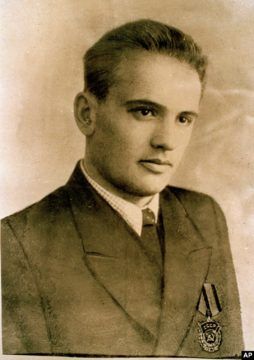 Gorbachev was born in 1931, on the other side of the revolutionary chasm. Though famine and terror made their appearances in his childhood, he entered adulthood after the most traumatic periods of Soviet history had already passed. Graduating from university two years after Stalin’s death, Gorbachev became part of a generation of starry-eyed young utopians. As their elders began to make their peace with the indefinite deferral of communism, young people were determined to see it in their lifetimes. In 1967, a group of youth in the city of Novorossiisk sank a time capsule into the Black Sea filled with letters addressed to the anticipated space-faring communist future of 2017. A schoolgirl named Olga wrote, “We dream of communism, of a time when you can eat ice cream and go to the movies for free, when machines will do our homework while our teachers will be patient robots. You live under communism, and I will live under communism too, with the only difference being that you will be as old as I was fifty years ago.” Gorbachev, on the older end of this generation, was then just beginning his rapid political ascent in the nearby city of Stavropol.
more here.
Brecht In Los Angeles
Peter Wollen at New Left Review:
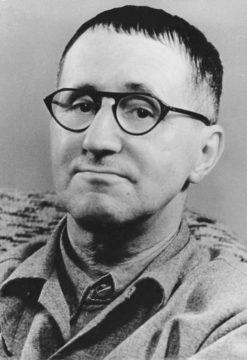 The exile Bertolt Brecht arrived in Los Angeles on 21 July 1941, and was taken by friends to a small house in Hollywood found for him by the director William Dieterle and his wife. Orson Welles’s Citizen Kane had recently premiered in New York, on 1 May. On his previous short visit to the United States, in connection with the New York opening of his play The Mother in 1935, Brecht had met the composer Marc Blitzstein through Hanns Eisler, who was teaching at the New School for Social Research. Blitzstein had played one of his new songs to Brecht and Brecht had advised Blitzstein to go ahead and write a full-scale opera. The result was Blitzstein’s The Cradle Will Rock, which was dedicated to Brecht and directed on stage by Orson Welles. A decade later, in 1946, Brecht saw Welles’s production of Cole Porter’s Around the World in Boston and went backstage afterwards to announce that, ‘This is the greatest thing I have seen in American theatre. This is wonderful. This is what theatre should be.’ Subsequently Brecht tried to persuade Welles to direct his own new play, Galileo. Welles was keen to do it but negotiations broke down over the role of Mike Todd, with whom Welles had become involved as his producer. Instead, it was Joseph Losey who directed Galileo.
more here.
Can’t We Come Up with Something Better Than Liberal Democracy?
Adam Gopnik in The New Yorker:
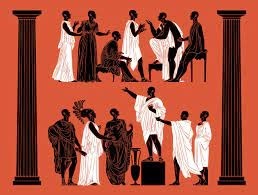 Democracy is the worst form of government,” Churchill is said to have said, “except all those other forms that have been tried.” Actually, what he excepted was “all those other forms that have been tried from time to time,” with that last phrase implying that democracy is the root form, and the others mere occasional experiments. It was an odd notion, but was perhaps called for by the times in which he was speaking, the mid-nineteen-forties, when a war was won for democracy at a nearly unbearable cost. The art historian Kenneth Clark recalled appearing in those years on a popular BBC radio quiz program, “The Brains Trust,” and fumbling a question on the best form of government. The “right” answer, given by all the other panelists, was “democracy,” but this seemed to Clark “incredibly unhistorical”; he had, after all, studied the rise of Botticellian beauty in the Medici-mafia state of Florence, and of Watteau and rococo under the brute dynastic rule of France, and generally valued those despotic regimes where more great art and music got made than has ever been created under a bourgeois democracy. Wrong answer, nonetheless. He was never again trusted to be a Brain.
More here.
What Makes Your Brain Different From a Neanderthal’s?
Carl Zimmer in The New York Times:
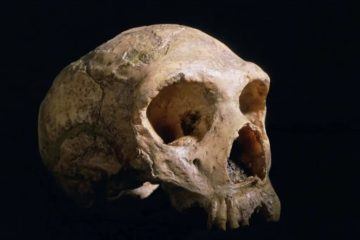 Scientists have discovered a glitch in our DNA that may have helped set the minds of our ancestors apart from those of Neanderthals and other extinct relatives. The mutation, which arose in the past few hundred thousand years, spurs the development of more neurons in the part of the brain that we use for our most complex forms of thought, according to a new study published in Science on Thursday.
“What we found is one gene that certainly contributes to making us human,” said Wieland Huttner, a neuroscientist at the Max Planck Institute of Molecular Cell Biology and Genetics in Dresden, Germany, and one of the authors of the study. The human brain allows us to do things that other living species cannot, such as using full-blown language and making complicated plans for the future. For decades, scientists have been comparing the anatomy of our brain to that of other mammals to understand how those sophisticated faculties evolved.
More here.
Friday Poem
“You can’t write poems about the trees when the woods are full of policemen.”
…………………………………………………………………………… —Bertolt Brecht
Broken Ghazal for Walter Scott
A video looping like a dirge on repeat, my soul—a psalm of bullets in my back.
I see you running, then drop, heavy hunted like prey with eight shots in the back.
Again, in my Facebook feed another black man dead, another fist in my throat.
You: prostrate on the green grass, handcuffed with your hands tied to your back.
Praises for the video, to the witness & his recording thumb, praises to YouTube
for taking the blindfold off Lady Justice, dipping her scales down with old weight
of strange fruit, to American eyeballs blinking & chewing the 24-hour news cycle:
another black body, another white cop. But let us go back to the broken taillight,
let’s find a man behind on his child support, let’s become his children, let’s call him
Papa. Let us chant Papa don’t run! Stay, stay back! Stay here with us. But Tiana—
you have got to stop watching this video. Walter is gone & he is not your daddy,
another story will come to your feed, stay back. But whisper—stay, once more,
with the denied breath of his absent CPR, praise his mother strumming Santana
with tiny hallelujahs up & down the harp of his back. Praise his mother hugging
the man who made her son a viral hit, a rerun to watch him die ad infintum, again
we go back, click replay at any moment. A video looping like a dirge on repeat—
by Tianna Clark
from I Can’t Talk About the Trees Without the Blood
University of Pittsburg Press, 2018
Thursday, September 8, 2022
Alexander Kluge’s information epic and how the time for learning is running out
Ryan Ruby in The New Statesman:
 Unlike most modern European languages, English designates book-length works of prose fiction with the term “novel”. Imported sometime in the mid-16th century from Italy – where novella had been coined to describe the short stories collected in Boccaccio’s Decameron 200 years before – and extended to its more or less current sense in the 17th century, the word retains a semantic filiation to that other child of the age of print, the newspaper, and thus to the concepts of information and modernity itself. Until the Austenite revolution of 1811 the novel often cloaked itself in the trappings of genres later classified as nonfiction – histories, biographies, travelogues, letters – in addition to descriptors derived from oral tradition like stories, tales and chronicles. Thereafter, newspapers provided it with an essential platform, where serialised fictional narrative existed on a continuum with scenes, sketches, feuilleton pieces and other genres of reportage. It is clear that one of the tangential pleasures of reading fiction during the golden age of the novel was akin to consuming “news”, whether it was about country life, factory conditions, adventures on the high seas, or scandalous crimes.
Over the course of the 20th century radio, film, television and digital media eroded print’s controlling stake in information transfer. Already in 1946 Gertrude Stein was complaining that “everyone gets so much information all day long that they lose their common sense”.
More here.
AI outperforms clinicians in diagnosing ear infections
Mike Kotsoupolos at the Harvard Medical School website:
 An artificial intelligence model built by Harvard Medical School and Massachusetts Eye and Ear scientists was shown to be significantly more accurate than doctors at diagnosing pediatric ear infections in the first head-to-head evaluation of its kind, the research team working to develop the model for clinical use reported.
According to a new study published Aug. 16 in Otolaryngology–Head and Neck Surgery, the model, called OtoDX, was more than 95 percent accurate in diagnosing an ear infection in a set of 22 test images compared with 65 percent accuracy among a group of clinicians consisting of ENTs, pediatricians, and primary care doctors, who reviewed the same images.
More here.
Are Republicans and Conservatives More Likely to Believe Conspiracy Theories?
Adam Enders, Christina Farhart, Joanne Miller, Joseph Uscinski, Kyle Saunders, and Hugo Drochon in a paper at the Springer website:
 A sizable literature tracing back to Richard Hofstadter’s The Paranoid Style (1964) argues that Republicans and conservatives are more likely to believe conspiracy theories than Democrats and liberals. However, the evidence for this proposition is mixed. Since conspiracy theory beliefs are associated with dangerous orientations and behaviors, it is imperative that social scientists better understand the connection between conspiracy theories and political orientations. Employing 20 surveys of Americans from 2012 to 2021 (total n = 37,776), as well as surveys of 20 additional countries spanning six continents (total n = 26,416), we undertake an expansive investigation of the asymmetry thesis. First, we examine the relationship between beliefs in 52 conspiracy theories and both partisanship and ideology in the U.S.; this analysis is buttressed by an examination of beliefs in 11 conspiracy theories across 20 more countries. In our second test, we hold constant the content of the conspiracy theories investigated—manipulating only the partisanship of the theorized villains—to decipher whether those on the left or right are more likely to accuse political out-groups of conspiring. Finally, we inspect correlations between political orientations and the general predisposition to believe in conspiracy theories over the span of a decade.
More here.
Steven Pinker: Let’s Discuss Language and Meaning
Thursday Poem
Talking
It can be a way of thinking. Some shy people
Fear it more than flying or heights or dying.
To be all talk is being less than nothing but
“Now you’re talking” is more than you were before.
“I like how when he takes me to the market
He talks to all the packages,” Debbie said
Not long before she died. “He talks to lettuce.”
In the cold queue of grief at Stalin’s prison
The question to Akhmatova: Can you
Describe this? “Yes” the poet answers “I can.”
The child’s hand on her throat can feel her voice
Vibrate. It means to her she is there, inside.
The stammerer finds relief in speaking verses
Because it’s less like talking. More like singing.
I mutter flakes of meaning. Foofaraw,
Shmagegeh. Blah-blah-blah.
A way of thinking a way of avoiding something.
Articulated grunts of grief and rage.
Even the Iliad yacks.
The baby rehearses melodies of speech,
The tunes of chat, of menace. Vocal
Without words Morricone’s music
Speaks for the iron faces of ugly cowboys.
Does her legendary “Yes, I can” exceed
Requiem itself? It is all one meaning. Now you
Really are saying something yes and can you?
Long before Stalin long before everything,
The new lungs learning to breathe.
Her tongue already studying its mission.
by Robert Pinsky
from The Yale Review
Defeat by Truth is Victory
Jonathan Shaw in Harvard Magazine:
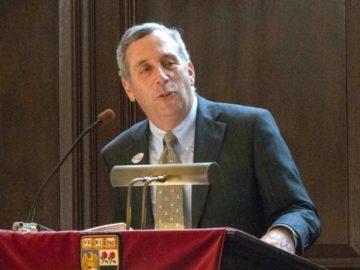 PRESIDENT LAWRENCE S. BACOW delivered a Morning Prayers address on August 31, following a tradition in which the Harvard president speaks in Memorial Church at the beginning of the fall term.
…He expanded on thoughts he’d shared with the freshmen class at their Convocation: “Over time,” he had told them on the previous day, “truth is revealed; it needs to be tested on the anvil of competing ideas. If you really seek the truth, you must engage with those who think differently than you” and “be willing to change your mind.” At Morning Prayers, he shared Rabbi Lord Jonathan Sacks’s argument for healthy debate. “We ought to argue… ‘out of a desire to discover the truth, not out of cantankerousness or a wish to prevail over [our fellows],’ not ‘out of envy and contentiousness and ambition for victory.’ When we argue for the sake of the latter… ‘what is at stake is not truth but power, and the result is that both sides suffer. If you win, I lose. But if I win, I also lose, because in diminishing you, I diminish myself […] The opposite is the case when the argument is for the sake of truth. If I win, I win. But if I lose, I also win—because being defeated by the truth is the only form of defeat that is also a victory.”
More here.
The biggest myths of the teenage brain
David Robson in BBC:
 Terri Apter, a psychologist, still remembers the time she explained to an 18-year-old how the teenage brain works: “So that’s why I feel like my head’s exploding!” the teen replied, with pleasure. Parents and teachers of teens may recognise that sensation of dealing with a highly combustible mind. The teenage years can feel like a shocking transformation – a turning inside out of the mind and soul that renders the person unrecognisable from the child they once were. There’s the hard-to-control mood swings, identity crises and the hunger for social approval, a newfound taste for risk and adventure, and a seemingly complete inability to think about the future repercussions of their actions.
In the midst of this confusion, adolescents are consistently assessed for their academic potential – with ramifications that can last a lifetime. No one’s fate is sealed at 18 – but an impeccable school record will certainly make it far easier to find a place at a prestigious university, which will in turn widen your options for employment. Yet the emotional rollercoaster of those years can make it extremely difficult for teens to reach their intellectual potential.
More here.
Wednesday, September 7, 2022
Enemies of the Enlightenment – J. G. Hamann (Isaiah Berlin 1965)
To the Depths and Back With Dostoevsky
Christopher Sandford at The Hedgehog Review:
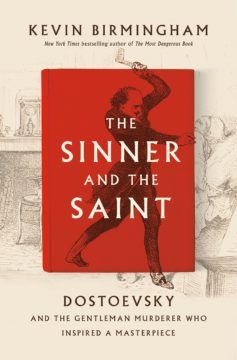 Dostoevsky’s own fixation on Lacenaire and his crime, which he declared “more exciting than all possible fiction,” is the focus of Birmingham’s consistently immersing The Sinner and the Saint. The Lacenaire who emerges from these pages is a subtle, ambiguous, sometimes insidiously appealing challenger to a corrupt established order. “I come to preach the religion of fear to the elite,” he announced at his trial, sounding a bit like a prototype Charles Manson. Almost anyone could write a gripping account of Lacenaire’s particular offense, but it took a writer of Dostoevsky’s gifts, not to mention of his experience in Semyonovosky Square, to painstakingly lead his readers on a course between the extremes of revulsion and fascination. What really interested Dostoevsky, and interests us, is the morality of crime, and how people can come to rationalize even the most depraved homicidal frenzy. He’s an author who takes risks, makes us both laugh and wince, and (depending on the translator’s art) writes like an angel with a devilish sense of humor.
more here.
How Mathematics Changed Me
Alec Wilkinson at The New Yorker:
 I did not expect that studying a childhood discipline would lead me to wonder about divine matters, but the possibility of a divine entity is threaded throughout mathematics, which, in its essence, so far as I can tell, is a mystical pursuit, an attempt to claim territory and define objects seen only in the minds of people doing mathematics. Why do I care about abstract possibilities and especially about God, when I have no idea what such a thing might be? A concept? An actual entity? Something hidden but accessible, or forever out of reach? Something once present and now gone? Something that ancient people appear to have experienced at close hand?
I seem temperamentally drawn to the idea of a divinity. As a child, I sometimes had the feeling of an accompanying presence, usually when I was by myself in the woods, a feeling of something infinite behind everything.
more here.
Embryos with DNA from three people develop normally
Yvaine Ye from Nature:
 When the first baby to be conceived using a technique that mixes genetic material from three people was born, in 2016, scientists worried that the procedure had not been studied to show it was safe. Now, scientists in China have conducted the first comprehensive study of the technique in early-stage human embryos, and report that it seems does not seem to affect their development1.
Techniques for using genetic material from three people to make embryos are designed to prevent mothers with defects in their mitochondria — the organelles that provide cells with energy — from passing them on to their children. Mitochondria contain their own DNA, and children inherit all of their mitochondria from their mother.
“Mitochondrial replacement therapy is a controversial field,” says study co-author Wei Shang, an obstetrician and gynaecologist at the Chinese PLA General Hospital in Beijing. “With our research, we hope to provide a foundation for the development of the technique.”
More here.
John Waters on Filmmaking, Felonies, Fox News, and Fucking
Conor Williams in the Los Angeles Review of Books:
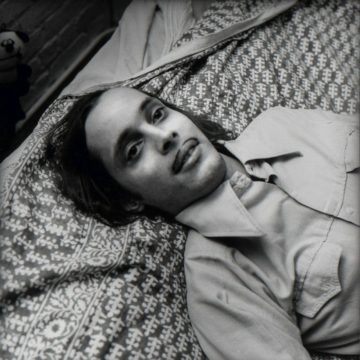 While his filmography is now iconic — his mainstream hit Hairspray (1988) has spawned both a remake and an acclaimed musical — the 76-year-old provocateur hasn’t made a picture since 2004. Waters has instead occupied himself with other projects, namely fine art and writing. His more recent books include Carsick: John Waters Hitchhikes Across America (2014) and Mr. Know-It-All: The Tarnished Wisdom of a Filth Elder (2019). The so-called “filth elder” has now written his first novel, Liarmouth: A Feel-Bad Romance, released this May by Macmillan Publishers.
To celebrate this latest endeavor, Waters speaks with me over the phone from his getaway in Provincetown, Massachusetts. Winding down to the end of a whirlwind press tour, he sounds relaxed. Provincetown, after all, has become something of another home to him over the years, his first home being, famously, the city of Baltimore. He speaks softly, but his voice retains its charismatic warmth.
More here.