
Enjoying the content on 3QD? Help keep us going by donating now.
Category: Recommended Reading
An Essay On An Essay By Mary McCarthy
Katy Waldman at The New Yorker:
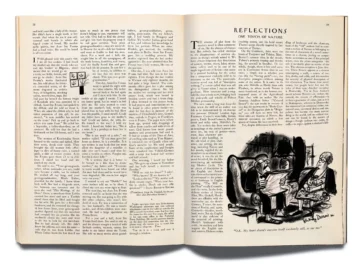 Like novelistic interludes concerning pine forests, McCarthy’s breed of criticism feels endangered. The breezy authority, the absurd plenitude: these qualities suggest a more hospitable era for the printed word, even if you prefer today’s careful efficiency. That McCarthy rarely bothers to explain her voluminous references evokes a time when the writer’s job was less to make thinking easy than to make it rewarding. “One Touch of Nature” supplies the loveliness it praises, pausing to describe “the still, ribbony roads leading nowhere” in paintings by the Dutch artist Jacob van Ruisdael (whereas the essay itself is a snarl of colored lines on an M.T.A. map, leading everywhere at once) and “the snow in ‘The Dead’ falling softly over Ireland, a universal blanket or shroud.” As McCarthy surveys her subject, she conjures a living artistic ecosystem that is constantly evolving, including in its relationship to the natural world. The subtext is that this system, like the carbon-based one, is beautiful and worth attending to; McCarthy, novelist that she is, encrypts her themes on the way to elucidating them.
more here.
Enjoying the content on 3QD? Help keep us going by donating now.
Why Peter Scholze is once in a Generation Mathematician
Enjoying the content on 3QD? Help keep us going by donating now.
Why cancer can come back years later — and how to stop it
Amanda Heidt in Nature:
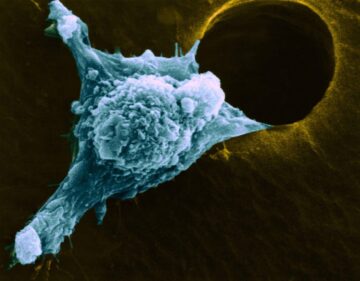 When Lisa Dutton was declared free of breast cancer in 2017, she took a moment to celebrate with family and friends, even though she knew her cancer journey might not be over. As many as one-third of people whose breast tumours are cleared see the disease come back, sometimes decades later. Many other cancers are known to recur in the years following an initial treatment, some at much higher rates.
“It’s always in the back of your mind, and that can be stressful,” says Dutton, a retired health-care management consultant living in Philadelphia, Pennsylvania. As part of her treatment, Dutton had enrolled in a clinical trial called SURMOUNT. This would monitor her for sleeping cancer cells, which many researchers now think might explain at least some cancer recurrence1. These dormant tumour cells evade initial treatment and move to other parts of the body. Instead of multiplying to form tumours right away — as is typical for metastatic cancer, in which cells spread from the main tumour — the dormant cells remain asleep. They are hidden from the immune system and not actively dividing. But later, they can reawaken and give rise to tumours.
Even though Dutton understood that her treatment might not have removed all signs of cancer, she says she was floored in 2020 when dormant cells were found in her bone marrow for the first time.
More here.
Enjoying the content on 3QD? Help keep us going by donating now.
Tuesday Poem
The Horizon of Being
As far as my love of the clarity and transparency
of Galileo’s writing allows me to decipher the
deliberate obscurity of Heidegger’s language that
“time temporalizes itself only
to the extent that it is human,”
for him also, time is the time of
mankind. the time for doing, for that
with which mankind is engaged
even if, afterward, since he is
interested in what being is for man,
“the entity that poses the problem of existence”,
Heidegger ends up by identifying the internal
consciousness of time as the horizon of being itself.
by Carlo Rovelli
from The Order of Time
Riverhead Books, 2018
Enjoying the content on 3QD? Help keep us going by donating now.
Monday, January 5, 2026
Decoding the Pyramid Statues of King Menkaure
Enjoying the content on 3QD? Help keep us going by donating now.
Review of “This Is Where the Serpent Lives” by Daniyal Mueenuddin
Patrick Gale in The Guardian:

Imagine a shattering portrayal of Pakistani life through a chain of interlocking novellas, and you’ll be somewhere close to understanding the breadth and impact of Daniyal Mueenuddin’s first novel. Reminiscent of Neel Mukherjee’s dazzling circular depiction of Indian inequalities, A State of Freedom, it’s a keenly anticipated follow-up to the acclaimed short-story collection with which he made his debut in 2009, In Other Rooms, Other Wonders – also portraying overlapping worlds of Pakistani class and culture.
We begin in the squalor and bustle of a Rawalpindi bazaar in the 1950s, where the heartbreaking figure of a small child, abandoned to his fate and clutching a pair of plastic shoes, is scooped under the protection of a tea stall owner. He proceeds to raise the boy as his own son, having only daughters, but Yazid is also adopted by the stall’s garrulous regulars, who teach him both to read and to pay keen attention to the currents of class, wealth and power which flow past him every day.
Loved, popular, clever, Yazid grows into a bull of a teenager with keen entrepreneurial instincts; he soon makes the tea stall, and his shack behind it, the cool place for a gang of privileged schoolboys to hang out, smoke and play games.
More here.
Enjoying the content on 3QD? Help keep us going by donating now.
The Tree Killers
Rosa Lyster at Harper’s Magazine:
 It is not clear how Carruthers and Graham imagined the public would respond. The tree was a beloved landmark, its silhouette an instantly recognizable symbol of England’s North East. As virtually every news report would go on to stress, it had also been featured in the 1991 movie Robin Hood: Prince of Thieves. The two men must have anticipated that people in the area would be upset. It seems implausible, though, that they had in mind what actually ended up happening, which is that the felling of the Sycamore Gap tree made international news straightaway. It became one of the biggest stories in England, prompting a prolonged nationwide spasm of outrage and what sometimes looked like genuine grief.
It was as if there had been a cosmic violation. The lamentation went far beyond those with a personal link to the tree—everyone who had hiked there, or gotten engaged there, or scattered ashes there, or even seen it from their car as they drove by. People across the country spoke of slaughter, and compared its loss to that of a close family member, or to the death of Princess Diana.
more here.
Enjoying the content on 3QD? Help keep us going by donating now.
This Lizard Plays Rock-Paper-Scissors
Carl Zimmer in the New York Times:
 If you live in the United States, chances are you’re familiar with the game rock-paper-scissors. You put out your hand in one of three gestures: clenching it in a fist (rock), holding it out flat (paper) or holding up two fingers in a “V” (scissors). Rock beats scissors, scissors beat paper and paper beats rock.
Americans by no means have a monopoly on the game. People play it around the world in many variations, and under many names. In Japan, where the game has existed for thousands of years, it’s known as janken. In Indonesia, it’s known as earwig-man-elephant: The elephant kills the man, the man kills the earwig and the earwig crawls up through the elephant’s trunk and eats its brain.
The game is so common that it exists beyond our own species. Over millions of years, animals have evolved their own version of rock-paper-scissors. For them, winning the game means passing down their genes to future generations. A study published on Thursday in the journal Science reveals the hidden biology that makes the game possible — and shows how it may be an important source of nature’s diversity.
More here.
Enjoying the content on 3QD? Help keep us going by donating now.
New York City Mayor Zohran Mamdani’s full speech after taking oath of office
And read “The Moral Imagination of Mamdani” by Corey Robin here.
Enjoying the content on 3QD? Help keep us going by donating now.
Giving some context to Venezuelan oil
Hannah Ritchie at By the Numbers:
 Over the weekend, the United States bombed Venezuela, and captured its president Nicolás Maduro. There has been a lot of speculation about the legality, true motive and implications going forward.
Oil has been a central part of the discussion. I wanted to get a quick overview of what the global picture looks like. So here are five(ish) simple charts that give some context on the history of oil in Venezuela, and why the United States — which is, by far, the world’s largest producer itself — would care so much.
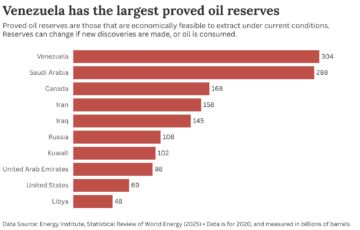
While we often think about the Middle East when it comes to large oil stocks, it’s Venezuela that has the largest proved reserves in the world.
The chart below shows the ten countries with the largest proved oil reserves. These are deposits that are deemed economically feasible to extract under current market conditions. This number can change as new reserves are found, or become economic.
More here.
Enjoying the content on 3QD? Help keep us going by donating now.
A Case for Beauty in a Fleeting World
Margaret Renkl in The New York Times:
 “I can’t believe you haven’t read this,” my husband said one day right before Thanksgiving. He was holding Maggie O’Farrell’s 2020 novel, “Hamnet.” “This book has your name all over it.”
Haywood wasn’t the first person to tell me I’d love “Hamnet.” But I found myself avoiding it when it first came out — a book subtitled “A Novel of the Plague” was not what I wanted to read in the early days of the Covid-19 pandemic — and never got back to it later on.
That was most likely a matter of unconscious design. This beautiful, haunting novel is an imagined account of the death of William Shakespeare’s 11-year-old son, and even Ms. O’Farrell found its subject a challenge. “One of the reasons I kept putting off writing the book was because I had a weird superstition about not writing it before my son was past the age of 11,” she told People magazine. My own sons are long since grown, but it takes only the smallest imaginative leap for me to fall into similar atavistic thoughts.
But the possibility of encountering a devastating plot point is not a reasonable measure by which to judge a work of art. Art is supposed to break our hearts. It’s supposed to crack us open to every raw, elemental feeling a human heart can bear. That’s how it makes us more human.
More here.
Enjoying the content on 3QD? Help keep us going by donating now.
The Fragile Foundations of the Intelligent Age
Klaus Schwab in Time Magazine:
 Our society faces a dramatic, but elusive, crisis.
Beneath a surface of political volatility and technological acceleration lie two quietly deteriorating foundations: truth and trust. Their erosion is reshaping the global landscape more profoundly than the events that dominate headlines.
Truth and trust are often treated as virtues, but they function as conditions: the prerequisites for coherent societies, functional institutions, and stable international systems. Without them, even the most advanced technologies fail to deliver progress; without them, democratic debate becomes impossible; without them, economic and social life slowly lose their connective tissue.
More here.
Enjoying the content on 3QD? Help keep us going by donating now.
The Oliver Sacks Problem
Lawrence Weschler at Wondercabinet:
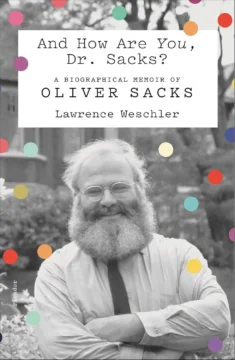 And here we arrive at a whole knot of issues at the heart of both Aviv’s and my own earlier characterizations of Oliver’s story. Because Oliver could relate to the situation of those wretched patients both out of the residue of his mother’s malediction itself and the sheer extent of the drug induced extravagances and catatonias he’d thenceforth experienced as its direct result during his ensuing wild California days (when his slogan had been “Every dose an overdose”), and beyond that, the wider identification he’d come to feel more generally with what his California-era friend, the psychoanalyst Bob Rodman, termed “communities of the refused” (an identification which would subsequently extend to Parkinsonians, Touretters, amnesiacs, the Deaf, the catatonic, the colorblind, the faceblind, and other such marginalized communities, and for that matter ferns and cuttlefish and even certain inert chemical elements as well). That sense of identification came to ground a profound empathy which, on the one hand helped him to give voice to the otherwise voiceless by helping them to reclaim their own stories, their own narratives, in so doing allowing them to reemerge as the active agents of their own lives—a practice which, granted, occasionally overstepped its bounds into outright projection and, in the subsequent recounting, downright confabulation.
more here.
Enjoying the content on 3QD? Help keep us going by donating now.
Sunday, January 4, 2026
Richard Smallwood (1948 – 2025) Gospel Music Pioneer
Enjoying the content on 3QD? Help keep us going by donating now.
Carmen de Lavallade (1931 – 2025) Dancer, Choreographer, and Actor
Enjoying the content on 3QD? Help keep us going by donating now.
A Global Euro
Shahin Vallée in Phenomenal World:
A profound sense of uncertainty dominates the question of the international monetary order today. Trump’s presidency in the US, the growing Sino-American rivalry, and widespread sanctions against Russia’s Central Bank reserves are all contributing to the general indeterminacy. The rise of crypto assets, digital currencies and the return of precious commodities as a potential store of value have prompted some to predict the demise of a fiat based monetary order powered by fractional reserve banking at home and offshore money creation abroad.
After decades acting as the anchor of the global monetary order, the role of the dollar has now come into question. The promotion of stablecoins and other advanced commercial cryptocurrencies have been designed to expand the dollar’s global role, but the outcome of this cryptomercantilism remains to be seen. China has its own internationalization strategy built on the expansion of its central bank’s bilateral swap network to advance renminbi invoicing and the creation of a fully digital payment system backed by a digital currency.
Europe’s strategy is yet to emerge. There is an opportunity for European leaders—not just central bankers—to seize the moment to expand Europe’s global monetary role. A stronger role for the euro would likely enhance European resilience, be it by expanding protections from US sanctions, by helping to insulate Europe’s economy from swings in foreign exchange rates, or by securing better financing conditions for European governments, businesses, and households. But a stronger role for the euro, which doesn’t preclude some costs, will require a degree of planning and policy coordination across member states, as well as between fiscal and monetary authorities—both of which are so far lacking.
More here.
Enjoying the content on 3QD? Help keep us going by donating now.
Among the Prophets
Nicholas Russell in The Baffler:
In David Fincher’s most mainstream film, The Social Network, an aggrieved ex of Mark Zuckerberg tells him that “the internet isn’t written in pencil, Mark, it’s written in ink.” Disappearing ink perhaps, given how difficult it has become to search for useful or accurate information, let alone its source, amid the hallucinatory derangements of artificial intelligence. Media literacy has never been more important. Society has never been lazier.
For the past few months, I’ve been researching how science fiction has been used as a guide for predicting the future. This has included reading interviews and speeches, the testimony of would-be prophets. Naturally, certain quotes pop up like weeds—but, in the case of the more platitudinal selections, no one can seem to agree on who actually said them. “Prediction is very difficult, especially about the future” was either coined by Danish physicist Niels Bohr or mythic Yankees catcher Yogi Berra. It’s entirely possible both men did, in fact, say some variation of the quote, though it’s more likely that Bohr, who was forty years older, said it first. But then again, he may not have said it at all.
The origin of the less elegant but more popular “We can predict everything, except the future” is similarly elusive. In 2012, user1202136 on the Stack Exchange forum for English etymology asked about the quote’s source, a question that’s been viewed four thousand times. The highest-rated answer, provided by a user going by Sven Yargs—who, according to his profile, has answered 3,444 other questions—is exhaustive in its detail: “The earliest instance of that approximate wording that I could find in a Google Books search is from David Redburn, ‘The ‘Graying’ of the World’s Population,’ in Social Gerontology (1998): ‘An oft-stated demographer’s joke comments, ‘it is easy to predict everything except the future’ and while this is demographic humor, or lack of it, it does relate the trepidation with which population specialists approach projections.’”
More here.
Enjoying the content on 3QD? Help keep us going by donating now.
Behind the News Podcast with Thea Riofrancos and Alyssa Battistoni
Over at Doug Henwood’s Behind the News,
Thea Riofrancos, author of Extraction: The Frontiers of Green Capitalism, on the complications of using lithium batteries to green our future (think tank here) [and] Alyssa Battistoni, author of Free Gifts, on the weird relationship between capitalism and Nature.
Enjoying the content on 3QD? Help keep us going by donating now.
Janet Fish (1938 – 2025) Painter And Printmaker
Enjoying the content on 3QD? Help keep us going by donating now.