
 Daniela Gabor in Phenomenal World:
At COP26, US Special Envoy for Climate John Kerry sanguinely declared the need to “derisk the investment, and create the capacity to have bankable deals. That’s doable for water, it’s doable for electricity, it’s doable for transportation.” Derisking is financial speak for the public sector—be it through official development aid, multilateral resources or national fiscal resources—accepting to take some risks from private financiers in order to persuade them to invest, public efforts variously described as “mobilizing private finance”or “blended finance.” In response, the UN Special Envoy for Climate and head of the Glasgow Financial Alliance for Net Zero (GFANZ) Mark Carney announced GFANZ’s intentions to work in partnership with governments and multilateral development institutions to mobilize its $130 trillion for green purposes.
At this year’s COP27 in Egypt, Carney was less triumphant. On the contrary, he defensively explained why the GFANZ financiers had dropped the partnership with UN Race to Zero, intended to police their green pledges and reduce pervasive greenwashing. No longer flanked by top financiers like BlackRock’s Larry Fink (who reportedly stayed away to avoid further incensing the US Republican party), and amid several reports denouncing the systematic failure of the GFANZ-Global North mobilization drive, Carney cut a lonely figure.
More here.
 Mona Ali in Green:
 In early September 1957, Jack Kerouac achieved the dream of every writer. Around midnight he and his girlfriend, Joyce Glassman, left her brownstone apartment in New York City for a nearby newsstand at Broadway and 66th Street. They waited while the nightman cut the twine around the morning edition of the New York Times. Rifling through the paper, they found on Page 27 an expected review of Kerouac’s new book, “
 In their controversial 2013 opus The Undercommons, radicals Fred Moten and Stefano Harney detail the eponymous academic-activist ferment to which they owe their radicality. The undercommons is located in the university—more generally, in the swarm of relations and systems we could call “academia” or “intellectual life”—but is not a physical place; rather, it is a “downlow lowdown maroon community of the university … where the work gets done, where the work gets subverted, where the revolution is still black, still strong.”
 Of most interest to us, the readers of Eliot’s poetry, is the writing of verse for which he somehow found the time and energy. The early drama in Crawford’s account is Eliot’s composition of “The Hollow Men” and “Ash Wednesday” out of his struggles with the frailty of the body (exemplified in Vivien’s constant and severe intestinal illness and his own frequent bouts of flu and bronchitis) and the soul (tormented by shame over the body’s needs and failures, including the repeated fall into sexual guilt). Tormented, Eliot turned to an array of cultural resources. While Baudelaire and Dante continued to inform his thinking, they were joined now by an increasing interest in the theatre, especially the non-naturalistic modes available in puppetry, ballet, and mechanistic work. The poetry of other languages and the suspension of access to meaning entailed in the act of translation helped him to incorporate estrangement into his own poems; Eliot’s labor on a translation of Saint-John Perse’s Anabasis shaped the lines and phrases of his work of the mid-1920s. But the cultural resources Eliot brought to the processing of pain were not limited to the literary.
 Cambodian American Eden Teng was was born in a refugee camp on the border of Thailand and Cambodia just a few years after the Cambodian genocide. She moved to the U.S. with her mom and aunt when she was 6. Teng attributes much of her own resilience in transitioning to the U.S. to her exuberant mom, who wore whatever she wanted and wasn’t afraid to defy social norms — even when it was embarrassing for a teenage Teng.
 Political strategists on winning campaigns are visited like gurus after an election, with reporters looking to discern secrets of success that might be replicated at scale. In this spirit, in the days after the midterms, the
 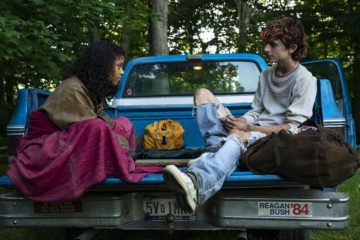 IF ’80S CINEMA experienced a “
 The digital era has two basic axioms. The first is that information has no form; information technology is a means of disseminating and aggregating data, but data itself belongs to no place or context. Data cannot tell the story; information is uninforming and uninformative. The digital age can therefore have no real culture of its own, no culture in the etymological sense of cultivation and accumulated growth. Things trend or happen online, but nothing settles into lasting place or takes its time to show itself significant. Each day’s frenzy and distraction are as overwhelming unto the day as they are forgettable.
 The second axiom is that the Internet is for cat pictures; everyone knows that transmitting images of cute animals is the whole point of it. It remains astounding that pet videos run into the tens of millions of views. That they have their own film festival. That they are used as bait to pull people into political misinformation campaigns. That there are bona fide pet celebrities and pet influencers. That some of them are raking it in, with spin-off merch and copyrighted brand clout all their own.
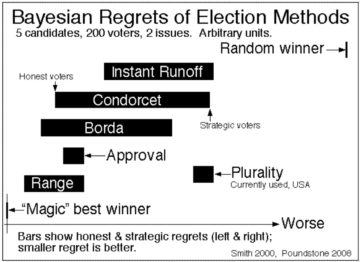 Here is the setup. You have a set of voters {1, 2, 3, …} and a set of choices {A, B, C, …}. The choices may be candidates for office, but they may equally well be where a group of friends is going to meet for dinner; it doesn’t matter. Each voter has a ranking of the choices, from most favorite to least, so that for example voter 1 might rank D first, A second, C third, and so on. We will ignore the possibility of ties or indifference concerning certain choices, but they’re not hard to include. What we don’t include is any measure of intensity of feeling: we know that a certain voter prefers A to B and B to C, but we don’t know whether (for example) they could live with B but hate C with a burning passion. As
  Now that the American electorate appears to have rejected Republican extremism, some will argue that Biden should tack right to capture the political center. But that is the wrong way to read the 2022 midterm result, because the electorate is not seeking some kind of Solomonic splitting of the baby.
 The Liz Truss
  Bacterial infections are the second leading cause of death worldwide, accounting for one in eight of all deaths in 2019, the first global estimate of their lethality revealed on Tuesday.
 Your classiest friend invites you to dinner. They take out a bottle of Chardonnay that costs more than your last vacation and pour each of you a drink. They sip from their glass. “Ah,” they say. “1973. An excellent vintage. Notes of avocado, gingko and strontium.” You’re not sure what to do. You mumble something about how you can really taste the strontium. But internally, you wonder: Is wine fake?