
Morgan Meis at The Easel:
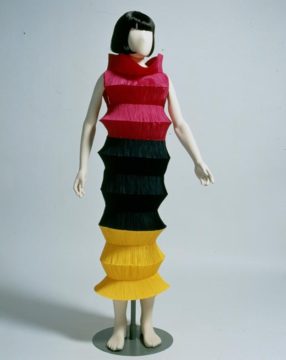 I don’t remember exactly where or when I came across the book. I know it was in New York City sometime in the 1990s. I know that the book made a visual impact because I’ve remembered it ever since. When I heard that Miyake died, it was the first thing that came to my mind.
But I bring up the crazy and sometimes hilarious shapes and designs in the book for a more specific reason, and it is not to poke fun at haute couture, a tired exercise that was already boring more than a century ago. I bring up the book because Miyake was a fashion designer whose work demanded to be taken seriously as both fine art and popular culture. His ready to wear designs were, and remain, hugely successful. He was also the sort of fashion designer whose designs the editors of Artforum had no qualms about featuring on the cover of the magazine. Given his recent death, it seems a worthy endeavor to say a few loosely related things about what made Miyake so special.
Miyake’s unique fashion sensibility is undoubtedly related to Issey Miyake the person. He was, by all accounts, an exceptional individual.
More here.
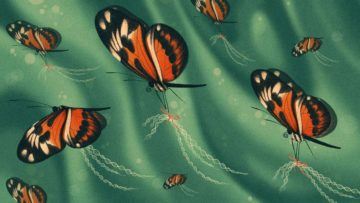 Bates had noticed that some of the brightly colored Heliconius butterflies in the forest didn’t flit about like the rest; they moved more slowly. When he captured them and examined them under his makeshift microscope, he discovered that they weren’t really Heliconius at all, but astonishing look-alikes from unrelated families of butterflies.
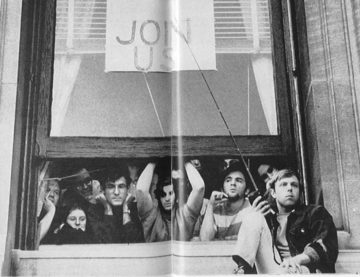 The accumulative capacity of universities and hospitals is a New Deal-era political and economic solution that has been retooled to address contradictions with capital as industrial profits waned from the mid-century onwards. During this same period, carceral and policing institutions also swelled to enormous size. Viewed together, these shifts register the American notion of “the public good,” as purveyed by the state. This sheen of democratic and collective values burnishes the motives of profit and launders the racialized violence of accumulation. In truth, the state serves capital and its institutions, not the public. A key project of ideology is to invert this perception.
 One afternoon not long after the Obamas had moved into the White House, Michelle organised a playdate for her youngest daughter, Sasha. The children were at their new school and she was worried about how they were settling in. So, in a move recognisable to parents everywhere, she hovered unseen nearby, listening intently, “quietly overcome with emotion any time a new peal of laughter erupted from Sasha’s room”.
  John P. Porcari is a bit of a reality TV show junkie. When he wants to work out, Dr. Porcari, a retired professor of sports and exercise science from the University of Wisconsin-LaCrosse, goes downstairs and watches “Alaska: The Last Frontier” or “Naked and Afraid” while bouncing on a mini trampoline. Just before speaking with The Times, he had completed four sets of 50 bounces while watching Discovery Channel’s “Gold Rush.” “I have a ski trip in January to get ready for,” he said.
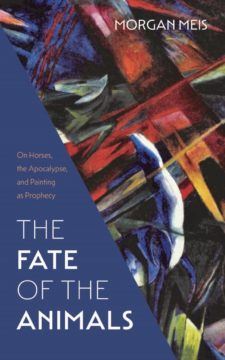 Meis employed his dis- or un-layering style first in The Drunken Silenus: On Gods, Goats, and the Cracks in Reality.There Meis used Peter Paul Rubens’s 1620 painting, “The Drunken Silenus,” to expose the thinness of the membrane that separates mortality from immortality. Meis probes that membrane again in this second book, The Fate of the Animals. Here, he chooses Franz Marc’s 1913 painting, “The Fate of the Animals,” as a source for revealing or at least giving us a glimpse of the coming-into and going-out-of existence of all beings, including our own transient selves.
 High school physics teachers describe them as featureless balls with one unit each of positive electric charge — the perfect foils for the negatively charged electrons that buzz around them. College students learn that the ball is actually a bundle of three elementary particles called quarks. But decades of research have revealed a deeper truth, one that’s too bizarre to fully capture with words or images.
 I met Jerry when I was a pariah. I had repeatedly and publicly denounced the invasion of Iraq and, for my outspokenness, had been pushed out of The New York Times. I was receiving frequent death threats. My neighbors treated me as though I had leprosy. I had imploded my journalism career.
 After they find dry ground for refuge, tie up surviving livestock, scan the ground for snakes and scorpions, queue, break queue and grab for food, plead for water, scream for tents, weep for loss, curse officials, lament fate — after all that, people whose lives have been upended by floods want to talk. I tell them I can’t do much. I am a researcher documenting and analyzing disaster impacts for various organizations, and it can be months before anyone even reads my reports. But sometimes, it’s enough for them to find someone who will listen.
 Andrea Wulf’s substantial yet pacey new book concerns itself with a dazzling generation of German philosophers, scientists and poets who between the late 18th and early 19th centuries gathered in the provincial town of Jena and produced some of the most memorable works of European romanticism.
 Judging by the titles of bills they propose, members of Congress occupy a space between used-car salesperson and poet. Over the past two years, lawmakers in the 117th Congress have introduced the
  A
A Vergara’s newest book, Detroit Is No Dry Bones, powerfully documents the transformation of Detroit over the last several decades, offering an unflinching portrayal of a city gutted by decades of anti-urban public policies, intense racial segregation, and heartlessly mobile capital. Vergara’s approach is a reminder of the power of looking at small things—a fence, a broken window, a graffiti-strewn brick wall, a lawn ornament—to illustrate what might otherwise be impersonal processes and grand social forces. But Vergara’s keen eye also sees what cannot simply be reduced to urban decay. A raggedy lot becomes a lush garden, a blank wall becomes a canvas for an unknown artist, a pile of tires and a piece of wood become an impromptu bench at a bus stop. Vergara’s Detroit is not simply an acropolis, it is a place of rebirth and reinvention.