
Kenan Malik in Pandaemonium:
There is a scene in Marilynne Robinson’s novel Gilead in which the main character, John Ames, a pastor, walking to his church, comes across a young couple in the street. “The sun had come up brilliantly after a heavy rain, and the trees were glistening and very wet,” he recalls. The young man ahead of him “jumped up and caught hold of a branch, and a storm of luminous water came pouring down on the two of them, and they laughed and took off running, the girl sweeping water off her hair and her dress”. It was “a beautiful thing to see, like something from a myth”. In such moments, “it is easy to believe… that water was made primarily for blessing, and only secondarily for growing vegetables or doing the wash”.
It is a wonderful, luminous passage, typical of Robinson’s ability to discover the lyrical even within the mundane. Deeply Christian, and Calvinist, there is in her writing a spiritual force that springs from her faith. She would probably describe that scene as the discovery of a divine presence in the world. And yet, flowing out of that scene, is also an awareness that transcends the religious. It is the uncovering of something very human, a celebration of our ability to find the poetic in our simplest activities.
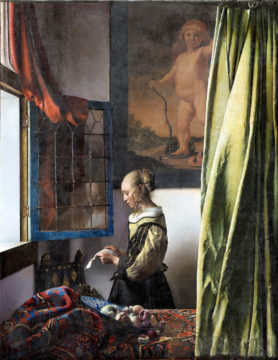
I was reminded of that passage as I was wandering through the Vermeer exhibition at the Rijksmuseum in Amsterdam last week.
More here.
 For more than a decade, scholars, journalists, and tech leaders have focused on two ways that data-driven technologies are altering jobs: by automating tasks and therefore displacing certain workers, and by discriminating on the basis of race, sex, national origin, or disability. Those are critical issues, but surveillance technologies are having another effect on work as well. Companies across today’s vast service economy are using such technologies as tools of class domination, deploying them to limit wage growth, prevent workers from organizing, and enhance labor exploitation. Workers’ increasing resistance to surveillance is therefore also a process of class formation—and reforms that support such resistance could encourage a more democratic politics of workplace technology.
 INTERVIEWER
 In the summer of 2021, I experienced a cluster of coincidences, some of which had a distinctly supernatural feel. Here’s how it started. I keep a journal and record dreams if they are especially vivid or strange. It doesn’t happen often, but I logged one in which my mother’s oldest friend, a woman called Rose, made an appearance to tell me that she (Rose) had just died. She’d had another stroke, she said, and that was it. Come the morning, it occurred to me that I didn’t know whether Rose was still alive. I guessed not. She’d had a major stroke about
 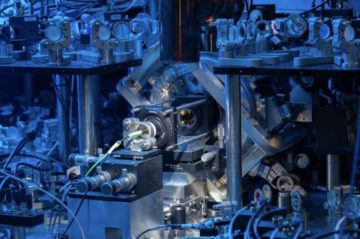 Researchers at University of Oxford have recently created a quantum memory within a trapped-ion quantum network node. Their unique memory design, introduced in a paper in Physical Review Letters, has been found to be extremely robust, meaning that it could store information for long periods of time despite ongoing network activity. “We are building a network of quantum computers, which use trapped ions to store and process quantum information,” Peter Drmota, one of the researchers who carried out the study, told Phys.org. “To connect quantum processing devices, we use
  A 13-sided shape known as “the hat” has mathematicians tipping their caps.
 The specter of parental neglect no longer orders U.S. politics as it did in the late twentieth century. But as indispensable recent books by sociologists Lynne Haney and Dorothy Roberts demonstrate, the knotty legal infrastructures and punitive policies inspired by this rhetoric have endured, with devastating consequences for poor families. These books focus on different areas of U.S. family policy—Haney writes about child support enforcement, Roberts about child protective services—but together they expose the state’s massive and creeping apparatus for surveilling and disciplining parents.
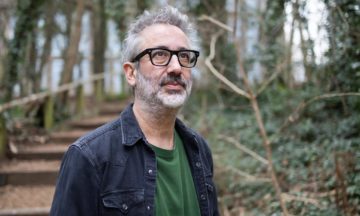 David Baddiel was six years old when his mother told him death was like a long sleep from which you never wake up. “I think from that point,” he says, “I never really wanted to go to sleep again.” That night, he lay on the top bunk of his bed, fervently praying – “probably” the first and last time he has prayed with any sincerity – that “my life as it was in Dollis Hill in 1971 would still somehow continue after death”.
 From
From