
Category: Recommended Reading
Jerry Springer (1944 – 2023) Talk Show Host And Philosopher
Mark Stewart (1960 – 2023) Singer
Why the Brain’s Connections to the Body Are Crisscrossed
R Douglas Fields in Quanta Magazine:
 Dazzling intricacies of brain structure are revealed every day, but one of the most obvious aspects of brain wiring eludes neuroscientists. The nervous system is cross-wired, so that the left side of the brain controls the right half of the body and vice versa. Every doctor relies upon this fact in performing neurological exams, but when I asked my doctor last week why this should be, all I got was a shrug. So I asked Catherine Carr, a neuroscientist at the University of Maryland, College Park. “No good answer,” she replied. I was surprised — such a fundamental aspect of how our brain and body are wired together, and no one knew why?
Nothing that we know of stops the right side of the brain from connecting with the right side of the body. That wiring scheme would seem much simpler and less prone to errors. In the embryonic brain, the crossing of the wires across the midline — an imaginary line dividing the right and left halves of the body — requires a kind of molecular “traffic cop” to somehow direct the growing nerve fibers to the right spot on the opposite side of the body. Far simpler just to keep things on the same side.
Yet this neural cross wiring is ubiquitous in the animal kingdom — even the neural connections in lowly nematode worms are wired with left-right reversal across the animal’s midline. And many of the traffic cop molecules that direct the growth of neurons in these worms do the same in humans. For evolution to have conserved this arrangement so doggedly, surely there’s some benefit to it, but biologists still aren’t certain what it is. An intriguing answer, however, has come from the world of mathematics.
More here.
Tip of the Iceberg: A litany of cliches
Michael Massing in The New York Times:
 Ramped up, amped up, ratchet up, gin up, up the ante, double down, jump-start, be behind the curve, swim against the tide, go south, go belly up, level the playing field, open the floodgates, think outside the box, push the edge of the envelope, pull out all the stops, take the foot off the pedal, pump the brakes, grease the wheel, circle the wagons, charge full steam ahead, pass with flying colors, move the goal posts, pour gasoline on, add fuel to the fire, fly under the radar, add insult to injury, grow by leaps and bounds, only time will tell, go to hell in a handbasket, put the genie back in the bottle, throw the baby out with the bathwater, rearrange the deck chairs on the Titanic, have your cake and eat it too, a taste of one’s own medicine, stick to one’s guns, above one’s pay grade, punch above one’s weight, lick one’s wounds, pack a punch, roll with the punches, come apart at the seams, throw a wrench into, caught in the cross hairs, cross the Rubicon, tempt fate, go ballistic, on tenterhooks, hit the nail on the head…
More here.
Sunday Poem
A Ball
It is going on inside a transparent ball
Above which God the Father, short, with a trimmed beard,
Sits with a book, enveloped in dark clouds.
He reads an incantation and things are called into being.
As soon as the earth emerges, it bears grasses and trees.
We are those to whom green hills have been offered
And for us this ray descends from opened mists.
Whose hand carries the ball? Probably the Son’s.
And the whole Earth is in it, Paradise and Hell.
by Czeslaw Milosz
from Unattainable Earth
Ecco Press, 1986
Saturday, April 29, 2023
What should the action be?
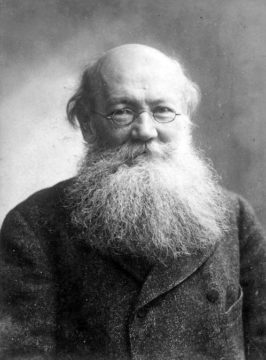 Greg Afinogenov in the LRB:
In summer 1876, Peter Kropotkin was given a pocket watch by a visiting relative. He was 33 years old, bore one of the Russian Empire’s oldest princely titles and had been a page de chambre to Tsar Alexander II. He was already famous in Russia for his scientific work on zoology and glaciation. Two years earlier, however, he had been arrested and imprisoned as a member of a revolutionary secret society. The watch was delivered to him in a prison hospital, to which he had been transferred after his health declined in the dungeons of the Peter and Paul Fortress. Concealed in the watch was a coded message detailing his role in an elaborate escape plan involving some two dozen comrades, many operating in disguise. The plan went off without a hitch; minutes after climbing into the waiting carriage, Kropotkin had changed his prison clothes for those of an aristocrat, blending in perfectly with the crowd on Nevsky Prospekt. While the imperial secret police fruitlessly combed the area, Kropotkin went out to dinner at a fashionable restaurant. After a few days lying low in nearby dachas, he was spirited away to Britain. He didn’t return to Russia until after the February Revolution of 1917.
In exile, Kropotkin drew on both his scientific and political interests to create the theoretical foundations of modern anarchism. His comrades in Russia, who were known as narodniki, or populists, shared many of his views but not all. Inspired by their liberation of Kropotkin and other daring feats, some of them embarked on a campaign of terrorism that culminated in the assassination of Alexander II in 1881.
More here.
The Politics of Disenchantment: On Wendy Brown’s “Nihilistic Times”
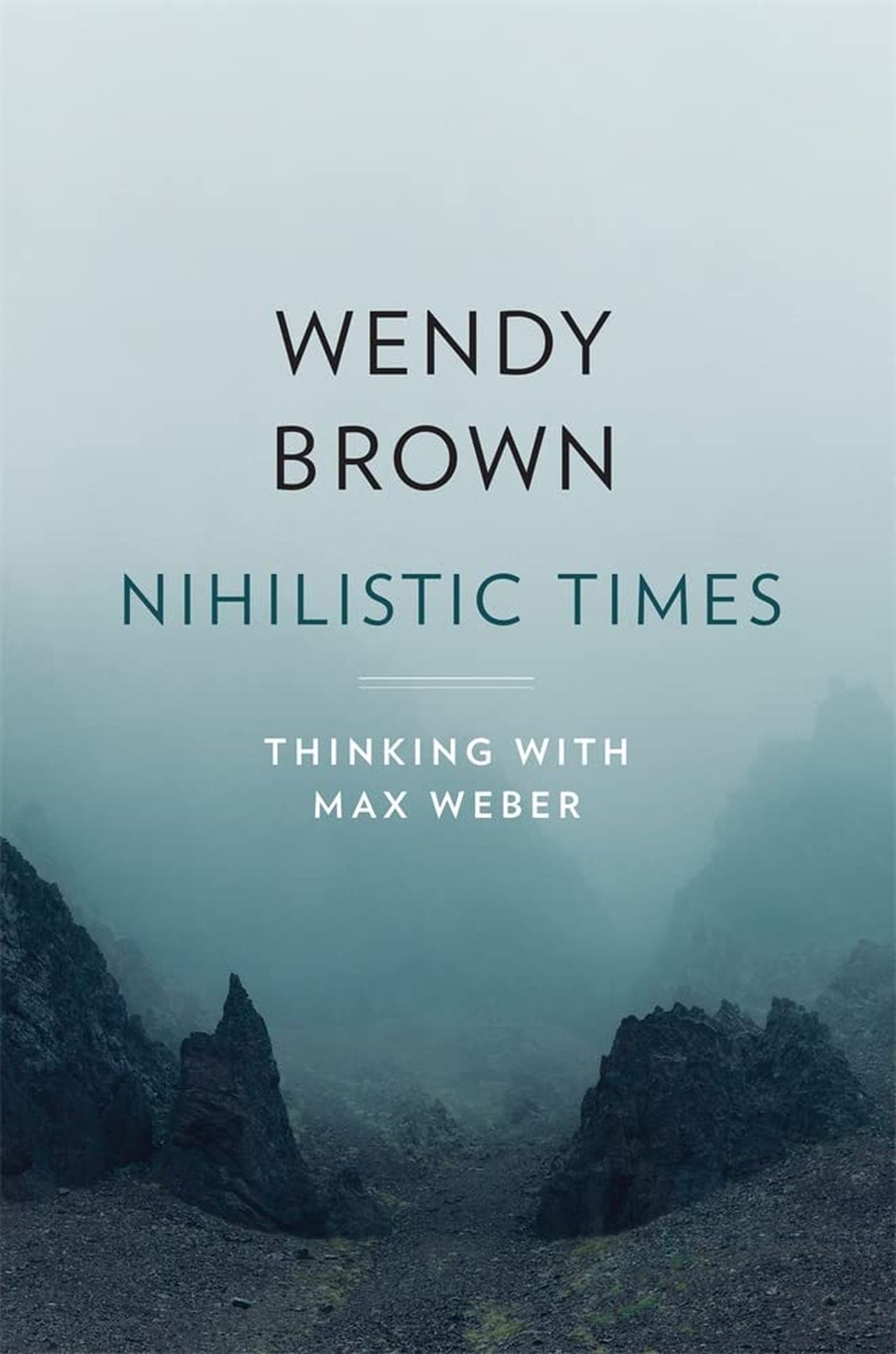 Kieran Setiya in the LA Review of Books:
IN NOVEMBER 1917, a group of left-leaning students at the University of Munich invited sociologist Max Weber to lecture on “Science as a Vocation.” They were troubled by the state of the academy in a time of increasing specialization, subject to distorting influences, both economic and political.
It’s hard to imagine that the students were uplifted by Weber’s lecture. His embrace of specialized knowledge—divorced from ethics, politics, and the search for meaning—portrays the advance of science as planned obsolescence. The scientist’s vocation lies in pursuing truth, knowing that the fate of her work is to be superseded. Weber’s advice to the would-be scientist was, more or less, “suck it up.”
Worse still, the upshot of technical progress is a disenchanted world. We no longer pray to spirits but “can in principle control everything by means of calculation.” And while science tells us how to achieve our ends, it does not tell us what our ends should be. For Weber, disenchantment lapses into nihilism:
And suppose that Tolstoy rises up in you once more and asks, “who if not science will answer the question: what then shall we do and how shall we organize our lives?” […] In that event, we must reply: only a prophet or a savior. […] [But] the prophet for whom so many of [us] yearn simply does not exist.
Since the scientist is not a prophet, “politics has no place in the lecture room.”
More here.
In defense of the dollar
 Jay Newman and Meyrick Chapman in Politico:
There’s no question about it — the United States dollar is under attack.
Finance is prone to fads, and its latest mania is de-dollarization: the notion that the dollar will soon meet its demise as the world’s preeminent reserve currency.
Everyone seems to hate the greenback. China recently crowed about its “triumphant” purchase of an LNG cargo, which was paid for in yuan and traded through China’s Shanghai Petroleum & Natural Gas Exchange. And Brazilian President Luiz Inácio Lula da Silva has called for development of a new currency for BRIC countries — Brazil, Russia, India, China and South Africa — to dethrone the dollar.
Such events attract media attention, of course, but they may just turn out to be sideshows. Of greater import are China’s arbitrary punishment of Deloitte for alleged audit failures, the summary arrest of the Mintz Group’s corporate due diligence team in Beijing and the political corruption that has long plagued Brazil.
In essence, the devil may be hated, but for all the chatter about its death, neither the numbers nor the stories support the hype. And while it’s true that the U.S. government does itself no favors by applying economic sanctions indiscriminately, spending profligately and printing money, in the immediate future, there’s no replacing the dollar and the institutions that go along with it.
More here.
Capital’s Militant
 Marco D’Eramo in Sidecar:
He’s not as rich as Jeff Bezos, not a social media star like Elon Musk, nor an icon like Bill Gates. Yet he is the most interesting of the Silicon Valley tycoons, for more than any other he embodies the new breed of capitalist ideologue. Rather than using politics to make money, he uses his billions for politics, in the hope of emancipating the rich from ‘the exploitation of the capitalists by the workers’. Peter Thiel (b. 1967): German by birth, American and South African by upbringing; according to Forbes, he is worth $4.2 billion. Equipped, in contrast to his peers, with a degree in philosophy and a doctorate in law, he likes to affect the posture of a philosopher king. In his most ambitious piece of writing, The Straussian Moment (2004), he sketches a kind of Geistes Weltgeschichte in light of 9/11, citing with carefully cultivated intellectual effrontery Oswald Spengler, Carl Schmitt, Leo Strauss, Pierre Manent, Roberto Calasso, and name-checking Machiavelli, Montaigne, Hobbes, Locke, Hegel, Nietzsche and Kojève.
Ever since his university days, Thiel has been devoted to a kind of impudence of position, always embracing the most conservative one possible (he has been an admirer of Reagan since high school). According to his biographer Max Chafkin, Thiel felt that ‘mainstream liberals had accepted communists, but conservatives were unable to bring themselves to associate with members of the far-right…He really wished the right would become more like the left’.
More here.
Eliezer Yudkowsky Doing His Thing
Yoga
Clinton Caward at the Sydney Review of Books:
 Yoga depicts Carrère’s third major depressive crisis. His first followed the success of his fifth novel, The Moustache (1986) from which he recovered by writing a biography of Phillip K Dick. His breakthrough work came in 1993 when he was drawn to the case of Jean-Claude Romand, who had pretended he was a doctor at the World Health Organisation for eighteen years, and on the cusp of having his fraud exposed, murdered his entire family. Carrère had no idea when he followed the journalistic throng to Romand’s little French village just how many years he’d spend trying to narrativize the murders in the style of Capote’s In Cold Blood. But how to do it? He didn’t want his intrusive ‘I’ to appear on the page, drawing attention to itself. Not yet, anyway. The author should be everywhere present but nowhere visible, Flaubert, one of his role models, had proclaimed. After seven years of bashing his head against Capote, he gave up and sought closure by writing a conversational letter to himself about all he’d been through.
This message to self about the Romand case, became The Adversary, (2000) a non-fiction book which launched Carrère’s use of himself as a character. The story, framed by his struggle to write the book, unexpectedly liberated his voice. ‘It’s the first time you hear my adult voice’, he told the Paris Review.
more here.
Maths And Literature
Rohan Silva at The Guardian:
 “The universe (which others call the Library) is composed of an indefinite, perhaps infinite number of hexagonal galleries.” That’s how Jorge Luis Borges starts The Library of Babel, beloved by maths geeks and book nerds alike for the way it toys with the mathematical concept of infinity.
I liked the short story so much I nicked its main idea when I started my Libreria bookshop, blanketing the store’s insides with mirrors to trick you into thinking you are in a “perhaps infinite” space. (The mirrors require a near infinite amount of cleaning, but there we go. As for maths professor Sarah Hart, she’s so enthralled by the ways her academic field has enriched the work of poets and novelists that it is the subject of her ebullient debut book. “By seeing mathematics and literature as complementary parts of the same quest to understand human life and our place in the universe, we immeasurably enrich both fields,” she writes.
more here.
Saturday Poem
Cartoon Physics, part 1
Children under, say, ten, shouldn’t know
that the universe is ever-expanding,
inexorably pushing into the vacuum, galaxies
swallowed by galaxies, whole
solar systems collapsing, all of it
acted out in silence. At ten we are still learning
the rules of cartoon animation,
that if a man draws a door on a rock
only he can pass through it.
Anyone else who tries
will crash into the rock. Ten-year-olds
should stick with burning houses, car wrecks,
ships going down—earthbound, tangible
disasters, arenas
where they can be heroes. You can run
back into a burning house, sinking ships
have lifeboats, the trucks will come
with their ladders, if you jump
you will be saved. A child
places her hand on the roof of a schoolbus,
& drives across a city of sand. She knows
the exact spot it will skid, at which point
the bridge will give, who will swim to safety
& who will be pulled under by sharks. She will learn
that if a man runs off the edge of a cliff
he will not fall
until he notices his mistake.
by Nick Flynn
from: Some Ether.
Graywolf Press, 2000
When Did Clothing Originate?
Ian Gilligan in Smithsonian:
 Though many gaps in the story remain, the emerging evidence suggests clothing really had two origins: first for biological needs, then cultural. Archaeologists who study the Paleolithic or Stone Age tend to ignore clothing. Perhaps this isn’t surprising, considering not a single shred has survived from this ice age era between roughly 2.6 million and 12,000 years ago. Archaeologists are reluctant to look for something they will never find.
Stone Age clothing may be invisible to archaeology, but that does not mean Paleolithic clothing origins cannot be investigated scientifically. For instance, fossils show humans inhabited ice age Eurasia when the frigid windchill reduced safe exposure times to an hour or two. Clearly, those people had adequate clothes. And, fortunately, tools used to make clothing, such as sewing needles, provide some tangible—albeit indirect—evidence.
It’s also helpful to distinguish between simple and complex clothing. Simple clothes hang loose, such as capes, cloaks or loincloths. They can be warm—a drapey fur cloak, for instance—but simple clothes are prone to wind penetration. Complex clothes hug the body snuggly, usually with separate sleeves or pantlegs. Also, complex clothes may have multiple layers.
More here.
How The British Took Over India
Note: (For Arfa and Bhaijan with love)
Friday, April 28, 2023
Ryan Ruby on Literary Criticism and the Internet
Ryan Ruby in Vinduet:
 On December 1, 2021, I tweeted: «Earlier this year I argued that we are living in a golden age of popular criticism. To prove my point … here’s the tip of the iceberg: my list of 21 of the best essays, reviews, and criticism published in 2021.»
The thread of 21 essays that followed were warmly received, which came as something of a surprise since any optimism about contemporary cultural production tends to be regarded as suspect, even controversial. If you spend any time in the Anglophone public sphere, you’ll know that a deep pessimism is instead the prevailing mood. Whether the issue is the stagnation of fees for freelance writers at rates first offered by magazines a century ago, the decline of the average book advance, the conglomeration of publishing houses, the endangerment of the species of the midlist author, and the role of Amazon as a distributor and publisher; whether it’s the extremely precarious financial position of little magazines, the collapse of book reviews sections in newspapers, and the oceanic supply of free content (i.e. published writing that is not paid for by the consumer), some of which is no longer even being generated by humans; whether it’s the state of the PhD job market, the casualization of academic labor, the drying up of tenure lines, the downsizing or wholesale closure of humanities departments; or whether it’s the cost of living crises and the collapse of economic protections in the societies in which these workers are embedded, this pessimism is not entirely unjustified.
Yet against the vulgar logic that suggests the quality of economic arrangements determines the possibility of quality work, a great deal of evidence points the other way.
More here.
The Universe Sucks
Paul Sutter in Ars Technica:
 Beginning as early as the 1970s, astronomers noticed something funny going on with the galaxies in our nearby patch of the Universe. There was the usual and expected Hubble flow, the general recession of galaxies driven by the overall expansion of the Universe. But there seemed to be some vague directionality on top of that, as if all of the galaxies near us were also heading toward the same focal point.
Astronomers debated whether this was a real effect or some artifact of Malmquist bias, the bias we get in our observations because bright galaxies are easier to observe than dim ones (for fans of statistics, it’s just another expression of a selection effect). It could be that a complete census of the nearby cosmos, including the much more numerous small and dim galaxies, would erase any apparent extra movement and return some sanity to the world.
But then came more detailed observations of the cosmic microwave background (CMB).
More here.
Review of Peter Turchin’s “End Times”
Branko Milanovic in his Substack newsletter:
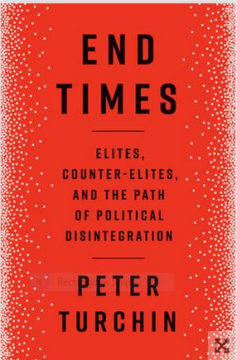 For almost two decades, Peter Turchin has been involved, with many colleagues and co-authors, in an epochal project: to figure out, using quantifiable evidence, what are the forces that lead to the rise, and more importantly, to the decline of nations, political turbulence and decay, and revolutions. This has resulted in the creation of an enormous database (CrisisDB) covering multitude of nations and empires over centuries, and several volumes of Turchin’s writings (e.g., Secular Cycles (with Sergey Nefedov), War and Peace and War; I have read the former, not the latter).
End Times is Turchin’s attempt to break to the broader public what he has learned from the complex work in the field that he calls Cliodynamics. It is a work of “haute vulgarisation” even if the adjective “haute” is sometimes inapplicable since, in his attempt to reach the broadest possible audience, Turchin has at times stylistically gone much too low assuming almost no prior knowledge amongst his readers. But this is a question of style.
What is the substance?
More here.