
Category: Recommended Reading
On Hans Pfitzner & The Conservative Artist
Adam Kirsch at The New Criterion:
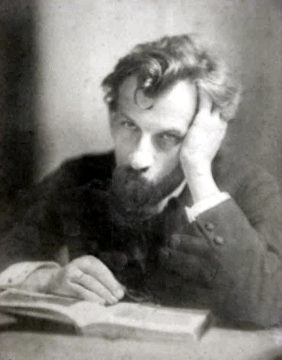 When Hans Pfitzner’s opera Palestrina premiered in Munich in June 1917, it found an enthusiastic admirer in Thomas Mann. “Quickly I made this difficult and audacious production into my own, my intimate possession,” Mann said in Reflections of a Nonpolitical Man (1918), the nonfiction book he spent most of World War I writing. “Its appearance at this moment brought me the consolation and blessing of complete sympathy.” Before the year was out, he saw the opera performed five times.
Pfitzner continued to compose until his death in 1949 at the age of eighty, yet Palestrina is his only work widely known today. Part of the reason is that his reputation went into a deep eclipse after World War II—a backlash against his celebrity status in Nazi Germany, where he was one of the regime’s favored composers. It is only in recent years that many of his chamber, orchestral, and choral works have been recorded. None of them, however, seems likely to join Palestrina in the canon. Pfitzner’s magnum opus continues to repay listening and reflection today for the same reason that it fascinated Mann more than a century ago: its powerful expression of the pathos and the perils of conservative artistry in the modern world.
more here.
The Playoffs: A Dispatch
Rachel B. Glaser at The Paris Review:
 I like when the refs touch each other in any way, but especially when all three of them put their arms around one another, huddling to discuss a difficult call. I like watching endless replays of fouls, trying to decide whether something was a block or a charge, or who touched the ball last. I like when the commentators disagree with the refs and when the broadcast cuts to the former ref Steve Javie in some NBA warehouse in New Jersey, standing in front of TV screens, calmly hypothesizing what the refs are discussing.
I love the emotions, which in other sports are often hidden under the players’ helmets and hats. Jamal Murray’s arms outstretched in joy as he backpedals after nailing yet another three. Jimmy Butler’s and Grant Williams’s noses touching while they scream at each other like two feuding angelfish. Robert Williams’s head in his hands on the bench.
more here.
Thursday, May 25, 2023
Martin Amis’s 15 Rules For Writers (2014)
From Essayful at Twitter:
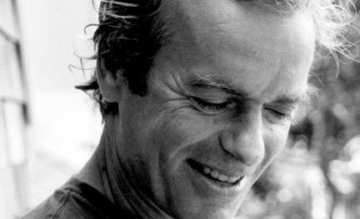 1. Write in longhand: when you scratch out a word, it still exists there on the page. On the computer, when you delete a word it disappears forever. This is important because usually your first instinct is the right one.
2. Minimum number of words to write every day: no “quota.” Sometimes it will be no words. Sometimes it will be 1500.
3. Use any anxiety you have about your writing — or your life — as fuel. Ambition and anxiety: that’s the writer’s life.
4. Never say ‘sci-fi.’ You’ll enrage purists. Call it SF.
5. Don’t dumb down: always write for your top five per cent of readers.
More here.
The first air traffic controller
Jeannette Cooperman in The Common Reader:
 In the twenties, Archie League was spinning, diving, and doing loop-the-loops above the clouds, engine roaring, little plane shaking as he and the other barnstormers in his flying circus entertained folks across Missouri and Illinois. Necks grew stiff from watching, eyes squinted against the light, jaws dropped and air rushing in with every oooohhhh and whoa and oh my sweet Lord Jesus.
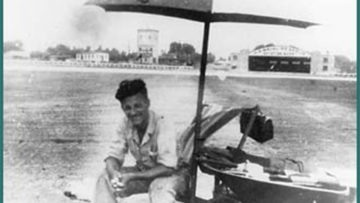
By 1929, though, League had crossed over to safety’s side and taken a job with St. Louis’s nine-year-old airport. Every day, he walked to the end of the Lambert Field runway with a wheelbarrow that held a deck chair, a beach umbrella for summer heat, a notepad, his lunch and, most important, two flags. The big red one meant STOP, and the checkered one meant GO, you can take off or land now.
He was, in other words, the first air traffic controller.
More here.
The Standard Model of Particle Physics: A Triumph of Science
Atomic Bombs: Why Were They Dropped?
Algis Valiunas in The New Atlantis:
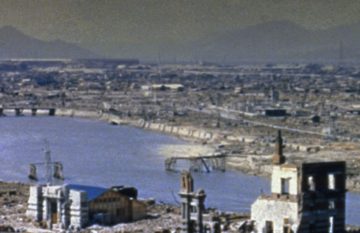 Amid the carnage of the Second World War, which saw some 60 million killed, including the Nazis’ industrialized annihilation of six million Jews, one event stands out in American memory as the most momentous: the atomic bomb attack that leveled Hiroshima on August 6, 1945. According to the most authoritative Japanese casualty count, which is higher than the American figure, the bomb killed some 100,000 people outright and another 40,000 over the next several months; blast, flash burns, and firestorm took care of the former, and radiation sickness accounted for the latter. A second bomb that dropped just three days later on Nagasaki killed 70,000 all told but gave some people misgivings even more troubling than those produced by Hiroshima.
Political men at the time understood, or at least appreciated sufficiently to exult in, the historic scale of the devastation. Upon getting word of the successful mission, while he was returning to the United States from the Potsdam Conference in Germany, President Harry Truman, ultimately responsible for the bombing, let off an exclamation of fiery triumph: “This is the greatest thing in history!”
More here.
Alien Debate: Sara Walker and Lee Cronin
Targets: American Sniper
Adam Nayman at The Current:
 While Bogdanovich was about as immersed in cinema as is possible, a key inspiration for his 1968 debut, Targets—a thriller whose terse, nightmarish qualities would not be repeated across his wide-ranging and influential filmography—came not from the movies but from real life. Charles Whitman was an altar boy, an Eagle Scout, a marine, and a mass murderer: in 1966, between the last day of July and the first day of August, the twenty-five-year-old ex–bank teller killed sixteen people—including his wife and mother—and wounded more than thirty others, shooting the majority of his victims from the observation deck of the Main Building of the University of Texas at Austin. For the mass media, which made him a household name—“The Psychotic and Society,” declared a Time cover featuring his image—he was a cleaner-cut cousin to Lee Harvey Oswald, his sights trained not on political power or celebrity but on the everyday citizens whom he resembled at a distance, and maybe under the skin as well. “I don’t really understand myself these days,” the shooter himself observed in the half-typed, half-handwritten suicide note discovered at his residence. “I am supposed to be an average reasonable and intelligent young man. However, lately (I can’t recall when it started) I have been a victim of many unusual and irrational thoughts.”
more here.
The Porcupine Illusion: Freud’s Prickly Secret
George Prochnik at Cabinet Magazine:
 It began as an urbane fable about how to brush down bristling nerves. Sometime in the summer of 1909, not long before Sigmund Freud was due to embark on his only visit to the United States, he was enjoying a cigar in the company of his inner circle in the busy Biedermeier interior of Berggasse 19, when he suddenly announced, “I am going to America to catch sight of a wild porcupine and to give some lectures.”
The declaration no doubt provoked coughs and clinks of china—perhaps punctuated here and there by crinkling mouth-corners in anticipation of Freud’s masterstroke, which would illuminate the conceit. No one credited him with being so avid a porcupine aficionado that he would travel three thousand miles by steamship to make the acquaintance of one specimen of Erethizon dorsatum in its native woodland habitat.
more here.
Thursday Poem
Nothing Gold Can Stay
Nature’s first green is gold,
Her hardest hue to hold.
Her early leaf’s a flower;
But only so an hour.
Then leaf subsides to leaf.
So Eden sank to grief,
So dawn goes down to day.
Nothing gold can stay.
Robert Frost
from The Poetry of Robert Frost
Holt and Company, LLC
‘Democracy’ as a civic religion
Richard Rorty in Achieving Our Country from Delancey Place:
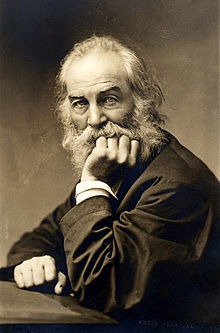 John Dewey (1859-1952) was an American philosopher, psychologist, and educational reformer; Walt Whitman (1819-1892) an American poet, essayist, and journalist. Both hoped for a thoroughly secular “democracy” as a civic religion displacing conventional religion: Whitman and Dewey were among the prophets of [an American] civic religion. They offered a new account of what America was, in the hope of mobilizing Americans as political agents. The most striking feature of their redescription of our country is its thoroughgoing secularism. In the past, most of the stories that have incited nations to projects of self-improvement have been stories about their obligations to one or more gods. For much of European and American history, nations have asked themselves how they appear in the eyes of the Christian God. American exceptionalism has usually been a belief in special divine favor, as in the writings of Joseph Smith and Billy Graham.
“Dewey and Whitman wanted Americans to continue to think of themselves as exceptional, but both wanted to drop any reference to divine favor or wrath. They hoped to separate the fraternity and loving kindness urged by the Christian scriptures from the ideas of supernatural parentage, immortality, providence, and — most important — sin. They wanted Americans to take pride in what America might, all by itself and by its own lights, make of itself, rather than in America’s obedience to any authority — even the authority of God. Thus Whitman wrote:
And I call to mankind, Be not curious about God,
For I who am curious about each am not curious about God.
More here.
How some people get away with doing nothing at work: All hail the jobless employed
Emily Stewart in Vox:
 In theory, Nate works 40 hours a week in the operations department at a major fintech company. In reality, Nate works one hour a day at most. He moseys over to his computer whenever he gets an alert on his phone that he’s got a task to complete. Otherwise, he spends most of the day doing, basically, whatever he feels — he sleeps in, he watches TV, he does household chores. His only real restriction is that he can’t stray too far from home in the event he is needed for something.
“I don’t have a problem with being asked to do work; it’s just I’m not really being asked,” he says. Maybe he could take more initiative and try to take on more, but he gets good performance reviews and raises as it is, so he figures, why bother? Plus, it’s not like he can waltz up to his boss to announce there’s no real business reason for his existence. “How do I initiate that conversation that’s, ‘Hey, I haven’t been doing much of anything this whole time, I need more to do’? You don’t really want to draw attention to it,” says Nate, which is a pseudonym. Vox granted him anonymity to speak for this story for obvious reasons, as we did all of the workers interviewed.
Strongly suspecting that a certain person isn’t doing much, or not nearly enough to fill up what is ostensibly an eight-hour day, seems to be a near-universal work experience.
More here.
Wednesday, May 24, 2023
“The Covenant of Water” by Abraham Verghese
Maaza Mengiste in The Guardian:
 Spanning from 1900 to 1977 in Kerala, The Covenant of Water reveals some of the contradictions of living in a colonised, segregated society. Dr Digby Kilgour, the lonely son of an impoverished alcoholic mother, flees Scotland for colonised India, only to discover that he is “oppressed in Glasgow; oppressor here. The thought depresses him.” Yet the complicated questions that might develop as he negotiates with those increasingly fraught realities are set aside while he contends with his new hospital job and begins an affair with a woman who is married to a colleague. Tensions rise as that colleague makes a fatal medical error and places the blame on Digby. Any confrontation that would have occurred, however, is derailed by an accident that conveniently pushes Digby’s storyline in another direction.
More here.
Bees can learn, remember, think and make decisions – here’s a look at how they navigate the world
Stephen Buchmann in The Conversation:
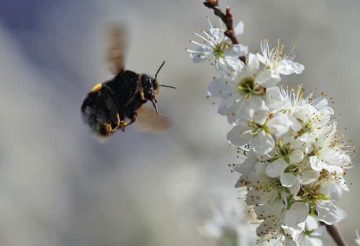 As trees and flowers blossom in spring, bees emerge from their winter nests and burrows. For many species it’s time to mate, and some will start new solitary nests or colonies.
Bees and other pollinators are essential to human society. They provide about one-third of the food we eat, a service with a global value estimated at up to $US577 billion annually.
But bees are interesting in many other ways that are less widely known. In my new book, “What a Bee Knows: Exploring the Thoughts, Memories, and Personalities of Bees,” I draw on my experience studying bees for almost 50 years to explore how these creatures perceive the world and their amazing abilities to navigate, learn, communicate and remember. Here’s some of what I’ve learned.
More here.
Geoffrey Hinton Warns of the “Existential Threat” of AI
Cafe Yafa: A Palestinian bookshop reviving literary culture
Eliyahu Freedman in Aljazeera:
 “Jaffa will be a Jewish city … Allowing Arabs to return to Jaffa would not be righteousness but stupidity,” David Ben-Gurion wrote in his diary in June 1948.
Israel’s first prime minister, who arrived in Palestine at Jaffa port in 1910, was writing after right-wing Irgun forces razed Jaffa in April and expelled nearly 70,000 Palestinian residents.
After the bombs stopped, looting began: Ben-Gurion was one of the strongest supporters of the expropriation of Palestinian property. Months later, thousands of Arabic books lay on the streets, “badly damaged during the war … wind, rain and sun”, according to Adam Raz, historian and author of The Looting of Arab Property in the 1948 War.
More here.
How a little more silence in children’s lives helps them grow
LA Johnson in NPR:
 A group of small children sits cross-legged with their teacher, Steve Mejía-Menendez, on a round carpet. He’s a pre-K teacher at Lee Montessori Public Charter School’s campus in Southeast Washington, D.C., and although I’m here to meet him, I almost don’t spot him because he’s eye level with his students.
Mr. Steve, as he’s known here, is talking a few students through a geometry lesson when another student approaches to ask an unrelated question. This kind of distraction happens all the time in classrooms around the United States. Mr. Steve doesn’t lose focus. He uses American Sign Language to say “wait” — palms facing up, fingers wiggling — and the child waits quietly. When the lesson arrives at a natural stopping point, the student is invited to ask his question, and Mr. Steve silently responds by nodding his head along with his fist, which is sign language for “yes.”
Blink, and you could miss the whole interaction.
This isn’t a school for students with hearing disabilities, but Mr. Steve uses ASL as part of a broader approach to minimize noise in the classroom. And it’s noticeably quiet. No one is talking louder than what’s often referred to in Montessori schools as “the hum.”
More here.
A mental-health crisis is gripping science — toxic research culture is to blame
Shannon Hall in Nature:
 There is a mental-health crisis in science — at all career stages and across the world. Graduate students are being harassed and discriminated against, paid meagre wages, bullied, overworked and sometimes sexually assaulted. It doesn’t get much better for early-career researchers struggling to land long-term employment. And established senior researchers face immense pressure to win grants, publish in high-profile journals and maintain their reputations in highly competitive fields.
Scientists have raised concerns for years about the impacts of all these pressures on mental health. But a series of studies in the past few years are now providing hard data. And the findings show that the situation is dire.
More here.