Chris O’Kane over at the blog of the Journal of the History of Ideas:
The 100th anniversary of the founding of the Institute for Social Research (ISR) has led to a multitude of celebrations and reflections on Frankfurt School Critical Theory by prominent Critical Theorists at Critical Theory conferences and in Critical Theory Journals in the Anglophone world. In what follows, I focus on William Scheuerman’s and Samuel Moyn’s recently published short commentaries criticizing contemporary Frankfurt School Critical Theory for not focusing on the political economic dimensions of contemporary capitalism.
Scheuerman’s and Moyn’s criticisms are largely right when it comes to what is defined as Frankfurt School Critical Theory in the Anglophone world today (what Scheuerman rightly calls “Habermasian Critical Theory”). Yet, in what follows, I show that Scheuerman’s and Moyn’s comments are not accurate for Anglophone work that should be considered Frankfurt School Critical Theory.
In the space that permits, I first provide an outline of Scheuerman’s and Moyn’s criticisms of contemporary Frankfurt School Critical Theory. I then contextualize the emergence of the predominant understanding of the development of Frankfurt School Critical Theory into Habermasian Critical Theory in the Anglophone world alongside the development and marginalization of two subterranean lines of Frankfurt School Critical Theory, that drew on and developed what they saw as Max Horkheimer and Theodor W. Adorno’s relationship to Marxism and political economy.
I then provide an overview of recent work in political economy that has drawn on and expanded these subterranean understandings of the Frankfurt School in the areas that Moyn and Scheuerman indicate contemporary critical theory should take up. I conclude with a plea that these contributions be taken seriously as Frankfurt School Critical Theory, lest it be eclipsed.
More here.
William Scheuerman’s original piece can be found here:
Commemorations of the 100th anniversary of the founding of the Institute for Social Research—the Frankfurt School—have taken place around the world this year, many of them at prestigious universities and featuring illustrious contemporary representatives. Yet those events have overlooked a crucial and still relevant conjuncture in the Institute’s intellectual history. That oversight points to some unfortunate lacunae within recent Frankfurt-oriented critical theory.
By 1941 the Institute’s resident political economist, Friedrich Pollock, had embraced the idea that a qualitatively new model of state capitalism had crystallized. Pollock had spent much of the previous decade studying real-world experiments in state planning and major structural shifts within capitalism.
And Sam Moyn’s piece here (access required).

 Payne is America’s poet laureate of losers. Over thirty years, the writer-director has sheltered a menagerie of the bumbling, the henpecked, the ineffectual, the distressed, and the depressed. Payne lists both Italian neo-realism and American movies of the 1970s (he was born in 1961) as influences. But his films bear a stamp all his own. Their hallmark elements include a fondness for voiceovers; a reliance on music as an active arm of storytelling; a use of both professional actors and non-actors; a commitment to character-forward stories, adapted from novels, that emphasize place and character; and, above all, a balancing, or mingling, or juxtaposition, of disparate tones and intentions.
 In Cave’s weltanschauung, as laid out in the letter, the machine is a priori precluded from participating in the authentic creative act, because it is not, well, human. If this argument sounds hollow and slightly narcissistic, that’s because it is. It follows a circular logic: humans (and Nick Cave) are special because they alone make art, and art is special because it is alone made by humans (and Nick Cave). His argument is also totally familiar and banal—a platitude so endlessly repeated in contemporary discourse that it feels in some way hard-baked into the culture. According to historians of ideas (see Arthur Lovejoy, Isaiah Berlin, Alfred North Whitehead), this thesis took form sometime in the second half of the eighteenth century. A brief and noncomprehensive summary: to preserve human dignity in the face of industrialization, philosophers and poets, who were later called the Romantics, began to redraw ontological boundaries, placing humans, nature, and art on one side, and machines, industry, and rationalism on the other. Poets became paragons of the human, and their poems examples of that which could never be replicated by the machine. William Blake, for instance, one of Cave’s heroes, proposed that if it were not for the “Poetic or Prophetic character,” the universe would become but a “mill with complicated wheels.”
 V
V An
An  A colophon is the design or symbol publishers place on the spines of their books. Glance at your bookshelves, at the bottom edge of each volume, and you might see the Knopf borzoi, the three fish of FSG, the interlocking geometric shapes of Graywolf. They are designed to be
  The social cost of greenhouse gas (GHG) emissions, considered the single most important measure in addressing the climate crisis, is generally defined as an estimate of societal damages, including health harms, resulting from unpaid or externalized GHG emissions. Researchers have been calculating this cost
  Hutchison wore the trash company’s jumpsuit, cap and reflective vest, and he sported a few days of beard stubble. He was collecting trash hoping to find something valuable: the DNA of a person who might prove to be a suspect in the sexual assault and murder of an 18-year-old security guard in Sunnyvale in 1969.
 Watching lawyers for
 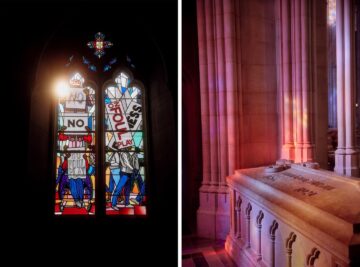 On March 31, 1968, days before he would be assassinated, the Rev. Martin Luther King Jr.
  The Mexican writer Álvaro Enrigue’s new novel has a soft, nebulous title: “You Dreamed of Empires.” Its cover is forgettable, too. Like nearly every book on the New Fiction table, it is all wavy patterns and beach-towel colors. This generic look has come to promise a) bright settings and b) young characters out to conquer racial and sexual threats as they perceive them. This would be excellent were it not for, as often as not, c) writing in which one is instructed how to feel at almost every moment.