
The Misuses of the University

François Furstenberg at Public Books:

Johns Hopkins is launching its 150th anniversary celebration. When it was founded in 1876, American universities were still mostly finishing schools for children of the nation’s elite. Hopkins introduced the modern research university to the US, importing the model from Germany, helping reshape American higher education in its image.

At the convocation, speakers announce the coming “sesquicentennial”: once, twice, three times, and then again, lest anyone forget. It’s a great word, he thinks. He tries to use it in a sentence.

The incoming chair of the university’s board of trustees is on hand. He looks nervous. He’s younger than most faculty on stage, the managing partner of a private equity firm based in Boston, with offices in London, Mumbai, Hong Kong, and Menlo Park. Kept, like all faculty, at a safe distance from the trustee, the history professor asks himself what this person can know about running a university.

More here.

Enjoying the content on 3QD? Help keep us going by donating now.

Tuesday Poem


“Real improvement can be hoped for only if there is a
radical change of consciousness. I fear all other measures will
remain unreliably palliative since they do not penetrate to the
depths where the evil is rooted and constantly renewed.”
…………………………………………………………………. —Carl Jung

By Way of Compensating

By way of compensating for the loss of a world
that pulsed with our blood and breathed with our breath,
we have developed an enthusiasm for facts— mountains
of facts, far beyond any single individual’s power to survey.

We have the pious hope that this incidental accumulation of
facts will lead to a meaningful whole, but nobody is quite sure,
because no human brain can possibly comprehend the gigantic
sum total of this mass-produced knowledge.

The facts bury us.

No one has yet become a good surgeon
by learning the textbooks by heart.
Yet the danger that faces us today is that
the whole of reality will be replaced by words.
This accounts for that terrible lack of instinct
in modern man, particularly the city-dweller.
He lacks contact with life and the breadth of nature.

All time-saving devices, amongst which we must count
easier means of communication and other conveniences,
do not, paradoxically enough, save us time but merely
cram our time so full that we have no time for anything.

Hence the breathless haste, superficiality, and nervous
exhaustion with all the concomitant symptoms— craving
for stimulation, impatience, irritability, vacillation, etc.
Such a state may lead to all sorts of other things,
but never to any increased culture of the mind and heart.

Author, Anonymous
From Salty Politics, 02/23/26

Enjoying the content on 3QD? Help keep us going by donating now.

The Cultural Politics Of Sumo Wrestling

Joshua Hunt at Harper’s Magazine:

The rules of Japan’s national sport are relatively straightforward: two rikishi—literally, “strong men”—face each other near the center of the ring, crouched on their haunches, like plus-size sprinters waiting to explode out of the starting block. They will often squat and then rise to stamp their feet or throw salt on the ground. When the referee signals the start of the match, they rush toward each other and collide with the same force that a person might absorb after falling from a height of two or three stories. From their fleshy collision, one man tends to emerge with the advantage of surer footing or a firmer grip on his opponent’s loincloth, known as a mawashi, which wrestlers can use to lift and toss each other around the ring. Whoever can force his adversary from the ring or get any part of his body other than the soles of his feet to touch the ground is the winner.
What I was watching near Lake Suwa was only a practice bout, but the wrestlers were nevertheless busy with their usual prematch rituals, pacing back and forth and tossing salt.

more here.

Enjoying the content on 3QD? Help keep us going by donating now.

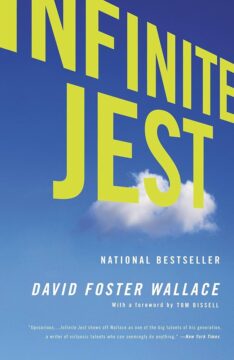
What’s So Funny About Infinite Jest?

Lora Kelley at the Paris Review:

How does one start Infinite Jest? In the year 2026, thirty years after its initial release, the book is a distinctive cultural object. It has been memed to oblivion, its author eulogized and criticized and transformed into an enormous posthumous celebrity. Infinite Jest has a reputation for being brilliant, transcendent, transformative, genius. But it’s also thought to be tricky, long, confusing, pretentious, unfashionably male, and embarrassing to read on the subway. “There’s that horrible joke: ‘If you go to a guy’s house and he has a copy of Infinite Jest, don’t fuck him,’ ” Sarah McNally, the owner of McNally Jackson, told me. “I profoundly disagree with that,” she added, laughing. To the contrary, she said, she finds the book quite “seductive.”

David Foster Wallace meant for the novel to pull readers in; he wanted, among other things, for people to like it. He said a few months after Infinite Jest came out that “a lot of the avant-garde has forgotten that part of its job is to seduce the reader into being willing to do the hard work,” and that he feared that people would find his new book gratuitously difficult.

more here.

Enjoying the content on 3QD? Help keep us going by donating now.

Monday, February 23, 2026

Why it’s funnier when you’re not allowed to laugh

Michelle Spear in The Conversation:

Most people recognise the experience. A solemn setting. Absolute silence. A fleeting visual detail that is, in any other context, only mildly amusing at best. Yet the harder you try to suppress the laugh, the more uncontrollable it becomes. When someone else notices it too, restraint becomes next to impossible.

This kind of laughter that comes from trying not to laugh isn’t confined to religious spaces. It happens in any setting where silence, seriousness and self-control are tightly enforced and uncontrolled laughter is frowned upon.

Rather than being bad manners or a lack of emotional maturity, it tells us something about how the brain behaves under pressure. The science behind it is surprisingly complex.

More here.

Enjoying the content on 3QD? Help keep us going by donating now.

Microsoft team creates ‘revolutionary’ data-storage system that lasts for millennia

Elizabeth Gibney in Nature:

Researchers at Microsoft have created a data-storage system that can remain readable for at least 10,000 years — and probably much longer.

In the digital age, the need for data storage is ballooning. But current magnetic tapes and hard drives are ill-suited for long-term data storage because they degrade in about ten years. This “impressive” glass-based alternative could “in principle, act as near-permanent archival storage for backup of critical data”, says Mark Bathe, a biological engineer at the Massachusetts Institute of Technology in Cambridge.

The Microsoft team used a high-energy laser to imprint deformations into a 3D chunk of borosilicate glass, the kind used in ovenware. Each deformation encodes data that can be read out using a microscope.

A 12-centimetrewide, 2-millimetre-thick square of the glass can store 4.8 terabytes of data, the equivalent of around two million printed books, the authors demonstrate in their paper published in Nature on 18 February.

More here.

Enjoying the content on 3QD? Help keep us going by donating now.

The Thing We Call Exile

Carlos Manuel Álvarez (translated by Will Noah) at Equator:

It is five years since I was exiled. My own erasure must be underway. Though for a long time I resisted settling in the US, I now live in New York. If I’m ever able to return to Cárdenas, it will surely be as an intruder in my own town; another ambassador from a foreign society. While the government or the military banish you deliberately, ordinary people can do the same through indifference – a form of cruelty that can’t be blamed on anyone in particular because, in truth, nobody wills it.

People tend to assume that the challenge of exile lies in finding a sense of purpose in your displacement, in inventing something from nothing. But often it’s sadder and more concrete: accepting the meaning that others have assigned to your life.

There’s something anachronistic about becoming an exile from communism long after the fall of the socialist bloc. The Cold War ended, and even what came after it seems to be reaching its end. I can’t pretend I live in a world where the Soviet Union still exists. Yet much of the Cuban community in the US has decided to keep replicating this conservative fantasy, especially after the rise of Donald Trump.

More here.

Enjoying the content on 3QD? Help keep us going by donating now.

The Nativist Dogma Of Ecology

Carlos Santana at Aeon Magazine:

You don’t need a degree in biology to see that invasive species occupy a peculiar moral position: they are the one part of nature we are told not to love. As a philosopher of science, my ears prick up whenever I notice moral complexities emerging among scientists. It makes me wonder: when it comes to invasive species, is the science shaping our moral attitudes or are those attitudes shaping the work of ecologists and conservationists?

The casting of ‘invasives’ as ecological villains has long been backed by scientific and political consensus. Yet as species increasingly move into unfamiliar regions, a favouritism towards natives is growing harder to defend. The traditional approach of trying to stop invasions and eradicate successful invaders isn’t just costly and often ineffective. It may be entirely the wrong approach, if we’re concerned about the environment. While some invasive species are truly harmful and need to be fought, others are a healthy ecological response – they’re part of how the biosphere is adapting to humanity’s environmental impact. If we want a science that responds honestly to planetary change, we need to address the deep biases against Burmese pythons, out-of-control weeds and other species on the move. We desperately need a new way of coexisting with the forms of life that are being rapidly redistributed on our changing planet.

more here.

Enjoying the content on 3QD? Help keep us going by donating now.

Looking at Attention

D. Graham Burnett at The Paris Review:

Many filmmakers, going back to some of the earliest experiments with the moving picture, have depicted the intensity of the gazes fixed on their own medium. One thinks of Dziga Vertov’s interwar metacinema, or even a vaudeville-steeped silent classic like D. W. Griffith’s Those Awful Hats (1909). It was something they thought about a lot, early cinematographers—the mesmeric power of their own images. And so it was a very alluring topic to explore.

But it is one thing to shoot an actor who has been told to make a face “as if” he is looking at a movie. It is another to put the camera in the movie screen itself, and then to play the movie and record the actual reaction. This is a much more recent technique. To be sure, shots of people seeing things in the world are a cinematic commonplace. But the majority of such imagery captures these reactions within the established triangle of subject, object, camera. It is much rarer for a filmmaker to close that triangle down into pure bilateral eyeline gaze: to film from the perspective of the thing being seen, where that thing is itself a moving image.

more here.

Enjoying the content on 3QD? Help keep us going by donating now.

Sunday, February 22, 2026

Where Does Politics Take Place?

Ege Yumusak in The Point:

The starkest, most disquieting scene from the film was printed on postcards and handed out at the door. We picked up our postcards as we hurried into the theater to secure our seats. My eyes widened: a group of women in burqas sat on a beach facing the ocean. Before them stood a woman with dark hair—uncovered—wearing a long, flowing white dress as she faced the women in the burqas. I began mentally preparing for the ideological and cultural translations—and mistranslations—I might be in for by the end of the movie, when we would inevitably run into acquaintances and friends in the foyer.

The director was privy to the provocations of her film, Leila and the Wolves. “This film offended everyone,” she proudly told the packed room at the Brooklyn Academy of Music, at a screening last spring. When the movie came out in the Eighties, everybody, including those on the left, could find something to be offended by in it. Her films were deemed insufficiently feminist for being full of guns, while at the same time criticized for “overemphasizing” women’s liberation in comparison to imperialism. Now her films could finally resume their provocations: since last spring, the “eighty-springs-young” director, Heiny Srour, has toured Europe, the U.K. and the U.S., screening new restorations of her masterpieces The Hour of Liberation Has Arrived (1974) and Leila and the Wolves (1984), thanks to programmers determined to bring her provocative socialist feminist oeuvre to wider audiences (a destiny all too rare in the history of Global South cinema). But this time around, especially in the West, she has found the political engagement with her work to be lacking. “In France, they shower me in praises,” Srour complained. Praise is boring. Trained as a sociologist, she wants her films to spark arguments.

More here.

Enjoying the content on 3QD? Help keep us going by donating now.

The Long Civil Rights Movement

Shehryar Fazli in The Ideas Letter:

“The white cracker who wrote the national anthem knew what he was doing,” says the Black nurse Belize in Tony Kushner’s Angels in America, set in the 1980s, “He set the word ‘free’ to a note so high no one can reach it.”

This statement may sound overly despairing to someone keen to reconcile America’s high principles to the daily experience of living in the nation, as Belize’s (white) interlocutor Louis is. Whatever the turpitudes of the Reagan administration, whatever the horrors of the AIDS epidemic, for Louis the nation has kept its holdings in the sacred honor that carried the Revolution, twenty years after the fulfillment of Black civil and political rights.

Belize’s line could have been the epigraph for the scholar Brandon M. Terry’s new book Shattered Dreams, Infinite Hope: A Tragic Vision of the Civil Rights Movement, a powerful dissent from the romantic view of American history in general and the civil rights movement in particular. He tests the mainstream historiography of that struggle as an exemplary political action whose success incorporated “the excluded into this healthy political sphere and the mainstream of social life.”

In the romantic vision of the movement, the 1950s and 60s saw civic struggle, court rulings, and legislation defeat white supremacy in a reckoning with the past that would place the US firmly ahead of the Soviets in moral terms. It would also authenticate the promise of the Constitution, which in 1787 was “meant to mark the start of a new era, in which the course of history might be made predictable and a government established that would be ruled not by accident and force but by reason and choice,” as historian Jill Lepore wrote in her book, These Truths.

So ingrained is the belief in the constitution’s reflection of a political ideal, high above the facts on the ground, that no less a learned liberal commentator than Ezra Klein was surprised, in a 2019 interview with Lepore, to learn that today’s Electoral College was a byproduct of slavery.

More here.

Enjoying the content on 3QD? Help keep us going by donating now.

China and the World to Come

Pankaj Mishra interviews Zhang Weiwei in Equator:

Pankaj Mishra: […] there’s very little coverage in the Western press of how people in China view these developments. Can you tell us something about that?

Zhang Weiwei: Indeed, the Chinese are watching all this drama closely and with fascination. I think many people feel Carney was a bit more courageous than his European counterparts in calling this so-called rules-based international order a kind of disguise that allows the West to benefit – the US more, Canada maybe less. Now Donald Trump has said: we don’t need this disguise. We can approach everything based on the darkest aspects of realpolitik.

People [in China] see very clearly that these are naked acts of imperialism, hegemonism and colonialism. We have a holistic perception of all this: the crisis in in Greenland, the genocide in Gaza, the low-intensity civil war in Minneapolis and elsewhere in the US. All these are, in fact, interrelated, and it reflects deep structural problems in the Western political system.

In 2006, I wrote a small piece for The New York Times, saying that the Chinese model will be far more attractive than the American model in the Global South. Because in our model, we focus on people-centred development. The US, on the other hand, orients its political structure to favour the super-rich, and to sustain that today, they’re going back to the roots of capitalism: exploitation and territory grabs. In 2018, I gave a talk at Harvard in which I said that China’s leadership was looking to the 2050s while Trump was looking to the 1950s. Now he’s looking to the 1850s, which is clear in the US security strategy report issued at the end of last year. I remember Jeffrey Sachs saying that it is not so much anti-Russia or anti-China, it’s anti-everyone – except, perhaps, Israel.

More here.

Enjoying the content on 3QD? Help keep us going by donating now.