
John Horgan at his own website:
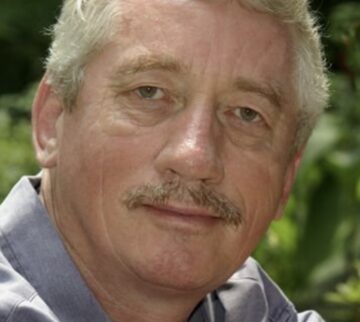 I interviewed de Waal in 2007 while researching my book The End of War. At the time, high-profile scientists were promoting the notion that humans are genetically predisposed to war. As evidence, they cited the violence of our closest genetic relatives, chimpanzees. In his influential 1996 book Demonic Males: Apes and the Origins of Human Violence, anthropologist Richard Wrangham declared: “Chimpanzee-like violence preceded and paved the way for human war, making modern humans the dazed survivors of a continuous, five-million-year habit of lethal aggression.” This hypothesis, which I call the deep-roots theory of war, was embraced by public intellectuals like Steven Pinker and Francis Fukuyama.
I discussed the deep-roots theory with de Waal on June 12, 2007, at the Yerkes Primate Research Center in Georgia, which houses chimpanzees and monkeys. De Waal was tall with sandy-colored hair. He still spoke with a faint Dutch accent, although he left his native Holland in the 1980s. We chatted in a watchtower overlooking a yard where three male chimps and a dozen females lolled, lazily nitpicking and sniffing each other.
Against this backdrop, de Waal heatedly rejected the widespread belief in “some sort of blind aggressive drive that makes us go to war.”
More here.
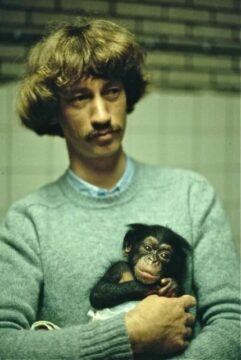 The Netherlands-born scientist spent decades studying chimpanzees and
  W
W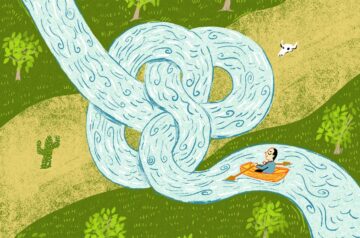 As a Ph.D. student, I spent many days and nights standing on a steep forested slope in the rain, measuring how water drops move into the soil. I loved the outdoors, and it was more like play than work. Many nights, I would dream about my research. I was endlessly curious about what I saw in the field and thrilled when I could connect it to what I read. My ideas seemed to flow like the stream I was trying to understand. But when I became a professor, I was inundated with responsibilities and my creative stream slowed to a trickle. It took me decades to figure out how to revive it.
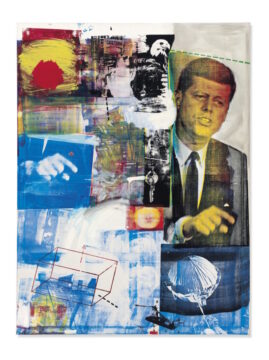 A new documentary delves into the scandals that plagued the 1964 Venice Biennale, where Robert Rauschenberg became the first American to earn the Golden Lion grand prize amid allegations of a rigged jury. Critic and director Amei Wallach’s film
  “There isn’t really anybody who occupies the lens to the extent that Lindsay Lohan does,” the artist Richard Phillips observed in 2012. “Something happens when she steps in front of the camera … She is very aware of the way that an icon is constructed, and that’s something that is unique.” Phillips, who has long used famous people as his muses, was promoting a new short film he had made with the then-twenty-five-year-old actress. Standing in a fulgid ocean in a silvery-white bathing suit, her eyeliner and false lashes dark as a depressive mood, she is meant to look healthily Californian, but her beauty is a little rumpled, and even in close-up she cannot quite meet the camera’s gaze. The impression left by Lindsay Lohan (2011), Phillips’s film, is that of an artist’s model who is incapable of behaving like one, having been cursed with the roiling interior life of a consummate actress. Most traditional print models can successfully empty out their eyes for fashion films and photoshoots, easily signifying nothing, but Lohan looks fearful, guarded, as if somewhere just beyond the camera she can see the terrible future. Unlike her heroine Marilyn Monroe, Phillips also observed in a promotional interview, Lohan is “still alive, and she’s more powerful than ever.”
 When I read that Barbra Streisand’s memoir, My Name Is Barbra (2023), would be 970 pages long, a devilish chuckle bubbled up from deep within me. There was something ecstatic about this moment—How pharaonic the ambition! What an absolute thrill that a woman famous for show business—and not, say, the Nobel Peace Prize—believes her life story worthy of such an expansive word count. I am grateful that someone, somewhere, isn’t endlessly struggling to feign correct attitudes, that someone believes there is time and space to read 970 pages about the life and times of Barbra Streisand, one of those someones being Barbra Streisand.
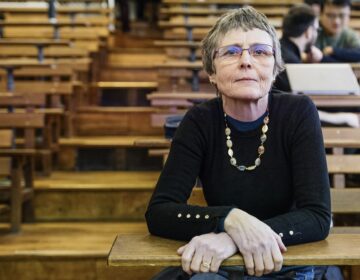 Voisin is a senior researcher at the French National Center for Scientific Research in Paris. There, she studies algebraic varieties, which can be thought of as shapes defined by sets of polynomial equations, the way a circle is defined by the polynomial x2 + y2 = 1. She is one of the world’s foremost experts in Hodge theory, a toolkit that mathematicians use to study key properties of algebraic varieties.
 Imagine you’re a middle-class, middle-aged mom in any number of American suburbs outside Atlanta, Philadelphia, Detroit, or Phoenix—the kind of civic-minded, active voter that both parties chase every election.
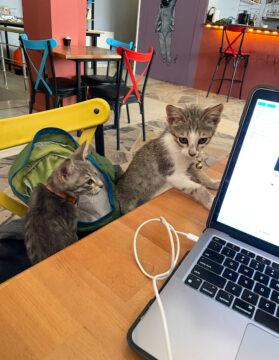 As an anthropologist, this intimacy with cats fascinates me because they represent another instance of how “human culture” is in fact made up of our relationships with nonhumans. Globally, cats have accompanied humans since ancient times, beginning in
  Rihanna, Mark Zuckerberg, bejeweled elephants and 5,500 drones. Those were some of the highlights of what is likely the most ostentatious “pre-wedding” ceremony the modern world has ever seen.
 I
I