
////
Some People
Wislawa SzymborskaSome people flee some other people.
In some country under a sun
and some clouds.They abandon something close to all they’ve got,
sown fields, some chickens, dogs,
mirrors in which fire now preens.Their shoulders bear pitchers and bundles.
The emptier they get, the heavier they grow.What happens quietly: someone’s dropping from exhaustion.
What happens loudly: someone’s bread is ripped away,
someone tries to shake a limp child back to life.Always another wrong road ahead of them,
always another wrong bridge
across an oddly reddish river.
Around them, some gunshots, now nearer, now farther away,
above them a plane seems to circle.Some invisibility would come in handy,
some grayish stoniness,
or, better yet, some nonexistence
for a shorter or a longer while.Something else will happen, only where and what.
Someone will come at them, only when and who,
in how many shapes, with what intentions.
If he has a choice,
maybe he won’t be the enemy
and will let them live some sort of life.Poems New and Collected, 1957-1997(Harcourt, Brace & Company, 1998),
translated from the Polish by Stanislaw Baranczak and Clare Cavanagh.
////
Category: Recommended Reading
The magical mirror of The Arabian Nights
From The Guardian:
Although The Arabian Nights became widely known in Europe after the Crusades and inspired countless artists and writers (from Chaucer to Dickens to Rushdie in Britain), Sir Richard Burton's translation in the late-19th century brought it a new level of popularity on these shores, not least because it was purported to expose the vagaries of the Muslim mentality and Arab way of life. Perhaps these injudicious perceptions, callusing over time, even laid the foundations for present-day Islamophobia.
The Arabian Nights is that magical mirror that reflects Islam's genius, its vast cultural scale and its incalculable contribution to the arts and sciences. The tales celebrate life and the blessings it offers. Praising love, joy, courage, defiance, compassion, they negate the teachings of such death-worshippers as Khomeini, Al-Qaida, Taliban et al. For those wondering where the true voice of Islam is, be assured it is here in these 1,001 tales.
But what of the brutality they contain? What about their obsession with death?
True, Death, “the destroyer of delights”, is forever on the prowl. Indeed, even before Shahrazad, the teller of these tales, utters a word, it has claimed 3,000 virgins – all deflowered and executed, at the rate of one each day, by Sultan Shahryar, as punishment on womanhood for his wife's infidelity. However, when Shahrazad volunteers to be Shahryar's next victim, her intention is to defy Death, not to surrender to it meekly. And as she secures her daily reprieve with a fresh story, she denounces summary brutality and exalts the sanctity of life. Eluding Death is The Arabian Nights' raison-d'être.
More here.
Saturday, November 29, 2008
Bush Pardons Scooter Libby In Giant Turkey Costume
trust truss

Q: A caller just said she forgot to baste every 10 minutes. I advised her to serve the turkey anyway. Was I correct? A: Not at all. The turkey is merely the vehicle for the basting. In a recent poll, nine out of 10 people would rather sit down at the table and suck on the end of a baster full of buttery juices than gnaw at some dry old wing. Bad call. Q: I just overheard my co-worker advising a home cook to truss the bird. I arrived late at the “Talk Turkey” seminar last week and missed the trussing segment. Can you advise? A: Trussing, while not the chef’s best friend, is that pleasant acquaintance you see about once a year and always have a compliment for. Trussing is legal in every state. Trussing comes from the word “truss,” which means to truss, or tie string or put pins in a turkey to help it stay in a pretty poultrylike shape that is pleasing to the eye. Cooks must remove pins and string before consuming. If a caller wants to know if she should truss, you should tell her you only go around this crazy world once. Trust truss.
more from McSweeney’s here.
felix salmon explains synthetic CDOs

Over the past few days, two very smart people have asked me about a passage in Michael Lewis’s cover story for Portfolio in which he talks about synthetic CDOs without actually using the term. They said that they didn’t quite understand it, so I’m going to try to explain what a synthetic bond is. Once I’ve done that, the Lewis passage should be a lot more comprehensible. Let’s start with a simple single-credit synthetic bond. You’re an investor, and looking at the credit markets, you see that IBM debt is trading at attractive levels, especially around the 5-year mark, where they yield about 150bp over Treasuries. You’d really like to buy $100 million of IBM bonds maturing in five years, but IBM isn’t returning your calls (they have no desire to borrow money at these spreads), and there aren’t any IBM bonds with exactly the maturity you want. What’s more, even the bonds with maturities nearby are illiquid, and closely held: there’s no way you can just blunder into the market and buy up that many bonds without massively skewing the market, since the overwhelming majority of the bonds are just not for sale.
more from Market Movers here.
Original Sins
David Gates reviews Toni Morrison's “A Mercy” in The New York Times:
“A Mercy” has neither the terrible passion of “Beloved” — how many times can we ask a writer to go to such a place? — nor the spirited ingenuity of “Love,” the most satisfying of Morrison’s subsequent novels. But it’s her deepest excavation into America’s history, to a time when the South had just passed laws that “separated and protected all whites from all others forever,” and the North had begun persecuting people accused of witchcraft. (The book’s most anxious moment comes when a little white girl goes hysterical at the sight of Florens and hides behind her witch-hunting elders.) Postcolonialists and feminists, perhaps even Greens and Marxists, may latch onto “A Mercy,” but they should latch with care, lest Morrison prove too many-minded for them. This novel isn’t a polemic — does anybody really need to be persuaded that exploitation is evil? — but a tragedy in which “to be given dominion over another is a hard thing; to wrest dominion over another is a wrong thing; to give dominion of yourself to another is a wicked thing.”
Except for a slimy Portuguese slave trader, no character in the novel is wholly evil, and even he’s more weak and contemptible than mustache-twirlingly villainous. Nor are the characters we root for particularly saintly. While Lina laments the nonconsensual deaths of trees, she deftly drowns a newborn baby, not, as in “Beloved,” to save it from a life of slavery, but simply because she thinks the child’s mother (the “mongrelized” girl who goes by the Morrisonian name of Sorrow) has already brought enough bum luck to Jacob’s farmstead. Everyone in “A Mercy” is damaged; a few, once in a while, find strength to act out of love, or at least out of mercy — that is, when those who have the power to do harm decide not to exercise it. A negative virtue, but perhaps more lasting than love.
More here.
Mumbai: The city I love
Amit Chaudhuri in The Guardian:
The Indigo is only a five minutes' walk from the Taj Mahal hotel. In the past 12 hours, I have been watching pictures of the Taj taken from different angles: trapped guests leaning out of windows; the top storey burning; swathes of smoke covering the majestic dome. I have also seen pictures of two very young men with AK 47 rifles, one of them in a T-shirt with Versace printed on it in large letters. People, including my wife calling from India, have mentioned 9/11 and New York, and I suppose there is a comparable degree of strangeness – combined with the inevitable sense of having been betrayed and outwitted – in these attacks. The comparison also possibly arises from the joy-loving nature of both cities, capitalism and the new world order after the collapse of the Soviet Union having transformed them both decisively – New York into the world's first city, Bombay into India's great metropolis.
My parents moved to Bombay from Calcutta in 1965, when I was an infant – they stayed at the Taj for two weeks while the company found them a flat. This was the beginning of Calcutta's decline, companies and professionals fleeing labour trouble, and relocating at this optimistic seaside metropolis in western India. It was a charmed life – from at least two of the flats we lived in when my father was finance director and then chief executive of Britannia Biscuits, flats in Malabar Hill and Cuffe Parade, the city's two richest localities, you could see a skyline that, with its lissom, tall buildings (Bombay is the only Indian city to have had an obsessive romance with the vertical, the skyscraper), approximated Manhattan in some ways; in its sunniness, its palm trees, its disguised but obvious carnality, it echoed what we knew of California from films; and the gothic buildings were remnants of the old history that had first brought together these seven fishing islands.
More here.
I, too, am a Mumbaikar today
Adil Najam in All Things Pakistan:
I know what living with terror feels like. I have thought too much and too deeply about what it feels like to be the target of violence propelled by hatred. I know the pain of helplessness one feels as one stands stunned in grief, wanting so desperately to do something – anything – but not knowing what to do. This is why I identify with the expression on the face of the woman in this picture. This is why, like so many others in the world, today I too am a Mumbaikar.
This is why I stand with Mumbaikars everywhere, in prayer and in solidarity. At a loss for words but with an urge to speak out. My words of condemnation will not change the actions of those who have committed such heinous murder and mayhem. Nor will my words of sympathy diminish the agony of the victims. But speak out I must. In condemnation as well as in sympathy. To speak against the inhumanity of hatred and violence. To speak for the humanity in all of us that we all must hold on to; especially in the testing moments of grave stress.
But, today, I have no words of analysis. What words can make sense of the patently senseless? I do not know who did this. Nor can I imagine any cause that would justify this. But this I know: No matter who did this, no matter why, the terror that has been wrought in Mumbai is vile and inhuman and unjustifiable. And, for the sake of our own humanness, we must speak out against it.
And, so, to any Mumbaikar who might be listening, I say: “I stand with you today. In prayer and in solidarity.”
More here.
Friday, November 28, 2008
of time and the city
Terence Davies’ cinematic essay Of Time and the City was widely hailed as a masterpiece at this year’s Cannes Film Festival. Although the film, the director’s first for a decade, did not win any prizes, it was recognized as part of the official selection by an honorary special screening. Not unlike Davies’ previous odes to Liverpool, The Long Day Closes (1992) and Distant Voices, Still Lives (1998), the film is a subjective expression of love, disdain and anomie for his home city and indeed himself.
more from Frieze here.
the Toughest Man in Cairo vs the Zionist Vegetable

Kamal could see it. A flood of Israeli vegetables, inundating the Egyptian market, washing away the old dream of agricultural self-sufficiency. More pernicious still: the image of oversized Zionist produce coming for his two young daughters. Kamal was very concerned with what his children put in their mouths. “It is difficult to keep them pure,” he complained, before listing the few shops that still sold untainted greens from Umm Al’Dunya. But it wasn’t just the vegetables. In the years since Sadat’s policy of infitah liberalized the Egyptian economy, delectable imports have come dancing through the open door to tempt the girls of Egypt. It began with foreign banks, foreign aid, and joint ventures with Xerox, Colgate-Palmolive, and Ford; and it culminated in a torrent of chocolates from Hershey’s and Nestlé, as well as Dove Bars, Lay’s potato chips, Pepsi, Diet Pepsi, acid-wash jeans, waffles, bikinis, rap music, exercise videos, Britney Spears, and lesbianism. If he had a son, things would be easier. But Kamal has not been so lucky. He’s been trying to have a son for years. He tries every night, he told me, but all his wife has given him are girls he will lose one day to a wet t-shirt contest and the all-you-can-eat breakfast buffet in Sharm el Sheikh.
more from Bidoun here.
He made pictures from life

For more than 50 years, Saul Steinberg was the New Yorker’s nonpareil sketcher, observer, spy and – though he would have thought the word dingy and depressing – its chief cartoonist, too. (He found the word depressing because, like “humorist”, it cast too wide a net.) But then he disliked being called an artist, too, since it called to his mind the salon-swindle of “exciting” objects and collectors’ manias. “All of those drawings, whimpering at night in the wrong houses,” was his dry description of the consequences of selling pictures to collectors, rather than publishers. So: a cartoonist, of the highest, most complicated poetic order, was what he was, and will remain. A cartoonist, because a cartoonist is someone who sees with his mind – someone who is concerned less with preserving a world than recording a thought. Steinberg could make a metaphor into a matrix of lines, and, in an instant, turn an idea into an image.
more from The Guardian here.
Friday Poem
///
Cleis
Sappho
Sleep, darling
I have a small
daughter called
Cleis, who islike a golden
flower
I wouldn't
take all Croesus'
kingdom with love
thrown in, for her—
Don't ask me what to wear
I have no embroidered
headband from Sardis to
give you, Cleis, such as
I wore
and my mother
always said that in her
day a purple ribbon
looped in the hair was thought
to be high style indeedbut we were dark:
a girl
whose hair is yellower than
torchlight should wear no
headdress but fresh flowers
translation: Mary Barnard
////
Robert Fischell’s Medical Inventions
For Syed T. Raza, M.D.
India cannot pin all the blame on outsiders
Maria Misra in The London Times:
But despite the multi-religious and multi-ethnic origins of terrorist violence the Indian authorities have, until recently, tended to treat only Muslims as terrorists. So while Muslim “terrorists” have been subject to extraordinary laws of detention and trial in special courts, Hindu nationalist “rioters” have been tried in regular courts, or, more usually, not been punished at all.
One of the principal complaints of Indian Muslim groups is the failure to bring to trial any of the Hindu ringleaders responsible for pogroms in Bombay in 1993 and Gujarat in 2002 in which more than 4,000 Muslims died. While the Pakistani intelligence agency, the ISI, and international jihadist groups have undoubtedly trained and funded Indian Muslim terrorists, the chief recruiting officer is often the Indian State.
This is especially true at regional and state level where the police and judiciary are often “captured” by Hindu political interests that have used anti-terrorist laws to pursue political vendettas. The extreme poverty of many Muslims in India, whose status, according to a recent report, was below that of the “Untouchable” caste of Hindus, has increased frustration. While “Untouchable” and other low-caste groups are actively promoted into universities and prestigious state jobs, India's 150 million Muslims, who make up 13 per cent of the population, hold only 3 per cent of state posts. They are even less well represented in the police.
More here.
The terrorists attacked my city because of its wealth
Suketu Mehta in The Guardian:
The Taj was born out of a slight: because a man was turned away from a fancy hotel. When the prominent Parsi industrialist Jamshetji Tata was refused entrance into Watson's hotel in the 19th century because he was a native, he swore revenge, and built the Taj in 1903. It is less a hotel than a proving-ground for the ego. The Taj lobby and its adjoining toilets are where you test your self-worth; theoretically, anyone can come in out of the heat and sit in the plush lobby, or relieve themselves in the gleaming toilets. But you need that inner confidence to project to the numerous gatekeepers, the toilet attendants; you need to first convince yourself that you belong there.
The terrorists who swarmed the hotel on Wednesday ignored the gatekeepers, or shot them dead. They marched into the lobby with confidence, and in a rage. If, as seems likely, they are Muslims, then they are only the latest manifestation of the original sin of modern south Asia: the partition of the subcontinent into India and Pakistan.
India has been congratulated, and has congratulated itself, for not supplying recruits to al-Qaida. India's 150 million Muslims are different, it was thought. During partition, they voted with their feet; until recently, there were more Muslims in India than in Pakistan. But Muslims are poorer, and less educated, than other Indians. Urban Muslims have a poverty rate of 38% – much higher than any other segment of the population, including the lower castes. The 2002 anti-Muslim pogroms in Gujarat, just north of Bombay, made many Muslims think that if the state could not or would not protect them, they would have to take matters into their own hands.
More here.
Thursday, November 27, 2008
Terror Strikes in Mumbai
Jyoti Thottam in Time:
As the debate over terror continues, various parties have been trading blame. The BJP has accused the Congress of cooking up charges against the arrested Hindu right-wingers, while the Congress has been accusing the BJP of playing a double-game of pointing fingers at the Congress while lending a hand to Hindu-fundamentalist terrorists. Mumbai has been a focus of the tension between the parties, as several of the so-called “Hindu terror” arrests have taken place in or near the city. Perhaps the size and scale of this most recent attack will force the country's political leaders to finally push through a long-shelved proposal to co-ordinate intelligence on terror incidents between the states and prevent a repeat of Wednesday's bloody spectacle.
More here.
After Mumbai, an end to complacency?
M J Akbar in The Guardian:
Some three years ago India's prime minister, Manmohan Singh, rather smugly told President Bush in Delhi that Indian Muslims were not involved in any act of terrorism. The implication was that they constituted a success story, healed by the virtues of democracy, a conclusion that Bush happily repeated. Singh certainly did not fool any terrorists, some of whom may have read his self-congratulation as a challenge.
I am an Indian Muslim and proud to be both. Like any Indian, today I am angry, frustrated and depressed. I am angry at the manic, rabid dogs of war who have invaded the commercial capital and fountainhead of business energy. I am frustrated by the impotence of my governments in Mumbai and Delhi, its ministers tone-deaf to the anguish of my fellow citizens. And I am depressed at the damage being done to the idea of my India.
More here.
dispatch from mumbai
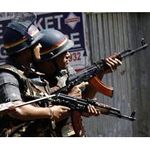
As columns of smoke rose from the Italianate dome of the Taj Mahal hotel in downtown Mumbai on Wednesday night, I came upon a woman standing a short distance away from the building, waiting for her friends trapped inside. She’d just ordered a steak when she heard gunfire as terrorists stormed through the establishment. The woman, who had been rescued through a window by the fire brigade after hours of hiding under a table, said that her name was Dalbir Bains. I recognised it from the society pages of the newspapers. She’s the owner of a fancy lingerie store in the beachside neighbourhood of Juhu, and, amidst the chatter of gunfire, I found myself involved in a brief discussion about edible underwear. Everything that evening had been surreal.
more from TNR here.
tofucken!
The Ethiopian cooks had two antelopes brought in from the zoo. They gutted, skinned, and roasted them in spices and butter. Twenty turkeys — stuffed with herbs and bread — were thrust into the antelopes and the empty crevasses filled with hundreds of hardboiled eggs. A bleating camel, feeling something sinister in the room, was soon slaughtered as well, his innards replaced with the antelopes, whose innards had been replaced with the turkeys and eggs, whose innards had been replaced with breads, spices, herbs, and fish. And the Emperor of Ethiopia ate only just a little. Bawdy, exorbitant, unethical. In the most mythic banquets, everything is permitted, nothing impossible. Mile-high desserts carved to resemble palaces, grapes served upon platters of young boys, vomit buckets. But aside from the slaves, drunkenness, and orgies, it is perhaps the dining upon outrageously prepared animals — much like the stuffed camel Bohumil Hrabel describes in I Served the King of England — that is most…indelible. Heliogabalus enjoyed ostrich brains and eels fattened with Christians. The Emperor Vitellius once served a dish including flamingo tongues and lamprey milt in the name of Minerva. Hampton Court under Henry VIII was often the stage for feasts of whale, peacock beaks, and the ever-popular flaming boar’s head. No organ was left unturned. The home version of this is the Turducken…
more from Table Matters here.
Don’t Wet-Brine Your Turkey. Do Stir-Fry Your Sweet Potatoes
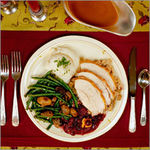
It’s already Christmas in print—this week, the mailman started delivering frost-kissed, cookie-strewn, tinseled December issues of my food magazines. But online, the media are content to let November persist until at least Thursday with lavish guides to the biggest eating holiday of the year. The Thanksgiving food advice on the Web is plentiful, copiously illustrated with videos and slide shows, and, best of all, free. I’ve sorted through the avalanche of online guidance and compiled a digest of cyber-Thanksgiving with trends of note—and the recipes that stand out as probable winners. The biggest turkey trend this year is a push-back against wet brining, which the gastronomic press corps has promoted enthusiastically for the past decade or so.
more from Slate here.