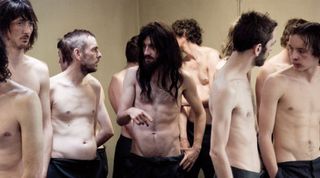
Careful What You Wish For: Two novelists portray the allure—and limitations—of liberation

More here.

Anchorage Daily News: Obama for President

Palin’s rise captivates us but nation needs a steady hand.

Editorial in Alaska’s own ADN:

Screenhunter_08_oct_28_1119Sen. McCain describes himself as a maverick, by which he seems to mean that he spent 25 years trying unsuccessfully to persuade his own party to follow his bipartisan, centrist lead. Sadly, maverick John McCain didn’t show up for the campaign. Instead we have candidate McCain, who embraces the extreme Republican orthodoxy he once resisted and cynically asks Americans to buy for another four years.

It is Sen. Obama who truly promises fundamental change in Washington. You need look no further than the guilt-by-association lies and sound-bite distortions of the degenerating McCain campaign to see how readily he embraces the divisive, fear-mongering tactics of Karl Rove. And while Sen. McCain points to the fragile success of the troop surge in stabilizing conditions in Iraq, it is also plain that he was fundamentally wrong about the more crucial early decisions. Contrary to his assurances, we were not greeted as liberators; it was not a short, easy war; and Americans — not Iraqi oil — have had to pay for it. It was Sen. Obama who more clearly saw the danger ahead.

The unqualified endorsement of Sen. Obama by a seasoned, respected soldier and diplomat like Gen. Colin Powell, a Republican icon, should reassure all Americans that the Democratic candidate will pass muster as commander in chief.

More here.  [Thanks to Tasnim Raza and Shiko.]

Hitchens on Sarah Palin’s War on Science

The GOP ticket’s appalling contempt for knowledge and learning.

Christopher Hitchens in Slate:

Screenhunter_07_oct_28_1107In an election that has been fought on an astoundingly low cultural and intellectual level, with both candidates pretending that tax cuts can go like peaches and cream with the staggering new levels of federal deficit, and paltry charges being traded in petty ways, and with Joe the Plumber becoming the emblematic stupidity of the campaign, it didn’t seem possible that things could go any lower or get any dumber. But they did last Friday, when, at a speech in Pittsburgh, Gov. Sarah Palin denounced wasteful expenditure on fruit-fly research, adding for good xenophobic and anti-elitist measure that some of this research took place “in Paris, France” and winding up with a folksy “I kid you not.”

It was in 1933 that Thomas Hunt Morgan won a Nobel Prize for showing that genes are passed on by way of chromosomes. The experimental creature that he employed in the making of this great discovery was the Drosophila melanogaster, or fruit fly. Scientists of various sorts continue to find it a very useful resource, since it can be easily and plentifully “cultured” in a laboratory, has a very short generation time, and displays a great variety of mutation. This makes it useful in studying disease, and since Gov. Palin was in Pittsburgh to talk about her signature “issue” of disability and special needs, she might even have had some researcher tell her that there is a Drosophila-based center for research into autism at the University of North Carolina. The fruit fly can also be a menace to American agriculture, so any financing of research into its habits and mutations is money well-spent. It’s especially ridiculous and unfortunate that the governor chose to make such a fool of herself in Pittsburgh, a great city that remade itself after the decline of coal and steel into a center of high-tech medical research.

More here.

The Met showcases a sneaky Morandi

Our own Morgan Meis in The Smart Set:

Screenhunter_06_oct_28_1057By the time Giorgio Morandi discovered himself as an artist he had reduced his universe to a handful of things. These were primarily bottles, tins, jugs, vases, and a few bowls. In a pinch, Morandi was perfectly happy with two tins and a vase. He would arrange the three things and then paint them. Generally he stuck to a muted palate: grays and beige, an overall preponderance of brown. Even when Morandi used brighter colors it still seemed like brown dressing up in drag for the occasion. His paintings do the opposite of pop. They simmer. They wait for you to come to them.

If Morandi painted his two tins and vase in an arrangement one day, he would move the vase a few inches and paint them anew the next. These minute transformations amazed Morandi. He didn’t need anything more. A slight change in the light, a subtle shift in direction, and his world of three things was forever fresh and new.

By all rights, these ought to be the most boring paintings in history. Nothing happens in them. His works aren’t quite abstract and so do not have the formal freedom to impress us with proportion and color as Mondrian’s can, or a wildness in pure movement and action as Pollock’s can. They aren’t full-bodied realism, either, and so cannot show us the richness of fruits and flowers and so forth of traditional still lifes, nor the striking still life deconstructions of someone like Cezanne. Morandi is content to do as close to nothing as a painter can do. He sits at his easel, year after year, shifts his two tins and the one damn vase, and then paints the scene in his own special vision of muted brownness.

Yet, these are extraordinarily beautiful and moving paintings.

More here.

Countdown to the Obama Rapture

Jack Shafer in Slate:

Screenhunter_04_oct_28_1008With the election just a week away and Barack Obama pulling away from John McCain, tiny tendrils of trepidation are starting to drift over the liberal members of the commentariat and the political press corps.

If McCain wins, ample boilerplate exists from which to form their disposable Wednesday, Nov. 5, stories about his victory: “He took risks and they paid off … courage of his convictions … left for dead one time too many … the pundits eat crow … how could the pollsters have gotten it so wrong—again! … Will his White House harbor Straight Talk or double talk?”

But if Obama wins, these scribes know that they’ll be facing the toughest assignment of their careers. They’ve all oversubscribed to the notion that Obama’s candidacy is momentous, without parallel, and earth-shattering, so they can’t file garden-variety pieces about the “winds of change” blowing through Washington. They’re convinced that not only the whole world will be reading but that historians will be drawing on their words. Will what I write be worthy of this moment in time? they’re asking themselves. It’s a perfect prescription for performance anxiety.

More here.

Love, Sex and the Changing Landscape of Infidelity

From The New York Times:

If you cheated on your spouse, would you admit it to a researcher?

Marriage That question is one of the biggest challenges in the scientific study of marriage, and it helps explain why different studies produce different estimates of infidelity rates in the United States. Surveys conducted in person are likely to underestimate the real rate of adultery, because people are reluctant to admit such behavior not just to their spouses but to anyone. In a study published last summer in The Journal of Family Psychology, for example, researchers from the University of Colorado and Texas A&M surveyed 4,884 married women, using face-to-face interviews and anonymous computer questionnaires. In the interviews, only 1 percent of women said they had been unfaithful to their husbands in the past year; on the computer questionnaire, more than 6 percent did.

At the same time, experts say that surveys appearing in sources like women’s magazines may overstate the adultery rate, because they suffer from what pollsters call selection bias: the respondents select themselves and may be more likely to report infidelity. But a handful of new studies suggest surprising changes in the marital landscape. Infidelity appears to be on the rise, particularly among older men and young couples. Notably, women appear to be closing the adultery gap: younger women appear to be cheating on their spouses nearly as often as men.

More here.

Poll Power

Scott Keeter in the Wilson Quarterly:

Screenhunter_03_oct_28_0943New Hampshire gave new life to many nagging doubts about polling and criticisms of its role in American politics. Are polls really accurate? Can surveys of small groups of people give a true reading of what a much larger group thinks? What about bias? Don’t pollsters stack the ­deck?

At a deeper level, the unease about polling grows out of fears about its impact on democracy. On the strength of exit polls in the 1980 presidential election, for example, the TV networks projected a Ronald Reagan victory—and Jimmy Carter conceded—even though people in the West still had time to vote. Critics charged that this premature call may have literally stopped some westerners from taking the trouble to cast their ballots. There is also a more generalized suspicion that polls (and journalists) induce political passivity by telling Americans what they think. As the New Hampshire story unfolded on January 8, former television news anchor Tom Brokaw seemed to have this idea on his mind when he said, with a bit of exasperation, that professional political observers should simply “wait for the voters” instead of “making judgments before the polls have closed and trying to stampede, in effect, the process.”

At the same time, some worry that polls put too much power in the hands of an uninformed public, and that they reduce political leaders to slavish followers of public opinion. In the White House, efforts to systematically track public opinion date back to the dawn of modern polling, during the administration of Franklin D. Roosevelt, and nobody seems to get very far in American politics today without a ­poll-­savvy Dick Morris or Karl Rove whispering in his or her ­ear.

But while there may be reason to worry about the public’s political competence, a far more serious threat to democracy arises from the large disparities in income, education, and other resources needed to participate effectively in politics. Compared with most other Western democracies, the United States has a more pronounced class skew in voter turnout and other forms of political participation, with the affluent much more politically active than those who are less well off. This uneven distribution of political engagement is what makes public-opinion polls especially valuable. Far from undermining democracy, they enhance it: They make it more democratic.

More here.

UCLA researchers use Scotch tape to produce X-rays

Thomas H. Maugh II in the Los Angeles Times:

Screenhunter_02_oct_28_0919In an unexpected finding that could have applications in medicine and elsewhere, UCLA researchers have found that unspooling a simple roll of Scotch tape produces X-rays — enough to produce clear images of their fingers.

The discovery could eventually lead to, among other things, compact X-ray sources that could be used for treating cancer, according to a study published Thursday in the journal Nature.

Although the researchers suspected that the process might produce X-rays, they were astounded by their intensity and duration, said Seth Putterman, a UCLA physicist and lead author of the study. “We’re marveling at Mother Nature.”

The phenomenon is known as triboluminescence and is similar to what causes sparks of light to be emitted when one bites on wintergreen-flavored LifeSavers in the dark. The process is not entirely understood but may involve, in part, a separation of charges during the rubbing of two materials together or the separation of the tape.

More here.  [Thanks to Winfield J. Abbe.]

Monday, October 27, 2008

Bollywood in Fact and Fiction

by Liz Mermin

LizWhen I was asked two summers ago if I’d like to make a documentary on “Bollywood,” I thought: melodramatic love stories, endless musical numbers, glittery kitsch… not my thing.  Six months later I was at a trendy café in Mumbai listening to a vigilante cop once known as “Bombay’s Dirty Harry” extol the virtues of P. G. Wodehouse and Jodie Foster. ‘Truth is stranger than fiction’ is a cliché documentary filmmakers take seriously, but when the fiction in question is Bollywood, it’s quite a challenge.  Except in Bombay.

That documentary has just been broadcast and is about to come out on DVD, so it seems as good a time as any to reflect on the madness of it all.   If you aren’t familiar with this story, please pay attention, because it’s complicated.  The Bollywood film we chose to focus on for the documentary was called “Shootout at Lokhandwala”: a star-studded, highly-dramatized retelling of an incident that took place in 1991 in a middle-class housing complex in the Bombay suburbs, in which seven alleged gangsters and over 400 cops spent four and a half hours in the middle of the afternoon shooting at each other.  At the end of the day the seven gangsters (or in some versions, six gangsters and one hostage) were dead.  There were some at the time who suggested that the police reaction might have been a bit heavy-handed, but for the most part the media treated the incident as a victory for law and order, and the lead officer, A. A. Khan, as a hero.  (Khan later wrote a book about the incident, sprinkled with quotes about justice from, among others, Tennyson, Emerson, and Martin Luther King.)

Sib The film had a lot going for it, by Bollywood standards: a dramatic story, a huge star cast, a hot young director, and a production house famous for edgy fare (as well as, if one believed the rumours, more than a passing acquaintance with the underworld).  But there was a problem.  The actor playing the lead role of A. A. Khan, superstar Sanjay Dutt, was on trial for weapons possession, in connection with the largest terrorist attack in India’s history, and could at any point be sent to jail.

It started in 1993, when Dutt allegedly received some weapons (three AK-56 rifles, a few dozen hand grenades, and a pistol) from a notorious gangster with close ties to the film industry.  He said at the time that he needed the weapons for self-defense, because his father – a beloved film-star turned MP – had been helping Muslim riot victims, and as a result Hindu nationalists were threatening the family.  Shortly after Dutt received the weapons, a series of bomb-blasts ripped through Bombay, killing over 250 people and injuring 700 more.  Dutt’s weapons suppliers were alleged to be behind the blasts, and the film star became one of the 125 accused in what would become the longest trial in India’s history.

Over the next fourteen years, although (or because) Dutt was in and out of jail, his career took off.  He made over 50 films – the most successful being one in which he plays a gold-hearted gangster who receives ethics lessons from Mahatma Gandhi’s ghost.  The fact that the star might be sent to jail at any moment didn’t stop the industry’s top producers from signing him, possibly because his predicament seemed to deepen the devotion of his fans, who were convinced that he was the victim of political machinations.  But just as “Shootout” was going into production, verdicts came down: Dutt was acquitted of terror charges, but convicted of weapons possession.  The judge granted him provisional bail in dribs and drabs while he awaited sentence, requiring him to report to court almost every week; and the filmmakers had to get “Shootout” in the can before their star was put away.

It turns out that nothing is easy in Bollywood, and what should have been a cake-walk to fame and fortune for the unproven young director and his team became a test of patience and strategic ingenuity.  Shots and reverse shots were filmed weeks, even months apart, with ample use of body doubles.  Scenes that should have been shot in three days were completed in three hours.  Sets went up and down so quickly you couldn’t be sure they’d ever been there.  And while hundreds of technicians frantically embedded thousands of tiny explosives in the walls of the fake housing complex, the vigilante cop and the convicted film star palled around. “I suppose he got carried away,” Khan said, when I asked how he felt about Dutt’s troubles with the law.  Dutt himself looked surprisingly vulnerable, with sad matinee eyes that could melt any heart – though not, it would turn out, that of the judge.

If this is your reality, why would you turn to fiction?

The scary thing about documentaries is you never know how your story will end: would they finish the film? Would it be a hit or a flop? Would Dutt go to jail? If you’re interested in finding out, the documentary – called “Shot in Bombay”is playing at the MIAAC film festival in New York on Nov 8 and is coming out on DVD in Europe.  And if you’d like to see how Bollywood turns a four hour shootout into twenty minutes of hand-to hand combat, ending with a gooey impalement, you might check out “Shootout at Lokhandawala” – also playing at MIAAC.

Liz Mermin is a documentary filmmaker.

Sunday, October 26, 2008

Culture and “Quantum”

Pwonlinequantum1 Robert Crease in Physics World:

Its name is Quantum Cloud. Visitors to London cannot miss it when visiting the park next to the Millennium Dome or taking a cruise along the Thames. It rises 30 m above a platform on the banks of the river, and from a distance looks like a huge pile of steel wool. As you draw closer, you can make out the hazy, ghost-like shape of a human being in its centre. It is a sculpture, by the British artist Antony Gormley, made from steel rods about a metre and a half long that are attached to each other in seemingly haphazard ways. Framed by the habitually grey London sky, it does indeed look cloud-like. But “quantum”?

The word quantum has a familiar and well-documented scientific history. Max Planck introduced it into modern discourse in 1900 to describe how light is absorbed and emitted by black bodies. Such bodies seemed to do so only at specific energies equal to multiples of the product of a particular frequency and a number called h, which he called a quantum, the Latin for “how much”. Planck and others assumed that this odd, non-Newtonian idea would soon be replaced by a better explanation of the behaviour of light.

No such luck. Instead, quantum’s presence in science grew. Einstein showed that light acted as if it were “grainy”, while Bohr incorporated the quantum into his account of how atomic electrons made unpredictable leaps from one state to another. The quantum began cropping up in different areas of physics, then in chemistry and other sciences. A fully fleshed out theory, called quantum mechanics, was developed by 1927.

Less familiar and well documented, though, is quantum’s cultural history. Soon after 1927 the word, and affiliated terms such as “complementarity” and “uncertainty principle”, began appearing in academic disciplines outside the sciences. Even the founders of quantum mechanics, including Bohr and Heisenberg, applied such terms to justice, free will and love. Quantum has made unpredictable leaps to unexpected places ever since. The next James Bond film, for example, is to be called Quantum of Solace.

Salt doesn’t dissolve in oil, silly

Herve364 Rob Mifsud talks to Hervé This, in The Globe and Mail:

Trained as a physical chemist, Dr. This is the godfather of molecular gastronomy, the emerging discipline of understanding the physical and chemical structure of food and the scientific processes of cooking.

Naysayers accuse him of tarnishing culinary traditions, but to Michelin three-star chefs such as Spain’s Ferran Adria and Paris’s Pierre Gagnaire, he’s a guru. Molecular Gastronomy: Exploring the Science of Flavor and Kitchen Mysteries: Revealing the Science of Cooking, the first of his books to be released in English, set out to make kitchen science accessible to the lay cook. We talked to him about distilling countless napkins’ worth of experimental results into practical advice on how to prepare meltingly tender meat and why all you need is a good oven.

The term “molecular gastronomy” is now associated with chefs like Ferran Adria, but you disagree with that usage. Why?

They are doing molecular cooking. The truth is that molecular gastronomy is science, molecular cooking is cooking, and chefs are not scientists.

What equipment do you consider essential for home cooks?

A good oven, certainly. Induction is fine, because induction is more efficient than a gas stove. That’s all.

The Roar of Justice

Adam Kirsch reviews Raymond Geuss’s Philosophy and Real Politics, in City Journal:

Raymond Geuss, a political philosopher who teaches at the University of Cambridge, does not seem like the kind of man who would try to devour his opponents. But his intention in Philosophy and Real Politics, his short, sharp new book, is the same as Thrasymachus’s: to introduce a note of realism into contemporary philosophical debates about justice, by force if necessary. “I object to the claim that politics is applied ethics,” he writes in his introduction. Rather than starting out, like Socrates, with questions about the good or the just, we should ask the question famously posed by Lenin: “Who whom?” That is, in any actual society, who has power, what do they use it for, and who suffers as a result? “To think politically,” writes Geuss, “is to think about agency, power, and interests, and the relations among these.”

Of course, this is hardly an unprecedented approach to political philosophy. In addition to Lenin, Geuss invokes Hobbes, Nietzsche, and Max Weber as teachers in his hard-headed analysis of power. But Geuss’s perspective is especially needed today, he believes, because American political thought is dominated by what he sees as the uselessly abstract neo-Kantian theories of Robert Nozick and especially John Rawls. These thinkers commit what Geuss views as the cardinal sin of political thought: they begin not by addressing the concrete power relations of their societies, but by speculating at will about imaginary concepts like rights and fairness.

Derek Walcott and Seamus Heaney Do Opera

Dheaney_385x185_411245a Andrew Billen in The Times:

If, a couple of Mondays ago, on your way to pay your council tax at Woolwich town hall you happened to get lost and found yourself in its basement, you would have chanced upon not one but two winners of the Nobel Prize for Literature. Seamus Heaney, the English language’s most-read living poet, should surely, I thought, be digging a sod somewhere or debating poetry over a Guinness. And, even at 78, his fellow grand old man of letters, the Caribbean author Derek Walcott, would have looked more himself striding from the waves on to one of the St Lucian beaches evoked in his great poem, Osmeros.

But here the two friends were in southeast London, scruffy jackets, crumpled brief-cases at their feet, up to their ears in a project that in itself sounds like a game of Consequences: an opera adapted from Heaney’s The Burial at Thebes, a version of Sophocles’ Antigone, to be directed by Walcott and staged at Shakespeare’s Globe. It is the Globe’s first opera, the first opera Walcott has directed and about the seventh Heaney will have ever been to.

The poets were having fun, or at least the thrice-married Walcott was, flinging his arms round his Antigone, the German singer Idit Arad, who remarked, in praise of Heaney, how unusual it was to sing arias containing thoughts more complex than “I love you, I love you. Don’t leave me, don’t leave me.” Heaney confined himself to reminding Brian Green, singing the part of the tyrant Creon, not to rely on the Faber edition of The Burial at Thebes, as he had changed some lines for the libretto.

The conductor, Peter Manning, whose company is producing the piece, eventually called lunch, and the laureates and I retired to a room where a dancer was rehearsing. As he flew around the space, we sat on plastic chairs, a pile of M&S sandwiches behind us.

Heaney seemed to regard this operafication of The Burial at Thebes as a fait accompli. Eighteen months ago, he had received a letter from the composer Dominique Le Gendre saying that she and Manning intended making an opera of his 2004 reworking of Sophocles’ tragedy of personal versus civic duty. He did not like to object, especially since Walcott was committed and he had long wanted Heaney to write a play he could direct.

Al Qaeda Endorses John McCain

Robert Dreyfuss in The Nation:

The Post today reports that Al Qaeda has endorsed John McCain for president. With seemingly impeccable logic, the cave dwellers — actually, more likely, Quetta-squatters — say that by electing McCain, the United States will commit itself to an extension of President Bush’s blunders and thus exhaust itself militarily and financially.

Of course, Al Qaeda says that the way it can assist McCain is through a terrorist act that will rally Americans to his side.

Saying that McCain will continue the “failing march of his predecessor,” Al Qaeda added:

“Al-Qaeda will have to support McCain in the coming election. … [We] will push the Americans deliberately to vote for McCain so that he takes revenge for them against al-Qaeda. Al-Qaeda then will succeed in exhausting America.”

The quotes came from an AQ-linked website called al-Hesbah and were written by Muhammad Haafid, a longtime contributor to the site.

Conspiracy theorists, along with pessimists and Cassandras on the left, will no doubt see in those words an imminent fatal blow to the Obama campaign in the form of a looming attack that would shift the electoral dynamic. I wouldn’t worry. If the cave-dwellers and Quetta-squatters could attack the United States, they would have done it by now. I suppose its remotely possible that Al Qaeda types might blow something up, but there isn’t a chance in the world that in the next two weeks they can do anything that could shift the election. In fact, by stepping up attacks in Pakistan and Afghanistan, where Al Qaeda does indeed have some actual ability to kill people, the organization will only add to Obama’s arguments that the Bush-McCain policies have failed.

Return of the visionary

From The Guardian:

A Mercy by Toni Morrison reviewed by Tim Adams

Toni460x276_2 Since winning the Nobel Prize in 1993, Morrison has, not altogether reluctantly, taken on the voice of America’s conscience. After the marvels of empathy that were Beloved and, to a lesser extent, Jazz, that public voice has grown – she has sometimes seemed a spokeswoman rather than a writer – and the voice of her novels has become sparer. In this book, a good deal of Morrison’s stark, almost biblical imaginative power is on display, without all of her former detailing energy. Nathaniel Hawthorne has become her model in some ways; like him, she is capable of creating fictional environments in which everything can come to seem symbolic. Portentous is not always a comfortable tone, but in the coming American weeks it may well be the appropriate one. The first line of A Mercy? ‘Don’t be afraid.’

More here.

Minding Her Manners: The not-always-decorous life of Emily Post

Amanda Vaill in The Washington Post:

EMILY POST: Daughter of the Gilded Age, Mistress of American Manners By Laura Claridge

Post_2 It was in part to make that world more hospitable to others that Post embarked on her magnum opus, Etiquette: In Society, in Business, in Politics, and at Home, in which she declared that “charm of manner . . . and instinctive consideration for the feelings of others, are the credentials by which society the world over recognizes its chosen members.” Despite the book’s “glacial prose” and a morality-play dramatis personae that included such characters as the Toploftys, the Kindharts, Mrs. Bobo Gilding and the Richan Vulgars, Claridge argues that Etiquette’s emphasis on manners over money places it in a “triumvirate of the modern moment,” with Sinclair Lewis’s Babbitt and Edith Wharton’s Age of Innocence. By the 1930s it had sold over a million copies, and its author had become a brand name, with a syndicated newspaper column and radio show, all of which she had engineered on her own initiative (and often without the help of an agent). The book remained on bestseller lists through World War II and the social changes that followed; and although attempts to extend her reach to television were (in the words of her grandson and manager) “a disaster,” Post’s influence and activity continued well into the 1950s: The last edition of Etiquette overseen by its author was published in 1955, and the book has never gone out of print.

Much of Claridge’s narrative is devoted to an examination of Post’s career, and accounts of contractual negotiations — not to mention tallies of sales and circulation figures, exegeses of revisions and lengthy quotes from reviews — don’t always make for compelling reading. Such details do, however, provide a measure of the ways in which a girl who just wanted to be a worthy heir to her father turned herself into one of the most powerful women in America, second only to Eleanor Roosevelt, according to a 1950 poll of women journalists. They also show how (as Claridge puts it) Post’s Etiquette was “a cultural history of her nation.”

In 1960 — having lived through the introduction of the telephone, automobile, airplane, radio and television — Emily Post died politely in her bed. “Just over two weeks later,” Claridge tells us, “during a General Assembly meeting at the United Nations, Comrade Nikita Khruschchev removed his shoe and banged it on the table.” As Life magazine asked, “What Would Emily Post Have Said?” ·

More here.

Sunday Poem

///
The Physiology of Kisses
Tony Hoagland

The kiss begins……………in the center of the belly
and travels upwards……  through the diaphragm and
throatalong fine filaments…………which no forensic scientist
has ever been able to find.

From the hard flower………of the kisser’s mouth,
the kisses leave the body……   in single file,
into the reciprocal mouth…  of the kiss-recipient,
which for me is Kath.

What can I say? My kisses make her happy and I need that.
And sometimes, bending over her,
I have the unmistakable impression
………………   .that I am watering a plant.

gripping myself softly………by the handle,
tilting my spout……………… forward
pouring what I need to give
………………into the changing shape of her thirst.

I keep leaning forward………   to pour out
what continues to rise up
from the fountain……………of the kisses
which I, also, …………… am drinking from.

//