The heat in Max Butler's safe house was nearly unbearable. It was the equipment's fault. Butler had crammed several servers and laptops into the studio apartment high above San Francisco's Tenderloin neighborhood, and the mass of processors and displays produced a swelter that pulsed through the room. Butler brought in some fans, but they didn't provide much relief. The electric bill was so high that the apartment manager suspected Butler of operating a hydroponic dope farm.
But if Butler was going to control the online underworld, he was going to have to take the heat. For nearly two decades, he had honed his skills as a hacker. He had swiped free calls from local telephone companies and sneaked onto the machines of the US Air Force. Now, in August 2006, he was about to pull off his most audacious gambit yet, taking over the online black markets where cybercriminals bought and sold everything from stolen identities to counterfeiting equipment. Together, these sites accounted for millions of dollars in commerce every year, and Butler had a plan to take control of it all.
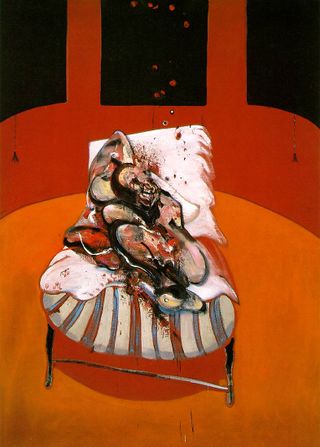
For Bacon, a chronic asthmatic, the struggle began early: it was the struggle for breath itself. The second son of a bad-tempered military man-turned-horse breeder and the heiress to a Sheffield steel fortune, he was brought up in Ireland and England in a succession of big houses where the omnipresence of dogs and horses was a perpetual challenge to his well-documented will to live. Bacon senior made no secret of his disappointment in his sickly, sensitive son, whose party piece was to appear at family gatherings in full drag. Michael Peppiatt is one among many writers on Bacon to make the connection, in his absorbing biography Francis Bacon: Anatomy of an enigma (1995, now revised, updated and reissued by Constable in paperback), between the father’s screaming rages, the child’s gasping for air and the importance of the gaping mouth in the work of the mature artist. The killings and house-burnings of the Irish uprising and Civil War (“Violence upon the roads; violence of horses”, in Yeats’s words) formed the backdrop to Bacon’s childhood, further enlivened by the attentions of the grooms who were encouraged to take horsewhips to the young master to punish him for the attentions he was over-fond of paying them.
Three of his four siblings died premature deaths, but Francis would enjoy long life, vigorous appetites and legendary resilience, physical and psychological. Ejected from the family at sixteen, he soon discovered the resourcefulness and the hunger for risk that would sustain him both as a homosexual adventurer and a painter, along with his preferred modus vivendi: to lurch between opulence and squalor, between a punishing creative routine and an equally punitive, if delighted (and delightful), dissipation.
Well, it's pretty simple. There are three things we need to do. One is fairly easy and the other two get harder. One is back off on this commitment to ethanol, reduce the subsidies we're giving– it's about 51 cents a gallon now– and cut out the tariffs on importing ethanol from Brazil. They can produce it more efficiently, and basically we're protecting our market by keeping that ethanol out.
The next thing we have to do is a little more complicated. The other reason for this increase in food prices, and it's related, is the high price of oil. If the food economy is as dependent on oil as I'm suggesting, we need to get the food economy off of fossil fuel and back onto the sun. We have to in effect “re-solarize” our food chain by getting animals off of feedlots, where they are eating grain and competing with people for grain.
We need to develop organic agriculture, which helps sequester carbon and reduces the need for fossil fuel in the form of synthetic fertilizers. We need to move towards a more sustainable, more solar-based agriculture. That will take a lot of price pressure off, because so much of the underlying, expensive input in agriculture is oil. So you have a situation today where SUVs in America are competing with eaters around the rest of the world for good food and arable land. You can imagine who's going to win.
The world was very different when a distinguished philosopher could say, as St. Thomas Aquinas did, “the existence of God can be proved in five ways.” Contemporary Christian philosophers often content themselves with pulling up the drawbridge and manning the barricades, rather than crusading against the infidel. Alvin Plantinga, perhaps the most eminent living philosopher of religion, devotes the five hundred pages of his Warranted Christian Belief to fending off objections to either the truth or rationality of belief in traditional Christian doctrines. He does not argue for the existence of God, and still less for the truth of Christianity; rather, his main question is whether a reasonable person who finds herself with firm religious convictions should change her mind. Plantinga is not trying to persuade Dawkins and company to change their minds.
The traditional arguments for God’s existence are very much worth our attention, though, for at least three reasons: they are of great intrinsic interest; popular discussions of them often fail to pin down their defects; and one argument, the “design argument,” has had a new lease on life as the intellectual underpinning of the intelligent design movement.
Joseph Stiglitz in Daily News Egypt (via Economist's Voice):
Many in the developing world have benefited greatly from the last boom, through financial flows, exports, and high commodity prices. Now, all of that is being reversed. Indeed, it is the ultimate irony that money is now flowing from poor and well-managed economies to the US, the source of the global problems.
The point of reciting these challenges facing the world is to suggest that, even if Obama and other world leaders do everything right, the US and the global economy are in for a difficult period. The question is not only how long the recession will last, but what the economy will look like when it emerges.
Will it return to robust growth, or will we have an anemic recovery, à la Japan in the 1990’s? Right now, I cast my vote for the latter, especially since the huge debt legacy is likely to dampen enthusiasm for the big stimulus that is required. Without a sufficiently large stimulus (in excess of 2 percent of GDP), we will have a vicious negative spiral: a weak economy will mean more bankruptcies, which will push stock prices down and interest rates up, undermine consumer confidence, and weaken banks. Consumption and investment will be cut back further.
Many Wall Street financiers, having received their gobs of cash, are returning to their fiscal religion of low deficits. It is remarkable how, having proven their incompetence, they are still revered in some quarters. What matters more than deficits is what we do with money; borrowing to finance high-productivity investments in education, technology, or infrastructure strengthens a nation’s balance sheet.
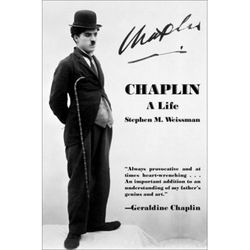
The story of Chaplin's life is well-known, or at least, it is thought to be: The hellish Victorian upbringing and terrifying poverty, the lightning, apparently inexorable rise of the vaudeville protege, the journey to America, the early involvement in the one-reeler movies and then the dizzying ascent to superstardom and legendary status. Also, the notorious promiscuity throughout his prime years, improbably settling down to belated domesticity and enduring happiness in late-middle age with what was, in effect, a child bride; the principled and courageous defiance and condemnation of fascism and Nazism, and then the utterly naive soft spot for communism and Stalin. However, psychiatrist Stephen Weissman shines a fresh and fascinating light on all these things so it is as if we are learning them all anew.
Here at last is a showbiz biography that is not just a tired collection of superficial press clippings. Here is a psychological study of a major artist delivered without pretension, jargon or absurdity – three curses that poor Orson Welles has attracted in especial intensity. Dr. Weissman tells a riveting story delivered like a good dry martini – in perfect proportion, just right. It is also a story filled with surprises: Chaplin did not have a Jewish father. His father, Charlie Chaplin Sr., was a brief minor star of the English Victorian music hall in London who burned out fast and died of drink. Dr. Weissman convincingly argues Charlie's classic drunk slapstick routines as The Tramp were inspired directly by observation of his poor, permanently inebriated father.
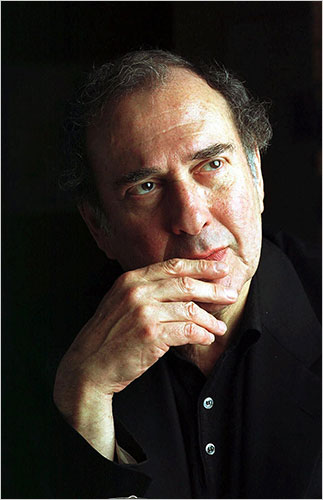
Harold Pinter, who has died at the age of 78, was the most influential, provocative and poetic dramatist of his generation. He enjoyed parallel careers as actor, screenwriter and director and was also, especially in recent years, a vigorous political polemicist campaigning against abuses of human rights. But it is for his plays that he will be best remembered and for his ability to create dramatic poetry out of everyday speech. Among the dramatists of the last century, Beckett is his only serious rival in terms of theatrical influence; and it is a measure of Pinter's power that early on in his career he spawned the adjective “Pinteresque” suggesting a cryptically mysterious situation imbued with hidden menace.
Pinter was born into a Jewish family in the London borough of Hackney. His grandparents were Jews who had fled persecution in Poland and Odessa. His father, Jack, was a hard-working tailor whose own family had artistic leanings: his mother, Frances, came from a convivial, extrovert and spiritually sceptical clan. And it was not difficult to trace in Pinter's own complex personality elements from both sides of the family. He balanced his father's faintly authoritarian nature with his mother's instinctive generosity.
Pinter was an only child: as a boy, he conducted conversations in the back garden with imaginary friends. But such circumstances conspired to give him a sense of solitude, separation and loss: the perfect breeding-ground for a dramatist. He was evacuated to Cornwall at the age of nine where he became aware of the cruelty of schoolboys in isolation. Back in London during the Blitz, he also absorbed the dramatic nature of wartime life: the palpable fear, the sexual desperation, the genuine sense that everything could end tomorrow. All this fed into his work as a writer: his memories of wartime London led to a particularly vivid 1989 screen adaptation of Elizabeth Bowen's The Heat of the Day.
Believe it or not, stuff happened that had nothing to do with the presidential election, gas prices or Michael Phelps. Not that you'd have an easy time sifting through all the media debris to find the information that actually meant something.
With so many distractions, you probably didn't hear that using Facebook makes you a better employee, or that drinking wine can help you avoid lung cancer, or that doing tai chi makes life easier for asthmatics. (Unless you do it in a public park wearing something approximating pajamas, of course. Then you just look silly.)
For those and other warm, delicious infomuffins, we humbly present our list of stuff you know this year that you didn't know this time last year. Feel free to unleash these at your New Year's Eve party:
1. Dogs appear to experience jealousy and pride. Previously, only humans and chimpanzees were thought to suffer those emotions.
2.Two pounds of a dried plant that turned out to be the oldest marijuana in the world was discovered in a 2,700-year-old grave in the excavated Yanghai Tombs in the Gobi Desert. The cannabis was found near the head of a blue-eyed, 45-year-old shaman among other objects intended for use in the afterlife.
3.Starch grains embedded in plaque on the teeth of early Peruvians show they had a more varied diet than previously believed, including beans and a local fruit known as pacay that indicate they had settled into farming long before we thought they had.
5. Puerto Rican anole lizards perform push-ups and unfurl their dewlaps, the flaps of skin beneath their chins, to grab the attention of others when the forest is noisy.
Mel Gussow and Ben Brantley in the New York Times:
Harold Pinter, the British playwright whose gifts for finding the ominous in the everyday and the noise within silence made him the most influential and imitated dramatist of his generation, died on Wednesday. He was 78 and lived in London.
The cause was cancer, his wife, Lady Antonia Fraser, said Thursday.
Mr. Pinter learned he had cancer of the esophagus in late 2001. In 2005, when he received the Nobel Prize in Literature, he was unable to attend the awards ceremony at the Swedish Academy in Stockholm but delivered an acceptance speech from a wheelchair in a recorded video.
In more than 30 plays — written between 1957 and 2000 and including masterworks like “The Birthday Party,” “The Caretaker,” “The Homecoming” and “Betrayal” — Mr. Pinter captured the anxiety and ambiguity of life in the second half of the 20th century with terse, hypnotic dialogue filled with gaping pauses and the prospect of imminent violence.
Along with another Nobel winner, Samuel Beckett, his friend and mentor, Mr. Pinter became one of the few modern playwrights whose names instantly evoke a sensibility. The adjective Pinteresque has become part of the cultural vocabulary as a byword for strong and unspecified menace.
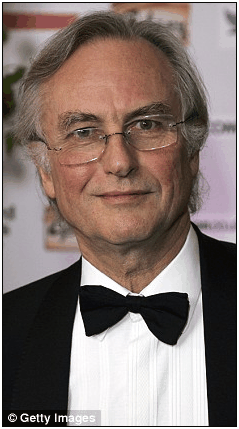
Scientist and atheist Richard Dawkins has admitted he does celebrate Christmas – and enjoys singing traditional Christmas carols each festive season.
The writer and evolutionary biologist told singer Jarvis Cocker that he happily wishes everyone a Merry Christmas – and used to have a tree when his daughter was younger.
Dawkins, one of the most famous atheists in the world, was interviewed by Sheffield born Cocker when he stepped in as a Christmas guest editor on Radio Four's Today programme.
'I am perfectly happy on Christmas day to say Merry Christmas to everybody,' Dawkins said. 'I might sing Christmas carols – once I was privileged to be invited to Kings College, Cambridge, for their Christmas carols and loved it.
'I actually love most of the genuine Christmas carols. I can't bear Jingle Bells and Rudolph the Red Nosed Reindeer and you might think from that that I was religious, that I can't bear the ones that make no mention of religion. But I just think they are dreadful tunes and even more dreadful words. I like the traditional Christmas carols.'
ONE DAY, a man named Walter Bennett walked into my Aspen, Colorado, office holding a laptop. He was in his mid- to late fifties, with a graying crew cut, wearing khakis and a button-up shirt. He looked like, and described himself as, a west-Texas redneck. His younger (second) wife accompanied him, saying little. As we chatted, Walter mentioned that his daughter had just given birth to a baby boy—a grandson. Walter reminded me of the aging, Cheney-esque board members I’d been hoping would die off so we could actually start doing something on climate change. But that was exactly what he wanted to talk about. He set down his laptop and hooked it up to a projector.
“Do you mind if I show you this presentation I’ve prepared for my senior management?”
“No problem,” I said, thinking, Get me out of here. This is going to hurt.
I’m a climate guy. I work for a ski resort, Aspen Skiing Company, where my title is “sustainability director.” In theory, I work to address all aspects of the resort’s environmental impact, from weed control to cage-free eggs, from taking calls about new technologies to handling attacks about what a bunch of hypocrites we are. It’s fun. I enjoy it.
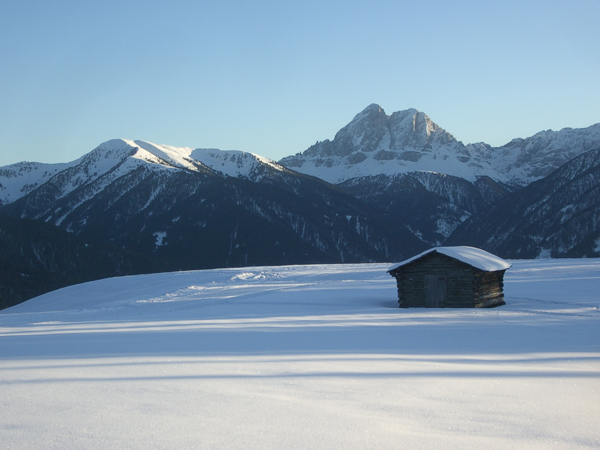
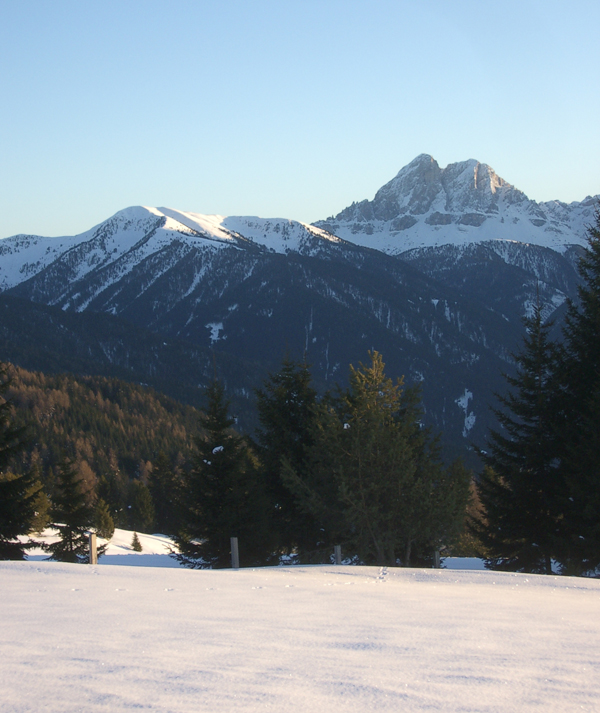
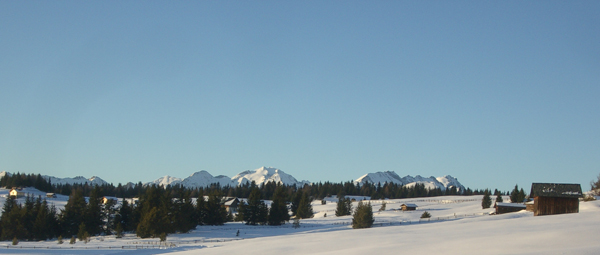
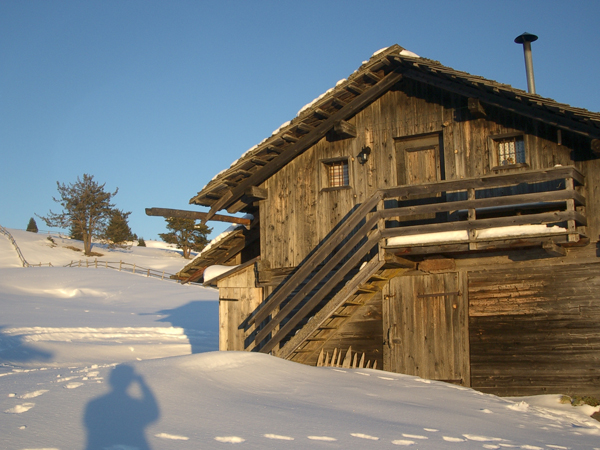
My wife Margit and I spent the day trekking up to the Rodenecker Alm near Lüsen in snowshoes with our friends Ram Manikkalingam and Ramani Muttettuwegama who are visiting from Amsterdam. We were heading for a hut which is supposed to serve food and drink, but never found it. Luckily, Ram produced various refreshments from his backpack, which we badly needed after a few hours of climbing. It was quite a hike, and my legs are killing me, but in the interest of making 3QD readers jealous, I am posting some photographs here. 🙂
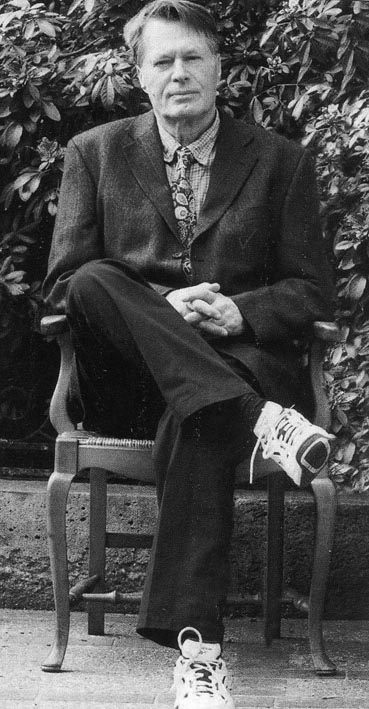
All pictures were taken by me, except the one of me with Margit in the backround, which was taken by Ramani.
These are from along the way:
Go ahead, make fun of the way I dress. See if I care. 🙂 Stuffed into my coat pocket are the very nice goat-leather gloves I got from Margit as a Christmas present.
Earlier this year Prospect teamed up with Foreign Policy to list the world’s 100 greatest living public intellectuals, a contest won (after some sharp-elbowed campaigning) by the Turkish cleric Fetullah Gülen. But who has had the most impact in 2008? We gathered an all-star judging panel (see opposite) from the worlds of policy, media and ideas to find out. The concept of “public intellectual” remains satisfyingly vague. Nonetheless, we instructed our panel to weigh up the field on three criteria: novelty, real-world impact, and intellectual pizzazz. Internal debate, along with soundings on our blog, First Drafts, created a shortlist of ten—the names you see on these pages. From there it was down to one judge, one vote. A three-way contest for the crown quickly emerged, with Roubini, “Thalerstein” and Petraeus all popular. Generally the panel voted according to type: the wonks liked Nudge, number crunchers wanted an economist, while foreign policy watchers thought the scholarly general deserving of the nod. On our website we provide details of all our judges’ votes, and their reasons. Ultimately, though, there could only be one winner. As in Iraq, so in Prospect: Petraeus surged to victory.
1. David Petraeus American general and current commander of United States Central Command
This was the year in which General David Petraeus, who holds a PhD from Princeton, demonstrated the battlefield success of his marine field manual—itself a solid intellectual piece of work produced after 16 months of study and consultation. Arguably, the so-called “Petraeus doctrine” is the only written piece of intellectual output in the last two years that has made a direct difference to the lives of millions. It’s radical among other things for being the first actively humane warfighting doctrine to ever come out of the Pentagon, enshrining the ideas that winning a modern war requires ensuring the security and wellbeing of the civilian population, that humanitarian assistance and construction projects are critical to any fight, and that 80 per cent of the battle is a political one. Petraeus has also waged a war of ideas against many in Washington who have argued that fewer constraints and more ruthless tactics were required in Iraq. This year, he won. And so he is a worthy winner of our award. Prospect was against the war in Iraq. But we know an original thinker when we see one, especially one who uses brainpower to achieve change in the most difficult of circumstances. He is a worthy winner.
Christmas music has never ranked highly among music aficionados. It exists, but no one likes to think about it much. Still, to create Christmas music is to belong in America. I don’t think this is a religious phenomenon. It is about homely feelings, about playing at tradition in a land that hasn’t any real ones. Americans imported their traditions from other lands and then went on to neglect them generally. Christmas is our pathetic, if charming, attempt at compensation.
The big question no one was asking in the 1980s was whether rap music could ever go that far. Was rap American enough to accomplish the Christmas song? When you do the Christmas song you are solid, you are in the club. Moreover, you are in the club to stay. A successful Christmas song will make it into a radio-cum-internet rotation that is beyond the vicissitudes of time. Think of “Christmas Wrapping” by The Waitresses. No one has heard of the band, every person in the world hears that song dozens of times every December. When the season rolls around, the songs do, too.
It fell, thus, on the broad shoulders of Run-DMC to accomplish this singular and difficult task. Such tasks were always confronting the hip-hop boys from Queens. They had to get white college kids to listen to rap music. Mission accomplished with Raising Hell. They had to make rap seem like the heir to rock and roll. Witness the collaboration with Aerosmith in “Walk This Way.”
It is no wonder, then, that one of their musical acts as good Americans was to produce a Christmas song. They called it “Christmas in Hollis.”
A short story by Jean-Marie Gustave Le Clézio in Archipelago:
The Frenchmen’s Pier was not really a town because there were no houses or streets, only shacks made of plywood, tarpaper or dirt. Perhaps it got its name from the fact that it was inhabited by Italians, Slavs, Turks, Portuguese, Algerians, Africans, stone masons, laborers and peasants who weren’t sure of finding work and who never knew if they would be staying for one year or just two days. They arrived at the Pier, near the swamps that bordered the estuary, found shelter wherever they could, and built their huts in just a few hours. The ones who were leaving sold them wood planks so old and with so many holes in them you could see right through them. They used plywood for the roof too, and large sheets of tarpaper or if they were lucky enough to find it, pieces of corrugated iron held together with wire or stones. They used old rags to fill in the holes.
This is where Alia lived, west of the Pier, near Martin’s house. She arrived there at the same time he did, early on when there were only about ten shacks, and the still soft ground was covered with large grassy fields and reeds near the edge of the swamp. Her father and brother had died in an accident when she was still too young to do much else but play with other children. Her aunt had taken her in. Now, four years later, the Pier had gotten larger. The estuary’s left bank was covered with hundreds of dirt paths and so many shacks that it was impossible to count them. Every week, truckloads of new families arrived at the Pier and others left. When going to the pump for water or buying rice or sardines at the co-op, Alia would stop to look at the new arrivals searching for any place left to set up camp. Sometimes the police would come to the Pier to keep an eye on things or keep track of who was coming and going.
Joseph Stiglitz, Naomi Klein, and Hernando de Soto in a discussion moderated by David Harvey:
City University of New York (CUNY) New York, NY Oct 20th, 2008
What is the role of the U.S. in the disposition of the world's economic and environmental resources? How are financial markets best defended from economic shock? Does liberalization ensure prosperity?
Journalist Naomi Klein speaks with economists Joseph Stiglitz and Hernando de Soto in a conversation moderated by David Harvey, Distinguished Professor of Anthropology at the Graduate Center – City University of New York (CUNY)
[E]xperts say that the worst financial crisis since the Great Depression is only going to get worse.
So how's a man to cope? Through the usual litany of vices: booze, cigarettes, cards, sex, and drugs, of course!
Conventional wisdom has long held that the “vice” industries are generally repression-proof. (Gambling revenue and booze consumption rose sharply after the stock market collapse of 1929, for example.) People may be broke and depressed, but they'll still smoke, drink, gamble, and screw—perhaps with even more vigor than when they could afford to put their kids through college.
So, is America on the verge of turning into a nation of alcoholic, coke-sniffing, Marlboro-smoking blackjack players with a penchant for fake breasts and a willingness to pay for sex? If so, is it time to pad your portfolio with stock in Philip Morris and Vegas casinos?
We talked with experts from all of the major vice industries, from strip club owners to Wall Street drug dealers, to find out if it's possible to parlay one man's personal tragedy into another man's financial gain. After some data crunching, we slapped a “buy” or “sell” label on each industry. Our careful analysis follows.

The heat in Max Butler's safe house was nearly unbearable. It was the equipment's fault. Butler had crammed several servers and laptops into the studio apartment high above San Francisco's Tenderloin neighborhood, and the mass of processors and displays produced a swelter that pulsed through the room. Butler brought in some fans, but they didn't provide much relief. The electric bill was so high that the apartment manager suspected Butler of operating a hydroponic dope farm.