
///
Autumn Unreadiness
Jim CrennerFifty swallows flocked along the wires
twitter frantically about the impending
journey south. On the lawn below,a scattering of robins, glassy-eyed
from the summer's regimen of sex
and parenting, stagger about uncertainly,heads cocked as if to keep one eye
on the sky and the other ear to the ground,
for that extra earthworm that could meanthe difference between making it across
the Rio Grande or not. Woolly-bear
caterpillars hump along doggedly,wasps burrow into the earth, squirrels
hustle from larder to larder to larder—
everything in nature gripped by the urgeto make ready for the massive seasonal
die-off drawing near. Everything, that is,
but me. If ever found, the fieldnotesof my Observer from Deneb will read
somewhat as follows: “The creature, now
concluding his sixty-ninth orbit of the starhe calls the Sun, evinces no awareness
that the coming winter prefigures his own
end. Today, as usual, he sits and staresat either nothing, or the sheer passing
of this blue (quite lovely, I must say)
September afternoon on earth. He shows
…..
no inclination to put his life in order, as if
he has no clue that he will soon cease to be.
Or maybe knows it only too well.”//
Category: Recommended Reading
The Devil at 37,000 Feet
William Langewiesche in Vanity Fair:
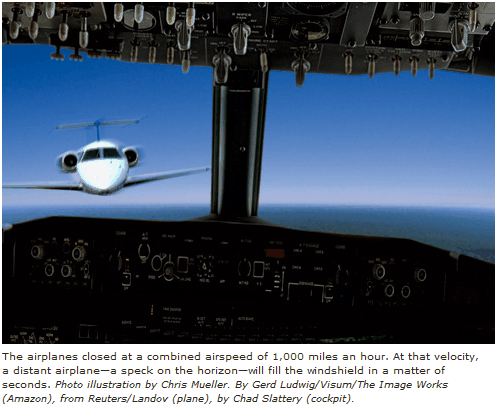
There were so many opportunities for the accident not to happen—the collision between a Legacy 600 private jet and a Boeing 737 carrying 154 people. But on September 29, 2006, high above the Amazon, a long, thin thread of acts and omissions brought the two airplanes together. From the vantage point of the pilots, the Brazilian air-traffic controllers, and the Caiapó Indians, whose rain forest became a charnel house, the author reconstructs a fatal intersection between high-performance technology and human fallibility.
More here.
Afghan Shiites Embrace New Acceptance
Pamela Constable in The Washington Post:
For the past week, caravans of cars have raced triumphantly around the Afghan capital, trailing huge green and red banners. Overpasses are draped with black cloth, and loudspeakers blare hypnotic religious chants punctuated with the slow rhythm of clanking chains.
This is Muharram, the 10-day period of ritual mourning — including emotional bouts of chest-beating and self-flagellation — observed by Shiites throughout the world in remembrance of Imam Hussein and other Shiite martyrs who died defending their faith in the 7th century.
But in Afghanistan, a Sunni-dominated country where Shiites have been a despised and oppressed minority during many periods of history, this Muharram is being observed with new boldness and political acceptance. It is a dramatic sign of the rapid emergence of Shiism under democratic rule in the seven years since the overthrow of the ultraconservative Sunni Taliban.
More here.
Origin of the specious
Daniel Hahn in The Guardian:
It's hard not to like a book that devotes several pages to the consistency of the inner core of a walrus tusk (“a rice-pudding pattern”, resembling cucumber seeds, since you ask). The passage in question appears in a long chapter digressing on the identity of the “khutu”, which might be a fish, a bull or a giant eastern bird-god, whose horn/beak/forehead is useful in the cutlery trade, and which is not to be confused with the karkadann, which is similar, but different.
The myth of the unicorn is filled with similar-but-different and unlikely (but often true) species, with plenty of misidentifications, misleading or mendacious sources and lies that turn out to be truths. It's a testimony to Chris Lavers's skilful deployment of his arguments that his dissection of this myth is neither baffling nor stiflingly crammed with technical supporting evidence to dull the reading; on the contrary, it is lively, compelling, full of anecdote, wry scepticism and an honest humility about the things it is simply impossible for us to know for certain. (How can we be sure that a cave-painting animal has only one horn and not two, when depicted in profile?)
The book, like its subject, is not quite one thing nor another, but a fascinating hybrid. For a start, this “natural history” is just that – a study that is attentive to the natural sciences, a scientific quest into the origins of a species with real, living relatives. Our imaginary, iconic, mythological beast has a lineage linking it to the real world, many times over.
More here.
Even Barack Obama can’t solve the Middle East problem – and he’d be foolish to try
From The Telegraph:
The smoke billowing over Gaza serves, among much else, as a bitter warning for Barack Obama. As Israel's onslaught on Hamas strongholds enters its second week, with key leaders of the radical Islamist movement now singled out as targets, the Holy Land is locked in a new spiral of conflict. Sewage from shattered mains runs in the streets of Gaza City, while tanks and infantry mass at the borders, preparing for a possible invasion. And the world's leaders are turning to the one man who they believe could break the cycle of retaliation and push Israel and the Palestinians into achieving a comprehensive peace agreement – President-Elect Obama.
With their love of acronyms, European diplomats pepper their documents with references to the “MEPP” – the Middle East Peace Process. They, and others, want the new president to place it first on his to-do list, to make this quest the number-one priority of his foreign policy. But look at the situation from Obama's point of view. The agony of Gaza, and of Israeli towns under attack from Palestinian rockets, drives home an uncomfortable truth: a viable peace agreement is almost certainly impossible, at least in the medium term. Safe in the knowledge that they will bear no responsibility for failure, European leaders can afford to urge Obama to pursue the “MEPP”. But why should the world's most powerful man waste effort on an enterprise that cannot succeed? Why should he risk almost certain failure?
Sir Nigel Sheinwald, the British Ambassador to Washington, provided a more realistic forecast of Obama's likely approach in a detailed assessment of the next president, leaked to The Daily Telegraph last year. “The MEPP is unlikely to be a top priority for Obama,” wrote Sir Nigel. “But he would pursue it reasonably vigorously.” As he ponders the issues, Obama will doubtless reflect on the searing experience of the last Democrat in the White House. Bill Clinton made the quest for a Middle East settlement a central theme of his presidency. Yet after eight years of diplomatic effort, he was driven to a rare confession of powerlessness.
More here.
Party to Murder
Chris Hedges in Truthdig:
Editor’s note: In light of the recent fighting in Gaza, Truthdig asked Chris Hedges, who covered the Mideast for The New York Times for seven years, to update a previous column on Gaza.
Can anyone who is following the Israeli air attacks on Gaza—the buildings blown to rubble, the children killed on their way to school, the long rows of mutilated corpses, the wailing mothers and wives, the crowds of terrified Palestinians not knowing where to flee, the hospitals so overburdened and out of supplies they cannot treat the wounded, and our studied, callous indifference to this widespread human suffering—wonder why we are hated?
Our self-righteous celebration of ourselves and our supposed virtue is as false as that of Israel. We have become monsters, militarized bullies, heartless and savage. We are a party to human slaughter, a flagrant war crime, and do nothing. We forget that the innocents who suffer and die in Gaza are a reflection of ourselves, of how we might have been should fate and time and geography have made the circumstances of our birth different. We forget that we are all absurd and vulnerable creatures. We all have the capacity to fear and hate and love. “Expose thyself to what wretches feel,” King Lear said, entering the mud and straw hovel of Poor Tom, “and show the heavens more just.”
More here.
Saturday, January 3, 2009
To Live and Die in Gaza
Laila al-Arian in The Nation:
On Sunday morning, I found out through a note my friend wrote on Facebook, that the Israeli Air Force was attacking my grandfather's neighborhood in Gaza. Safa, who lives near my grandfather in the densely-populated “Asqoola” in Gaza City, recounted the harrowing hours she spent terrorized by what she called “the constant, ominous, maddening, droning sound” of Apache helicopters flying above. “Outside my home, which is close to the two largest universities in Gaza, a missile fell on a large group of young men, university students,” Safa wrote over the weekend. “They'd been warned not to stand in groups–it makes them an easy target–but they were waiting for buses to take them home. Seven were killed.”
My family had been trying to speak with my grandfather since Saturday, after Israel began its onslaught on Gaza. But we haven't managed to reach him, perhaps not surprising since so many phone lines are down. “Hold one moment,” is all we hear. A computerized directive from the phone company, one that sounds increasingly strident the more it's repeated. “Hold one moment.” My mother hangs up in frustration, unable to ease her anxiety or clear her mind from worst-case scenario thoughts.
My grandfather moved to Gaza five years ago after living all over the Middle East for almost fifty years. As far as he was concerned, it was always a matter of time before he'd find his way back to his birthplace.
a kaddish that’s run out of control

“Humboldt’s Gift,” first published in 1975 and just re-issued (Penguin: 512 pp., $16), is both a crazy mess of a novel and an abiding testament to the vital exuberance of Saul Bellow’s genius. “The book of ballads published by Von Humboldt Fleisher in the Thirties was an immediate hit. Humboldt was just what everyone had been waiting for. Out in the Midwest I had certainly been waiting eagerly, I can tell you that,” the book begins. The narrator is Charlie Citrine, and his friend Humboldt has just died in a fleabag New York hotel. Citrine uses his relationship with the doomed poet as a springboard for meditations on the relationship between the artist and society in America, on women, on marriage, on contemporary life, on pretty much anything, in effect, that interests or obsesses his creator, Saul Bellow.
more from the LA Times here.
Our interest’s on the dangerous edge of things

Soon after completing “The Quiet American,” Graham Greene confessed to Evelyn Waugh, his fellow Roman Catholic novelist,that “it’ll be a relief not to write about God for a change.” “Oh, I wouldn’t drop God if I were you,” Waugh retorted. “Not at this stage anyway. It would be like P. G. Wodehouse dropping Jeeves halfway through the Wooster series.” Waugh had a point. Born in 1904, Greene belonged to a lost British generation that had been too young either to fight in World War I or to reflect soberly on its calamitous effects. Until his conversion to Catholicism in 1926 (in order to marry a believer), Greene had known only the private neurosis of a privileged English youth. As a preternaturally bored schoolboy, he is said to have played Russian roulette; it could be argued that he never recovered from the ennui of the 1920s and the following even lower (and more dishonest) decade.
more from the NY Times here.
Reading Mom and Dad in Tehran
From The New York Times:
When Azar Nafisi was a professor of Western literature in Tehran in the 1980s and ’90s, she told her best stories anonymously, sometimes to visiting foreign journalists seeking guidance about Iran’s Islamic Republic. In 1997 she settled for good in the United States and discovered her public voice, turning the volume up high in her 2003 memoir, “Reading Lolita in Tehran.” That memoir wove her personal stories with those of her former students, using as a touchstone their two years of shared experiences in a reading group at her home focused on banned authors like Nabokov and Fitzgerald. “Reading Lolita” became an international best seller; Nafisi, who is a visiting fellow and lecturer at the School of Advanced International Studies at Johns Hopkins University, became famous.
Now she has written a second memoir, much more intimate than the first, a dissection of her often difficult family life, recounted against the dramatic sweep and turbulence of recent Iranian history. The idea for the book sprang from a list that she began compiling in her diary sometime after the 1979 Islamic revolution, entitled “Things I Have Been Silent About.” It draws on other sources as well, including diaries her father, a former mayor of Tehran, started when she was 4, and addressed to her; his sanitized published memoirs and his unvarnished unpublished version; and family photographs, some of which she said she tookfrom her mother and which appear in the book. Much of the time she relies on memory, a powerful tool that can distort as well as enlighten.
(Picture shows Azar Nafisi’s mother, Nezhat.)
More here.
Saturday Poem
///
What the Doctor Said
Raymond CarverHe said it doesn't look good
he said it looks bad in fact real bad
he said I counted thirty-two of them on one lung before
I quit counting them
I said I'm glad I wouldn't want to know
about any more being there than that
he said are you a religious man do you kneel down
in forest groves and let yourself ask for help
when you come to a waterfall
mist blowing against your face and arms
do you stop and ask for understanding at those moments
I said not yet but I intend to start today
he said I'm real sorry he said
I wish I had some other kind of news to give you
I said Amen and he said something else
I didn't catch and not knowing what else to do
and not wanting him to have to repeat it
and me to have to fully digest it
I just looked at him
for a minute and he looked back it was then
I jumped up and shook hands with this man who'd just given me
something no one else on earth had ever given me
I may have even thanked him habit being so strong
/
‘Somewhere Towards the End’
Michael Dirda in The Washington Post:
Thirty years ago the literary critic and editor Malcolm Cowley brought out a memoir called The View from 80. It was, as you might guess, a slender volume about old age, much of it emphasizing the “grow old along with me!/The best is yet to be” approach to the advancing years. I had to assign the book for review and, after some thought, called up the distinguished and elderly scholar Douglas Bush, long a fixture of the English department at Harvard. I had every reason to expect Professor Bush to confirm an image of old age as a time of retirement and happy retrospection, of favorite volumes reread before the fireplace, of glasses of brandy shared with friends while reminiscing over the good times, a period, in other words, of serene pleasures and quiet satisfactions.
Wrong.
Bush's piece was an angry cry of rage at these familiar clichés. Old age was cruel and bitter, a time of ashes, not warming fires. He wrote that he could hardly read anymore, and when he could, even favorite books seemed stale and unprofitable. His doctors had cut out drink; his diet was restricted; his body gave him nothing but trouble and misery. A once formidable memory was going, and with it the accumulated knowledge and wisdom of a lifetime of scholarship. Those rosy images of a cultivated and leisurely Otium were all mirages. The so-called sunset years were at best tedious and at worst an ordeal.
Somewhere Towards the End, Diana Athill's account of growing old, lacks Bush's passion but does underscore that, on the whole, the later years are a time of making do with less of everything except aches and pain. Only writing — a talent that the now 91-year-old Athill discovered relatively late in life — affords some modest pleasure to this former editor for the English publisher André Deutsch. To readers Athill delivers far more than modest pleasure: Her easy-going prose and startling honesty are riveting, for whither she has gone many of us will go as well.
More here.
Ambition, Distraction, Uglification and Derision
John C. Butcher reviews Lewis Carroll in Numberland: His Fantastical Mathematical Logical Life by Robin Wilson, in American Scientist:
Charles Lutwidge Dodgson, who wrote under the pen name Lewis Carroll, was an Oxford don, a talented mathematician, a deacon in the Church of England and a pioneer in portrait and studio photography. He is best known as the author of Alice’s Adventures in Wonderland and Through the Looking-Glass, which are, on one level, books for children. Within them, however, are philosophical discussions, sophisticated word plays, parodies, satirical comment and mathematical allusions. In Lewis Carroll in Numberland , Robin Wilson focuses on Dodgson’s personal life and particularly on his mathematical life, asking, “What mathematics did he do? How good a mathematician was he, and how influential was his work?”
In a nod to the playful nature of Dodgson’s writing style, Wilson divides his own text not into chapters but into eight “fits,” after Dodgson’s extended poem The Hunting of the Snark: An Agony in Eight Fits . Wilson’s fits follow the chronology of Dodgson’s life as they delve into his mathematical pursuits and other activities. The final two deal with puzzles, problems, paradoxes and logic.
Wilson is insightful, and his approach to his subject is scholarly and serious. The portrait of Dodgson that emerges is intriguing. The book shows him to have been an earnest and pious churchman, a dedicated teacher and popularizer of mathematics, an artistic and creative pioneer in photography, and a diffident and stammer-prone adult. Dodgson took his vows of celibacy very seriously, Wilson emphasizes; his opinion is that Dodgson would never have engaged in inappropriate behavior or done anything “untoward” in his friendships with children, whom he regarded as “the embodiment of purity.”
More here.
The Reader
Jacob Heilbrunn in the New York Times Book Review:
In November 1915 a German corporal in the 16th Bavarian Reserve Infantry Regiment left his billet in a two-story farmhouse near Fournes, two miles behind the front lines in northern France, and walked into town. Instead of enjoying the traditional soldiers’ comforts of visiting a brothel or purchasing cigarettes and schnapps, he spent four marks to buy a slender book about Berlin’s cultural treasures. Referred to as “the artist” by his fellow message runners, he was something of a figure of amusement to them, partly because it was easy to get a rise out of him by declaring that the war was lost, and partly because he spent hours in the trenches hunched over newspapers and books during lulls in his duties. This withdrawn infantryman had denounced the Christmas Truce of December 1914, when British and German soldiers fraternized for a day. The only living being he reserved his affection for was a white terrier that strayed across enemy lines and obeyed him unconditionally.
Nor did his habits ever really change. Decades later he would abandon his companions late in the evening to retire to the solitude of his study, where reading glasses, a book and a steaming pot of tea awaited him. When his girlfriend was once so indelicate as to intrude upon his reveries, she met with a tirade that sent her running red-faced down the hallway. A sign hanging outside, after all, adjured “Absolute Silence!” By the end of his life, when he had been abandoned by most of his retinue and staged his own Götterdämmerung, the only personal effects the invading Soviet soldiers found in his Berlin bunker were several dozen books.
More here.
SAMUEL BECKETT: Watt (spoken by Jack Emory)
More oddities in the U.S. “debate” over Israel/Gaza
Glenn Greenwald in Salon:
Is there any other significant issue in American political life, besides Israel, where (a) citizens split almost evenly in their views, yet (b) the leaders of both parties adopt identical lockstep positions which leave half of the citizenry with no real voice? More notably still, is there any other position, besides Israel, where (a) a party's voters overwhelmingly embrace one position (Israel should not have attacked Gaza) but (b) that party's leadership unanimously embraces the exact opposite position (Israel was absolutely right to attack Gaza and the U.S. must support Israel unequivocally)? Does that happen with any other issue?
Equally noteworthy is that the factional breakdown regarding Israel-Gaza mirrors quite closely the factional alliances that arose with regard to the Iraq War. Just as was true with Iraq, one finds vigorous pro-war sentiment among the Dick Cheney/National Review/neoconservative/hard-core-GOP crowd, joined (as was true for Iraq) by some American liberals who typically oppose that faction yet eagerly join with them when it comes to Israel. Meanwhile, most of the rest of the world — Europe, South America, Asia, the Middle East, the U.N. leadership — opposes and condemns the attack, all to no avail. The parties with the superior military might (the U.S. and Israel) dismiss world opinion as essentially irrelevant. Even the pro-war rhetorical tactics are the same (just as those who opposed the Iraq War were demonized as being “pro-Saddam,” those who oppose the Israeli attack on Gaza are now “pro-Hamas”).
More here.
Friday, January 2, 2009
Violence without limits and Pakistan’s challenge
A H Nayyar & Zia Mian in Himal South Asia:
The murderous assault on Bombay by Islamist militants, at least some of whom were from Pakistan, has exposed once again the grave danger that radical Islamist movements pose to Pakistan, its neighbours and the world. The urgent challenge now is for Pakistan and its neighbours, together with the international community, to work together to confront the risk of Pakistan spiralling into chaos and collapse.
Ten years ago, the political thinker and activist Eqbal Ahmad wrote that “conditions for revolutionary violence have been gathering in Pakistan since the start in 1980 of the internationally sponsored Jihad in Afghanistan.” He argued that “revolutionary violence in Pakistan is likely to be employed by religious and right‑wing organizations which have not set theoretical or practical limits on their use of violence.” He then warned that Pakistan “is moving perilously toward a critical zone from where it will take the state and society generations to return to a semblance of normal existence. When such a critical point of hard-return is reached, the viability of statehood depends more on external than internal factors.”
Pakistan’s leaders have failed for a decade to heed this warning. Sadly, the recognition of the need to act against the Islamist violence that now imperils Pakistan has come not from the terrible war that jihadi groups have unleashed on state and society, wreaking havoc from remote border areas to the heart of the capital city, targeting both the powerful and the powerless. It has come due to external pressure.
More here.
Friday Poem
///
The Story of Keys
Richard GarciaIf you would give me
the key to your house
I would think of it
as a one-dimensional
mountain range.
I would hold it up
to the sky
and study how clouds
drink in its valleys.
Think of it
as a tiny file
that cuts through
vertical shadows.
The door to your house
would be a rectangle of lightthat shuts behind me
trapping the moon
by the coattails.
I would no longer need
the twisted path
that brought me to you.
It would disappear
along with the forest
that popped up
on springs and hinges.
And the stagehands
and roadies of my dreams
could put away their props—
cups, pools, musical perfumes
darker than your hair.Entering for the first time
would be as if I never left.
And I would tell you
the story of keys.
They were made long before
the invention of doors.
Although no one knew their function,
wise men suspected their importance.
carefully, they would place them
into the cracks of tree bark and twist.Anything can be a key: a piece of wire,
a safety pin, laughter.
/
In search of the God neuron
Steven Rose examines the latest theories about the human brain in The Guardian:
Half a century ago, passionate to study the brain, I began my graduate research in a gloomy, red-brick building in south-east London – the Maudsley Institute of Psychiatry. In the biochemistry department I was rapidly disabused of any idea that my research might lead to a greater understanding of how the brain could be “the organ of mind” – and still less that it might provide any help for the hospital's patients, whom I could dimly see through my laboratory windows. Neurochemistry meant grinding rats' brains up and extracting their enzymes; neuroanatomy was about cutting thin slices and staining them to be viewed under the microscope; neurophysiology was sticking minute electrodes into nerve cells and checking their electrical responses. To articulate the thought that this might tell one anything about “higher nervous functions” was strictly out of bounds. A dozen years ago, I heard a young American physiologist describe the study of consciousness as a “CLM” – a career limiting move. No topic for a young and ambitious neuroscientist, best left for those old enough to be experiencing the “philosopause” – said to affect scientists who had run out of research steam.
How times have changed! What was once dangerous territory is now the hottest theme in brain research. The subtitle of Semir Zeki's excellent new book is Love, Creativity and the Quest for Human Happiness. David Linden's is brasher: How Brain Evolution Has Given Us Love, Memory, Dreams, and God. Richard Joyce goes even further in claiming that our very morality is an evolved property of the brain. The rupture with the past is striking. From the ancients to the 20th century, it was philosophers who speculated about how the mind and brain might work. Now it is neuroscientists who are displacing the philosophers and theologians and telling us how we must behave. Three hundred years ago, David Hume argued that one could not derive an ought from an is, but now we are being told that our “oughts” – our moral feelings – are indeed “ises”, genetically and developmentally incarnated in our brains. Whole new scientific disciplines – neuroeconomics, neuroethics, neuroaesthetics – are emerging. No wonder that an issue of Science, timed for November's US election, claimed that brain imaging could identify voting intentions.
More here.
STATEMENT BY THE UNITED NATIONS SPECIAL RAPPORTEUR FOR HUMAN RIGHTS IN THE OCCUPIED TERRITORIES
Richard Falk:
The Israeli airstrikes on the Gaza Strip represent severe and massive violations of international humanitarian law as defined in the Geneva Conventions, both in regard to the obligations of an Occupying Power and in the requirements of the laws of war.
Those violations include:
Collective punishment – the entire 1.5 million people who live in the crowded Gaza Strip are being punished for the actions of a few militants.
Targeting civilians – the airstrikes were aimed at civilian areas in one of the most crowded stretches of land in the world, certainly the most densely populated area of the Middle East.
Disproportionate military response – the airstrikes have not only destroyed every police and security office of Gaza’s elected government, but have killed and injured hundreds of civilians; at least one strike reportedly hit groups of students attempting to find transportation home from the university.
More here.