And here, Neil deGrasse Tyson objects to Richard Dawkins' style, Dawkins gives a quick, 30-second response:

And here, Neil deGrasse Tyson objects to Richard Dawkins' style, Dawkins gives a quick, 30-second response:
Stanley Fish in the New York Times:
Last week we came to the section on academic freedom in my course on the law of higher education and I posed this hypothetical to the students: Suppose you were a member of a law firm or a mid-level executive in a corporation and you skipped meetings or came late, blew off assignments or altered them according to your whims, abused your colleagues and were habitually rude to clients. What would happen to you?
The chorus of answers cascaded immediately: “I’d be fired.” Now, I continued, imagine the same scenario and the same set of behaviors, but this time you’re a tenured professor in a North American university. What then?
I answered this one myself: “You’d be celebrated as a brave nonconformist, a tilter against orthodoxies, a pedagogical visionary and an exemplar of academic freedom.”
My assessment of the way in which some academics contrive to turn serial irresponsibility into a form of heroism under the banner of academic freedom has now been at once confirmed and challenged by events at the University of Ottawa, where the administration announced on Feb. 6 that it has “recommended to the Board of Governors the dismissal with cause of Professor Denis Rancourt from his faculty position.” Earlier, Rancourt, a tenured professor of physics, had been suspended from teaching and banned from campus. When he defied the ban he was taken away in handcuffs and charged with trespassing.
More here.
Tony Karon in Rootless Cosmopolitan:
Whereas Ariel Sharon saw the need to humor the Americans by indulging the rituals of Bush’s two-state vision, Netanyahu never bothered. In fact, it was Netanyahu’s rejection of Sharon’s tactical move to evacuate Gaza in order to tighten Israel’s grip on the West Bank that led to the Likud split that created the Kadima Party. Netanyahu isn’t stupid — even though right now there’s a good chance that he’d be able to build a ruling coalition only with blatantly rejectionist parties, he’ll make space for Kadima and Labor, hoping that he can stir the Pollyannaish hopes in Washington that their presence signals a “willingness” to make a peace agreement. Not that Netanyahu has any intention of doing so. Nor did Olmert, or Sharon.
Ariel Sharon campaigned furiously against Oslo, urging the settlers to “grab more hills” and making clear his own intention to stop the process. Sharon’s problem with Camp David was not that Arafat rejected what Barak’s “generous offer” (which even Barak’s chief negotiator, Shlomo Ben-Ami, later said he, too, would have rejected if he’d been Palestinian); it was that the offer had been made at all. That was why Sharon marched up the Temple Mount and onto the sanctuary around the Al-Aqsa mosque with a security detail of some 200 men, in the event that triggered the protests that mushroomed into the Second Intifada. And as soon as the fires were raging, Sharon triumphantly declared, “The Oslo Agreement is finished. It is null and void.”
More here.
Dr. A. Q. Khan has been set free by the Islamabad High Court in Pakistan after five years of house arrest following a publicly broadcast apology to the nation by Khan for his nuclear proliferation activities. Under international pressure, the government of Pakistan is considering appealing his release. This is a November 2005 article about Khan's activities by William Langewiesche in The Atlantic:
Rawalpindi is a city of two million residents on the northern plains of the Punjab, in Pakistan. It is a teeming place, choked with smoke and overcrowded with people just barely getting by. A large number of them live hand to mouth on the equivalent of a few hundred dollars a year. Much of their drinking water comes from a lake in the peaceful countryside north of town. The lake is surrounded by tree-lined pastures and patches of sparse forest. The navy of Pakistan has a sailing club there, on a promontory with a cinder-block shack, a dock, and one small sloop in the water—a Laser 16 with dirty sails, which sees little use. Though fishermen and picnickers sometimes appear in the afternoons or evenings, the lakefront on both sides of the promontory is pristine and undeveloped. The emptiness is by design: though the land around the lake is privately owned, zoning laws strictly forbid construction there, in order to protect Rawalpindi's citizens from the contamination that would otherwise result. This seems only right. If Pakistan can do nothing else for its people, it can at least prevent the rich from draining their sewage into the water of the poor.
But Pakistan is a country corrupted to its core, and some years ago a large weekend house was built in blatant disregard of the law, about a mile from the navy's sailing club, clearly in sight on the lake's far shore. When ordinary people build illegal houses in Pakistan, the government's response is unambiguous and swift: backed by soldiers or the police, bulldozers come in and knock the structures down. But the builder of this house was none other than Dr. Abdul Quadeer Khan, the metallurgist who after a stint in Europe had returned to Pakistan in the mid-1970s with stolen designs, and over the years had provided the country—single-handedly, it was widely believed—with an arsenal of nuclear weapons.
More here.
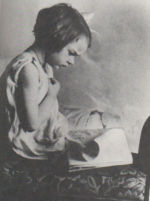
Even then, it was obvious she was a genius,” said Miss Katherine Scott, Flannery O’Connor’s freshman-composition teacher, speaking to a reporter many years later about her most famous student—“warped, but a genius all the same.” The teacher no doubt focused on the warped part when the seventeen-year-old Catholic girl with the spectacles and the searing wit took her writing class at Milledgeville’s Georgia State College for Women in the summer of 1942; and it was the warped part she noticed some ten years later, when she read O’Connor’s first book, Wise Blood, and flung it across the room. “I thought to myself that character who dies in the last chapter could have done the world a great favor by dying in the first chapter instead,” she told the same reporter. This was the sort of understanding and encouragement that surrounded Mary Flannery O’Connor from her earliest years in Savannah to her death at the age of thirty-nine in the Milledgeville area. But we should not be entirely sorry about that. Familial and social disapproval evidently spurred this writer on, enabling her to form a pearl around each painful speck of grit. That O’Connor’s pearls are among the most luminous and valuable we have in all of American literature does not detract in any way from their strangeness and hardness. Indeed, their value lies precisely in that hardness, that strangeness. However many times you read “A Good Man Is Hard to Find,” “The Life You Save May Be Your Own,” “The Artificial Nigger,” and “Good Country People,” you will not be able to figure out the source of their enormous power; in fact, they will become increasingly mysterious to you as the years go by.
more from Bookforum here.
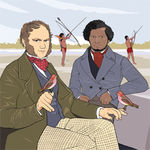
Shackled legs, thumbscrews used to crush the fingers of errant female slaves, a six-year-old boy horse-whipped for handing out water in a dirty glass: these sound like scenes from a modern horror story, but all were seen by the young Charles Darwin on his travels with the Beagle around the slave-owning continent of South America. You will find no mention of them in the proudly reasoned, scientific pages of On the Origin of Species. Glance at Darwin’s journals, private notebooks and family background, however, and you will find a man immersed in the rhetoric and fervent belief of the anti-slavery movement. Was the public man of science influenced by these private passions? In the light of painstaking archival investigations into Darwin’s letters, papers and notes, I believe the answer is a firm “yes.” Although he never admitted publicly to so political a motivation, anti-slavery sentiment was the handmaiden of Charles Darwin’s great intellectual achievement—the theory of evolution. The standard tale of a disinterested gentleman-naturalist’s journey of discovery will no longer wash. Rather, to understand both the man in his times and the true radicalism of his theory, we must look to the political and moral considerations that shaped his thought.
more from Prospect Magazine here.
Jessica Palmer over at bioephemera:
I have two physics-based games to plug: Crayon Physics and Fantastic Contraption.
Crayon Physics is, well, just watch the demo:
Crayon Physics Deluxe from Petri Purho on Vimeo.
Michael Wood reviews Slumdog Millionaire in the LRB:
The show [Who Wants to Be a Millionaire], in other words, provides the narrative structure of the film, but also something more: an atmosphere of chance and suspense, where the sheer tackiness of the trademark mode of presentation gives us a kind of parody of destiny. The vaguely threatening sci-fi music, the eerie lighting, the repeated questions, the long pauses, the parade of the four possible answers, and in this case the acting of Anil Kapoor as a wonderfully creepy Indian version of Chris Tarrant – it all looks like bad media magic. The film implicates us too by giving us right at the beginning a version of the show’s four answers, in this case to the question of how Jamal can get so many responses right: A. He knows; B. He’s cheating; C. He’s lucky; D. It is written. In a very fine joke on its own status the movie explicitly settles on D, and goes straight into the rousing musical credits.
The uncertainty and embarrassment of the film’s direction have to do with the sheer misery it dives into and flies over. In the early sections, everything happens too fast and is too brightly lit: it feels like tourism in poverty, and perhaps reflects a tension between Danny Boyle and Loveleen Tandan, his Indian co-director. I have to say, though, that if I were protesting about the film, as certain groups in India are, it would not be about pictures of poverty or the word slumdog but about the images of torture in a Bombay police station, where Jamal is badly beaten up and given vicious electric shocks just because he knows things above his notional class. The war on error, perhaps.
What leads the film out of its uncertainty and embarrassment is both the sheer intricacy of the plot and its flashbacks, the ingenuity of the connections between Jamal’s life and his quiz questions, and the interesting and awkward story hiding behind the appearances of conventional romance.
Stefany Anne Golberg in The Smart Set, via Andrew Sullivan's Daily Dish:
“Is it not a reproach that man is a carnivorous animal? True, he can and does live, in a great measure, by preying on other animals; but this is a miserable way — as anyone who will go to snaring rabbits, or slaughtering lambs, may learn…Whatever my own practice may be, I have no doubt that it is a part of the destiny of the human race, in its gradual improvement, to leave off eating animals….”
— Henry David Thoreau, WaldenIn 1845, Henry David Thoreau set off on a lone journey into the woodlands owned by his friend Ralph Waldo Emerson. He wanted to know if living more simply, in closer proximity to nature, would make him a better person, and if being a better, simpler person was the path to creating a better society. Walden is a unique and pioneering work in civil disobedience. But Thoreau’s two years in the woods were part of late-18th- and 19th-century America’s many experiments with alternative ways of life. All over the United States, people were living guinea pigs of their own idealism. Wacky communes espousing everything from free love to chastity sprouted up from Massachusetts to Texas. These eccentric communities shared one fundamental creed: that self-improvement, self-discovery, and self-fulfillment were essential to achieving a better society. At a time when the Western world was being swallowed by industrial smokestacks, and men, women, and children toiled away in nightmarish working conditions, Utopian community leaders went back to the basics, namely, the power of the individual to control his own destiny and do good, often in opposition to the mainstream. It’s no surprise, then, that diet was considered central to radical self-improvement. Vegetarianism was honored as the most radical diet of them all.
More here.
From Wikipedia:
The Civil Rights Movement in the United States has been a long, primarily nonviolent struggle to bring full civil rights and equality under the law to all Americans. The movement has had a lasting impact on United States society, in its tactics, the increased social and legal acceptance of civil rights, and in its exposure of the prevalence and cost of racism. The American Civil Rights movement has been made up of many movements. The term usually refers to the political struggles and reform movements between 1945 and 1970 to end discrimination against African Americans and to end legal racial segregation, especially in the U.S. South. This article focuses on an earlier phase of the struggle. Two United States Supreme Court decisions—Plessy v. Ferguson, , which upheld “separate but equal” racial segregation as constitutional doctrine, and Brown v. Board of Education, which overturned Plessy— serve as milestones. This was an era of stops and starts, in which some movements, such as Marcus Garvey's Universal Negro Improvement Association, achieved great success but left little lasting legacy, while others, such as the NAACP's painstaking legal assault on state-sponsored segregation, achieved modest results in its early years but made steady progress on voter rights and gradually built to a key victory in Brown v. Board of Education.
After the Civil War, the U. S. expanded the legal rights of African Americans. Congress passed, and enough states ratified, an amendment ending slavery in 1865—the 13th Amendment to the United States Constitution. This amendment only outlawed slavery; it did not provide equal rights, nor citizenship. In 1868, the 14th Amendment was ratified by the states, granting African Americans citizenship. Black persons born in the U. S. were extended equal protection under the laws of the Constitution. The 15th Amendment (ratified in 1870) stated that race could not be used as a condition to deprive men of the ability to vote. During Reconstruction (1865-1877), Northern troops occupied the South. Together with the Freedmen's Bureau, they tried to administer and enforce the new constitutional amendments. Many black leaders were elected to local and state offices, and others organized community groups.
More here.
From The New York Times:
Reading Daniyal Mueenuddin’s mesmerizing first collection, “In Other Rooms, Other Wonders,” is like watching a game of blackjack, the shrewd players calculating their way beyond their dealt cards in an attempt to beat the dealer. Some bust, others surrender. But in Mueenuddin’s world, no one wins. Set in the Pakistani district of Punjab, the eight linked stories in this excellent book follow the lives of the rich and powerful Harouni family and its employees: managers, drivers, gardeners, cooks, servants.
The patriarch, K. K. Harouni, of the feudal landowning class, owns a farm in Dunyapur and a mansion in Lahore. In the title story, we meet him in the final years of his life, living mostly in Lahore, apart from his estranged wife, having surrendered the management of his farm to the corrupt Chaudrey Jaglani. When Husna, a distant relative whose branch of the family “had not so much fallen into poverty as failed to rise,” shows up at his door, Harouni takes her in, first as a servant, then as his mistress. For the aging paterfamilias, Husna is a distraction whose unrefined speech and manners offer a temporary escape from the infinite politesse of his own class. For her part, Husna, a more hard-boiled Madame Bovary, envious of the glittering, jet-setting lives of the rich, ingratiates herself to the old man through calculated flirtations, believing sex is her ticket out of her lowly status. And for a while she is right. Until she no longer is.
More here.
Reading WG Sebald I felt a growing affinity, although not with the man himself – I never met, let alone knew him – nor with humanity in general. Indeed, immersed in Sebald, the inversion of Schopenhauer’s dictum “The more I love mankind, the less I love men” often occurs to me: the more his fictional alter ego reverences individual men and women, the less he seems to love mankind. I couldn’t say exactly what my Sebaldian progression has been: there was reading and then rereading, so that passages from one text interpolated, Russian-doll-like, into another, much as his raconteur characters find their voice in the accents of Sebald’s style. I suspect The Rings of Saturn came first, followed by The Emigrants, followed by Austerlitz. Then I tackled the lectures Sebald gave in Zurich in 1997, published under the title On the Natural History of Destruction. As for Vertigo, until a few weeks ago I had both confused and conflated this with After Nature, and while I had nibbled at the latter, I managed only a morsel. Speaking of Sebald with his (and now my) editor Bill Swainson, I learned of the existence of this other novel – one that Swainson felt would help me with my as yet inchoate theory concerning Sebald’s methodology.
more from The Guardian here.
In an often-overlooked 1992 novel with perhaps the most intentionally dull title in literary history — “Memories of the Ford Administration” — John Updike has fun with an issue that long deviled his career. He introduces a secondary character named Brent Mueller, a “rapid-speaking fellow with the clammy white skin of the library bound” who had “deconstructed Chaucer right down to the ground.” Mueller serves as antagonist to the novel’s narrator — both are history professors at a New Hampshire college — and becomes a campus cult figure by deeming every masterpiece “a relic of centuries of white male oppression, to be touched as gingerly as radioactive garbage.” Updike’s protagonist, in return, cuckolds the deconstructionist throughout the novel. This caricature was the author’s way of playfully pushing back at his critics and detractors. Updike’s death last week was met with the usual fulsome praise and sighs of sadness. But the writer, who was regarded as a gracious, decent man, was not unanimously loved or respected in the literary world. Over the years, he had become a symbol of the out-of-touch, tweed-wearing realist to younger, more experimental writers.
more from the LA Times here.
It’s not merely that Jacob finds women’s feet attractive. It’s that, for him, “the feet were the breasts, the legs, the buttocks, the genitals.” Simply hearing the words “size 8” or “size 9” can get him excited. Like a man partial to a particular breast size, Jacob also has his ideal foot shape: a high arch, a wide instep and a staircaselike progression of toes. Once when he was stalled in traffic, the woman in the car next to him had her feet up on the dash — his version of a naked swimsuit model — and he climaxed seconds later. Distraught, Jacob ends up in the office of a nationally renowned expert on sexual disorders — a psychiatrist known for his empathy, even with patients like a necrophiliac who worked at a funeral parlor, a gynecologist voyeur and reviled characters like Jeffrey Dahmer and Michael Ross. Of Ross, who confessed to raping and killing eight girls and young women, the doctor explains, as Bergner puts it, that Ross was “a man who had, in effect, restrained himself except for those eight . . . acts of primal gratification — such a tiny fraction of the number that most adults seek and find.” Jacob can relate. “No matter where you go,” he tells Bergner, “there are people, and people have feet. Unless I lived in a center for amputees. That would be peace.”
more from the NY Times here.
From britishschoolriyadh:
Very few, if any, African-Americans accepted their status as slaves. Most, if not all, slave-owners were completely aware of this and, in general, they lived in fear of the African-Americans under the control. They were constantly afraid of the slaves running away, rebelling etc. Yes, there were rebellions. Here are 2 main ones:
Gabriel Posser: he was a deep Christian and definitely against slavery. He lay many plans to abolish slavery, however, he was defeated. However, this rebellion laid out the fear over the slave-owners… He was definitely an example, which inspired other people to rebel like he did.
Denmark Vesey: he was an African-American and came from the ‘upper class of slaves’, who worked as engineers, craftsmen etc. Still, he was FILLED with anger about the way people treated the black slaves. In 1821 he began to build up his own revolt. He organized a group of working lieutenants (Gullah Jack, Peter Poyas). By 1822, almost all the slaves around joined. Their plan was very simple. The rebels would all station themselves at the doors of European-Americans and, late at night, a group of rebels would start a major fire. When the men came out their doors, the rebels would kill them with axes, picks, or guns. They would then enter the houses and kill all the occupants. Like Prosser's revolt, they almost won. They were betrayed early in the game, but the cell structure prevented officials from finding out the plot itself or identifying any of the leaders. It was only the day before that a slave, who knew the entire plot, betrayed Vesey. He and his co-leaders were hung, but only one confessed.
Thomas Wentworth Higginson writing in June 1861 in The Atlantic:
Denmark Vesey had come very near figuring as a revolutionist in Hayti, instead of South Carolina. Captain Vesey, an old resident of Charleston, commanded a ship that traded between St. Thomas and Cape Français, during our Revolutionary War, in the slave-transportation line. In the year 1781 he took on board a cargo of three hundred and ninety slaves, and sailed for the Cape. On the passage, he and his officers were much attracted by the beauty and intelligence of a boy of fourteen, whom they unanimously adopted into the cabin as a pet. They gave him new clothes and a new name, Télémaque, which was afterwards gradually corrupted into Telmak and Denmark. They amused themselves with him until their arrival at Cape Français, and then, “having no use for the boy,” sold their pet as if he had been a macaw or a monkey. Captain Vesey sailed for St. Thomas, and presently making another trip to Cape Français, was surprised to hear from his consignee that Télémaque would be returned on his hands as being “unsound,” — not in theology nor in morals, but in body, — subject to epileptic fits, in fact. According to the custom of that place, the boy was examined by the city physician, who required Captain Vesey to take him back; and Denmark served him faithfully, with no trouble from epilepsy, for twenty years, travelling all over the world with him, and learning to speak various languages. In 1800, he drew a prize of fifteen hundred dollars in the East Bay Street Lottery, with which he bought his freedom from his master for six hundred dollars, — much less than his market value. From that time, the official report says, he worked as a carpenter in Charleston, distinguished for physical strength and energy.”Among those of his color he was looked up to with awe and respect.
More here.
Martin Woollacott in The Guardian:
The great virtue of Tyler's book is that it is so relentlessly personal. It may be criticised by some for the limited attention it pays to underlying causes, such as America's determination to secure oil resources and the constraints of the cold war, or to cultural factors, such as the west's early infatuation with Israel's military successes, and, more recently, the Christian right's beliefs about the end of the world. But Tyler is a reporter, not an academic. He is interested in moments – moments when confused and angry leaders and their counsellors swear at one another, weep, get drunk, or tell outrageous lies.
Moments such as the one where William Sullivan, the American ambassador to Iran, irritated by Zbigniew Brzezinski's pursuit of the chimera of a last-minute military coup to save the shah's regime, told him there was not the faintest chance of such a thing, adding cuttingly: “Do you want me to translate it into Polish?” Moments such as the one where Bill Clinton, still just president, rang Colin Powell, the incoming secretary of state in George W Bush's new administration, to tell him that Yasser Arafat was “a goddamned liar” who had destroyed the chances of peace. The blame for the failure at Camp David, as Tyler writes, belonged to Ehud Barak and Clinton rather than to Arafat but, cheated of the achievement that might have balanced the Lewinsky scandal, a self-righteous and self-deceiving Clinton was intent on “poisoning the well”.
Or moments such as the one where Henry Kissinger, entrusted with a message from Nixon to Brezhnev calling for joint superpower action to end the 1973 Arab-Israeli war and then proceed to a just settlement of the Palestinian question, simply decided, in mid-flight to Moscow, not to deliver it. Nixon's message, Tyler writes, “threatened to undermine the record Kissinger was seeking to create; that he and Nixon had run the Soviets into the ground and they had protected Israel”. The truth was that the Russian leaders had reacted cautiously and moderately when war broke out, and that Nixon himself had a statesmanlike grasp of what was necessary. But a joint US-Russian initiative “would have thrust Kissinger into the thankless and perilous task of applying pressure on Israel”. So he simply dumped the message. He later encouraged Israel to violate the ceasefire that was supposed to end hostilities so that it could better its military position. With these acts of disobedience – acts which were also, as Tyler says, arguably unconstitutional – Kissinger closed off the possibility that the 1973 war could have been ended on terms which would have left Israel in a less powerful position, making it more amenable to an ensuing push for a settlement by the Americans and the Russians.
More here.
Graeme Wood in The Atlantic:
Mullah Masood Akhundzada, guardian of the Shrine of the Blessed Cloak of the Prophet Muhammad, in Kandahar, is wary of guests. When his brother was the guardian, 13 years ago, he accepted an insistent visitor. Today, a youngster with a Kalashnikov shadows Mullah Masood around the shrine, just in case the visitor, Mullah Omar, or any of his friends return.
The mosque itself is a modest cube with filthy blue-and-gilt mosaics. But in a poor city, it is an outpost of opulence and safety. When Masood and I relax in the courtyard, sipping imported packets of Iranian cherry juice, it seems as if we’re at the estate of a country lord. Its most aggressive resident is the goat that mows the lawn. Aside from the bodyguard, there’s little hint of the dangers outside: the area’s main boulevard is Khuni Serok, or “Bloody Road”; on the way to the shrine, I passed the blackened divot left by a suicide bombing.
More here.