
Category: Recommended Reading
Katherine Porter (1941 – 2024) Painter And Artist
Proud Boys

Sunday Poem
Early Morning In Your Room
It’s morning. The brown scoops of coffee, the wasp-like
Coffee grinder, the neighbors still asleep.
The gray light as you pour gleaming water–
It seems you’ve traveled years to get here.
Finally you deserve a house. If not deserve
It, have it; no one can get you out. Misery
Had its way, poverty, no money at least.
Or maybe it was confusion. But that’s over.
Now you have a room. Those lighthearted books:
The Anatomy of Melancholy, Kafka’s Letter
to his Father, are all here. You can dance
With only one leg, and see the snowflake falling
With only one eye. Even the blind man
Can see. That’s what they say. If you had
A sad childhood, so what? When Robert Burton
Said he was melancholy, he meant he was home.
by Robert Bly
from Poetic Outlaws
Does Memorial Day have its origins in defeated Confederates?
Gillian Brockell in The Washington Post:
 In July 1866, a
 He was bothered by reports that in towns across the South, women were decorating the graves of dead Confederates. Two years later, he proposed the same idea. On May 5, 1868, Logan ordered the first nationwide public holiday on May 30, then known as “Decoration Day,” to honor war dead. A national day honoring American men and women who have died while serving in the military has been observed ever since.
On Monday, millions of Americans will mark Memorial Day again with parades, picnics and cemetery visits. Officially, Memorial Day started in Waterloo, N.Y.; that’s according a 1966 law signed by President Lyndon B. Johnson. And there was definitely a local observance of war dead there in 1866. But here’s the thing — there’s no evidence Logan was inspired by or even aware of Waterloo’s observance when he pitched his plan. Contemporaneous coverage doesn’t credit Waterloo either. In 1868, the New York Times said: “The ladies of the South instituted this memorial day. They wished to annoy the Yankees; and now the Grand Army of the Republic in retaliation and from no worthier motive, have determined to annoy them by adopting their plan of commemoration.”
More here.
Saturday, May 25, 2024
Degrowth from the Left
Oliver Eagleton in The Ideas Letter:
Intra-Marxist debates are famously irascible, even when their stakes are low. Yet in recent years this intellectual tradition has been further fractured, at the same time as it has been focused and reanimated, by the gravity of the climate crisis. The character of a future egalitarian society, and the most viable way to get there, have been contested by two environmentalist camps: degrowthers and eco-modernists. The first argues that capitalism’s drive for perpetual expansion is the cause of planetary breakdown, and demands a slower, “steady-state” alternative based on less production and consumption. The second claims that this expansionism has created the technological preconditions for a sustainable society, which the working class must now bring to full fruition, rather than aiming for any aggregate contraction. It remains to be seen whether these positions can be reconciled. Yet in broad terms, it is clear that they are clashing expressions of the same phenomenon: the reemergence of a utopian sensibility on the left – one that is determined to identify history’s direction of travel following the premature announcement of its end.
The degrowth school, which has long asserted that humanity’s material impact exceeds the planet’s biophysical capacity, has gained ground with several recent eco-socialist tracts. Kōhei Saitō’s Capital in the Anthropocene (2020), which sold half a million copies in Japan and has been translated into English as Slow Down (2024), describes an apparent shift in Marx’s late thought: away from a naïve faith in the infinite potential of technology towards a sober recognition of ecological limits. The contemporary environmental movement, writes Saitō, must heed this rejection of Prometheanism and abandon the notion of developing the “productive forces” (which, in the lexicon of historical materialism, means the machinery and infrastructure used in the production of goods). It should rather advocate a reduction of resource use in the Global North, establishing a new model of democratic planning to decide what’s needed and what isn’t.
More here.
Leah Hunt-Hendrix and Astra Taylor – Solidarity: A World-Changing Idea
Good Enough
Sam Adler-Bell in The Baffler:
THERE’S A GAME my girlfriend and I sometimes play. Well, really, it’s more of an argument: “Fuck, Marry, Kill” with the past, present, and future. My answer, which I take to be a good, solid American answer, is fuck the present, marry the future, and kill the past. My reasoning is that you should always want to fuck the present, to live in the moment (as the advertisers say), screw every hole of the now. Likewise, marrying the future is admirable, like monogamy, and prudent, like monogamy; it’s a wish, and a promise, for stability and grace. You have to believe in the future, be loyal to what comes next, to what and who you are always becoming. And that leaves only the past to kill. Which, so what? It’s the past. It’s already passed.
My girlfriend—who is also an American, but an American writer and lover of fiction—has a different answer. She says you should fuck the future, marry the past, and kill the present. I definitely see the appeal of fucking the future; it’s where the action is, the excitement, the unknown. The future is a stranger, and we all want to fuck strangers. And for her, the past is too precious and monumental to kill. Memory is a repository, a treasured burden worth bearing; it’s what you can’t seem to get rid of, even if sometimes you want to. So, you marry it. But here’s where the trouble starts: I can’t allow her to kill the present. When we get going on this topic, she says, “Well, what’s the present? Isn’t it always slipping away? Isn’t it gone the moment you try to do something in it?” And I say, “No! The present is this,” slicing my hand through the air, as if to catch it. “Isn’t this precious?”
More here.
Beyond Athens and Jerusalem
Suzanne Schneider in Strange Matters:
When John McCain selected former Alaska governor Sarah Palin to be his running mate in 2008, it was the gift that kept on giving to the United States’ media and entertainment establishment.
For the mostly liberal chattering classes, her folksy mama bear affect, ignorance about basic geopolitical facts (the existence of two Koreas among them), and possible illiteracy were far more interesting than John McCain’s platform. Fifteen years later, Palin’s candidacy is far less amusing than it was to noughtie-era Daily Show writers, recognized instead as a pivotal moment in the emergence of movements that today constitute the New Right. From the Tea Partiers and Obama birthers to Trump stans, white nationalists, and anti-vaxxers, Sarah Palin walked so they could run (into the Capitol).
Outside observers peering into the abyss that is the New Right often envision it as a coherent force. The real divide, we hear, is between the conservative establishment – “respectable” Republicans of the George W. Bush type – and upstarts like J.D. Vance and lunatics like Marjorie Taylor Greene. If you’re able to forget the War on Terror, the invasion of Iraq, CIA black sites and the routinization of domestic surveillance, one might indeed prefer the oil-painting ex-president to Greene’s fleet of Jewish space lasers. But this divide is not the only fault line that runs through contemporary right-wing politics. Indeed, we find that the coalition of New Right Forces – a motley crew of techno-libertarians, America Firsters, post-liberals, economic nationalists, monarcho-fascists, vitalists, social conservatives, conspiracy theorists, incels, racists, and anti-Semites – is hardly proceeding in lockstep formation. In the words of one of its leading funders, Peter Thiel, the New Right is “a very ragtag Rebel Alliance. It’s like we have diversity on our side.”
More here.
Communication Breakdown
Mitch Leslie in Science:
 The tails were a clue. As some kinds of mice get old, their tails can stiffen and kink. But the aged rodents in the lab of molecular biologist Shin-Ichiro Imai at the Washington University School of Medicine in St. Louis sported tails that were limber and nearly straight. The genetically altered mice seemed to defy aging in other ways, too. They were more robust than control mice and spent more time scampering in their exercise wheels. Most dramatic, the animals lived about 7% longer than their normal counterparts, gaining an extra 58 days of life, Imai and colleagues reported earlier this year in Cell Metabolism.
The genetic modification the researchers had made boosted a key communication signal from the animals’ brain to their body. Thanks to the tweak, a specific group of neurons in the hypothalamus, a physiological control center deep in the brain, remained active as the animals got older. Imai’s team discovered that those neurons send signals to the animal’s fat stores via the sympathetic nervous system, a network of nerves carrying messages from the brain throughout the body. In response to the signal, the mouse fat burns lipids and secretes a long-distance signal known as NAMPT that forestalls aging-related damage in other parts of the body, including the hypothalamus itself.
More here.
Inside MAGA’s Plan to Take Over America
Jennifer Szalai in The New York Times:
 Despite Steve Bannon’s Wall Street pedigree, his taste for five-star hotels and billionaire-owned yachts, he is truly a man of the people — that, at least, is the impression he strains to convey each time he appears in “Finish What We Started: The MAGA Movement’s Ground War to End Democracy,” a new book by Isaac Arnsdorf, a journalist at The Washington Post. As far as Bannon is concerned, anyone who complains that Donald Trump’s far-right supporters are on the fringes of the fringe, an extremist minority bent on undermining what most Americans actually want, is just a whiner who can go cry some more. As he put it at the Conservative Political Action Conference in the summer of 2022: “All they talk about on MSNBC is ‘democracy, democracy, democracy.’ We’re gonna give them a democracy suppository on Nov. 8!”
The line was classic Bannon: gleeful, bombastic, mildly disgusting. It would also turn out to be wrong. The “red wave” that he and other MAGA enthusiasts envisioned for that year’s midterm elections never materialized; a number of Trump’s handpicked candidates had sailed through their primaries but struggled to prevail in the general election. Still, Bannon would not be deterred. In the book, he keeps insisting to Arnsdorf that most of the country is MAGA, even if some of those MAGA supporters don’t know it yet. “Bannon believed the MAGA movement, if it could break out of being suppressed and marginalized by the establishment, represented a dominant coalition that could rule for a hundred years,” Arnsdorf writes.
More here.
Stoic Origins of Western Occultism
In My Time of Dying by Sebastian Junger
Simon Usborne at The Guardian:
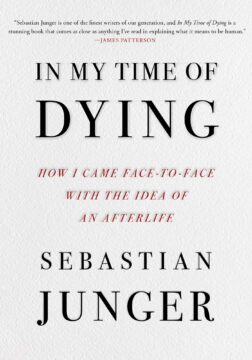 One might feel short-changed to read a book about death by Sebastian Junger that did not include some battlefield drama. After 1997’s The Perfect Storm, his bestselling account of a trawler disaster that became a blockbuster starring George Clooney, the American writer received even more acclaim for his war reporting. His narrative gifts earned him comparisons with Hemingway.
Sure enough, bullets do fly in Junger’s seventh book, a gripping exploration of the liminal space between life and death. In Afghanistan, he hid behind a meagre holly bush while “bits of leaves drifted down from bullets that were chopping through the foliage over our heads, and gouts of dust erupted around my feet”. There’s also an account of the death, in Libya in 2011, of British photojournalist Tim Hetherington, the colleague and friend with whom Junger had just made Restrepo, an Oscar-nominated documentary for which they spent a year at a US army outpost deep in Taliban territory.
more here.
Everyone Wants a Piece of Kafka
Benjamin Balint at the NYT:
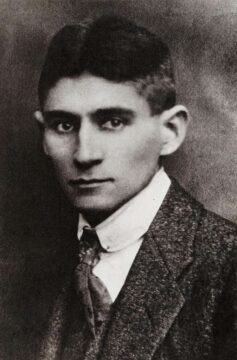 In his novella “The Prague Orgy,” Philip Roth has a Czech writer say: “When I studied Kafka, the fate of his books in the hands of the Kafkologists seemed to me to be more grotesque than the fate of Josef K.” Just as Franz Kafka’s prose both demands and evades interpretation, something about his legacy has both solicited and resisted claims of ownership.
Despite his astonishing clairvoyance about the impersonal cruelty of the bureaucratic state and the profound alienation of contemporary life, Kafka could not have foreseen how many admirers would read and misread his enigmatic fictions after his death, nor how many would-be heirs would seek to appropriate him as their own in the century since. Competing claims began to swirl almost as soon as Kafka died of tuberculosis, 100 years ago this June, a month short of his 41st birthday. Max Brod — close friend, betrayer of Kafka’s last instruction to burn his manuscripts, heavy-handed editor of his diaries and unfinished novels, and author of the first Kafka biography — depicted him as a modern-day “saint” whose stories and parables “are among the most typically Jewish documents of our time.”
more here.
Saturday Poem
Latent Prints
I don’t know how people live
without me. No, really. Everyday
I live with myself.
I’ve never not.
In the living room I cut
Aliya’s hair, and when she stood
a dark crescent moon
outlined where she sat.
Everything leaves something
behind, I’m told. Rope fibers,
gunshot residue, boot prints in mud
and muddy boot prints. If I were to step
outside my body and walk away,
I could see what shape
my absence takes.
Surely, it has a shape.
by Madusen Gummer
from Bodega Magazine
Friday, May 24, 2024
A Theoretical “Case Against Education”
Scott Alexander at Astral Codex Ten:
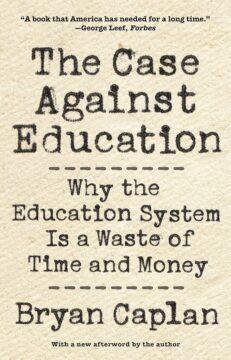 There’s been renewed debate around Bryan Caplan’s The Case Against Education recently, so I want to discuss one way I think about this question.
Education isn’t just about facts. But it’s partly about facts. Facts are easy to measure, and they’re a useful signpost for deeper understanding. If someone has never heard of Chaucer, Dickens, Melville, Twain, or Joyce, they probably haven’t learned to appreciate great literature. If someone can’t identify Washington, Lincoln, or either Roosevelt, they probably don’t understand the ebb and flow of American history. So what facts does the average American know?
More here.
A New Chapter in the Quest for a Longer Life
Emily Cataneo in The Undark:
 IN 2023, tech mogul Bryan Johnson revealed that he had been receiving blood plasma exchanges from his 17-year-old son, in the hope that siphoning his son’s young blood into his middle-aged body would help him combat aging and cheat death. Johnson might be an extreme outlier, but his quest exemplifies a common human trait: denial about our mortality. As Venki Ramakrishnan writes in his new book, “Why We Die: The New Science of Aging and the Quest for Immortality,” searching for the secrets to longevity has “driven human civilization for centuries.” Humans may be unique among animals in our ability to understand and anticipate death, and ever since we evolved into this awareness, we’ve struggled to accept it. We espouse religious beliefs about reincarnation or the everlasting immortal soul, we attempt to live on through offspring and legacy, and, of course, since antiquity, we have searched for eternal life.
Ramakrishnan, a Nobel Prize winner in chemistry who has spent his career studying how cell proteins are made, is primarily occupied with that last coping strategy in his fascinating book. For much of the 20th century, serious scientists dismissed gerontology, or the study of aging, as the provenance of cranks and loons. But in this century, it’s become a major research priority. In the past 10 years alone, Ramakrishnan writes, more than 700 startups have invested billions of dollars into solving this greatest human problem.
More here.
A Revolutionary Story Of Eggs, Evolution And Life On Earth
Leon Vlieger in The Inquisitive Biologist:
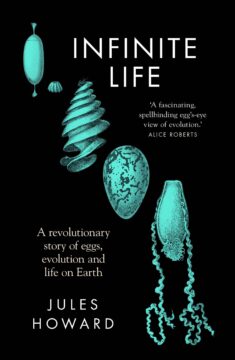 Jules Howard is no stranger to sex. A science writer and zoological correspondent, his gleefully amusing 2014 book Sex on Earth is particularly relevant to the topic at hand. Even there, however, eggs were just a sideshow. And therein lies the problem. Likely, the first question to be asked when eggs come up in conversation is how you like them for breakfast, or some hackneyed joke involving chickens. Focusing on the oology in zoology, Infinite Life retells the history of life, this time from the perspective of the almighty egg.
Howard’s approach in Infinite Life is to take the reader chronologically through the history of life, one geological period per chapter. Familiar as that framework might be for readers of popular evolutionary history books, it is the subject matter that is engrossing; eggs really have been a neglected topic so far.
More here.
“Spice: The 16th-Century Contest that Shaped the Modern World” by Roger Crowley
Peter Gordon in the Asian Review of Books:
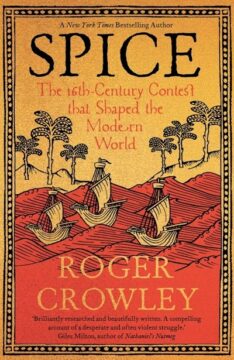 Although it is the Silk Road that captures most of the contemporary attention and discussion, it was in fact spices, not silk, that drove Western Europeans to seek routes to Asia. “Lightweight and durable, spices” writes Roger Crowley in his new history (appropriately entitled Spice), “were the first truly global commodity … they could be worth more than their weight in gold.”
And it was, for the most part, not China, Japan or India that was the object of Western fever dreams but a handful of tiny, now relatively obscure islands in what is now Indonesia:
Five microscopic volcanic islands – Ternate, Tidore, Moti, Makian and Bacan – were the only places on the planet where clove trees grew. Four hundred miles south another three islands – the Bandas – were the unique source of nutmeg.
The Moluccas, he writes, “were destined to become the epicentre of a sixteenth-century great game that literally shaped the world.”
More here.