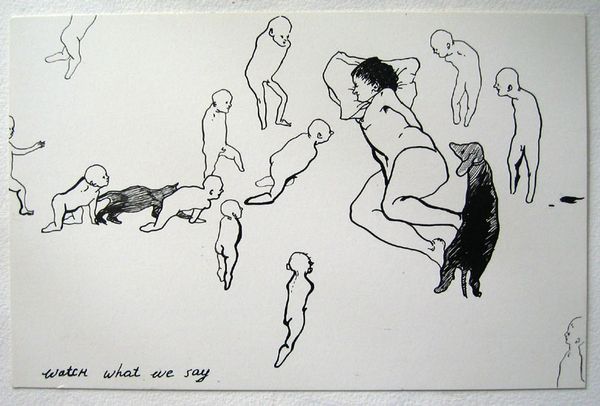
Dasha Shishkin. Watch What We Say.
Pen and ink drawing.
Thanks to Anjuli Raza Kolb.

Robyn Creswell in The National:
Adina Hoffman’s biography of the Palestinian poet Taha Muhammad Ali is a triumph of sympathetic imagination, dogged research and impassioned writing. More than the story of one man’s life, it brings to light entire strata of historical and cultural experience that have been neglected or purposefully covered over. For readers of English, there is no comparable work – certainly nothing so densely detailed or eloquently argued – for understanding Palestinian intellectual life in the second half of the 20th century. And for all that, it is anything but dry or ponderous or, to invoke a cliché that no critic of biography seems able to do without, monumental. Instead, Hoffman’s book is an unconventional and avowedly personal study – the record of an engagement with a man and a literary tradition that both deserve a wider audience.
My Happiness Bears No Relation to Happiness is the first biography of any Palestinian writer in any language – hard to fathom, but true – and the choice of Muhammad Ali as a subject, especially in this light, is a surprising one. For most of his life Muhammad Ali has not been a poet but a Nazarene businessman, selling souvenirs from his shop near the Church of the Annunciation. “A Muslim who sells Christian trinkets to Jews” is his humorous self-description. He didn’t write his first poem until he was 40 years old, and though he has now published five volumes of poetry and a collection of short stories, it is still a relatively modest oeuvre.
More here.
Graham Usher in the London Review of Books:
Pakistan and India have been at war since 1948. There have been occasional flare-ups, pitched battles between the two armies, but mostly the war has taken the form of a guerrilla battle between the Indian army and Pakistani surrogates in Kashmir. In 2004 the two countries began a cautious peace process, but rather than ending, the war has since migrated to Afghanistan and the Pakistani tribal areas on the Afghan border. ‘Safe havens’ for a reinvigorated Afghan Taliban and al-Qaida, the tribal areas are seen by the West as the ‘greatest threat’ to its security, as well as being the main cause of Western frustration with Pakistan. The reason is simple: the Pakistan army’s counterinsurgency strategy is not principally directed at the Taliban or even al-Qaida: the main enemy is India.
In the Bajaur tribal area, for example, the army is fighting an insurgency led by Baitullah Mehsud, the leader of one of Pakistan’s three Taliban factions, but it’s not because he is a friend of al-Qaida. What makes him a threat, in the eyes of Pakistan’s army, is that he is believed to be responsible for scores of suicide attacks inside Pakistan (including the assassination of Benazir Bhutto). He is also thought to have recruited hundreds of Afghan fighters, among them ‘agents’ from the Afghan and Indian intelligence services – ‘Pakistan’s enemies’, in the words of a senior officer.
More here.
Maywa Montenegro in Seed Magazine:
Ann Trason, Scott Jurek, Matt Carpenter. These are the megastars of ultra-distance running, athletes who pound out not just marathons, but dozens of them back-to-back, over Rocky Mountain passes and across the scorching floor of Death Valley. If their names are unfamiliar, it’s probably because this type of extreme running is almost universally seen as a fringe sport, the habit of the superhumanly fit, the masochistic, the slightly deranged.
But a handful of scientists think that these ultra-marathoners are using their bodies just as our hominid forbears once did, a theory known as the endurance running hypothesis (ER). ER proponents believe that being able to run for extended lengths of time is an adapted trait, most likely for obtaining food, and was the catalyst that forced Homo erectus to evolve from its apelike ancestors. Over time, the survival of the swift-footed shaped the anatomy of modern humans, giving us a body that is difficult to explain absent a marathoning past.
Our toes, for instance, are shorter and stubbier than those of nearly all other primates, including chimpanzees, a trait that has long been attributed to our committed bipedalism. But a study published in the March 1 issue of the Journal of Experimental Biology, by anthropologists Daniel Lieberman and Campbell Rolian, provides evidence that short toes make human feet exquisitely suited to substantial amounts of running.
More here.
Shireen Mazari in The News:
Despite our shock-weariness, the past week has been a traumatic one for Pakistan. In a curtain-raiser to the visit of members of the MPH (Mullen, Petreaus and Holbrooke) team, Pakistan has been ripped asunder with acts of terrorism and barbarity – across the land. Following from the horrors of Manawan, we saw the almost helpless personnel of the Frontier Constabulary targeted in Islamabad, US drones killing more women and children in FATA and the gruesome spectre of sectarian terrorism raising its head once again with an attack in Chakwal.
As if all that was not enough, we were confronted with the abhorrent video of the flogging of a teenage girl in Swat. Tragically, the whole debate seems to have been reduced to the timing of the event – as if that makes the crime, for that is what it is even under the Shariah laws of this country, any less horrific – and to the authenticity or otherwise of the video itself. The fact of the matter is that regardless of these issues, such inhuman acts against women have been taking place across the land, not only at the hands of the Taliban.
Which brings up the real issue – that is, of the state showing tolerance for such brutalities against women.
More here.

The opening sentence of their new book, The Spirit Level, cautions, “People usually exaggerate the importance of their own work and we worry about claiming too much” – yet by the time you reach the end you wonder how they could have claimed any more. After all, they argue that almost every social problem common in developed societies – reduced life expectancy, child mortality, drugs, crime, homicide rates, mental illness and obesity – has a single root cause: inequality.
And, they say, it's not just the deprived underclass that loses out in an unequal society: everyone does, even the better off. Because it's not absolute levels of poverty that create the social problems, but the differentials in income between rich and poor.

Suppose a man flirts with a woman and then asks her, “Will you solemnly promise to give me right now your telephone number if I make a true statement and, conversely, not give me your number if I make a false statement?”
Maybe he can soften the statement a bit, but let's assume that this is its gist.
Feeling that this is a flattering and benign request, the woman promises to give him her number if and only if he makes a true statement.
The man then makes his statement: “You will neither give me your telephone number now nor will you sleep with me tonight.”
What's the trick? Note that she can't give him her number since, if she were to do so, his statement would be made false, and so she would have broken her promise to give him her number only if he made a true statement. (This is the crux of it.) Therefore, she must not give him her number under any circumstances.
But if she also refuses to sleep with him, his statement becomes true, and this would require her to give him her number.
The only way she can keep her promise is to sleep with him so that his statement becomes false. The woman's seemingly innocuous promise ensnares her.
Fortunately or unfortunately, I suspect that the class of people for whom this seduction technique would prove effective is probably rather small. Nevertheless, it might make an interesting premise for a Star Trek episode or perhaps form part of a logicians' dating manual.
Consider now a slight variant of the above story. Suppose an investment con man is talking to a prospective client.
Nate Silver breaks down the meaning of the Rasmussen poll on American attitudes towards capitalism and socialism:

Among Americans making $20,000 a year or less, capitalism leads socialism by only 8 points, 35-27. Confidence in capitalism then rises steadily with income, such that among the wealthiest Americans, it has a 57-point lead on socialism (68-11).
This is not altogether surprising. Nevertheless, it has some potentially profound political implications. The poor, it seems, are having trouble suspending their disbelief. They're losing faith in the Clintonian restatement of the American Dream, that if they work hard and play by the rules, they can get ahead.
There are pitfalls for both parties given this climate. The Democrats have to worry, on the one hand, about replacing the Republicans in the public's mind as the party of hedge funds and big business. On the other hand, there may also be risks to activists in misinterpreting these results and overplaying their hand. There is a difference between the working class becoming more acutely skeptical of capitalism, and becoming more sympathetic to the abstraction of socialism; what we're seeing now is far more the former than the latter.
Evgeny Morozov asks if the Internet spread democracy in The Boston Review:
It is safe to say that the Internet has significantly changed the flow of information in and out of authoritarian states. While Internet censorship remains a thorny issue and, unfortunately, more widespread than it was in 2003, it is hard to ignore the wealth of digital content that has suddenly become available to millions of Chinese, Iranians, or Egyptians. If anything the speed and ease of Internet publishing have made many previous modes of samizdat obsolete; the emerging generation of dissidents may as well choose Facebook and YouTube as their headquarters and iTunes and Wikipedia as their classrooms.
Many such dissenters have, indeed, made great use of the Web. In Ukraine young activists relied on new–media technologies to mobilize supporters during the Orange Revolution. Colombian protesters used Facebook to organize massive rallies against FARC, the leftist guerrillas. The shocking and powerful pictures that surfaced from Burma during the 2007 anti–government protests—many of them shot by local bloggers with cell phones—quickly traveled around the globe. Democratic activists in Robert Mugabe’s Zimbabwe used the Web to track vote rigging in last year’s elections and used mobile phones to take photos of election results that were temporarily displayed outside the voting booths (later, a useful proof of the irregularities). Plenty of other examples—from Iran, Egypt, Russia, Belarus, and, above all, China—attest to the growing importance of technology in facilitating dissent.
But drawing conclusions about the democratizing nature of the Internet may still be premature. The major challenge in understanding the relationship between democracy and the Internet— aside from developing good measures of democratic improvement—has been to distinguish cause and effect.
Daniel Mendelsohn in The New Republic:
It is somehow appropriate that the voice of deep and anguished ambivalence that you hear at the beginning of Susan Sontag's early journals and notebooks does not belong to Susan Sontag. Self-doubt, after all, was not a quality you generally associated with her. From the moment she burst onto the literary scene nearly fifty years ago, with the publication of the essays subsequently collected as Against Interpretation–a cultural-critical Athena, armored with a vast erudition, bristling with epigrams–Sontag exhibited a preternatural self-assurance in matters of art and culture, an unwavering belief in her own judgments and tastes that, as these early private papers now make clear, she possessed already in her early teens. (The first of a projected three volumes of Sontag's journals, this one takes her to the age of thirty; fully one-third of it is a record of her teenaged years.)
The embarrassment with which Reborn begins belongs, rather, to her son, the writer David Rieff, who edited his mother's journals. In a moving preface, Rieff describes how he uneasily consented to publish this “raw” and “unvarnished” sampling of Sontag's adolescent effusions about life and early perceptions about art. Throughout his short introduction he shows a marked queasiness about “the literary dangers and moral hazards of such an enterprise. ” The anxiety stems from two sources, of which the first was ethical and, so to speak, generic: although his mother, in one of her final illnesses, was anxious for him to know where the journals were kept, there was no indication that Sontag would have wanted the contents of these papers to be made public. “The diaries,” Rieff notes, “were written solely for herself … She had never permitted a line from them to be published, nor, unlike some diarists, did she read from them to friends.”
More here.
Walter Benn Michaels talks to George Miller about the economic background in the US, and France, and how it affects the question of diversity.
download (MP3, 15.9 Mb)
Matthew Chalmers in New Scientist:
Edward Witten, a leading architect of string theory, works at the cutting edge of mathematics and physics in his quest for a “theory of everything”. Matthew Chalmers met up with him to ask how it feels to work in an area so rarefied that it's a problem simply conveying to other people what he's up to.
LISTENING to Ed Witten talk physics can be a little unsettling. His concise sentences resemble steps in a logical proof: his grammar is flawless and his eyes occasionally close as he translates the great sweep of knowledge that has earned him exospheric academic status. This softly spoken man leaves you in a state of mental disarray.
This year Witten is in Europe, on sabbatical at the CERN particle physics lab near Geneva in Switzerland, where the mathematical foundations of reality are about to be rocked by the Large Hadron Collider (LHC). As it happened, he turned up on the day last September that the LHC switched on. “Ed's very active, so it's great to have him around,” says Luis Alvarez-Gaume, head of CERN's theory department. “He's a genius, it's as simple as that.”
Such accolades haven't secured Witten a plush office, as I discovered when I met him in his sparse accommodation at CERN. Nor does he appear comfortable with the effusive descriptions sometimes applied to him – such as the “world's cleverest man” or “Einstein's successor”. “Believe me,” he says, “I'm definitely no Einstein.” Yet these monikers are founded in more than mere hyperbole. For the past 25 years Witten has been at the forefront of attempts to unify nature's four fundamental forces in a single framework – a goal pursued for a similar period by Einstein. And he has been credited with writing the largest number of high-impact papers of any living physicist.

No One Cares What You Had for Lunch , insists the title of an American book dispensing droll advice to wannabe blog superstars. But if Indian blog enthusiasts are to be believed, this is advice you should ignore. People are, in fact, scrambling to find out exactly what you had for lunch, eager to demand recipes if it was toothsome, and ready with commiseration if it left you cold. Food bloggers are a fast growing tribe in India, with enthusiasts ranging from busy young urban professionals to homebound housewives and tech-savvy retired folk; from seasoned chefs to bumbling first-timers. “I have plenty of friends who are hopelessly addicted to food blogs!” says celebrated chef Ritu Dalmia. Debashish Chakrabarty, founder of the blog award site Indibloggies, confirms that food blogs are the rage today.
While recipe sites have been around for a while, only a greenhorn could confound those with food blogs. A food blog entices with rapturous descriptions of the cooking and eating experience, and is as much a literary enterprise as it is a culinary one; while the recipe site provides a more mundane inventory of ingredients and instructions. Enthusiastic food blog writer Anita Tikoo confesses to spending a minimum of ten hours writing each blog post, regardless of whether her subject is the simple pakoda or the more elaborate Kashmiri kofta. Her blog, A Mad Tea Party, records an average of a 1,000 hits a day and allows Anita, a Delhi-based landscape architect, to share her love for food with audiences from Bahrain to Bolivia, while adroitly circumventing pesky editors. Sometimes, readers of her blog end up becoming real friends—recently, one of them flew all the way from Chennai to Delhi just to meet her.
Looking back to the birth of the modern verse-novel with Byron’s Don Juan and Pushkin’s Eugene Onegin, it is plain that ironised lightness of tone and touch is vital to their success, supported by their stanza-forms’ respective demands for triple and unstressed rhyme. In each poem much is narratively noticed, from the terrible to the trivial, and more is implied, some of it searing. Seth in The Golden Gate stuck closely to the Onegin stanza, including unstressed rhymes (as with ‘fellow/yellow’, ‘critic/arthritic’, and ‘poet/know it’), and like Byron and Pushkin maintained a detached, primarily comic tone to encompass tragicomic narrative with ironic observation. Fuller’s The Illusionists and Keating’s Jack, the Lady Killer also use Onegin stanzas and rely on their tone, but innovative choices of stanza-form – Dantean terza rima, blank heroic tercets, or Thompson’s single-rhymed, loosely heroic quatrains – are commoner, and bring a greatly expanded range of tones to match range and difficulties of subject-matter. And whatever it was Seth’s doubting interlocutors so scorned (or feared?) in the revived verse-novel, its modern authors are overwhelmingly poets far from “sad blancmange”, who know very well that the world is hard, and potently chart in their work some of the reasons that they and their countrymen find it so.
more from The Liberal here.
A year and a half ago, the attention paid to crime writers like Greg Rucka, David Morrell, Duane Swierczynski and Denise Mina turning their storytelling attention to the comic book format had me wondering about the opposite tack: What happens when prose-and-picture stars leave artwork behind to concentrate solely on the words? But now, with graphic novels permeating the mainstream with greater force and attendees flocking to comic book conventions in San Diego and New York in six-figure droves, it’s time to reverse course and revisit the pictorial approach to mystery and suspense stories. The timing is especially ripe now that DC Comics has confirmed its dedicated line for graphic crime novels, Vertigo Crime, will finally launch this August, ending the arduous buildup of expectation for Ian Rankin’s maiden voyage into this territory featuring “Hellblazer” main character John Constantine and Brian “100 Bullets” Azzarello’s 1960s noir re-imagining. But we can also look forward to Darwyn Cooke’s adaptation of Richard Stark’s Parker novels into comic books this summer and, down the line, Oni Press’ dedicated imprint of graphic novels curated by Karin Slaughter under the Slaughterhouse name.
more from the LA Times here.
The writers of the Beat Generation had the good fortune to give themselves a name and to write extensively about their lives, in novels like Jack Kerouac’s “On the Road” and William Burroughs’s “Junkie,” in poems like Allen Ginsberg’s “Howl” and, later, in memoirs like Joyce Johnson’s “Minor Characters” and Hettie Jones’s “How I Became Hettie Jones.” Jones once said they couldn’t be a generation because they could all fit in her living room, but in the popular imagination they were much more than the sum of their body parts or writings. They were a brand. When the country still considered literary writers and poets important public figures, these were literary writers and poets who came with luridly colorful lives, full of sex and drugs and cars, “the best minds of my generation,” “the mad ones, the ones who are mad to live,” cultural avatars who were often linked more by lifestyle considerations than by writerly ones. If they inspired lots of bad poetry set to bongos and little poetic discipline, they have even more effectively escaped disciplined literary or historical analysis. They rocked; they posed a threat to the nation’s youth. Either you got them or you didn’t. What could matter compared with that?
more from the NY Times here.
First Sight
W.S. Merwin
There once more the new moon in spring
above the roofs of the village
in the clear sky the cold twilight
under the evening star the thin
shell sinking so lightly it seems
not to be moving and no sound
from the village at this moment
nor from the valley below it
with its still river nor even
from any of the birds and I
have been standing here in this light
seeing this moon and its one star
while the cows went home with their bells
and the sheep were folded and gone
and the elders fell silent one
after another and loved souls
were no longer seen and my hair
turned white and I was looking up
out of a time of late blessings.