Tuesday Poem

One Art
Elizabeth Bishop

The art of losing isn’t hard to master;
so many things seem filled with the intent
to be lost that their loss is no disaster.

Lose something every day. Accept the fluster
of lost door keys, the hour badly spent.
The art of losing isn’t hard to master.

Then practice losing farther, losing faster:
places, and names, and where it was you meant
to travel. None of these will bring disaster.

I lost my mother’s watch. And look! my last, or
next-to-last, of three loved houses went.
The art of losing isn’t hard to master.

I lost two cities, lovely ones. And vaster,
some realms I owned, two rivers and a continent.
I miss them, but it wasn’t a disaster.

—Even losing you (the joking voice, a gesture
I love) I shan’t have lied. It’s evident
the art of losing’s not too hard to master
thought it may look like (Write it!) like disaster.

Ants really are random wanderers

From MSNBC:

Ants Ants don't march in predictable patterns to search for crumbs, as you might have thought by watching them. Instead, new research suggests they roam randomly.

This is not a matter of ant versus human intelligence, because a seemingly blind search can still make sense in both practical and mathematical terms.

“The beauty of a mathematical random walk is that it eventually visits all points in space if you walk long enough — and it always returns to its starting point,” said William Baxter, an experimental physicist at Penn State Erie, The Behrend College.

More here.

The Biggest of Puzzles Brought Down to Size

Natalie Angier in The New York Times:

Angier-190 Grim though the economic spur may be, some scientists see a slim silver lining in the sudden newsiness of laughably large numbers. As long as the public is chatting openly about quantities normally expressed in scientific notation, they say, why not talk about what those numbers really mean? In fact, they shamelessly promote the benefits of quantitative and scientific reasoning generally. As they see it, anyone, no matter how post-scholastic or math allergic, can learn basic quantitative reasoning skills, and everyone would benefit from the effort — be less likely to fall for vitamin hucksters, for example, or panic when their plane hits a bumpy patch.

One excellent way to start honing such skills is with a few so-called Fermi problems, named for Enrico Fermi, the physicist who delighted in tossing out the little mental teasers to his colleagues whenever they needed a break from building the atomic bomb.

Here is how it works. You take a monster of a ponder like, What is the total volume of human blood in the world? or, If you put all the miles that Americans drive every year end to end, how far into space could you travel? and you try to estimate what the answer might be. You resist your impulse to run away or imprecate. Instead, you look for a wedge into the problem, and then you calmly, systematically, break it down into edible bits. Importantly, you are not looking for an exact figure but rather a ballpark approximation, something that would be within an order of magnitude, or a factor of 10, of the correct answer. If you got the answer 900, for example, and the real answer is 200, you’re good; if you got 9,000, or 20, you go back and try to find where you went astray.

More here.

Monday, March 30, 2009

Sunday, March 29, 2009

How Rawls’s political philosophy was influenced by his religion

Via Andrew Sullivan, Joshua Cohen and Thomas Nagel in the TLS:

The recognition that political life presents a distinct moral problem is therefore a decisive break in Rawls’s development, and it would be interesting to know when and how it occurred. Rawls says in the Introduction to Political Liberalism (1993) that A Theory of Justice (1971) did not draw a distinction “between moral and political philosophy”. He was, however, concerned from early on with the special moral problems of political society. As early as his doctoral dissertation (submitted in 1950, and addressed to the role of reason in ethical argument), his philosophical work was animated by a sense of the political that is not evident in the undergraduate thesis. Thus he says in the dissertation that a “democratic conception of government . . . views the law as the outcome of public discussions as to what rules can be voluntarily consented to as binding upon the government and the citizens”. For this reason, he continues, “rational discussion . . . constitutes an essential precondition of reasonable law”, and an investigation of the “rational foundation of ethical principles” serves as “an addition to democratic theory, as well as to ethical philosophy”. The close association here of issues of philosophical ethics with concerns about public argument in a democracy marks a sharp departure from the view in the thesis, and anticipates the idea that justice as fairness is “the most appropriate moral basis for a democratic society”. Yet while Rawls came to see that a just society could not be a community “integrated in faith under God”, his personal knowledge and experience of religion were important for the formation of his later view, in particular his views about the kind of public reasoning that we could reasonably expect in a democratic society. Rawls’s liberalism, unlike that of many liberals who know very little about religion, is founded on a vivid sense of the importance of religious faith and an understanding of the difference between genuine and merely conventional religion. He knows what he is talking about when he says in Political Liberalism that the Reformation “introduces into people’s conceptions of their good a transcendent element not admitting of compromise”, that “this element forces either mortal conflict moderated only by circumstance and exhaustion, or equal liberty of conscience and freedom of thought”; and that political thought needs to understand “the absolute depth of that irreconcilable latent conflict”. By insisting on the importance of a terrain of political justification that is consistent with such ultimate commitments but does not depend on them, Rawls was not devaluing religion. On the contrary. The importance of liberty and of separating the state from religion is that they make possible the commitment of all members of a pluralistic society to common political institutions and a shared enterprise of public justification, despite their ultimate disagreements about the nature of the world, the ends of life, and the path to salvation. Such disagreement, he emphasizes, is not a disaster, but the natural consequence of reason’s exercise under free conditions.

Exile, Writing and Cultural Freedom

Bei-dao-65x80 From the Lannan archives, a reading and conversation with Bei Dao:

Bei Dao, who was forced into exile following the Tiananmen Square Massacre in 1989, is widely treasured by those who participated in China's democracy movement. Dao is a member of China's “misty school,” a movement of fresh poetics that emerged in the 1970s using “free verse” in a hermetic, semi-private language characterized by oblique imagery and elliptical syntax. Dao's poetry depicts the intimacy of passion, love, and friendship in a society where trust can literally be a matter of life and death.

Marijuana No Laughing Matter, Mr. President

Norm Stamper in The Huffington Post:

ScreenHunter_09 Mar. 29 19.08 The problem for Mr. Obama is that marijuana reform was at or near the top of the list of all questions in three major categories: budget, health care reform, green jobs and energy. Our leader doesn't seem to understand that millions of his interlocutor-constituents are actually quite serious about the issue.

Which is not to say that drugs, particularly pot, doesn't offer up a rich if predictable vein of humor. Cheech and Chong's vintage “Dave's not here!” routine is still a side-splitter. As Larry the Cable Guy would say, “I don't care who you are, that's funny right there.”

But there's nothing comical about tens of millions of Americans being busted, frightened out of their wits, losing their jobs, their student loans, their public housing, their families, their freedom…

And show me the humor in a dying cancer patient who's denied legal access to a drug known to relieve pain and suffering.

More here. And here are Bill Maher, Mos Def, Salman Rushdie, and Christopher Hitchens talking about the same thing:

A robot with a biological brain

Joe Kloc in Seed Magazine:

TheLivingRobot_HS Kevin Warwick’s new robot behaves like a child. “Sometimes it does what you want it to, and sometimes it doesn’t,” he says. And while it may seem strange for a professor of cybernetics to be concerning himself with such an unreliable machine, Warwick’s creation has something that even today’s most sophisticated robots lack: a living brain.

Life for Warwick’s robot began when his team at the University of Reading spread rat neurons onto an array of electrodes. After about 20 minutes, the neurons began to form connections with one another. “It’s an innate response of the neurons,” says Warwick, “they try to link up and start communicating.”

For the next week the team fed the developing brain a liquid containing nutrients and minerals. And once the neurons established a network sufficiently capable of responding to electrical inputs from the electrode array, they connected the newly formed brain to a simple robot body consisting of two wheels and a sonar sensor.

More here.

Rachel Maddow’s Star Power

From Mother Jones:

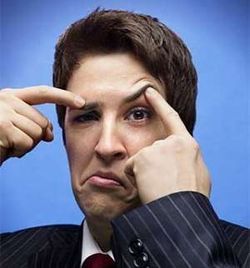
Rachel-maddow-320.300wide If you don't know by now, Rachel Maddow is the world's most unlikely cable news talk-show host. For one thing, she doesn't watch TV. And she's young (35), is a Rhodes scholar with a PhD from Oxford, and is openly gay—an industry first. (More than one friend has told me that her ascent is some consolation for the passage of California's anti-gay-marriage Prop 8.) But her combination of lefty sensibilities, a hipster vibe, wicked smarts, and genuine good cheer has taken the entire country by storm. She's made msnbc competitive against cnn's Larry King for the first time. Existing in the space between Jim Lehrer's NewsHour and Jon Stewart's Daily Show, Maddow's hour-long show privileges reporters and actual experts over pundits, real information over blather and fake fights, and comes with healthy sides of sass and sarcasm. It's a mix she learned at the left-of-center radio network Air America, where she still broadcasts a live show each weekday. In her spare time, Maddow's writing a book on the role of politics in the US military. In her other spare time, she's an enthusiast of graphic novels and mixology.

More here.

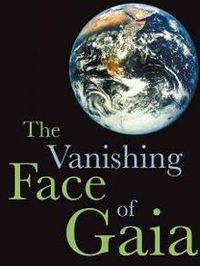
The Vanishing Face of Gaia: A Final Warning

From The Telegraph:

Lovelock_1369330f It is the stuff of legend. The story of the wild-eyed maverick who was attacked, vindicated and then hailed as a green visionary who could save the world. The tale of the free thinker who could teach the establishment a thing or two. There’s no better way to underline James Lovelock’s evolution to an elder statesman of science than to read the foreword to The Vanishing Face of Gaia, written by none other than Lord Rees, Order of Merit, President of the Royal Society, Astronomer Royal, and the Master of Trinity College, Cambridge: “He is a hero to many scientists – certainly to me.”

He Knew He Was Right, an authorised biography by John Gribbin and Mary Gribbin, gives a good sense of Lovelock’s inspirational, independent spirit. There are all kinds of engaging stories about the conscientious objector, the husband who sold his blood (a rare type) to support his family, the boffin who froze and reanimated hamsters, and the cannibal who augmented his impoverished wartime diet by turning waste human blood into omelettes. Lovelock has notched up many achievements during his career, notably his invention of an instrument crucial for documenting the use of the pesticide DDT and ozone-destroying chlorofluorocarbons, the latter providing a foundation for studies revealing risks to the atmosphere’s protective ozone layer.

Lovelock is best known for introducing the world to the seductive idea of Gaia, which says the Earth behaves as though it were an organism. The concept first reached a wide audience in 1975 in an article published in New Scientist, but was ridiculed, attacked for being teleological, even mocked as an “evil religion”.

More here.

Saturday, March 28, 2009

TOOLS OF AMERICAN MATHEMATICS TEACHING

Fernando Gouvêa in American Scientist:

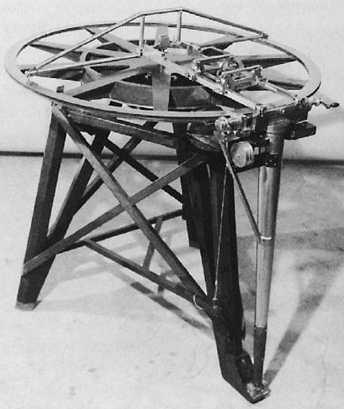
ScreenHunter_07 Mar. 28 22.48 Tools of American Mathematics Teaching, 1800–2000, by Peggy Aldrich Kidwell, Amy Ackerberg-Hastings and David Lindsay Roberts, is a historical survey of several of the objects that have formed, at some point during the past 200 years, the “material culture” of the American mathematics classroom. Each chapter is an essay focusing on one particular kind of object. Some treat things that are in general use, such as textbooks, blackboards and overhead projectors. Others study objects that are found almost exclusively in the mathematics classroom: protractors, blocks, beads, geometric models, slide rules, graph paper and the like. The four final essays focus on electronic technology.

In every case, we get both a close analysis of the objects themselves and a discussion of the available texts describing (and often promoting) their use.

More here.

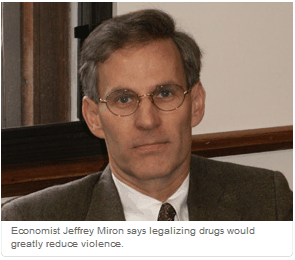
Legalize drugs to stop violence

Jeffrey A. Miron, senior lecturer in economics at Harvard University, at CNN:

ScreenHunter_06 Mar. 28 22.38 Prohibition creates violence because it drives the drug market underground. This means buyers and sellers cannot resolve their disputes with lawsuits, arbitration or advertising, so they resort to violence instead.

Violence was common in the alcohol industry when it was banned during Prohibition, but not before or after.

Violence is the norm in illicit gambling markets but not in legal ones. Violence is routine when prostitution is banned but not when it's permitted. Violence results from policies that create black markets, not from the characteristics of the good or activity in question.

The only way to reduce violence, therefore, is to legalize drugs. Fortuitously, legalization is the right policy for a slew of other reasons.

Prohibition of drugs corrupts politicians and law enforcement by putting police, prosecutors, judges and politicians in the position to threaten the profits of an illicit trade. This is why bribery, threats and kidnapping are common for prohibited industries but rare otherwise. Mexico's recent history illustrates this dramatically.

Prohibition erodes protections against unreasonable search and seizure because neither party to a drug transaction has an incentive to report the activity to the police. Thus, enforcement requires intrusive tactics such as warrantless searches or undercover buys. The victimless nature of this so-called crime also encourages police to engage in racial profiling.

More here.

bad times

Sir-Fred-Goodwins--home-a-001

I find it hard to see any hopeful humane radicalism in the planned protests against the G20 summit. Symbols say it all. Protestors plan to march behind the Four Horsemen of the Apocalypse. The Apocalypse of Saint John in the Bible inspired centuries of social protest in the middle ages. But as historian Norman Cohn demonstrated in his classic book The Pursuit of the Millennium, apocalyptic movements were irrational, violent, and slipped easily into persecution of minorities. Albrect Dürer’s woodcut of the Four Horsemen may be unforgettably vivid, but it is not a manifesto for progress. The cultural roots of Nazism lie in such visceral images. This is no time to be sensationalist. Keeping calm seems like good advice. But behind my nerves is a real and troubling fact. Hopefully this isn’t going to be anything like as bad as the 1930s; but some say it is, and democracy barely survived that era. Looking into the shattered glass of Weimar Germany’s violent art, I feel uneasy.

more from The Guardian here.

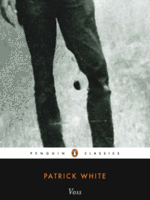
voss and the vivisector

45835033

Patrick White, the first great novelist to come out of Australia, was born in 1912, won the Nobel Prize in 1973, died in 1990 and his work promptly dropped from fashion. His style of narrative-driven psychological modernism seemed outmoded, perhaps, when the highbrow section of the literary marketplace had turned to the exuberant post-modernism of Salman Rushdie and David Foster Wallace, on the one hand, and the differently stylized realisms of Raymond Carver and Alice Munro on the other. A chapter from one of White’s novels, submitted pseudonymously to a list of top publishers in 2007, was rejected by every one of them. White — who was gay, had a gallows wit and self-consciously cast himself as an outsider, both ahead of his times and behind them — would have seen the humor in that. He once said that he had wasted his life writing and should have stuck to “learning to cook properly.”

more from the LA Times here.

THE AGE OF ENTANGLEMENT

Galison-190

With special relativity, Albert Einstein upended the long-understood meaning of time, space and simultaneity. With general relativity, he swapped Newton’s law of gravity based on force for curved space­time, and cosmology became a science. Just after World War I, relativity made front-page news when astronomers saw the Sun bend starlight. Overnight, Einstein became famous as no physical scientist before or since, his theory the subject of poetry, painting and architecture. Then, with the development of quantum mechanics in the 1920s, physics got ­really interesting. Quantum physics was a theory so powerful — and so powerfully weird — that nearly a century later, we’re still arguing about how to reconcile it with Einsteinian relativity and debating what it tells us about causality, locality and realism.

more from the NY Times here.

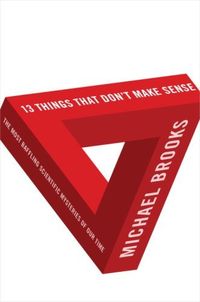
13 Things That Don’t Make Sense

William Leith in The Telegraph:

13 Why, Brooks asks, can’t physicists find a theory to explain how the universe works? Well, the universe contains particles, and these particles are guided by forces. The trouble is that the experts don’t really understand most of the forces and particles. “Almost all the universe is missing,” says Brooks. “Ninety-six per cent, to put a number on it.” Brooks surmises that there must be hugely powerful forces we don’t know about – or, to use the scientific term, “dark matter”. We know this – or, at least, we think we know this – because we don’t understand how gravity works.

Don’t we? Not really. In our solar system, we know that the Earth travels around the Sun faster than, say, Neptune for a simple reason: the Earth is closer, and is therefore subject to stronger gravitational force. But look at galaxies a little further out, and the same thing does not happen. In the Coma cluster of galaxies, objects at the edge are moving faster than they should. That must be because they are being held in place by something. Dark matter, almost certainly. Which might be just another way of saying, “we don’t know”.

Adding to the list of uncertainty, Brooks asks another question: what is life? Again, scientists don’t know. There are inanimate objects. And then there are living things. “But no scientist on Earth can tell you where the fundamental difference between these two states lies.” One definition might be that living things reproduce themselves. But then, so do some non-living things, such as computer viruses. And some living things, such as mules, do not.

More here.