Ananya Vajpeyi reads Wendy Doniger’s capacious study of the diversity of Hindu tales and traditions, which serves as a riposte to the self-appointed guardians of Indian culture by celebrating the multiple varieties of Hindu religious experience.
From The National:
 From ancient times men have dominated the world of Sanskrit scholarship. Originally those men were Brahmins; then they became Europeans, then Englishmen, and finally Indians. It is only in the past 50 years or so that women have begun to enter this esoteric field of study, and in this regard, Wendy Doniger has been a pioneer and a force to reckon with. Her new book, The Hindus: An Alternative History brings 30 years of her rigorous and innovative scholarly practice to a fitting climax – and I use the word advisedly. Doniger has studied Hinduism in its erotic, aesthetic and corporeal aspects, making her the target of envy as well as criticism from her colleagues. Her work, which includes a translation of the Kamasutra and extensive writing on Shiva, the Hindu god of cosmic destruction, who is worshipped in the form of a phallus (linga), is often seen to be titillating. She is interested in asceticism, but also in sexuality; in the spiritual, but also in the carnal.
Hindu traditions are diverse and heterodox enough to incorporate a number of parallel doctrines, theologies and belief systems, as well as an enormous repertoire of deities, symbols, rituals and concepts that contradict one another and yet coexist. Doniger’s openness to the varieties of religious experience permitted under the accommodating and multifarious rubric of Hinduism has upset all manner of people, from devout Hindus, to the votaries of Hindu nationalism (“Hindutva”), from American professors to German philologists. Nearly all of them misunderstand her work, particularly her creative ways of exploring how Hindu thought connects mind, body and soul, rather than placing them in conflict with each other.
More here. [Thanks to Namit Arora.]
Wednesday, September 9, 2009
David G. Victor and Richard K. Morse in the Boston Review:
 All fossil fuels emit carbon dioxide when burned, but the real heart of the warming problem is coal. Emissions from coal are growing faster than from any other fossil fuel. Beyond greenhouse-gas pollution, coal is linked to a host of other environmental troubles such as local air pollution, which is why a powerful coalition of environmentalists in the richest and greenest countries is rallying to stop coal. Mired in opposition, barely any new coal plants are being built anywhere in the industrialized world. Coal, it may seem, is on the precipice.
Yet coal remains indispensable. No other fuel matches its promise of cheap and abundant energy for development. About half the electricity in the United States comes from burning coal. Germany, the anchor of old Europe’s economy, is a coal country. Poland, the heart of new Europe, gets 90 percent of its electricity from coal. The fast-growing economies of Asia, in particular China and India, are all coal-fired. Indeed, while the outlook for coal consumption in the industrialized world is flat, soaring Asian growth is expected nearly to double world consumption by 2030.
The central task of any serious (and politically viable) global-warming policy, then, is to reconcile these diverging patterns.
More here.
Amanda Stern in Lessons in Curating. Lessons in Culture:
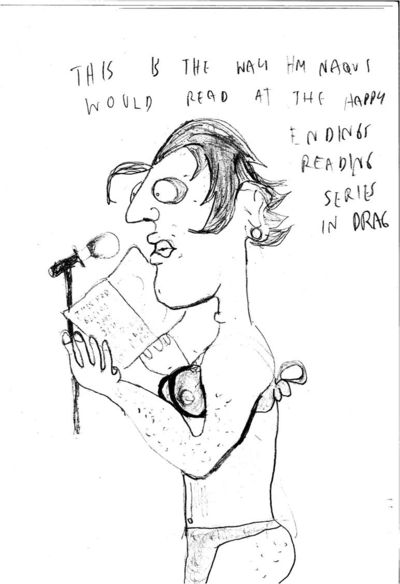
I asked the author,
Akhil Sharma to conduct a
One Word Celebrity Interview with
Husain Naqvi (author of
Home Boy). Granted, Husain cheats a little, stretching out those one words, but we'll cut him some slack because he's nice and wrote a good book.
(1) Your book is about the adventures and misadventures of several young Pakistani men. They basically want to drink and get laid and they come into conflict with their elders and also with the US government, both of whom have pre-conceived ideas of what it means to be a young Pakistani male. Did the plot, which has the feel of a picaresque adventure, come about as a result of these young men being shoved by these forces with their preconceived ideas?
A: Yes.
…
(11) Did you begin writing the novel with the idea that you were writing a novel or was it a short story that got longer and longer?
A: Slam (poem).
(12) You wrote this book in Cambridge, a town of tremendous affluence, while you and wife lived in a single room on very little money. How did you manage to slog through the years that it took to write the book?
A: Pasta, Ativan.
(13) You have now been living in Karachi for a little over a year and expect to be there for another year or so. Your book, in many ways, feels very American, young immigrants rejecting the ways of the “old country”. Has your conception of your book changed since you moved back to Karachi? Have certain colors in the book dimmed to your eyes and others brightened?
A: Brightened…
Even before the elections last November, particularly astute conservatives had lamented that many of the supposed victories for their cause were in truth nothing to celebrate. Most of these persons were paleo- or traditional conservatives, who saw in the Bush administration little that was genuinely conservative and much that testified to the further usurpation of the word “conservative,” and of the Republican Party by a neoconservative agenda. That agenda was largely repugnant to those who believed in local and limited government founded on enduring cultural traditions, stable and self-sustaining communities, and, above all, the Christian intellectual legacy which informs all things by means of faith and reason. They, naturally, saw even less to admire in the candidacy of John McCain. But the traditional and neo-conservative animus was not then and is not now reducible to competing definitions of “conservative” or even to competing public policy platforms. When, at the 1992 Republican National Convention, Patrick Buchanan, that arch paleo-conservative, railed that America was locked in a culture war, his observation was perspicuous but generally understood in unhelpful ways. The media and even most admirers of Buchanan drew the lines in that war between an abstract conservative theory of culture on the one hand and those who “manufacture” culture in our society, the culture industry mostly located in Hollywood and New York. As such, the culture war appeared to be little more than disgruntlement of the heartland against the coasts, of consumers against retailers, of passive recipients against makers, or, at best, armchair theorists against commercially successful practitioners, the categories of whose success went undisputed.
more from James Matthew Wilson at First Principles here.

There is a familiar story about a sad and lonely man filling up an entire house with bric-a-brac until he is obliged to crawl about inside it like a mole, searching for an unfilled corner. Collecting can develop into a disease. Grander collections demand endless money to feed the infection, but the symptoms are similar: an inability to throw anything away, a reluctance to organise what has already been bought in the mad drive to collect still more, and a pathological secretiveness. Henry Wellcome, renowned philanthropist and founder of a pharmaceutical empire, filled whole warehouses with crates of his purchases. Every crate was packed in turn with numerous objects – hundreds of pestles and mortars, dozens of spears, pillboxes, jujus, naïve paintings, African masks, stone tools. He wanted to collect the entire history of mankind. It all started modestly enough. The history of medicine was a neglected topic at the end of the nineteenth century. Inspired by the contemporary burgeoning of natural history and anthropological museums, Wellcome wished to create an exhibition laying out the story of medical treatment through the objects of the trade. The Wellcome Historical Medical Museum eventually opened in June 1913 in Wigmore Street, to general acclaim.
more from Richard Fortey at Literary Review here.
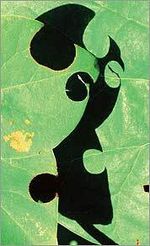
While compiling images for a guidebook to invertebrates and their tracks, Western Massachusetts-based biologist Noah Charney began entertaining an unscientific notion. Looking at the complicated patterns created by bees as they excised circular patches from leaves, the delicate arrangement of tiny hatchmarks made by a slug chewing its way across an algae-covered branch, or the radiating paths marking the progress of beetles through the bark of a fallen log, he made an observation: it looked like the bugs were making art. We’re often helpless (even those of us, like Charney, with a master’s degree in biology) against a tendency to anthropomorphize nature: we’re forever seeing rock formations that look like faces, or animal behaviors that remind us of our own. Suspending his disbelief, Charney put together an online gallery of photos devoted to the question of invertebrate aesthetics. The question was, if insects are artists, what kind of artists are they?
more from Roger White at the Boston Globe here.
From The Guardian:
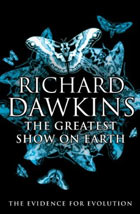 If Thomas Henry Huxley was famously “Darwin's bulldog”, then Richard Dawkins is probably best described as “Darwin's pit bull”. He gets his teeth into an argument, locks on and shakes it until submission is the only option. There's a certain glee when he admits to being “the devil's disciple” or the high priest of “ultradarwinism”, and his admission has an undeniably macho swagger about it. Real men (and women) take the toughest line on natural selection. Suffering and pain in nature and humanity are merely there to service the genes. Anything else is “Sentimental, human nonsense. Natural selection is all futile.” There is something bracing about belonging to this most astringent and clear-sighted set. Deluded theists! Wishy-washy agnostics! Welcome to the Fight Club. One is reminded of lines by Dawkins's favourite poet, WB Yeats: “Cast a cold eye / On life, on death. / Horseman, pass by.”
The greatest story is, of course, the story of evolution. This latest addition to the Dawkins canon is his summary of the vast array of evidence supporting the science. Palaeontology, embryology, anatomy, genetics, artificial breeding and geography are all grist to his evolutionary mill. Dawkins's writing demonstrates once again his consummate skill as an explainer. He never makes assumptions about prior knowledge; when he chooses an analogy it does actually cast light on the thing to be explained (some scientists seem to find this extraordinarily difficult); and occasionally he coins a brilliant phrase. Those who have already climbed Mount Improbable with him or contemplated the blind watchmaker will not be disappointed, even though some of the same ground has been re-ploughed for a new crop.
More here.
From Scientific American:
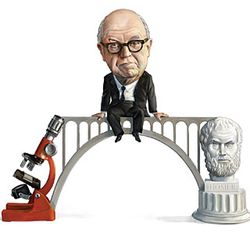 Earlier this summer marked the 50th anniversary of C. P. Snow’s famous “Two Cultures” essay, in which he lamented the great cultural divide that separates two great areas of human intellectual activity, “science” and “the arts.” Snow argued that practitioners in both areas should build bridges, to further the progress of human knowledge and to benefit society.
Alas, Snow’s vision has gone unrealized. Instead literary agent John Brockman has posited a “third culture,” of scientists who communicate directly with the public about their work in media such as books without the intervening assistance of literary types. At the same time, many of those in the humanities, arts and politics remain content living within the walls of scientific illiteracy.
More here.
Phil Plait on Barack Obama's speech to schoolchildren yesterday, in Bad Astronomy:
 Seriously, read this whole speech. It’s inspiring, wonderful, and designed to inspire kids to stay in school, accept the responsibility of the education, learn things, and then go and and do good for the world.
Of course, there is a lunatic fringe in this country who will go ballistic about Obama no matter what he does; these are the ones saying the speech is indoctrinating children into accepting his socialist health care plan that will mutilate puppies and convert our elderly into Soylent Green. These people may be rabid racists, or simply mentally unbalanced, but we know for a rock solid fact that these people are utterly, completely wrong. Whatever you want to call them, it’s clear they are so far from the norm of the American people that they can’t even see the horizon from where they are. Simply reading the speech transcript shows that simply and clearly. But it’s also a fact that this subset of the population will always be with us.
But you know what? That doesn’t mean we have to give them a voice in the mainstream press. They have a right to their speech, but that doesn’t obligate anyone to pay attention to them, especially on the platform of national TV. I’m looking you right in the eye, Fox News. Not only do you give these people — factually wrong and provably so — a voice, you reiterate their comments and use your own voice to back them up.
This sort of thing mainstreams a view that is charitably called crazy. Again, I urge you to read Obama’s actual speech. It’s awesome, and something every kid should see and hear.
More here.
Ben Zimmer in Word Routes:
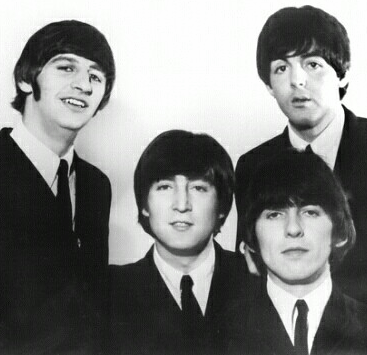 Today is a big day for Beatles fans: the band's entire catalog is being reissued in digitally remastered form, and the video game “The Beatles: Rock Band” is also set for release. And what better day than 09/09/09, considering the band's love of the number nine (enneaphilia?), from “The One After 909” to “Revolution No. 9.” In honor of the latest wave of Beatles nostalgia, I've been mulling over a bit of nonsense from the fertile mind of John Lennon: the timeless chant heard in “I Am the Walrus,” “Goo goo goo joob.”
Originally released as the B-side of “Hello Goodbye” and as a track on the Magical Mystery Tour album in November 1967, “I Am the Walrus” has been an endless source of lyrical debate. And that's just how Lennon wanted it: he reputedly constructed the song to be as confusing as possible, in order to keep the Beatle-ologists busy. The chorus of the song goes, “I am the eggman, They are the eggmen, I am the walrus, Goo goo goo joob.” The “walrus,” Lennon later confirmed, was an allusion to the Lewis Carroll verse, “The Walrus and the Carpenter,” from the children's classic Through the Looking-Glass. It's believed that the “eggman” is a nod to the character of Humpty Dumpty in the same book. But what of “goo goo goo joob” (also transcribed as “goo goo ga joob” or “goo goo g'joob”)?
One widely circulated tidbit is that Lennon was inspired by James Joyce's Finnegans Wake while writing the song.
More here.
Tuesday, September 8, 2009
Zaneb K. Beams in the Baltimore Sun:
 On Tuesday, September 1, I participated in House Majority Leader Steny Hoyer's town hall meeting on health care as a panelist. Despite some audience disruption the discussion was productive and comments and questions favored some type of health care reform two to one. More importantly, six major themes came up. The six common concerns were:
How will the legislation ensure better coverage for youth and families? How will tort reform help control health care expenditures? How will the legislation help small businesses? Will the plan pay for coverage of illegal aliens? Can we find a bipartisan solution? If and when our nations health care juggernaut is reformed, how will we find the doctors to care for the 47 million Americans who are currently uninsured?
I am a pediatrician in Prince Georges and Howard counties, and I live with these questions every day. I treat children from birth through 18 years. About 70 percent of my patient visits are by families with Medicaid or some type of government insurance.
Newborns cannot get insurance because their mothers are denied coverage due to pregnancy, which is described as a pre-existing condition. Newborns need frequent care to ensure proper growth and development at a crucial time for brain development, and proposed legislation will address this problem.
More here.
Popular fairy tales and folk stories are more ancient than was previously thought, according research by biologists.
Richard Gray in The Telegraph:
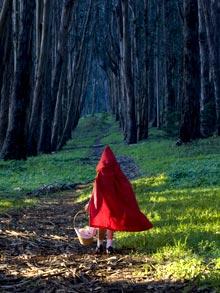 A study by anthropologists has explored the origins of folk tales and traced the relationship between varients of the stories recounted by cultures around the world.
The researchers adopted techniques used by biologists to create the taxonomic tree of life, which shows how every species comes from a common ancestor.
Dr Jamie Tehrani, a cultural anthropologist at Durham University, studied 35 versions of Little Red Riding Hood from around the world.
Whilst the European version tells the story of a little girl who is tricked by a wolf masquerading as her grandmother, in the Chinese version a tiger replaces the wolf.
In Iran, where it would be considered odd for a young girl to roam alone, the story features a little boy.
Contrary to the view that the tale originated in France shortly before Charles Perrault produced the first written version in the 17th century, Dr Tehrani found that the varients shared a common ancestor dating back more than 2,600 years.
More here.
Eric A. Taub in the New York Times:
 LED light bulbs, with their minuscule energy consumption and 20-year life expectancy, have grabbed the consumer’s imagination.
But an even newer technology is intriguing the world’s lighting designers: OLEDs, or organic light-emitting diodes, create long-lasting, highly efficient illumination in a wide range of colors, just like their inorganic LED cousins. But unlike LEDs, which provide points of light like standard incandescent bulbs, OLEDs create uniform, diffuse light across ultrathin sheets of material that eventually can even be made to be flexible.
Ingo Maurer, who has designed chandeliers of shattered plates and light bulbs with bird wings, is using 10 OLED panels in a table lamp in the shape of a tree. The first of its kind, it sells for about $10,000.
He is thinking of other uses. “If you make a wall divider with OLED panels, it can be extremely decorative. I would combine it with point light sources,” he said.
Other designers have thought about putting them in ceiling tiles or in Venetian blinds, so that after dusk a room looks as if sunshine is still streaming in.
More here.
Possibly as an act of vengeance, a history professor–compiling, verbatim, several decades' worth of freshman papers–offers some of his students’ more striking insights into European history from the Middle Ages to the present.
Anders Hendriksson in the Wilson Quarterly:
 History, as we know, is always bias, because human beings have to be studied by other human beings, not by independent observers of another species.
During the Middle Ages, everybody was middle aged. Church and state were co-operatic. Middle Evil society was made up of monks, lords, and surfs. It is unfortunate that we do not have a medivel European laid out on a table before us, ready for dissection. After a revival of infantile commerce slowly creeped into Europe, merchants appeared. Some were sitters and some were drifters. They roamed from town to town exposing themselves and organized big fairies in the countryside. Mideval people were violent. Murder during this period was nothing. Everybody killed someone. England fought numerously for land in France and ended up wining and losing. The Crusades were a series of military expaditions made by Christians seeking to free the holy land (the “Home Town” of Christ) from the Islams.
In the 1400 hundreds most Englishmen were perpendicular. A class of yeowls arose. Finally, Europe caught the Black Death. The bubonic plague is a social disease in the sense that it can be transmitted by intercourse and other etceteras. It was spread from port to port by inflected rats. Victims of the Black Death grew boobs on their necks. The plague also helped the emergance of the English language as the national language of England, France and Italy.
More here.
The Goths
I love them. They bring a little antilife and uncolour
to the Corn Exchange on city centre shopping days,
as if they had all just crawled out of that Ringu well,
so many Sadakos in monochrome horror, dripping
silver jewellery down flea-market undead fashions.
They are the black that is always the new black;
their perfume lingers, freshly-turned-grave sweet.
Black sheep, they pilgrimage twice a year to Whitby
through our landscape of dissolved monastery and pit,
which they will toast in cider’n’blackcurrant, vegan blood.
They danse macabre at gigs like the Dracula Spectacula.
Next day, lovebitten and wincing in the light, they take
photographs of each other, hoping they won't develop.
by Ian Duhig
from: Jericho Shanty
Publisher: Picador, London, 2009
From The Guardian:
 In 1969, Philip Roth's most famous character, the sex-obsessed Alexander Portnoy confessed to his analyst: “What I'm saying, Doctor, is that I don't seem to stick my dick up these girls, as much as I stick it up their backgrounds – as though through fucking I will discover America.” That was 40 years ago, but the reverberations are still being felt. Portnoy's Complaint, which the New Yorker greeted as “one of the dirtiest books ever published”, helped Roth shake off any lingering respectability he had earned from his early novels. “Enough being a nice Jewish boy, publicly pleasing my parents while privately pulling my putz!” cried Portnoy from his analyst's couch. As he did so, Roth was denounced by leading Jewish figures, while critics went wild and the novel became an instant bestseller. The respectable boy from Newark, New Jersey had embarked on his lifelong work refining what has been called his art of immaturity.
More here.
Carl Zimmer in The New York Times:
 Throughout his life, Charles Darwin surrounded himself with flowers. When he was 10, he wrote down each time a peony bloomed in his father’s garden. When he bought a house to raise his own family, he turned the grounds into a botanical field station where he experimented on flowers until his death. But despite his intimate familiarity with flowers, Darwin once wrote that their evolution was “an abominable mystery.”
Darwin could see for himself how successful flowering plants had become. They make up the majority of living plant species, and they dominate many of the world’s ecosystems, from rain forests to grasslands. They also dominate our farms. Out of flowers come most of the calories humans consume, in the form of foods like corn, rice and wheat. Flowers are also impressive in their sheer diversity of forms and colors, from lush, full-bodied roses to spiderlike orchids to calla lilies shaped like urns.
More here.
Our own Kris Kotarski in the Calgary Herald:
 It is increasingly apparent that modern copyright law is utterly and completely incompatible with the right to privacy. This is at the core of the Pirate movement in Europe which broke through to elect its first members of the European Parliament this summer, and the Pirate Party of Canada, which is collecting signatures on its website to register as an official political party as we speak.
While the name may sound a little humorous, the cause is very serious indeed. Whether you spend a lot of time online or not, the Pirate movement aims to keep the bounds of your and your children's relationship with their government in a reasonable place, and to make certain that the balance between citizen rights and the bottom line does not tilt in the wrong direction.
What has changed? Before home computers, compact discs and Internet file sharing, it was conceivable for copyright laws to be enforced in a manner that did not bring the state to any-one's doorstep. If there was an illegal copy of a book in a bookshop, one could report it to the authorities. If someone brought a video camera into a theatre or a concert, they could be readily seen.
Given today's technological realities, this is no longer the case.
More here.
