In light of Iran: “Politics is a matter of sorting things out once and for all then after a time doing it again.” ……………………………………….………—Akbar McCarthy
Under the Capitol Dome Carl Sandburg
There are those who speak of confusion today as if yesterday there was order rather than confusion.
There are those who point to confusion today as though if given a chance they could tomorrow transform it into order.
There are those who find benefits in confusion and make it a labor of delight to render any confusion more confounded.
There are those who expect today’s confusion to be followed by another tomorrow, the two confusions being different from each other.
The confusions of being born are followed by the confusions of how to live until a final moment when a stilled heart holds release complete and absolute from all former and earlier confusions.
When one confusions transforms itself into another there has been a death and a birth though the newborn confusion becomes known only across time and silence.
When a confusion results from seeing what is not all there it is an identical twin of the confusion to follow the hearing of what is not all there.
When a witness says there was confusion in what he saw and he can’t therefore be sure of what he saw, he may be a strictly honest witness.
A fine sunrise or an elegant sunset achieves moving colors and masses of changing light in a properly organized confusion.
….The orderly marches of the night stars and constellations when looked at by powerful telescopes …..hold flagrant and flaming confusions.
Michael Arditti takes the title of his new novel from Voltaire: “The best is the enemy of the good.” Arditti writes with the same compassion and humanity as Voltaire, but without the biting satire. The Enemy of the Good is an engaging exploration of contemporary manners that is tragic and comic: a mild and forgiving book about the damage that vehement religious ideas do to ordinary lives. The novel is set in contemporary Britain: Gordon Brown is Prime Minister, deportation and asylum laws are draconian, and religious conviction of all varieties seems stronger than ever. There are four parts: the first and last centred on Clement Granville, a gay HIV-positive artist in his forties; and two middle sections, one devoted to Clement’s sister, Susannah, the other to his mother, Marta.
The Granville family is the unconventional kind that traditionally appears in English novels. Clement’s father, Edwin, now in his eighties, is a retired bishop with a stately home that has been passed down the generations. His wife, Marta, originally a Polish refugee and Holocaust survivor, is a retired Oxford don. Clement had a twin, Mark, who died in early adulthood, and 18 years later the family is still grieving. Mark’s widow, Clara, and two children belonging to a deceased former boyfriend of Susannah’s, are all part of the extended family circle. There are echoes of Evelyn Waugh’s Brideshead Revisited in the way Arditti explores faith through the complicated, genteel Granville family. But whereas Waugh focused on Roman Catholicism, Arditti ranges across a wide spectrum of religious belief: Anglicanism, Islam, Buddhism and Judaism are all brought into the story.
Homosexual behavior seems pointedly un-Darwinian. An animal that doesn't pass along genes by mating with the opposite sex at every, well, conceivable opportunity, seems to be at an evolutionary disadvantage. So what’s in it for the 450-plus species that go for same-sex sex? Two evolutionary biologists from University of California, Riverside, set out to answer that question in a paper published today in Trends in Ecology and Evolution. “It's been observed a lot,” says Nathan Bailey, a post-doctoral researcher at U.C. Riverside and lead study author, of same-sex sexual behavior in animals. “But it took people a long time to put it in an evolutionary context.”
After studying dozens of published articles on the topic, Bailey and his colleague Marlene Zuk concluded that, in addition to being an adaptational strategy, “these behaviors can be a force,” Bailey said. “They create a context in which selection can occur [differently] within a population.” In the Laysan albatross, for example, previous research has shown that a third of all bonded pairs in a Hawaii colony are two females. This behavior helps the birds, whose colony has far more females than males, by allowing them to share parenting responsibilities. It also gives more stability to the offspring of males, already bonded to a female, who mate opportunistically with females in a same-sex couple. Such a dynamic, then may force gradual changes in behavior and even physical appearance of the birds, the authors note.
Picture: Male chinstrap penguins, such as the famous Roy and Silo of the Central Park Zoo, have paired and even cared for eggs.
The long-standing Middle East correspondent for The Independent, Robert Fisk, is defying the government crackdown on foreign media reporting in Iran.
From ABC News (Australia):
It was interesting that the special forces – who normally take the side of Ahmadinejad's Basij militia – were there with clubs and sticks in their camouflage trousers and their purity white shirts and on this occasion the Iranian military kept them away from Mousavi's men and women.
In fact at one point, Mousavi's supporters were shouting 'thank you, thank you' to the soldiers.
One woman went up to the special forces men, who normally are very brutal with Mr Mousavi's supporters, and said 'can you protect us from the Basij?' He said 'with God's help'.
It was quite extraordinary because it looked as if the military authorities in Tehran have either taken a decision not to go on supporting the very brutal militia – which is always associated with the presidency here – or individual soldiers have made up their own mind that they're tired of being associated with the kind of brutality that left seven dead yesterday – buried, by the way secretly by the police – and indeed the seven or eight students who were killed on the university campus 24 hours earlier.
Quite a lot of policeman are beginning to smile towards the demonstrators of Mr Mousavi, who are insisting there must be a new election because Mr Ahmadinejad wasn't really elected. Quite an extraordinary scene.
There were a lot of stones thrown and quite a lot of bitter fighting, hand-to-hand but at the end of the day the special forces did keep them apart.
I haven't ever seen the Iranian security authorities behaving fairly before and it's quite impressive.
Our youth, hoping to see their rightful will fulfilled, came on the scene and waited patiently. This was the greatest occasion for the government’s officials to bond with their people.
But unfortunately, they used it in the worst way possible. Declaring results that no one in their right mind can believe, and despite all the evidence of crafted results, and to counter people protestations, in front of the eyes of the same nation who carried the weight of a revolution and 8 years of war, in front of the eyes of local and foreign reporters, attacked the children of the people with astonishing violence. And now they are attempting a purge, arresting intellectuals, political opponents and Scientifics.
Now, based on my religious duties, I will remind you :
1- A legitimate state must respect all points of view. It may not oppress all critical views. I fear that this lead to the lost of people’s faith in Islam.
2- Given the current circumstances, I expect the government to take all measures to restore people’s confidence. Otherwise, as I have already said, a government not respecting people’s vote has no religious or political legitimacy.
3- I invite everyone, specially the youth, to continue reclaiming their dues in calm, and not let those who want to associate this movement with chaos succeed.
4- I ask the police and army personals not to “sell their religion”, and beware that receiving orders will not excuse them before god. Recognize the protesting youth as your children. Today censor and cutting telecommunication lines can not hide the truth.
Before Nelson’s pillar trams slowed, shunted, changed trolley started for Blackrock, Kingstown and Dalkey, Clonskea, Rathgar and Terenure, Palmerston park and upper Rathmines, Sandymount Green, Rathmines, Ringsend and Sandymount Tower, Harold's Cross. The hoarse Dublin United Tramway Company's timekeeper bawled them off:
— Rathgar and Terenure! — Come on, Sandymount Green! Right and left parallel clanging ringing a doubledecker and a singledeck moved from their railheads, swerved to the down line, glided parallel. — Start, Palmerston park!
Just about this time of day, 105 years ago, Leopold Bloom, the fictional ad-salesman antihero of James Joyce’s Ulysses, heard those words as he was stopping into the offices Weekly Freeman and National Press, the next stop on his day’s perambulations around “Dear Dirty Dublin.” Why should you care?
As developments proceed in the next few days, I would keep a close eye on the following:
1) Will the planned recount go ahead, and or will Mousavi succeed in forcing a revote? While the latter still seems very unlikely, it would be an extremely significant development, demonstrating that the position of Khamenei is much weaker than we thought only a few days ago.
2) Will the security forces in Iran move beyond what they are doing now – basically low levels of violence and apparently detaining opposition leaders – and unleash a more concentrated show of force (e.g., something in the spirit of what happened in Tiananmen Square or Andijan, Uzbekistan)?
3) Will the Iranian authorities take further steps to shut down technological means of communication being utilized by the opposition, such as text messaging and Twitter?
4) Can the opposition continue to deliver large numbers of people into the streets as the protests head towards a second week? One of the truly fascinating things about the Orange Revolution in Ukraine was the sheer number of days that people continued to protest, even in the dead of winter.
Also of interest at the Monkey Cage, Henry Farrell and John Sides on Twitter and organized political resistance.
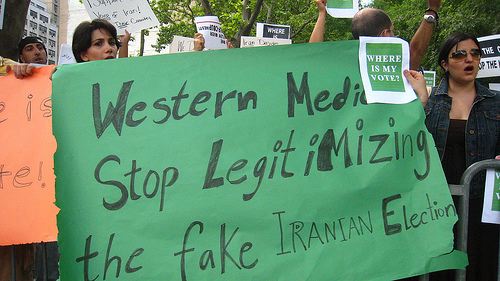
A sort of pernicious cliché has entered our discussion of Iranian politics, namely that the Western press cannot be trusted because American reporters are too lazy to leave North Tehran and too dazzled by the appearance of a vocal minority of upper-class Iranians who are congenial to our self-image. We believe Iran is overrun with people who think like we do, the argument goes, because these are the people who talk to us. It is true that the movements of American reporters in Iran are controlled and curtailed to the point where Tehran is the main, if not the only, point of access, apart from the hard-line holy city of Qom. I cannot speak for all American journalists who report from Iran, but I’m sure I’m not the only one who is acutely aware of, and frustrated by, the lack of insight into the rural heartland this affords us. The best that we can do is to familiarize ourselves with the full spectrum of urban life, across class and cultural boundaries. Most Iranians, after all, live in cities, of which Tehran is only the most gigantic.
It is from this reporting that I have written, in this magazine and elsewhere, that the urban poor had ceased to be a reliable constituency for Ahmadinejad. They were in 2005. But by 2006, it was hard to find a South Tehrani who was pleased with the outcome of that vote or prepared to vote for him again. Why? Because under Ahmadinejad, the country’s economic crisis deepened in ways that hit urban populations—both the poor and the middle class—harder than anyone.
The obvious evidence of fixing, fraud, and force to one side, there is another reason to doubt that an illiterate fundamentalist like Mahmoud Ahmadinejad could have increased even a state-sponsored plebiscite-type majority. Everywhere else in the Muslim world, in every election in the last two years, the tendency has been the other way. In Morocco in 2007, the much-ballyhooed Justice and Development Party wound up with 14 percent of the vote. In Malaysia and Indonesia, the predictions of increased market share for the pro-Sharia parties were likewise falsified. In Iraq this last January, the local elections penalized the clerical parties that had been making life a misery in cities like Basra. In neighboring Kuwait last month, the Islamist forces did poorly, and four women—including the striking figure of Rola Dashti, who refuses to wear any headgear—were elected to the 50-member parliament. Most important of all, perhaps, Iranian-sponsored Hezbollah was convincingly and unexpectedly defeated last week in Lebanon after an open and vigorous election, the results of which were not challenged by any party. And, from all I hear, if the Palestinians were to vote again this year—as they were at one point supposed to do—it would be highly improbable that Hamas would emerge the victor.
Yet somehow a senile and fanatical religious clique that has failed even to condition the vote in a country like Lebanon, where it has proxy and surrogate parties under arms, is able to reward itself by increasing its “majority” in a festeringly bankrupt state where it controls the media and enjoys a monopoly of violence. I think we should deny it any official recognition of this consolation. (I recommend a reading of “Neither Free Nor Fair: Elections in the Islamic Republic of Iran” and other productions of the Abdorrahman Boroumand Foundation. This shows that past penalties for not pleasing the Islamic Guardian Council have included more than mere disqualification and have extended to imprisonment and torture and death, sometimes in that order.
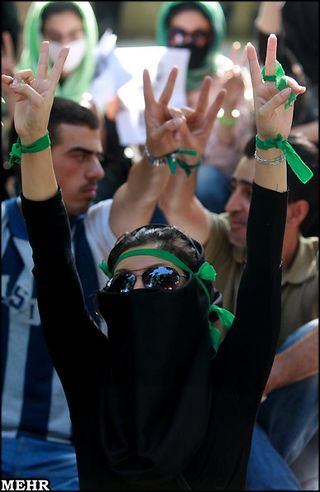
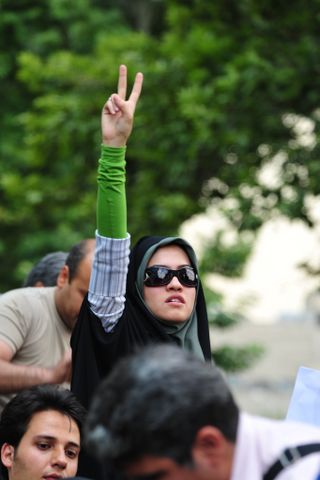
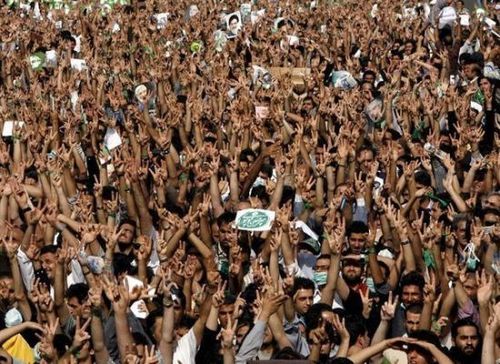
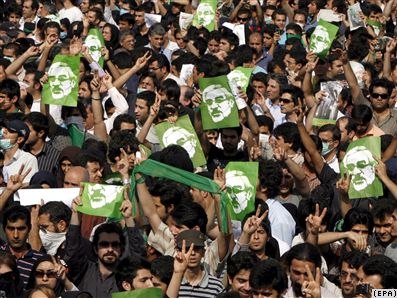
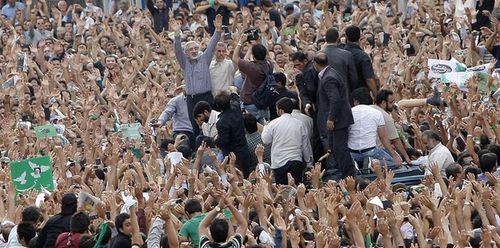
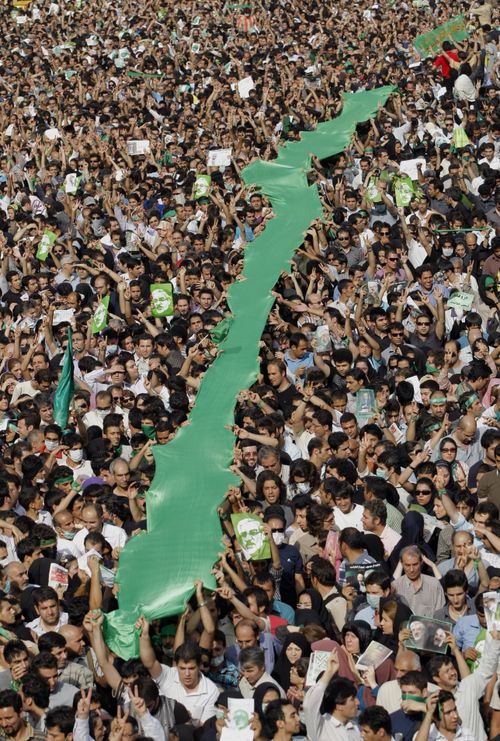
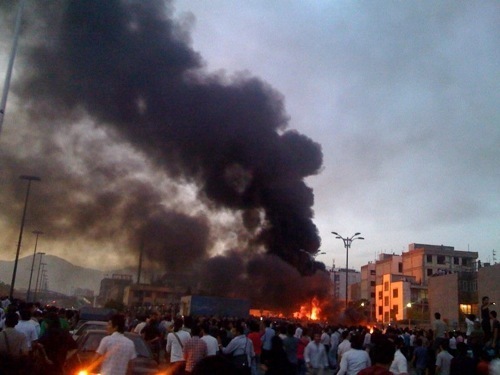
TEHRAN — In silence they moved, a vast throng, hundreds of thousands of people, down the street called Revolution. President Mahmoud Ahmadinejad had called his opponents mere “dust.” Well, said one student, “We will blind him with our dust.” This was the day followers of Mir Hussein Moussavi, the reformist candidate defeated in Iran’s disputed presidential elections, rose up en masse to protest the theft of their votes. “Quiet! Quiet!” they shouted, arms raised and fingers forming a “V” for victory that they pointed at a lonely police helicopter overhead. Moussavi himself, not seen since the night of the election, appeared on Revolution Square, answering a question much debated here in recent days: Will he lead what he started? For the first time, I saw traffic police smiling at the crowd. Even the black-clad elite riot police were impassive. “Raise your arms, raise your arms,” one man murmured to them. If the regime had hoped to quell Iran’s powerful democratic stirring with a massive show of force since last Friday’s vote, it failed to do so.
Venice was settled originally by refugees fleeing the barbarian hordes—who, apparently, didn’t like water. But that was then. This week, Swoon, a 31-year-old Brooklyn artist whose name is Caledonia “Callie” Curry, is leading a waterborne invasion of the Venice Biennale (she didn’t bother to try to get in officially) with a crew of 30 artists, musicians, and miscreants in tow. Though they have raised some $150,000 for this crash party, the money won’t show in the boats they’ll travel in, because the boats are made of trash—a symbol of the freedom that comes with radical self-reliance, and one that is meant to effect change. “Throughout history, pranksters have been looking at fences and then pushing them aside,” Swoon has said (the name came to an ex-boyfriend in a dream, in which he imagined her future as a graffiti artist long before her career began). “Through action, you can move the perception. It’s almost like a magic trick.” Swoon and her group are emissaries from a specific underground culture: the bike-riding, Dumpster-diving, anarchist street-art movement that has flourished in Bushwick, Greenpoint, and areas near the Gowanus Canal over the past decade.
more from Vanessa Grigoriadis at New York Magazine here.
ON AUG. 10, 1996, a single power line in western Oregon brushed a tree and shorted out, triggering a massive cascade of power outages that spread across the western United States. Frantic engineers watched helplessly as the crisis unfolded, leaving nearly 10 million people without electricity. Even after power was restored, they were unable to explain adequately why it had happened, or how they could prevent a similar cascade from happening again – which it did, in the Northeast on Aug. 14, 2003. Over the past year we have experienced something similar in the financial system: a dramatic and unpredictable cascade of events that has produced the economic equivalent of a global blackout. As governments struggle to fix the crisis, experts have weighed in on the causes of the meltdown, from excess leverage, to lax oversight, to the way executives are paid. Although these explanations can help account for how individual banks, insurers, and so on got themselves into trouble, they gloss over a larger question: how these institutions collectively managed to put trillions of dollars at risk without being detected. Ultimately, therefore, they fail to address the all-important issue of what can be done to avoid a repeat disaster. Answering these questions properly requires us to grapple with what is called “systemic risk.”
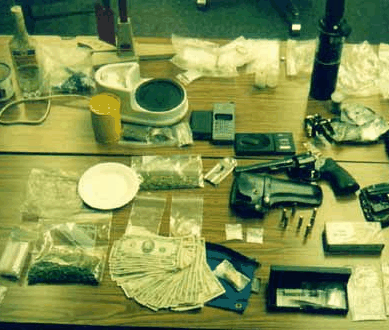
Here in the United States, four decades of drug war have had three consequences:
First, we have vastly increased the proportion of our population in prisons. The United States now incarcerates people at a rate nearly five times the world average. In part, that’s because the number of people in prison for drug offenses rose roughly from 41,000 in 1980 to 500,000 today. Until the war on drugs, our incarceration rate was roughly the same as that of other countries.
Second, we have empowered criminals at home and terrorists abroad. One reason many prominent economists have favored easing drug laws is that interdiction raises prices, which increases profit margins for everyone, from the Latin drug cartels to the Taliban. Former presidents of Mexico, Brazil and Colombia this year jointly implored the United States to adopt a new approach to narcotics, based on the public health campaign against tobacco.
Third, we have squandered resources. Jeffrey Miron, a Harvard economist, found that federal, state and local governments spend $44.1 billion annually enforcing drug prohibitions. We spend seven times as much on drug interdiction, policing and imprisonment as on treatment. (Of people with drug problems in state prisons, only 14 percent get treatment.)
Some 3.9 billion years ago, a shift in the orbit of the Sun’s outer planets sent a surge of large comets and asteroids careening into the inner solar system. Their violent impacts gouged out the large craters still visible on the Moon’s face, heated Earth’s surface into molten rock and boiled off its oceans into an incandescent mist. Yet rocks that formed on Earth 3.8 billion years ago, almost as soon as the bombardment had stopped, contain possible evidence of biological processes. If life can arise from inorganic matter so quickly and easily, why is it not abundant in the solar system and beyond? If biology is an inherent property of matter, why have chemists so far been unable to reconstruct life, or anything close to it, in the laboratory? The origins of life on Earth bristle with puzzle and paradox. Which came first, the proteins of living cells or the genetic information that makes them? How could the metabolism of living things get started without an enclosing membrane to keep all the necessary chemicals together? But if life started inside a cell membrane, how did the necessary nutrients get in?
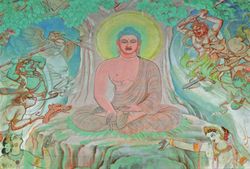
Buddha is said to have wooed his future wife by reeling off a huge number series.
In a world divided by culture, politics, religion and race, it is a relief to know one thing that stands above them — mathematics. The diversity among today's mathematicians shows that it scarcely matters who invents concepts or proves theorems; cold logic is immune to prejudice, whim and historical accident. And yet, throughout history, different families of humans have distilled the essence of the cosmos to capture the magic of numbers in many ways.
Mathematics in India shows just how different one of these ways was, and how culture and mathematical development are intimately connected. This carefully researched chronicle of the principal contributions made by a great civilization covers the earliest days of Indian history through to the beginning of the modern period. Regrettably, it stops short of the legendary mathematician Srinivasa Ramanujan (born 1887), whose name is still seen in today's research papers.
Kim Plofker's book fulfils an important need in a world where mathematical historiography has been shaped by the dominance of the Greco-Christian view and the Enlightenment period. Too little has been written on the mathematical contributions of other cultures. One reason for the neglect of Indian mathematics was Eurocentrism — British colonial historians paid it little attention, assuming that Indians had been too preoccupied with spiritual matters to make significant contributions to the exact sciences. Another reason is that many ancient Indian mathematical texts have long been extinct; often, the only indication that they existed comes from scholars who refer to the work of their predecessors. As Plofker wryly notes, two historians of Indian maths recently published articles in the same edited volume, wherein the estimates of their subject's origins differed by about 2,000 years.
I AM UNDER EXTREME PRESSURE TO ACCEPT THE RESULTS OF THE SHAM ELECTION. THEY HAVE CUT ME OFF FROM ANY COMMUNICATION WITH PEOPLE AND AM UNDER SURVEILLANCE. I ASK THE PEOPLE TO STAY IN THE STREETS BUT AVOID VIOLENCE
Via Andrew Sullivan, who is covering events very comprehensively (much better than the MSM) here.
BBC (whose reporters are being protected from the police by demonstrators) has live reports from Tehran here.
The Telegraph: Unconfirmed reports that leaked election results show Mahmoud Ahmadinejad came third, here.
The Huffington Post: Live blogging the uprising, here.
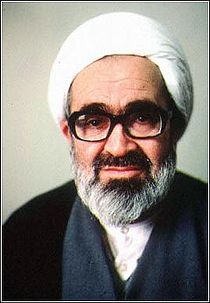
Grand Ayatollah Sanei in Iran has declared Ahmadinejad's presidency illegitimate and cooperating with his government against Islam. From Andrew Sullivan.
Al-Jazeera: Moussavi addresses tens hundreds of thousands of supporters, says he will fight in new elections, if called. More here.
Leave links to any kind of direct reporting out of Iran in the comments.
I'll be updating this page frequently, and adding stuff at the bottom as the day goes on.
Support the Uprising!
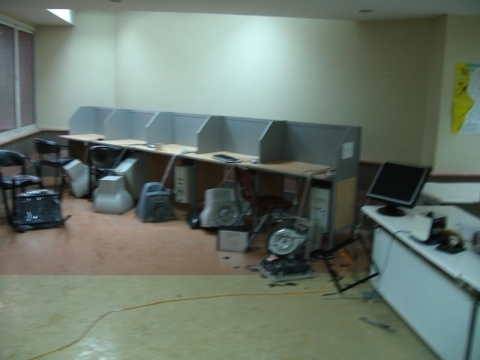
Security forces target computers in dorm raid at Tehran university:
Press TV is now reporting on “hundreds of thousands” in today’s rally from Enqelab Square to Azadi Square, protesting the outcome of the Iranian election. The gathering is in defiance of the Ministry of Interior’s refusal to give a permit. So far, based on video and on the correspondent’s report, the rally appears to be peaceful and calm.
Just to bring home the significance of the previous item, Press TV is state-owned media. Until this morning, it has given almost no attention to the protests against Ahmadinejad’s election. The sudden change to in-depth, even effusive coverage of the demonstrations points to a wider political shift: whether this is in line with a “compromise” accepting the legitimacy of the claims of the protests (and, beyond that, the appeal to the Guardian Council) remains to be seen.
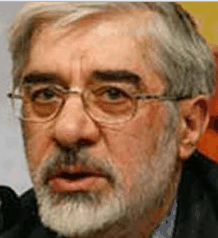
Moussavi appears:
The BBC: Millions protest in iran against election fraud in Iran:
Tweets coming out of Iran (again, via Andrew Sullivan):
“Mousavi now, 'these masses were not brought by bus or by threat. they were not brought for potatoes. they came themselves'”
“Tens of thousands of protestors are chanting 'No fear, No fear, we are with each other.'”
“It's worth taking the risk, we're going. I won't be able to update until I'm back. again thanks for your kind support and wish us luck.”
“Grand Ayatollah Saanei accompanies today's anti Ahmadinejad rally.”
“These people are not seeking a revolution,” said Ali Reza, a young actor in a brown T-shirt who stood for a moment watching on the rally’s sidelines. “We don’t want this regime to fall. We want our votes to be counted, because we want reforms, we want kindness, we want friendship with the world.”
12:43 PM ET — Cracks in the armor.“A source tells us that least one state run media channel has shown pictures of the protests and announced that Mousavi would be at the rally, which indicates that some in the media arerefusing marching orders.”
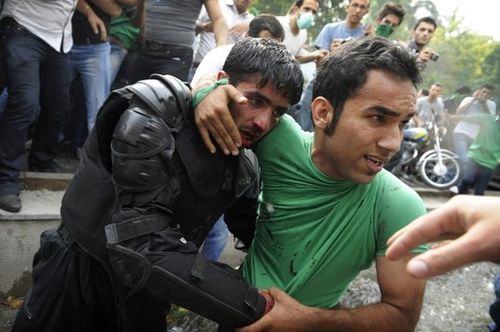
12:44 PM ET — At least one reported dead.ABC'sJim Sciutto: “sev reports of pro-govt militia firing on protesters, AP photog reports one protester dead”
From emailer Susan: @kapanak: Eyewitness relative from North Tehran just got back to me. District One and Three are in total Chaos.
12:47 PM ET — AP files.“TEHRAN, Iran (AP) — AP photographer sees pro-government militia fire at opposition protesters, killing at least 1.”
More from @persiankiwi: people are running in streets outside. There is panic in streets.people going ino houses to hide.
12:53 PM ET — More people shot?Emailer Walt sends a link tothis site, which is claiming (in Farsi) that she saw half a dozen hit by gunfire. I have seen no evidence corraborating this. But I note it because she also includes new cell photos from the scene:
And via Andrew Sullivan (who is providing amazing coverage of these events in real time):
Tehran University's Faculty Resigns En Masse
119 members of Tehran University faculty have resigned en-masse as a protest to the attack on Tehran University dorms last night. Among them is Dr Jabbedar-Maralani, who is known as the father of Iranian electronic engineering. They have asked for the resignation of Farhad Rahbari the appointed president of Tehran University, for his incompetence in defending the University's dignity and student lives.
3:10 PM ET — Back to basics.An Iranian civics lesson, in comic form, for those who are just getting interested in this. Via emailer Moazzam-Doulat, BBC has aninteractive version.
And now, Barack, “It would wrong for me to be silent,” walks the fine line perfectly:
And a good article in Salon (thanks to Zara Houshmand) is here.
McDonald wanted to test a hypothesis that the difference in cancer rates between the species could be due to differences in the way their cells self-destroy themselves — an important biological process known as programmed cell death or apoptosis.
The researchers saw that some of the genes for apoptosis were expressed differently in humans than in chimps, and their data suggests that human cells are not as efficient at carrying out programmed cell death as chimp cells, at least in the brain and other studied tissues.
What does apoptosis have to do with cancer?
Reduced amounts of apoptosis have been associated with an increased risk of cancer. Also, several genes involved in apoptosis are thought to “malfunction” in cancer cells. This makes sense: cancer cells divide uncontrollably and somehow seem to override the signal to self-destruct.
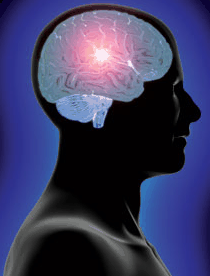
And what does that have to do with a large brain? During human evolution, it is thought that people were naturally selected for larger brains and increased cognition. There is also another hypothesis that to get these larger brains, we needed to have a high rate of neuron synthesis.