Sunday Iqbal Bano Special

Iqbal Bano, who died a few days ago, was one of Pakistan's most famous and beloved singers. She was expecially known for ghazal singing, and in particular for singing the ghazals of Pakistan's most famous and beloved poet, Faiz Ahmed Faiz. Thanks to my sister, Atiya, I had the privilege of meeting her after a concert once in New York City, and she was as imperious and gracious as I had imagined she would be.

UPDATE 4/27/09: There's a very informative post about Iqbal Bano by Fawad Zakaria here.

Here I have chosen a few videos of her, beginning and ending with poems by Faiz:

Searching for My Pakistani Identity

From Broken Mystic:

Flag It started off funny. I was at the mall buying a birthday gift for a friend of mine and, as usual, the store manager was friendly and conversational. After she took a good look at my gift, the following conversation took place:

    MANAGER: Aww, is this for your girlfriend?

    ME: She’s not my girlfriend.

    MANAGER: That’s an awful lot of money for just a friend.

    ME: (smiles) Well, maybe you can lower the price for me.

She laughed as she scanned the item through. Another customer approached the counter and waited patiently. She decided to chime in:

    CUSTOMER: Ooh, you’re buying gifts!

    ME: (smiles) Yeah, it’s for my friend’s birthday.

    CUSTOMER: Aww, that’s so romantic, your girlfriend is going to Love it.

    ME: She’s not my girlfriend.

    CUSTOMER: Hmm, maybe she’s a special friend!

I laughed at how both of them were teasing me while I waited for the manager to package the gift. The manager was really helpful that day, so I asked her if there was a number I could call to give her an “outstanding” customer service rating. She showed me the number on the receipt and thanked me for asking. As the manager wrote her name on the receipt, the customer waiting in line caught me off guard with an unexpected question:

“What country are you from?”

For some reason, the question struck me in an odd way, as if it triggered an alarm in my head and sprung forth countless things I’ve been ruminating about over the past few weeks. It wasn’t a new question at all. I have brown skin; it’s easy to notice, so I understood. People ask me where I’m from all the time, but it was different now. Almost immediately, I thought about the current crisis in Pakistan, I thought about the corrupt Pakistani president Asif Zardari, I thought about the Taliban taking control of Swat Valley – a beautiful place that I visited once – and I thought about the U.S. drone attacks in Pakistan and my sheer frustration with Obama’s foreign policy. Even though it only took me about two seconds to respond, I still had more thoughts and feelings swell inside me. I feared that disclosing my nationality would disrupt the friendly interaction I had with the manager and customer. I worried that their response would be offensive or ignorant and that I would go home feeling like an “outsider.” It was too late for that. And it wasn’t their fault.

“Pakistan,” I said slowly with an unfamiliar discomfort in my voice.

More here.

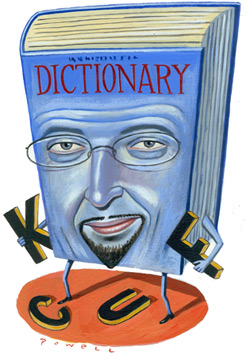
In Defense of Common English

Ben Yagoda in the Chronicle of Higher Education:

English Not long ago, I took part in a panel discussion at the Free Library of Philadelphia. My fellow panelists were two linguists and a lexicographer. Anyone who knows any linguists and lexicographers will be unsurprised to hear that their position on usage was descriptive rather than prescriptive: They were interested in charting and interpreting recent and historical changes in the way English is written and spoken, not interested in labeling those changes as “mistakes,” and even less interested in decrying such so-called errors as evidence of a decline in American civilization.

At the end of our conversation, there was time for questions from the sizable audience. The first questioner stood up and said (I paraphrase), “It always drives me crazy when people use 'impact' as a verb. How can we abolish that?”

The panelists hemmed and hawed, murmuring sweet nothings like “the language changes” and “functional shifting.”

More here.

Saturday, April 25, 2009

Twice-Sold Tales

William Cannon in American Scientist:

The_Oxford_Book_of_Modern_Science_Writing THE BEST AMERICAN SCIENCE AND NATURE WRITING 2008. Edited by Jerome Groopman. Series editor, Tim Folger. xx + 330 pp. Houghton Mifflin, 2008. $14 paper.

THE BEST AMERICAN SCIENCE WRITING 2008. Edited by Sylvia Nasar. Series editor, Jesse Cohen. xvi + 316 pp. Harper Perennial, 2008. $14.95 paper.

THE OXFORD BOOK OF MODERN SCIENCE WRITING. Edited by Richard Dawkins. xviii + 419 pp. Oxford University Press, 2008. $34.95.

People unlucky enough to have been born with the rare genetic disorder Lesch-Nyhan syndrome (nearly all are male) live in fear of attacking themselves uncontrollably with their own hands and teeth. Gifted science journalist Richard Preston gives voice to their otherwise silent suffering in “An Error in the Code,” an article from The New Yorker that is included in The Best American Science Writing 2008. Preston introduces us to two Lesch-Nyhan patients he has befriended who have bitten off their lips, chewed their fingers to the bone and attempted to rip off their noses. I was so riveted by the details of their stories that I was barely aware that I was learning science as I read.

I was less enthralled by the rest of this anthology. Its editor, Sylvia Nasar (the author of A Beautiful Mind), teaches journalism at Columbia and was once an economics correspondent for the New York Times. So it should perhaps come as no surprise that in this collection of articles from 2007 she focuses on “what was in the news and on people’s minds” that year (health and the environment, she says, not math and physics). Many of the articles concern medicine, health policy and the shenanigans of the pharmaceutical industry. The reporting is first-rate and powerfully documented. But by and large, storytelling like Preston’s is difficult to find in these pages.

Not so for The Best American Science and Nature Writing 2008, edited by Jerome Groopman. Groopman’s collection is more eclectic than Nasar’s and is a far better book.

More here. [I have Dawkins' book and it is indeed a brilliant collection.]

About-Face

Feature_3635_story Adam Kirsch reviews Michael Kimmage's The Conservative Turn: Lionel Trilling, Whittaker Chambers, and the Lessons of Anti-Communism, in Nextbook:

There is no shortage of books about the New York intellectuals—the mostly Jewish circle of writers clustered around Partisan Review—and their ideological schisms. But Kimmage offers a new perspective on this familiar story by focusing on an unlikely pair of protagonists. Lionel Trilling and Whittaker Chambers could not have been more different in terms of personality and background. Trilling, the child of Eastern European Jewish immigrants, was a quintessential New Yorker, who spent his whole career at Columbia University; Chambers, a WASP from Long Island, came to see New York as a symbol of America’s decadence, preferring to live on a remote farm in Maryland. Trilling wrote magisterial literary essays for Partisan Review; Chambers wrote blunt polemical articles for Time Magazine. Most important, Trilling was a reserved, professorial figure, while Chambers was a man of action, a Communist spy turned anti-Communist prophet who figured in one of the most scandalous trials of the century.

Yet The Conservative Turn shows that, from the time they met as classmates at Columbia in the 1920s, Trilling and Chambers followed similar intellectual courses. In the early 1930s, with America sunk in the Depression and fascism on the march in Europe, they were among the many American leftists who turned to the Soviet Union for inspiration. The appeal of Communism was especially strong to American Jews, who saw in Russia’s “great experiment” the promise of a world without poverty, injustice, or prejudice, including anti-Semitism. Hadn’t Lincoln Steffens, the crusading liberal journalist, visited the Soviet Union and proclaimed, “I have the seen the future and it works”?

For Trilling, becoming a fellow traveler was primarily an intellectual commitment, not a practical one. He did nothing more to advance the revolution than joining a Communist front organization, the National Committee for the Defense of Political Prisoners, and writing some pro-Soviet book reviews. Chambers was much more deeply involved in the Communist cause. After joining the Party, he became a secret agent for the Kremlin, helping to organize a spy ring among mid-level New Deal bureaucrats in Washington D.C. He even tried to recruit Lionel and Diana Trilling, asking if they would help him by acting as a “drop” for secret messages. They declined, not wanting to follow Chambers so far into the realm of espionage.

But in the mid-1930s, both Trilling and Chambers underwent a crisis of conscience about Communism.

thames & hudson

Couple-art_524624p

During the late Thirties, some of Britain’s most distinguished architects, artists, musicians, film-makers and others, many of them Jewish, arrived on our shores with their meagre belongings having escaped from the Nazi threat in continental Europe. Many of them made their homes here and went on to leave a lasting mark on our intellectual and cultural life. Britain reaped a rich reward for its tolerance. These émigrés later helped to create the Glyndebourne and the Edinburgh Festivals, the magazine Picture Post and the Royal Festival Hall. Sir Ernst Gombrich, author of the classic The Story of Art, was director of the Warburg Institute of the University of London; Sir Nikolaus Pevsner systematically documented the significant buildings of England, and the philosopher Sir Karl Popper, the historian Eric Hobsbawm and many others became important figures in our cultural landscape. Among them were two refugees from Vienna, Walter Neurath and Eva Feuchtwang. Walter had fled with his wife Marianne to London in 1938 and Eva had come later that year with her second husband, Wilhelm, fleeing Berlin on the last train out, just hours before the Gestapo came to pick them up.

more from the London Times here.

duke elric

46472735

Maybe it’s the books we read when we’re young that stick with us the longest. That’s the time when books not only excite us, but seem to tell us about ourselves and our futures. As a teenager I read (wallowed in and feasted upon, really) Tolkien, Evelyn Waugh, Emily Brontë, Jane Austen, “Great Expectations” and “David Copperfield,” “Crime and Punishment,” “The Great Gatsby,” P.G. Wodehouse and Kafka. A predictably unstructured and non-academic bag, I guess. I also read, with mounting glee, and seized from different corners of the bookstore when my mother wasn’t watching, the paperbacks of Michael Moorcock, especially those concerning the doomed prince Elric. I didn’t even know, back then, that Moorcock was already becoming one of the greatest British fantasy writers, the heir to Mervyn Peake, nor that his “Elric” books belonged to the “sword and sorcery” genre; and only later, as sword and sorcery swept like a virus through movies and games and into the digital universal, did I understand that I’d read works whose influence would prove to be immense — strange and exhilarating stories from someone at the top of his game. Moorcock is a master, and though he’s written more carefully, and more beautifully, and with much more high-minded purpose (in “Gloriana” and “Mother London” for instance, or the dazzling quartet of books concerning the dandy Jerry Cornelius), he’s never quite slammed home runs as outrageous as these.

more from the LA Times here.

the verse of Sherod Santos makes Logan want to put his hand into the whirring blade of a lawn mower

Ford-190

“Our Savage Art,” the latest installment in William Logan’s prolonged and rumbustious assault on the state of American poetry, comes furnished with no fewer than nine epigraphs in which the phrase “savage art” appears. One of these is taken from the second chapter of James Fenimore Cooper’s “Last of the Mohicans”: an unsuspecting party of white travelers, including a pair of sisters, is passing through a gloomy forest unaware that they are being secretly observed by “a human visage, as fiercely wild as savage art and unbridled passions could make it.” “A gleam of exultation,” Cooper continues, “shot across the darkly painted lineaments of the inhabitant of the forest, as he traced the route of his intended victims, who rode unconsciously onward.” One can’t help imagining Logan ripping open a freshly arrived Jiffy-Bag of review copies of slim volumes with a similar kind of exultant gleam shooting across his lineaments; and certainly many a poet over the last few decades must have felt a bit like one of Cooper’s hapless heroines, tied to the stake, war whoops in the ears, a blurred, scalp-hungry tomahawk glinting in the sun, as they absorbed the bad news about their latest collection in one of the hilariously damning New Criterion verse chronicles in which the savage critic biannually vents his spleen.

more from the NY Times here.

Cambodia Targets Opposition MP

MuSochua Mu Sochua is a Nobel peace prize nominee for her work on sex trafficking and senior MP in the main opposition party Sam Rainsy Party (SRP). She is also one of the subjects of the documentary play Seven Women. She recently filed a law suit against Prime Minister Hun Sen for comments made in a national radio broadcast during he referred to her as a 'cheung chat', a cross between hustler and a prostitute. She was suing for an apology and a symbolic sum equivalent to 15 Australian cents. In response, the Prime Minister Hun Sen's Justice Minister has charged her with gravely defaming the PM, which carries a prison term. (Here is the Australia Broadcasting Company story on the whole affair, and here is the story in The Daily Beast).

An email from Mu Sochua:

Between 1975-79 over 1 million Cambodian women, men and children, were killed by the Khmer Rouges, among them my parents. The world community knew about it but watched from afar. Cambodia has come out of genocide and on the road to reconstruction but this stage of reconstruction is stuck and in many ways fast falling back to point zero.30 years after the genocide of the Khmer Rouge, Cambodia has made some progress but too small. Over 2,000 innocent Cambodian women die every year of childbirth, at least one million Cambodian children go to bed hungry every night, hundreds of thousands Cambodian children and female youth are ruined in brothels, over 200,000 families have been brutally forced of their land and homes, and over 75% of Cámbodia's forests have now been destroyed. Innocent lives of my people could be saved if justice were served, if top leaders of my broken nation were less greedy, if development were meant for all.

Read more »

INSIDE THE TALIBAN’S ‘GRAVE ERROR’

From MSNBC:

Fateh “The Taliban finally made a grave error,” said Javed Siddiq, editor of the influential Urdu language daily Nawa-e-Waqt. “Once they challenged Pakistan’s constitution as un-Islamic, Islamic scholars and the Pakistani people no longer saw them as the self-styled defenders of Islam against western infidels – but infidels themselves who want to dismantle the Pakistani state.” Siddiq said that challenging the constitution was a wrong step and believes it has backfired. Pakistan’s constitution was carefully forged by a board of Islamic scholars in 1973 – every tenet was crafted to make sure it conformed to the principals of Islam. “Now, all the different sects of the Sunni and Shiite, the religious scholars, the army, the politicians and every Pakistani is against the Taliban,” Siddiq said. “They have lost.” The Taliban were quick to sense their blunder and the resulting sea change in the country. “The expansion into Buner was the turning point,” said Siddiq.

‘No ordinary Taliban commander’
It was soon after the Taliban signed the February peace agreement with the Pakistani government that Commander Fateh began to plan the militants’ move into Buner. “I saw Swat as an opening for us,” Fateh told NBC News in a recent interview. “I knew if I planned well, we would be able to advance little by little, hopefully in a peaceful way, and gradually enforce Islam in the valley.” Fateh, a 33-year-old native of Swat, rose up through the ranks of Taliban fighters after almost 15 years of fighting in Afghanistan. The somber-looking commander, who is married with three sons, is considered to be an accomplished military strategist, often brilliant in battle, according to Taliban commanders in the region. With the bearing of a de-facto prince exacting homage from his subjects, Fateh, whose name means victorious in Urdu, rode into Buner last Monday in the back seat of a black Toyota pick-up truck. Taliban fighters flanked his vehicle and brandished Kalashnikovs at the throngs of locals who had come out to catch a glimpse of him.

Fateh was meticulously turned out in a silky black turban that hung low on his clean, pressed tunic. He wore expensive-looking light brown leather ankle boots, and his long black beard gave off a heady smell of musk-scented oil in the afternoon sun. “This was no ordinary Taliban commander,” said an NBC cameraman, who caught up with Fateh in Buner. “Most of them are scruffy. This guy was different. I wanted to ask him where he got his shoes.”

More here.

I want my country back

Sehar Tariq in The News International:

Talib Today we legislated that a group of criminals would be in charge of governing and dispensing justice in a part of Pakistan according to their own obscurantist views. They have declared that the rulings of their courts will be supreme and no other court in the land can challenge them. They have also declared that their men that killed and maimed innocent civilians, waged war against the Pakistani army and blew up girls schools will be exempt from punishment under this law. A law that does not apply equally to all men and women is not worthy of being called a law. Hence today we legislated lawlessness.

What was most disturbing was the quiescence of the Parliament to this legislation. The utter lack of debate and questioning of this ridiculous legislation was appalling. The decision was not informed by any independent research or expert testimony, and to my knowledge none of the parliamentarians are authorities on matters of security, rule of law or regional conditions in Swat. This signals disturbing possibilities. Either our politicians are too afraid to stand up to criminals or maybe they don't possess the foresight to gauge the national impact of this action. There is no hope for a country led by cowards or fools.

How can one be hopeful about the political future of a country where the will and the wisdom of politicians becomes hostage to the threats of barbarians? How can I be optimistic about a country where doyens of the media like Ansar Abbasi hear the collective silence of the parliamentarians as the resounding support of the people of Pakistan, but are deaf to the threats issued by the Taliban to anyone opposing the legislation? How can I feel secure in a country where the army, despite receiving the largest chunk of our resources, cannot defeat a bunch of thugs? How can I expect justice when there are different laws for different citizens, and I as a woman am a second class citizen? How can I be inspired by a country where there is no culture, no music, no art, no poetry and no innovative thought?

How can I be expected to return to a country where women are beaten and flogged publicly, where my daughters will not be allowed to go to school, where my sisters will die of common diseases because male doctors cannot see them? How can I be expected to call that country home that denies me the rights given me by my Constitution and religion? I refuse to live in a country where women like me are forced to rot behind the four walls of their homes and not allowed to use their education to benefit the nation. By endorsing the NAR and giving in to the Taliban, Parliament has sapped my hope and optimism. Parliament has dealt a deathly blow to the aspirations of the millions of young Pakistanis who struggle within and outside the country, fuelled by sheer patriotism, for a peaceful, prosperous and progressive Pakistan.

When there is no hope, no optimism, no security, no justice, no education, no progress, no culture – there is no Pakistan. Maybe it is because I am the grandchild of immigrants who was raised on stories of hope, patriotism and sacrifice that even in this misery I cannot forget that Pakistan was created to protect the lives, property, culture and future of the Muslims of the Subcontinent. It was not established to be a safe haven for terrorists. We fought so that we could protect the culture of the Muslims of the Subcontinent, not so that we could import the culture of Saudi Arabia. Our ancestors laid down their lives so that the Muslims of the Subcontinent – both men and women – could live in a land free of prejudice, not so that they could be subjected to violent discrimination of the basis of sect and gender.

More here. (Note: Thanks to dear friend Abha Pandya.)

Saturday Poem

In Praise of Dreams
Wislawa Szymborska

In my dreams
I paint like Vermeer van delft.

I speak fluent Greek
and not just with the living.

I drive a car
that does what I want it to.

I am gifted
and write mighty epics.

I hear voices
as clearly as any venerable saint.

My brilliance as a pianist
would stun you.

I fly the way we ought to,
i.e., on my own.

Falling from the roof,
I tumble gently to the grass.

I’ve got no problem
breathing under water.

I can’t complain:
I’ve been able to locate Atlantis.

It’s gratifying that I can always
wake up before dying.

As soon as war breaks out,
I roll over to my other side.

I’m a child of my age,
but I don’t have to be.

A few years ago
I saw two suns.

And the night before last a penguin,
clear as day.

translated from the Polish by Stanislaw Baranczak & Clare Cavanagh
from: View With a Grain of Sand; Harcourt Brace, 1993

Friday, April 24, 2009

How to Understand the Disaster

Robert Solow reviews Richard Posner's A Failure of Capitalism, in the NYRB:

Judge Posner evidently writes the way other men breathe. I have to say that the prose in this book often reads as if it were written, or maybe dictated, in a great hurry. There is some unnecessary repetition, and many paragraphs spend more time than they should on digressions that seem to have occurred to the author in mid-thought. If not exactly chiseled, the prose is nevertheless lively, readable, and plainspoken. The haste may have been justified by the pace of the events he aims to describe and explain. Posner has an extraordinarily sharp mind, and what I take to be a lawyerly skill in argument. But I also have to say that, in some respects, his grasp of economic ideas is precarious. In his book on public intellectuals, Posner blames the decline of the species on the universities and their encouragement of specialization. I may be acting out that conflict. Remember that even hairsplitting is not so bad if what is inside the hair turns out to be important.

The plainspokenness I mentioned is what makes this book an event. There is no doubt that Posner has been an independent thinker, never a passive follower of a party line. Neither is there any doubt that his independent thoughts have usually led him to a position well to the right of the political economy spectrum. The Seventh Circuit is based in Chicago, and Posner has taught at the University of Chicago. Much of his thought exhibits an affinity to Chicago school economics: libertarian, monetarist, sensitive to even small matters of economic efficiency, dismissive of large matters of equity, and therefore protective of property rights even at the expense of larger and softer “human” rights.

Read more »

Making Extra Dimensions Disappear

MattJohnson Matt Johnson in Cosmic Variance:

Extra dimensions. Sounds preposterous at first. Well, perhaps more accurately, it sounds preposterous to most people who don’t do high-energy theory. But, really I assure you, there are many well-motivated reasons why us wacky theorists like to ponder the existence of extra dimensions.

For one, as shown long ago by Kaluza and Klein, it is possible to get Maxwell’s equations of electromagnetism in four dimensions by taking 5 dimensional General Relativity and wrapping one of the spatial dimensions up in a circle too small to see. The smaller the circle is, the harder it is to move in this “other direction,” and so there is no danger in getting lost on the way home. In this way, Maxwell’s equations have an elegant geometrical origin and gravity and electricity & magnatism are combined into one force (5 dimensional gravity).

Another strong motivation comes from string theory, which is only a consistent quantum theory of gravity if there are 10 or 11 dimensions in total. Again, since we don’t see them, it is necessary to hide the existence of the extra dimensions. Inspired by the fact that it was possible to hide one extra dimension by wrapping it up in a circle, generally the extra 6 or 7 dimensions are thought to be “compactified” into a very small compact geometry like a sphere or a torus.

At this point, the five-year-old in the audience is insistently asking, “If you have all these extra dimensions, and you are telling me that they are wrapped up into this tiny ball, how did they get wrapped up in the first place? Why are the four dimensions we see so large, and the others so small?”

The book everyone wishes they’d written

Kant

What is the best book for those who want to learn how to read English poetry? Were the ancient Greeks passionate and conflicted or just coldly rational (and why should we care)? How should we interpret landscapes, from Pembrokeshire to Papua New Guinea? And where can we find the most authoritative analysis of what is going on between men and women, not least within universities? To answer such questions, Times Higher Education asked leading scholars – in disciplines ranging from anthropology and architecture to social policy and international relations – to select a title from their personal canon. Their reflections are an inspirational introduction to a weekly series that will in time cover most of the academic landscape. Our writers were asked to choose a key text that defined their subject, set their personal academic agendas or even changed their lives. A single formative reading experience can often launch a long and distinguished academic career.

more from Times Higher Education here.