Remembering the Past is Like Imagining the Future

Sean Carroll in Cosmic Variance:

Because of the growth of entropy, we have a very different epistemic access to the past than to the future. In retrodicting the past, we have recourse to “memories” and “records,” which we can take as mostly-reliable indicators of events that actually happened. But when it comes to the future, the best we can do is extrapolate, without nearly the reliability that we have in reconstructing the past…

Mri-schacter

As it turns out, the way that the human brain goes about the task of “remembering the past” is actually very similar to how it goes about “imagining the future.” Deep down, these are activities with very different functions and outcomes — predicting the future is a lot less reliable, for one thing. But in both cases, the brain goes through more or less the same routine.

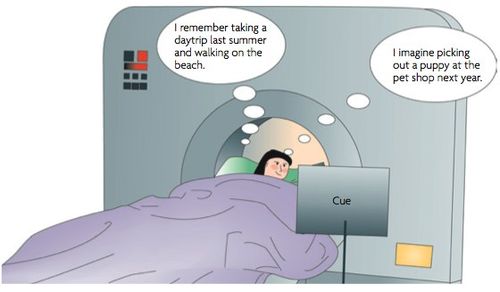
Doing_double_duty That’s what Daniel Schacter at Harvard and his friends have discovered, by doing functional MRI studies of brains subjected to different kinds of cues. (Science News report, Nature review article, Charlie Rose interview.) Subjects are inserted gently into the giant magnetic field, then asked to either conjure up a memory or imagine a future scenario about some particular cue-word. What you see is that the same sites in the brain light up in both cases. The brain on the left in this image is remembering the past — on the right, it’s concocting an imaginary scenario about the future.
More here.


Iran’s New Revolutionaries

Babak Sarfaraz in The Nation:

Iran students Unlike their wide-eyed parents with their utopias and romanticization of revolutionary violence, the new young revolutionaries are sophisticated and canny. They have few illusions about the magnitude of the problems facing their country or the complexities of living in a highly traditional and religious society. For example, despite the fact that they are overwhelmingly secular, their slogans mingle political and religious themes to avoid alienating the faithful. Their response to Obama's initially measured rhetoric is another sign of a new political sophistication at work: everyone understands that US meddling would be the proverbial kiss of death to the opposition's cause.

In the days and weeks to come, this infant movement will face difficult challenges. It may suffer some setbacks and reversals, but what matters is the experience it has gained. At this stage, it is doubtful that fear alone can contain the rising tide of discontent or return things to the status quo ante.

More here.

Michael Jackson Is Gone, but the Sad Facts Remain

Maureen Orth in Vanity Fair:

Michael_jackson In August 1993, I was on the beach in Nantucket when I was told that Vanity Fair editor Graydon Carter was trying to reach me: Michael Jackson had just been accused of child molestation by a 13-year-old boy. Thus began an odyssey of 12 years in which I wrote five lengthy articles for the magazine about the trials and tribulations of this music icon whose fame had literally deformed him. I spoke to hundreds of people who knew Jackson and, in the course of my reporting, found families who had given their sons up to him and paid dearly for it. I found people who had been asked to supply him with drugs. I even found the business manager who told me on-the-record how he had had to wire $150,000 to a voodoo chief in Mali who had 42 cows ritually sacrificed in order to put a curse on David Geffen, Steven Spielberg, and 23 others on Jackson’s enemies list. I sat through two trials and watched his bizarre behavior on the stand when he said he did not recognize his publicist of a decade. One of the reasons I endured this not-fun circus was that, when I began, I was the mother of a boy roughly the same age as the ones Jackson was so interested in spending the night with. His behavior truly troubled me. Understandably, in the wake of his death, there are those who do not want to hear these sad facts. Yet nothing that Vanity Fair printed was ever challenged legally by Jackson or his associates.

A man who made great music and entertained brilliantly has died. I’ve been told that he had endured an eight-hour rehearsal and was in rare form on the stage the night before his death. I’ve also been told that the lawyers swooped in yesterday to retrieve all the videos that had been made of these rehearsals. I believe the aftermath of his death will probably be as messy as his life was. I loved his music. Offstage, he could not escape his tragic flaw.

Here, in order of their appearance in Vanity Fair, are Maureen Orth’s closely reported articles about the Jackson cases.

No Smiting

Paul Bloom in The New York Times:

Cover-500 God has mellowed. The God that most Americans worship occasionally gets upset about abortion and gay marriage, but he is a softy compared with the Yahweh of the Hebrew Bible. That was a warrior God, savagely tribal, deeply insecure about his status and willing to commit mass murder to show off his powers. But at least Yahweh had strong moral views, occasionally enlightened ones, about how the Israelites should behave. His hunter-gatherer ancestors, by contrast, were doofus gods. Morally clueless, they were often yelled at by their people and tended toward quirky obsessions. One thunder god would get mad if people combed their hair during a storm or watched dogs mate.

In his brilliant new book, “The Evolution of God,” Robert Wright tells the story of how God grew up. He starts with the deities of hunter-­gatherer tribes, moves to those of chiefdoms and nations, then on to the polytheism of the early Israelites and the monotheism that followed, and then to the New Testament and the Koran, before finishing off with the modern multinational Gods of Judaism, Christianity and Islam. Wright’s tone is reasoned and careful, even hesitant, throughout, and it is nice to read about issues like the morality of Christ and the meaning of jihad without getting the feeling that you are being shouted at. His views, though, are provocative and controversial. There is something here to annoy almost everyone.

More here.

Friday, June 26, 2009

Serious Fun

Evan Lerner in Seed Magazine:

ScreenHunter_05 Jun. 27 13.42 “The starting position on video games is skepticism,” said New York Times columnist Nicholas Kristof in his keynote address to this May’s Games for Change Conference in New York City. In its sixth year, the conference is a gathering of developers, academics, and activists intent on using the medium of games for social and educational messages. Kristof was there to discuss his forthcoming social-networking game—an extension of his work on gender inequality and an endorsement of games as something more than mindless entertainment. “I think the way to change that perception is just the record of success in connecting to audiences,” he said.

But on what level are games connecting? The game industry’s roughly $26 billion a year in software sales is on par with Hollywood’s yearly box-office receipts, but the public conception of games remains closer to checkers than to Citizen Kane.

That perception may begin to change next Tuesday when Microsoft Research is slated to release Kodu for Xbox 360. Using terrain-drawing tools and an intuitive graphical programming language, players can design, play, and share a wide variety of 3D games.

More here.

Not Every Child Is Secretly a Genius

Christopher J. Ferguson

ScreenHunter_04 Jun. 27 13.31 A number of scholars, including L.L. Thurstone and more recently Robert J. Sternberg, have argued that intelligence has been defined too narrowly. But Gardner, a professor of cognition and education at the Harvard Graduate School of Education, who won a prestigious MacArthur Foundation “genius award” in 1981, has had enormous influence, particularly in our schools.

Briefly, he has posited that our intellectual abilities are divided among at least eight abilities: verbal-linguistic, logical-mathematical, visual-spatial, bodily-kinesthetic, naturalistic, musical, interpersonal, and intrapersonal. The appealing elements of the theory are numerous.

It's “cool,” to start with: The list-like format has great attraction for introductory psychology and education classes. It also seems to jibe well with the common observation that individuals have particular talents. More important, especially for education, it implicitly (although perhaps unintentionally on Gardner's part) promises that each child has strengths as well as weaknesses. With eight separate intelligences, the odds seem good that every child will be intelligent in one of those realms. After all, it's not called the theory of multiple stupidities.

More here.

The Eclipsed Celebrity Death Club

From New York Magazine:

ScreenHunter_03 Jun. 27 13.18 Farrah is just the latest to join a peculiar group: the Eclipsed Celebrity Death Club.

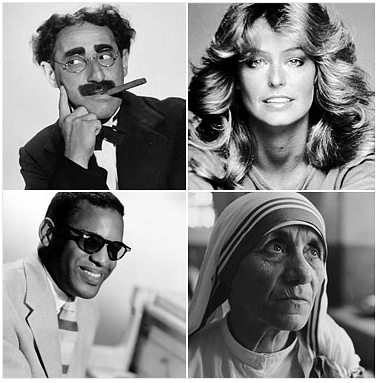
The classic ECD example is Groucho Marx, who passed away the same week as Elvis Presley, and thus missed out on a good week's worth of TV tributes. But the easiest way for a famous person to vanish from the earth without so much as a blip is to follow a president of the United States. Ray Charles caught barely a moment's coverage when he died in 2004, right in the middle of the weeklong blanket coverage of Ronald Reagan's death and funeral. Same story for James Brown, who got some press but definitely ran second to Gerald Ford. (The only person who could square off against a dead head of state, it seems, was Mother Teresa. When she died a few days after Princess Diana, a good deal of the coverage tried to frame them as comparably angelic figures.) And don't forget Alice Trillin—granted, not a worldwide celebrity, but a beloved figure to her husband Calvin's thousands of New Yorker-­reading fans. While awaiting a heart transplant, she died on September 11, 2001, following the horrible deaths of thousands of New Yorkers. Most of her husband's readers only learned about it many months later, when he published About Alice.

More here.

Why are There 60 Minutes in an Hour?

Gary Wallace at Scienceray:

ScreenHunter_02 Jun. 26 15.10 To understand the units of time we need to investigate the number systems of ancient civilizations. How did the Sumerians count to 12 on one hand and to 60 on two? What advances did the Babylonians make and how did they use this number system for measurement? And what refinements did the Egyptians make to time measurement to give us the system we still use today?

It is easy to see the origins of a decimal (base 10) number system. Our hands have 10 digits to count on, so a decimal system follows naturally. With the addition of the toes on our feet a vigesimal (base 20) number system, like that of the Maya, also makes sense. But understanding a sexagesimal (base 60) number system, as used by the Sumerians, takes a little more thought.

A quick glance at a hand shows us four fingers and a thumb that can be used for counting. But the human hand is a complex machine consisting of 27 bones…

Some of these features are evident externally, especially in the fingers. By using the thumb as a pointer, and marking off the distal phalanx, middle phalanx and proximal phalanx of each finger, we can count up to 12 on one hand, as shown [in the photo].

More here.

Science and Religion are Not Compatible

Sean Carroll at Cosmic Variance:

ScreenHunter_01 Jun. 26 14.52Scientifically speaking, the existence of God is an untenable hypothesis. It’s not well-defined, it’s completely unnecessary to fit the data, and it adds unhelpful layers of complexity without any corresponding increase in understanding. Again, this is not an a priori result; the God hypothesis could have fit the data better than the alternatives, and indeed there are still respected religious people who argue that it does. Those people are just wrong, in precisely analogous ways to how people who cling to the Steady State theory are wrong. Fifty years ago, the Steady State model was a reasonable hypothesis; likewise, a couple of millennia ago God was a reasonable hypothesis. But our understanding (and our data) has improved greatly since then, and these are no longer viable models. The same kind of reasoning would hold for belief in miracles, various creation stories, and so on.

More here.

See a psychiatrist? Are you mad?

From The Guardian:

Bentall Richard Bentall, a clinical psychologist, is a controversial figure in the field of mental health. An example of the hostility that his conclusions provoke among those practising conventional (that is, drug-based) psychiatry is given in the preface to this book, which raises serious questions about the treatment of mental illness. Bentall describes an encounter with an amiable-seeming psychiatrist who responds to a talk he has given as follows: “Professor Bentall has told us he is a scientist. But he is not! Nothing that Professor Bentall has said – not one single word – is true.”

The unlikelihood of a professor of psychology delivering, in the sober environment of an NHS conference, a talk in which every word is fictitious and every opinion fallacious gives a flavour of the threat that Bentall's theories pose. The response, as reported, sounds deranged and it is interesting to observe how debate among professionals over the causes of mental illness appears to induce its own version of madness, as if the topic itself were contagious. One sign of sanity, both in the individual and society, is the ability to deal with dissent.

In an earlier book, Madness Explained, Bentall was at pains to distinguish his approach from other anti-psychiatrists – for example, RD Laing, whose radical views were discredited because of his flamboyant lack of rigour and attendant inability to accept criticism. Bentall, as this book attests, is a different kettle of fish. With patient persistence and without recourse to rancorous diatribes, he has appraised the scientific evidence for the success of contemporary psychiatric treatments and come up with a dismal report. It is probably the very balance of his approach that drives his opponents crazy.

More here.

Dreaming of Nonsense: The Evolutionary Enigma of Dream Content

From Scientific American:

Evolutionary-enigma-dream_1 Friday, June 19, 2:12 a.m.: Loading up the trunk of my car with clothes hangers when approached by two transients… try to engage them in good-natured conversation about the benefits of wooden clothes hangers over metal ones, but they make me uneasy, say they want to go out to get a drink but I’ve got to go. In a city somewhere… looks like a post-apocalyptic Saint Louis.

Saturday, June 20, 4:47 a.m.: Was just now trying to return my dead grandmother’s cane to her. Took elevator to her apartment… meant to go to the 8th floor, but elevator lurched up to the 18th floor, swung around violently then shot back down. Could hear voices in the corridors outside elevator shaft…. a mother yelling at her child. Grandma then became my other grandma, also decesased, yet in a nursing home; doctors say she’s doing fine.

Sunday, June 21, 5:02 a.m.: On a floating barge in the sea trying to get to some other country, just made it, the dogs are running all over the place but seem more like rodents.

Monday, June 22, 3.31 a.m.
: Just learned that one of my colleagues died suddenly, everyone’s in shock (they say it was “an accidental overdose of oxygen from a breathing tank; he fell asleep”). Can’t believe it, was just talking to him today about death. Also something about an airplane delay… need to get home but can’t find my test results to submit, searching all over, trash cans, pulling out drawers… people preoccupied.

These are dreams, of course. Mine from the past few days, to be precise—and they are totally absurd. Why on earth do our minds conjure up such ridiculous imagery, such inane thoughts, such spectacularly vivid and surreal landscapes, intense emotions—such narrative trash?

More here.

Thinking About Michael

Andrew Sullivan:

There are two things to say about him. He was a musical genius; and he was an abused child. By abuse, I do not mean sexual abuse; I mean he was used brutally and callously for money, and clearly imprisoned by a tyrannical father. He had no real childhood and spent much of his later life struggling to get one. He was spiritually and psychologically raped at a very early age – and never recovered. Watching him change his race, his age, and almost his gender, you saw a tortured soul seeking what the rest of us take for granted: a normal life.

But he had no compass to find one; no real friends to support and advise him; and money and fame imprisoned him in the delusions of narcissism and self-indulgence. Of course, he bears responsibility for his bizarre life. But the damage done to him by his own family and then by all those motivated more by money and power than by faith and love was irreparable in the end. He died a while ago. He remained for so long a walking human shell.

I loved his music. His young voice was almost a miracle, his poise in retrospect eery, his joy, tempered by pain, often unbearably uplifting. He made the greatest music video of all time; and he made some of the greatest records of all time. He was everything our culture worships; and yet he was obviously desperately unhappy, tortured, afraid and alone.

More here.

Thursday, June 25, 2009

the myth and the man

Mandela

As a new South African permanent resident in April of 1994, I stood in line to vote in the first multiracial elections. I was a small-time activist in Cape Town for the next ten years, so I certainly shared Breytenbach’s brain fever over the “rainbow nation”. The West’s fight against racism and authoritarianism was supposed to find its final triumph here. I dealt with the shock of my disappointment much as Breytenbach did, by nearly going round the bend, although my disappointment went in the opposite direction. It began with facts about Mandela that I learned from his autobiography, Long Walk to Freedom (Little Brown, 1994), and progressed to knowledge of his business dealings when the local investigative magazine noseweek put me on the phone to get dirt. I found myself interviewing a business manager of Mandela’s. This man had told the national and international press that the profits from the sale of lithographs Mandela had signed (but not created, in noseweek’s opinion) went to a children’s charity. We had proof that the money — probably amounting to many millions of dollars — went into a private family trust of Mandela’s, from which he might be making charitable contributions (as anyone might from his own means), although there was no evidence of this that we could find. The manager finally told me that, yes, it was Mandela’s money without restriction — he could spend it all on sweets if he wanted.

more from Sarah Ruden at Standpoint here.

Love, Iranian Style

090629_r18609_p233

Sometimes, the soft literary citizens of liberal democracy long for prohibition. Coming up with anything to write about can be difficult when you are allowed to write about anything. A day in which the most arduous choice has been between “grande” and “tall” does not conduce to literary strenuousness. And what do we know about life? Our grand tour was only through the gently borderless continent of Google. Nothing constrains us. Perhaps we look enviously at those who have the misfortune to live in countries where literature is taken seriously enough to be censored, and writers venerated with imprisonment. What if writing were made a bit more exigent for us? What if we had less of everything? It might make our literary culture more “serious,” certainly more creatively ingenious. Instead of drowning in choice, we would have to be inventive around our thirst. Tyranny is the mother of metaphor, and all that.

more from James Wood at The New Yorker here.

getting to know ida

TLS_Tattersall_578580a

“Ida” is a beautiful fossil. A few weeks ago, she became a very famous one, when the squashed-flat remains of this squirrel-sized creature that lived some 47 million years ago, in quasi-tropical forest around a crater lake in what is now Germany, were pictured on every medium known to mankind. Overcome by exhalations of volcanic gas from the lake’s depths, and apparently already weakened by injury, Ida had fallen in and found herself preserved, along with the bodies of a remarkable variety of other animals, in the accumulating muds of the lake floor. Like us, Ida was a member of the zoological group known as the Primates. Today, there are two major kinds of primate in the world: the very successful “higher” ones, consisting of monkeys and apes along with ourselves; and the now largely marginalized “lower” primates that include the lemurs of Madagascar and the lorises, pottos and bushbabies of the tropical Old World.

more from Ian Tattersall at the TLS here.