
Category: Recommended Reading
Early Risers Are Mutants
Cassandra Willyard in Science:
Don't hate those people who are perky and efficient after only a few hours of sleep. They can't help it. New research suggests that a genetic mutation may explain why some people sleep less.
Researchers don't know exactly why some people do fine with as little as 4 hours of sleep a night, while others need 12. “We've believed for a long time that there's a genetic basis,” says Paul Shaw, a neurobiologist at Washington University in St. Louis, Missouri. But scientists have only recently begun to ferret out which genes are responsible.
In 2001, geneticist Ying-Hui Fu and colleagues identified a mutation in a gene called Per2 that appeared to cause familial advanced sleep-phase syndrome (FASPS). People who have this condition sleep a normal 8 hours, but they go to bed earlier than most people, retiring at 6 or 7 in the evening and waking at 3 or 4 in the morning. “After that was published, a lot of these people [with unusual sleep schedules] came to us,” says Fu, who is now at the University of California, San Francisco. “So we started to collect DNA samples.” The team now has genetic information from more than 60 families.
More here.
Nehru, Jinnah responsible for Partition: Jaswant
Karan Thapar interviews Jaswant Singh in IBN Politics:
Monday sees the publication of a biography of Mohammed Ali Jinnah which challenges the way we in India have seen the founder of Pakistan. It reassess Nehru's role in Partition, it sheds fresh light on the relationship between the Mahatma Gandhi and Jinnah.
Bharatiya Janata Party (BJP) leader Jaswant Singh’s book is likely to attract considerable attention and may be even a fair amount of controversy. Karan Thapar, in a special two-part interview with the author, discusses the book with Singh, a former defence, foreign and finance minister of India and also a former soldier.
Karan Thapar: Mr Jaswant Singh, let's start by establishing how you as the author view Mohammed Ali Jinnah? After reading your book, I get the feeling that you don't subscribe to the popular demonisation of the man.
Jaswant Singh: Of course, I don't. To that I don’t subscribe. I was attracted by the personality which has resulted in a book. If I wasn't drawn to the personality, I wouldn't have written the book. It's an intricate, complex personality of great character, determination.
More here. [Thanks to Ruchira Paul.]
the man is back

Cohen began his musical career suspended between song and speech. In 1967, “Songs of Leonard Cohen” introduced listeners to Cohen’s strong nasal tenor, which suited the casual roué he conjured on songs like “Suzanne” and “So Long, Marianne.” The production is spare: mostly acoustic instruments and, at Cohen’s request, no drums. Though he is working in Bob Dylan’s shadow, his manner is more relaxed and his visions are slightly less gnomic: “I lit a thin green candle, to make you jealous of me. But the room just filled up with mosquitoes—they heard that my body was free,” he sings, in “One of Us Cannot Be Wrong.” An unadorned style has served Cohen’s albums best, the voice clean and clearly audible. In 1977, for the album “Death of a Ladies’ Man,” Cohen’s uneasy collaboration with the producer Phil Spector—who excluded him from the final mixing sessions—resulted in a dreadful mix of pop, country, and some weird variant of disco. (Cohen later called it “grotesque.”) By the time of “I’m Your Man,” which came out in 1988, Cohen was composing on keyboard rather than on his nylon-string acoustic guitar. Synthesizers add a bright and lapidary quality that doesn’t always fit the lyrics. But the songs—about desire and aging—are stunning, and Cohen’s voice has shed its honking quality and grown darker and looser, like a tire ripped open.
more from Sasha Frere-Jones at The New Yorker here.
Arnold Bennett in a new light

Flaubert thought Stoke-on-Trent was called Stoke-on-Trend, a happy delusion which would have amused Arnold Bennett. Bennett admired Balzac, Flaubert, Guy de Maupassant and Emile Zola, and wrote to André Gide in 1920 that he suspected the French tended to despise English fiction as “rather barbaric, lacking in finesse and civilized breadth”. (In correspondence with Gide, he displayed a tendency to defend his own artistic credentials and aspirations to modernity. With other correspondents, he sometimes adopted a worldlier stance, though he never lapsed into the philistinism which some of his comic characters so triumphantly display.) French realism and its successor naturalism were, when Bennett was young, the avant-garde, and some of their freedoms were deeply shocking to what he called the BP (the British Public). The BP lagged far behind the French. It is startling to discover that Bennett was asked to remove the line “I am going to have a baby” from the serialization of one of his later novels in 1922. It is true that Flaubert and Zola had run into serious trouble with censorship, but not quite of this simplistic nature. It was Bennett’s misfortune that during his lifetime realism came to be seen not as radical but as reactionary. Its groundbreaking efforts were dismissed en bloc by some younger critics, as a self-conscious modernism began to push towards the centre stage. Bennett was a very trend-conscious man, both for good and ill, and much disliked the notion of being classed as one of the old guard. He preferred the young.
more from Margaret Drabble at the TLS here.
Thursday Poem
Communion at the Gate Theater
This is the time of life when a woman
goes to Dublin to the theatre to get away
the night every Leaving Cert student in Ireland
is up from the country to see the same RSC production.
Hamlet is small and elegant and very English. What did
she expect – that after all those years
he would have grown really Danish, the lies
would be less eloquent, gestures less fluid?
Tonight she finds the prince tedious and self-obsessed.
You are thirty years old for Christ’s sake,
she shouts, startling the audience.
The students are disapproving, then delighted.
Now that they have stopped texting one another,
the girls are shaping some of the words.
There is Royal Shakespearean body language
between Claudius and Gertrude.
The boys whistle, applaud uneasily.
The woman thinks Gertrude is entitled to her lover’s kiss.
What kind of twisted little shit are you?
she asks Hamlet, but silently. Hamlet is relentless.
The actor fifty if he’s a day, torturing his mother
who is the same age. No one cares.
It is as bad as MacLiammoir playing Romeo.
The kids are loving it. We are rearing
a generation of throwbacks, she thinks,
without Latin to sustain them, much less history.
She checks the exits, measures her chances. She rises
in a crouch just as a hush is spreading through the house.
Here and there along the rows the students begin
To mouth Hamlet’s soliloquy. The half-formed faces
half-lit are devout. At What is a man if his chief good be…
but to sleep…the ungodly voices join in as at Mass.
by Mary O’Malley
from: A Perfect V; Carcanet, Manchester, 2006
Mohammed Hanif on his homecoming to Pakistan
From The Guardian:
After living and working in London for more than a decade, I moved back to Pakistan just over a year ago – and soon realised that the Pakistan I knew had migrated elsewhere. Mainly to the front covers of the sombre current affairs magazines you find in posh dentists' waiting rooms. The world's media had reached a consensus that I had boarded a sinking ship. Time, Newsweek and the Economist have all written an obituary of Pakistan, some twice over. The more caring ones are still holding a wake.
A couple of years ago when we decided to return, Pakistan wasn't exactly the world's safest destination. It was fighting its demons of poverty, the Taliban and a military dictatorship that fostered them. But it very much belonged in this world: a new bank was going up on every street corner and a new generation of media, telecom and property professionals was working overtime to sell bits of the country to each other. It seems that between us negotiating with the removal men and stocking up on jars of Marmite, the various editorial boards across the western world decided that the end of the world was nigh and it would all begin in Pakistan. Channan, my 11-year-old born-and-bred-in- London son, was so miffed by this that when he saw some white people at Karachi airport, he whispered furiously: “What are they doing here? Don't they know it's not a tourist country. They are always saying it's a terrorist country.”
More here.
In Person: The Pursuit of Happiness
Huda Akil in Science:
Among her many talents, my granddaughter Sophie, who has just turned 2*, has a clear vision of what would make her happy, coupled with the persuasive skills and executive function to make it happen. “Slide?” she says, cocking her head to one side, meaning the nearby park in New York City, which has slides, swings, and a sandbox. I'm tired and would really rather not, having planned a quieter evening of baby-sitting her, with books and toys. I try to distract her but to no avail. “Slide,” she repeats, forgoing the questioning tone and nodding her head repeatedly, as if to hypnotize me into agreement. To remove all obstacles, she fetches her sand pail, wedges her shovel and ball neatly into it, and repeats, even more assertively: “Slide, Tayta” (i.e., Grandma). “Go to slide.” She brings me my shoes and my purse and waits expectantly at the door. Of course, I succumb.
At the park, we hit the sandbox first. Sophie is delighted except for a pesky problem–the sand getting into her sandals, seeping between her toes. Intermittently, she stops her play to clean it off. A teachable moment, I think–if you can't get rid of it, embrace it! I persuade her to take off her sandals and dig her feet into the sand. She is hesitant at first but humors me and then starts wiggling her toes and laughing. She pours a bucketful of sand over her feet with glee. “Tayta, take off shoes,” she commands, with the repeated nodding. “In for a penny,” I think to myself, and off come my shoes. Of course, I'm persuaded to stick them in deeper as Sophie pours her bucketfuls onto them. Amazingly, the sand feels great on my tired feet. I would have never imagined sitting in the middle of New York City, wearing black business pants, with my feet bare, burrowed into the sand. But it makes her happy, I think to myself, with a smile. It makes me happy, I realize! Then I have an odd thought–where is “happy” in my brain?
More here.
Wednesday, August 19, 2009
Iran’s Opposition Claims ‘Evidence’ of Rapes
Robert Mackey in the New York Times:
On Wednesday in Tehran, the reformist cleric Mehdi Karroubi asked to meet with President Mahmoud Ahmadinejad and other senior Iranian officials to present “documents and evidence” supporting his claims that some protesters detained during post-election demonstrations in Iran had been raped in custody.
Mr. Karroubi, one of the candidates in the June 12 presidential election, which the opposition continues to insist was rigged, made his call for a meeting in a letter to Ali Larijani, the speaker of Iran’s Parliament. He also published the letter online (in Persian).
According to a Reuters translation, Mr. Karroubi asked Mr. Larijani to organize a meeting with Mr. Ahmadinejad and other senior figures, including Mr. Larijani’s brother, Ayatollah Sadeq Larijani, who is the new head of Iran’s judiciary, and Ali Akbar Hashemi Rafsanjani, a former president who leads a powerful clerical body and has supported the opposition. If the meeting were to take place, Mr. Karroubi promised he would “personally present my documents and evidence over the cases of sexual abuse in some prisons.”
More here.
Farmacology
Dale Keiger in Johns Hopkins Magazine:
The United States Department of Agriculture (USDA) estimates that livestock and poultry produce 335 million tons of manure per year, which is one way resistant pathogens get out of animals and into the environment. That's 40 times as much fecal waste as humans produce annually. Farms use it for fertilizer and collect it in sheds and manure lagoons, but those containment measures do not prevent infectious microbes from getting into the air, soil, and water. They can be transported off the farms by the animals themselves, houseflies, farm trucks, and farm workers, and by spreading manure on other fields. Out in the environment, they form a sort of bank of genetic material that enables the spread of resistance.
Kellogg Schwab, director of the Johns Hopkins Center for Water and Health, refers to a typical pig farm manure lagoon that he sampled. “There were 10 million E. coli per liter [of sampled waste]. Ten million. And you have a hundred million liters in some of those pits. So you can have trillions of bacteria present, of which 89 percent are resistant to drugs. That's a massive amount that in a rain event can contaminate the environment.”
He adds, “This development of drug resistance scares the hell out of me. If we continue on and we lose the ability to fight these microorganisms, a robust, healthy individual has a chance of dying, where before we would be able to prevent that death.” Schwab says that if he tried, he could not build a better incubator of resistant pathogens than a factory farm.
More here.
Squandered Opportunity
William Greider in The Nation:
After his brilliant beginning, the president suddenly looks weak and unreliable. That will be the common interpretation around Washington of the president's abrupt retreat on substantive heathcare reform. Give Barack Obama a hard shove, they will say, rough him up a bit and he folds. A few weeks back, the president was touting a “public option” health plan as an essential element in reform. Now he says, take it or leave it. Whatever Congress does, he's okay with that.
The White House quickly added confusion to the outrage by insisting the president didn't really say anything new. He's just being flexible. He still wants what most Democrats want–a government plan that gives people a real escape from the profit-driven clutches of the insurance companies. But serious power players will not be fooled by the nimble spinners. Obama choked. He raised the white flag, even before the fight got underway in Congress.
He hands the insurance industry a huge victory. He rewards the right-wing frothers who have been calling him Adolph Hitler or Dr. Death. He caves to the conservative bias of the major media who insist only bipartisan consensus is acceptable for big reform (a standard they never invoked during the Bush years). Obama is deluded if he thinks this will win him any peace or respect or Republican votes.
More here.
Teaching anomalistic psychology to teenagers
Chris French in The Guardian:
From next month, potentially thousands of teenagers at schools and colleges throughout the UK will start lessons that deal with telepathy, psychokinesis, psychic healing, near-death experiences and talking to the dead. Surely the minds of the nation's youth will be corrupted by all this mumbo-jumbo?
Don't panic. I believe this is a development to be warmly welcomed, although I should declare a vested interest. From September, anomalistic psychology will be offered as an option on the A2 psychology syllabus for A-level students from the Assessment and Qualifications Alliance, the largest of the three English exam boards. For several years I have been teaching a course on anomalistic psychology at Goldsmiths, University of London, as part of our BSc in psychology. I have also been trying, along with others, to raise the academic profile of the discipline through the work of the Anomalistic Psychology Research Unit at Goldsmiths and am therefore delighted by this latest development.
What exactly is anomalistic psychology and why should it be taught in our schools and colleges?
More here. [Photo shows Uri Geller, famous spoon-bender.]
Literary giant – or a nasty piece of work?
From The Telegraph:
If William Golding tried, aged 18, to rape a girl of 15, as John Carey claims in his new biography, how should that change our view of his novels? It's not as if Golding pretended to a rosy view of human nature. The account by the author of Lord of the Flies of his bungled teenage sex attack, we learn, formed part of an explanation for his wife of his own monstrousness. Elsewhere he went as far as to say that if he had been around in Germany at the right time, he'd have become a Nazi.
As it happened, his intended rape victim ran away, and he was busy at Oxford when Hitler was recruiting. But Golding habitually surfeited on the fruit of the tree of knowledge of good and evil. If he'd been a caveman he'd have joined in the extermination of the gentle Neanderthals, as his novel The Inheritors suggests. Real rape, though, is different from imagined genocide, for it makes us hate the perpetrator. If the guilty man has set himself up as a moral arbiter it undermines his credibility. That happened to Arthur Koestler. By the 1950s he had become the “universal voice of the twentieth century”, wrote one biographer. In the same decade, another biographer discovered, he'd also become a serial rapist. Jill Craigie, the late wife of Michael Foot, confirmed that she was among his victims.
More here.
A world of dignity
The death of Sergio Vieira de Mello, the United Nations special representative in Iraq, robs the world of a calm voice of reason, humanity, and deep intelligence precisely when these qualities are most needed. In tribute, openDemocracy publishes his 11 November 2002 lecture on the universal character of human dignity.
In honor of World Humanitarian Day:
By conservative estimates, some eight million men, women and children died in the Great War of 1914-18. Countless others were wounded, imprisoned, displaced or disappeared. Millions more were scarred by this horror, a horror that occurred among what are viewed as being some of the pre-eminent civilisations of that time.
The international community resolved, at the end of that war – whose anniversary falls today – never again to allow such human devastation. Governments banded together to establish the League of Nations, an organisation dedicated to promoting international co-operation and achieving peace and security.
Many consider the League to have been unsuccessful. They consider it so because it failed to prevent the outbreak of what became the second world war of 1939-45, which was a conflict – to the extent these comparisons have any meaning – still more terrible than the first.
Yet it remains a fact that the League’s creation did see the emergence of a deeper appreciation and awareness of human dignity and the sanctity of human life, as well as of the world’s growing inter-connectedness. It laid the foundation for the establishment of the United Nations and paved the way for the international protection of human rights. It is a source of pride to me that the office of the United Nations Commission for Human Rights, which I arrived at only two months ago, is itself called the Palais Wilson – and was also the original home of the League of Nations.
More here. [Thanks to Kris Kotarski.]
Watch the Actress Playing the Actress Playing the Maid
Rave review of Harriet Harris (our own Elatia Harris's sister, who also played Frazier's agent Bebe Glazer in the long-running TV sit-com) playing Dottie Otley in Michael Frayn's play “Nothing On.” This is Anita Gates in the New York Times:
The fictional actress Dotty Otley is a very important woman. She may be playing a generally thankless role, the maid, in a dreadful British farce called “Nothing On.” That’s the play within a play in Michael Frayn’s hilarious “Noises Off.” But without Dotty, and without a real-life actress playing her to the hilt, “Noises Off” couldn’t rise to the heights.
Luckily for the Shakespeare Theater of New Jersey’s joyous new production, Harriet Harris plays the dowdy Dotty with major flair. Ms. Harris is the star attraction, known for her 2002 Tony Award-winning role as a landlady and sex-slave trader in “Thoroughly Modern Millie” on Broadway; her turn on NBC’s sitcom “Frasier” as Bebe Glazer, the title character’s blithely cutthroat agent; and a more recent recurring role, as the passive-aggressive sister of a recently murdered neighbor on ABC’s “Desperate Housewives.”
But to her credit, Ms. Harris, while demonstrating her comic genius, does not dominate the show. The best farce is ensemble work, and she stays both in tune and in line with the rest of this nifty nine-person cast.
More here.
Carla und Henriette Hochdorfer
Wednesday Poem
One Should See One’s Home From Far Off
One should see one’s own home from far off.
One should cross the seven oceans
to see one’s home,
in the helplessness of the unbridgeable distance,
fully hoping to return some day.
One should turn around, while journeying,
to see one’s own country from another.
One’s Earth, from space.
Then the memory of
what the children are doing at home
will be the memory of what children are doing on Earth.
Concern about food and drink at home
will be concern about food and drink on Earth.
Anyone hungry on Earth
will be like someone hungry at home.
And returning to Earth
will be like returning home.
Things back home are in such a mess
that after walking a few steps from home,
I return homewards as if it were Earth.
by Vinod Kumar Shulk
translation: Vinod Kumar Shukla and Daniel Weissbort
From: Survival (ed. by Daniel Weissbort and Girdhar Rathi)
Publisher: Sahitya Akademi, New Delhi, 2002
Gene therapy: An Interview with an Unfortunate Pioneer
From Scientific American:
Ten years ago this month the promise of using normal genes to cure hereditary defects crashed and burned, as Jesse Gelsinger, an 18-year-old from Tucson, Ariz., succumbed to multiorgan failure during a gene therapy trial at the University of Pennsylvania. Today the boardroom of the Translational Research Lab at the university is filled with artifacts reminiscent of the trial. Books such as Building Public Trust and Biosafety in the Laboratory sit on the shelves, and “IL-6” and “TNF-α” are scribbled on the whiteboard—abbreviations representing some of the very immune factors that fatally spiraled out of control in Gelsinger’s body.
These allusions to the past aren’t surprising considering how drastically the clinical trial changed gene therapy and, in particular, the career of James M. Wilson, the medical geneticist who headed Penn’s Institute for Human Gene Therapy, where the test took place. The U.S. Food and Drug Administration banned it from conducting human trials, and Wilson left his post at the now defunct institute (but he continued doing research at Penn). He disappeared from the public spotlight until 2005, when the agency announced he could begin clinical trials with a designated monitor but could not lead trials for five years and asked him to write an article about the lessons he has learned. He published it in Molecular Genetics and Metabolism this past April. Since then, he has begun giving university lectures about the importance of exercising caution as a clinical scientist, especially when it comes to stem cells, which today have the cachet once held by gene therapy.
More here.
Tuesday, August 18, 2009
Kim Dae-jung, 1924-2009
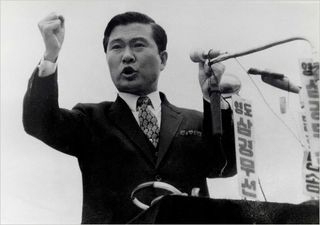
As president from 1998 till 2003, Mr. Kim was the first opposition leader to take power in South Korea.
Once vilified by his rivals as a Communist, Mr. Kim flew to Pyongyang, the capital of North Korea, in 2000 to meet that nation’s leader, Kim Jong-il, in the first summit meeting between the Koreas. That meeting led to an unprecedented détente on the divided Korean Peninsula, which remains technically at war because no peace treaty was signed at the end of the Korean War in 1953.
Under Mr. Kim’s “sunshine policy,” the two Koreas connected roads and railways across their shared border. They jointly built an industrial park. Two million South Koreans visited a North Korean mountain resort. And in a scene televised worldwide, aging Koreans separated by the war a half century ago tearfully hugged one another in temporary family reunions.
“Through his political dedication and persecution, he has come to symbolize South Korea’s democratization,” Kang Won-taek, a political scientist at Soongsil University in Seoul, said Tuesday. “He also broke longstanding taboos in South Korea — he led the liberals to the fore of South Korean politics after decades of conservative rule, and he changed North Korea’s status among South Koreans from an enemy to be vilified to someone that can coexist with the South and can be engaged.”
Friends or Acquaintances? Ask Your Cell Phone
From Science:
Your telephone may know more about your private life than you do, according to a new study of mobile phone calls. The insight opens the door to mining massive data sets from mobile phone call logs, which should allow researchers to test theories for how relationship networks make or break businesses, shape the flow of information, and even affect the course of epidemics.
A nagging problem for social scientists is the limitation of self-reported survey data. Not only are people expensive to poll, but they are also notoriously error-prone when they try to recall their own behaviors. What researchers would prefer is a record of people's behaviors that is cheap and accurate. Mobile phone call logs can certainly provide enormous amounts of cheap data. Researchers have used such data to map out people's social networks, utilizing the duration and frequency of calls between pairs of people as a measure of the intimacy of their relationships. Doing so has revealed patterns of people's contact with each other both in time and space, which is crucial for modeling everything from gossip to how flu viruses spread across populations.
But how accurately do call patterns reflect the intimacy of relationships? After all, sometimes the closest of friends rarely call each other, while some motor mouths call just about everyone.
More here.