Why it’s blasphemous to alter Shakespeare’s words for a modern audience

Antoni Cimolino in The New Republic:

Willy_shakespeare In “Will Shakespeare's Come and Gone,” John McWhorter recommends that Shakespeare be rewritten for the sake of clarity. He asks, “At what point do we concede that substantial comprehension across the centuries has become too much of a challenge to expect of anyone but specialists?”

Or as Shakespeare more simply put it when one of his characters had trouble understanding a speaker, “Those that understood him smil'd at one another and shook their heads; but for mine own part, it was Greek to me.” As this example shows, Shakespeare can be perfectly clear–in part because he so largely shaped the language we speak today. Countless expressions that he coined have become our “household words.”

There are indeed archaisms in Shakespeare's lexicon (we no longer say “mine own part”), but most of the difficulty we face in comprehending his dialogue has less to do with the passage of time than with the fact that these plays are not exercises in conversational English but dense, complex, and profoundly non-naturalistic dramatic poems.

Imagery, allusion, metaphor, and ambiguity are the poet's stock-in-trade, so it shouldn't surprise us to find that Shakespeare often seems to say more than one thing at a time. Our challenge today is not that we don't receive meaning from his words, but that we receive several meanings, some of them intentionally contradictory.

More here.
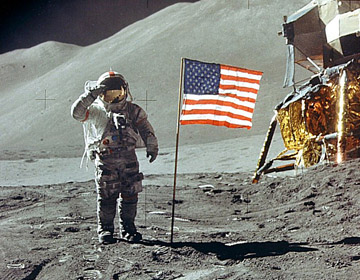
Fate has ordained that the men who went to the moon to explore in peace will stay on the moon to rest in peace

From Space.com:

Apollo11_salute In his 2001 book “Almost History,” which chronicles backup plans, speeches and documents that were never needed, author Roger Bruns details the origins of the Apollo 11 failure speech. They can be traced to astronaut Frank Borman, who commanded the 1968 Apollo 8 mission around the moon, who recommended to Nixon speechwriter William Safire that it would be prudent to have a plan in case the Apollo 11 astronauts suffered a very public demise, Bruns explained.

According to the plan, Bruns added, Nixon would have called the wives of the Apollo 11 astronauts to express his condolences and then give the following speech:

“Fate has ordained that the men who went to the moon to explore in peace will stay on the moon to rest in peace. These brave men, Neil Armstrong and Edwin Aldrin, know that there is no hope for their recovery. But they also know that there is hope for mankind in their sacrifice.

“These two men are laying down their lives in mankind's most noble goal: the search for truth and understanding. They will be mourned by their families and friends; they will be mourned by their nation; they will be mourned by the people of the world; they will be mourned by a Mother Earth that dared send two of her sons into the unknown.

More here.

Tuesday Poem

Nonce Words

The road taken
to bypass Cavan
took me west,
(a sign mistaken)
so at Derrylin
I turned east.

Sun on ice,
white floss
on reed and bush,
the bridge-iron cast
in an advent silence
I drove across,

then pulled in,
parked, and sat
breathing mist
on the windscreen.
Requiescat . . .
I got out

well happed up,
stood at the frozen
shore gazing
at rimed horizon,
my first stop
like this in years.

And blessed myself
in the name of the nonce
and happenstance,
the Who knows
and What nexts
and So be its.

by Seamus Heaney

from District and Circle;
Farrar, Straus, and Giroux, NY, 2006

Can You Be Too Perfect

From Scientific American:

Can-you-be-too-perfect_1 David Liu is a technology entrepreneur in San Francisco. He has helped found several start-ups to market products he has developed, including those stylus pens the UPS driver hands you to sign for your packages. But even as he dreams up new inventions, an ongoing patter in his head objects that they are stupidly obvious. And despite his accomplishments, Liu teeters on a mental precipice: “It feels shameful, like, hey, I’m in my early 30s, I should have had a Yahoo by now—or I should at least have had a company I sold for tons of money.”

Liu is a perfectionist, someone who demands utmost excellence from himself, an expectation that can lead to fear of failure and reflexive self-criticism. Even when he is doing well, Liu has trouble feeling good about himself. “It’s so habitual, the beating-myself-up part,” he says. Perfectionists, research shows, can become easily discouraged by failing to meet impossibly high standards, making them reluctant to take on new challenges or even complete agreed-upon tasks. The insistence on dotting all the i’s can also breed inefficiency, causing delays, work overload and even poor results. Perfectionism can hurt health and re­lationships, too. It is associated with anorexia, obsessive-compulsive disorder, social anxiety, writer’s block, alcoholism and depression. Such problems may be prevalent: a 2007 study that evaluated more than 1,500 college students revealed that nearly one quarter of them suffered from an unhealthy form of perfectionism.

And yet in recent years, some psychologists have amassed evidence suggesting that perfectionism encompasses positive qualities, including a drive to succeed, an inclination to plan and organize, and a focus on excellence. Why else would people brag about the trait in job interviews?

More here.

Is the Sun Missing Its Spots?

Kenneth Chang in The New York Times:

Sun Ever since Samuel Heinrich Schwabe, a German astronomer, first noted in 1843 that sunspots burgeon and wane over a roughly 11-year cycle, scientists have carefully watched the Sun’s activity. In the latest lull, the Sun should have reached its calmest, least pockmarked state last fall. Indeed, last year marked the blankest year of the Sun in the last half-century — 266 days with not a single sunspot visible from Earth. Then, in the first four months of 2009, the Sun became even more blank, the pace of sunspots slowing more. “It’s been as dead as a doornail,” David Hathaway, a solar physicist at NASA’s Marshall Space Flight Center in Huntsville, Ala., said a couple of months ago.

The Sun perked up in June and July, with a sizeable clump of 20 sunspots earlier this month. Now it is blank again, consistent with expectations that this solar cycle will be smaller and calmer, and the maximum of activity, expected to arrive in May 2013 will not be all that maximum. For operators of satellites and power grids, that is good news. The same roiling magnetic fields that generate sunspot blotches also accelerate a devastating rain of particles that can overload and wreck electronic equipment in orbit or on Earth.

More here.

Monday, July 20, 2009

Sunday, July 19, 2009

Vatican teaching Hezbollah how to kill Jews, says pamphlet for IDF troops

Ofri Ilani in Haaretz:

IDF The Pope and the cardinals of the Vatican help organize tours of Auschwitz for Hezbollah members to teach them how to wipe out Jews, according to a booklet being distributed to Israel Defense Forces soldiers.

Officials encouraging the booklet's distribution include senior officers, such as Lt. Col. Tamir Shalom, the commander of the Nahshon Battalion of the Kfir Brigade.

The booklet was published by the Union of Orthodox Jewish Congregations of America, in cooperation with the chief rabbi of Safed, Rabbi Shmuel Eliahu, and has been distributed for the past few months. The booklet, titled “On Either Side of the Border,” purports to be the testimony of “a Hezbollah officer who spied for Israel.”

“The book is distributed regularly and everyone reads it and believes it,” said one soldier. “It's filled with made-up details but is presented as a true story. A whole company of soldiers, adults, told me: 'Read this and you'll understand who the Arabs are.'”

More here.

Of Proust and Potter

Of potter and proustJesse Jarnow in Paste Magazine (illustration by Meg Hunt):

Once this birthday passes, I’m sure I’ll be fine. I’m not usually susceptible to believing wild generalizations, but preparing to turn 30 will have that effect on a dude. Recently, I fell for two in one week.

The first generalization—reading that a man reaches midlife crisis when he realizes he will never read Proust—was a throwaway line in an article I’ve since been unable to Google, an insignificant aside lodged like a popcorn kernel between the teeth. The second—Chuck Klosterman’s concern that, by not reading Harry Potter now, he was dooming himself to eventual cultural obscurity—suggested that I should fear the J.K. Rowling-weaned generation like a robot army.

The rest of this project came down to math. I’m 29, equal distance between high school and 40. There are seven volumes in each set, providing three months of potential beach/subway reading. A distant latch seemed to click: a plan to simultaneously stave off obsolescence and depression by reading 7,202 pages, alternating volumes, in a couple months’ time. But at the end, what? Preparation for my 30s? Transformation? Some sort of silky chrysalis sack for my roommates to clean up?

The first thing I learn is that it’s impossible to read Marcel Proust while listening to baseball on the radio. Since my dream of chipping away 50 pages every day revolves around digging Proust in the cool of the evening during a ballgame broadcast (a slow, pleasant rhythm that usually doesn’t prevent me from reading), this gets us off on the wrong foot, Marcel and me. His sentences are just too long—often half a page or more—and too easily tangled with the early-summer trials of a beleaguered bullpen.

Rich People Things: Steve Forbes Misunderstands Augustus, Caesar and Hannibal

Richpeoplethingsnew Chris Lehmann's funny review of Power Ambition Glory: The Stunning Parallels between Great Leaders of the Ancient World and Today…and the Lessons You Can Learn by Steve Forbes and John Prevas over at The Awl:

There’s a well-established cottage industry in American publishing, whereby latter-day lords of commerce and finance plunder the annals of the past for nuggets of motivational business wisdom. The genre arguably began with ad man Bruce Barton’s 1920s bestseller, The Man Nobody Knows, which deployed a series of extremely selective New Testament quotations to make the case that Jesus, in addition to his still quite impressive spiritual significance, was also a champion businessman. The intervening years have seen all sorts of amusing follow-on offerings, such as John Man’s The Leadership Secrets of Ghengis Khan and neocon toady Michael Ledeen’s Machiavelli on Modern Leadership. But as those entries show, there’s a staggering degree of self-involvement in these putative historical studies. No matter how far-flung or seemingly unsuited these Great Men (and yes, as business titan-role models, they are all capital-d Dudes) might otherwise seem, they all come bearing the same comforting lessons from their untended mausoleums: The greatness we embodied maps perfectly on the demands of modern-day success! Just heed our examples, oh wayward moderns, and prosper!

And so it came to pass that Steve Forbes was prowling a bookstore in Naples, Florida a few years back looking “for something interesting to read.” Forbes’ employees must live in dread that at such moments their maximum leader will stumble onto Max Stirner’s The Ego and Its Own or Iris Chang’s The Rape of Nanking; but happily for them, the quarry this time was Hannibal Crosses the Alps by John Prevas. And boy, did it ever get our correspondent thinking. First, he published a review of the book—well past its publication date–in his eponymous magazine, and thereby embodied a first principle of leadership: executive vanity will always trump timely coverage.

He also realized that Prevas’ popular history of that world-vanquishing moment posed—wait for it—critical lessons for today! “The financial crisis and America's recent foreign policy setbacks can be traced directly to a failure of leadership. But where do we turn for leadership, and what do we want in our leaders? History is one place to look. The past is filled with leaders who possessed extraordinary capabilities, enjoyed tremendous success, and directed societies that experienced problems similar to our own.”

[H/t: Misha Lepetic]

Jeffrey Goldberg Smears Human Rights Watch

LindsayLindsay Beyerstein over at her blog dissects Goldberg’s claims of corruption at HRW:

A non-profit calling itself NGO Monitor picked up on the story nearly two months ago in a post entitled, “HRW Raises Funds in Saudia Arabia by Demonizing Israel.” The author was incensed by the following passage in the Arab News story:

Human Rights Watch provided the international community with evidence of Israel using white phosphorus and launching systematic destructive attacks on civilian targets. Pro-Israel pressure groups in the US, the European Union and the United Nations have strongly resisted the report and tried to discredit it,” said Sarah Leah Whitson, director of HRW’s Middle East and North Africa Division. [AN]

That’s exactly what happened. HRW presented evidence that Israel was exploding white phosphorous shells in heavily populated areas of Gaza and inflicting hideous burns on civilians. Pro-Israel pressure groups absolutely freaked out about the HRW report and did their best to discredit it. HRW defended its work.

The IDF stopped using white phosphorus in the middle of the occupation after media reports revealed its effects on civilians. Yesterday, HRW published accounts of Israeli soldiers who admit using white phosphorous indescriminately in Gaza under unprecedently loose rules of engagement. HRW, FTW.

Predicatably, Israeli officials denounced HRW for its latest report.

Would it surprise you to learn that NGO Monitor is a pro-Israeli pressure group? According to his official bio, the group’s founder and executive director, Professor Gerald Steinberg is a consultant for the Israeli Ministry of Foreign Affairs and serves on a steering committee sponsored by the office of the Israeli Prime Minister.

Sued by the forest

From The Boston Globe:

Nature Last February, the town of Shapleigh, Maine, population 2,326, passed an unusual ordinance. Like nearby towns, Shapleigh sought to protect its aquifers from the Nestle Corporation, which draws heavily on the region for its Poland Spring bottled water. Some Maine towns had acquiesced, others had protested, and one was locked in a protracted legal battle. Shapleigh tried something new – a move at once humble in its method and audacious in its ambition. At a town meeting, residents voted, 114-66, to endow all of the town’s natural assets with legal rights: “Natural communities and ecosystems possess inalienable and fundamental rights to exist, flourish and naturally evolve within the Town of Shapleigh.” It further decreed that any town resident had “standing” to seek relief for damages caused to nature – permitting, for example, a lawsuit on behalf of a stream.

Shapleigh is one of about a dozen US municipalities to have passed measures declaring that nature itself has rights under the law. And in 2008, when Ecuador adopted a new constitution, it recognized nature’s “right to exist, persist, maintain itself and regenerate its own vital cycles, structure, functions and its evolutionary processes.” A campaign is also underway in Europe for a UN Universal Declaration of Planetary Rights, which would attempt to enshrine such principles in international law, following the model of the Universal Declaration of Human Rights.

More here.

How George Weidenfeld defied the sceptics

From The Telegraph:

Lolita_1444575a The landmark book in the firm’s early life was Nabokov’s Lolita, which had been published originally in Paris. Graham Greene called it one of the three best books of 1955; the Sunday Express condemned it as “sheer unrestrained pornography”. Which was it? Pornography or a literary masterpiece? Nicolson, by then a Tory MP, was shocked by it, but proposed the printing of a few sample copies. One was sent to the Director of Public Prosecutions, daring him, as it were, to prosecute.

If the authorities had chosen to sue the book as obscene, as other publishers feared, Weidenfeld & Nicolson would have been bankrupted, but word reached Weidenfeld in a telephone call at the Ritz, where the firm was toasting the book’s publication, that the Conservative government would not prosecute. Lolita was the firm’s first bestseller, selling more than 200,000 copies in hardback. Fiction, however, was not the mainspring of the firm’s output, although when George Orwell’s widow Sonia joined the staff she attracted two leading American authors, Saul Bellow and Mary McCarthy. In a rich period in the early Seventies, Edna O’Brien arrived (and is still published by the firm) and in successive years there were two Booker winners: John Berger’s G and J G Farrell’s The Siege of Krishnapur.

More here.

XXXL: Why are we so fat?

Elizabeth Kolbert in The New Yorker:

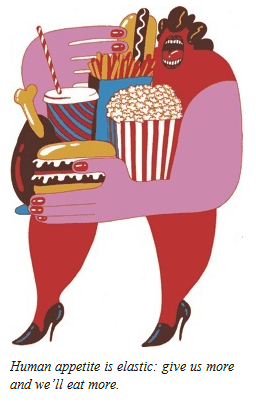
ScreenHunter_04 Jul. 19 12.40 Men are now on average seventeen pounds heavier than they were in the late seventies, and for women that figure is even higher: nineteen pounds. The proportion of overweight children, age six to eleven, has more than doubled, while the proportion of overweight adolescents, age twelve to nineteen, has more than tripled. (According to the standards of the United States military, forty per cent of young women and twenty-five per cent of young men weigh too much to enlist.) As the average person became heavier, the very heavy became heavier still; more than twelve million Americans now have a body-mass index greater than forty, which, for someone who is five feet nine, entails weighing more than two hundred and seventy pounds. Hospitals have had to buy special wheelchairs and operating tables to accommodate the obese, and revolving doors have had to be widened—the typical door went from about ten feet to about twelve feet across. An Indiana company called Goliath Casket has begun offering triple-wide coffins with reinforced hinges that can hold up to eleven hundred pounds. It has been estimated that Americans’ extra bulk costs the airlines a quarter of a billion dollars’ worth of jet fuel annually.

Such a broad social development seems to require an explanation on the same scale. Something big must have changed in America to cause so many people to gain so much weight so quickly. But what, exactly, is unclear—a mystery batter-dipped in an enigma.

More here.

You+

Jamais Cascio in The Atlantic:

ScreenHunter_02 Jul. 19 12.26 Subtle, long-term risks, particularly those involving complex, global processes, remain devilishly hard for us to manage.

But here’s an optimistic scenario for you: if the next several decades are as bad as some of us fear they could be, we can respond, and survive, the way our species has done time and again: by getting smarter. But this time, we don’t have to rely solely on natural evolutionary processes to boost our intelligence. We can do it ourselves.

Most people don’t realize that this process is already under way. In fact, it’s happening all around us, across the full spectrum of how we understand intelligence. It’s visible in the hive mind of the Internet, in the powerful tools for simulation and visualization that are jump-starting new scientific disciplines, and in the development of drugs that some people (myself included) have discovered let them study harder, focus better, and stay awake longer with full clarity. So far, these augmentations have largely been outside of our bodies, but they’re very much part of who we are today: they’re physically separate from us, but we and they are becoming cognitively inseparable. And advances over the next few decades, driven by breakthroughs in genetic engineering and artificial intelligence, will make today’s technologies seem primitive. The nascent jargon of the field describes this as “ intelligence augmentation.” I prefer to think of it as “You+.”

More here.

What Questions Can Science Answer?

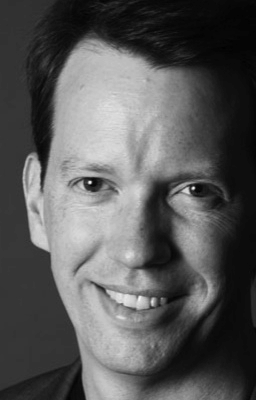
Sean Carroll in Cosmic Variance:

ScreenHunter_01 Jul. 19 12.03 One frustrating aspect of our discussion about the compatibility of science and religion was the amount of effort expended arguing about definitions, rather than substance. When I use words like “God” or “religion,” I try to use them in senses that are consistent with how they have been understood (at least in the Western world) through history, by the large majority of contemporary believers, and according to definitions as you would encounter them in a dictionary. It seems clear to me that, by those standards, religious belief typically involves various claims about things that happen in the world — for example, the virgin birth or ultimate resurrection of Jesus. Those claims can be judged by science, and are found wanting.

Some people would prefer to define “religion” so that religious beliefs entail nothing whatsoever about what happens in the world. And that’s fine; definitions are not correct or incorrect, they are simply useful or useless, where usefulness is judged by the clarity of one’s attempts at communication. Personally, I think using “religion” in that way is not very clear. Most Christians would disagree with the claim that Jesus came about because Joseph and Mary had sex and his sperm fertilized her ovum and things proceeded conventionally from there, or that Jesus didn’t really rise from the dead, or that God did not create the universe. The Congregation for the Causes of Saints, whose job it is to judge whether a candidate for canonization has really performed the required number of miracles and so forth, would probably not agree that miracles don’t occur. Francis Collins, recently nominated to direct the NIH, argues that some sort of God hypothesis helps explain the values of the fundamental constants of nature, just like a good Grand Unified Theory would. These views are by no means outliers, even without delving into the more extreme varieties of Biblical literalism.

More here.

Saturday, July 18, 2009

100%

29213815-15165720

In “100%” (Vertigo: 256 pp., $39.99), Paul Pope depicts a New York punctuated with bits of technological wizardry but still wholly recognizable — a city in which characters cower in fear from what might be lurking in the shadows, fall in love, eat sushi, drink too much and watch bad performance art. (“A naked woman smashing eggs,” one character observes. “What is the world coming to?”) The Gotham of this graphic novel, published serially in 2002 and 2003, is nestled somewhere between its incarnations in Thomas M. Disch’s beaten-down “334” and Martin Scorsese’s antic nightmare “After Hours.” With a palette dominated by stark black and white, “100%” would be your typical round-the-corner dystopia if everything didn’t feel so weirdly alive. Three couples, loosely linked, circulate in this grim nocturnal city of a few decades hence — there has been some sort of catastrophic war in India, the impact of which is left tantalizingly unclear. (For good measure, the upcoming 2050 World Cup will feature humans vs. mutants.) Here they make love or art while trying to figure out the necessary trick of how to get by. The jittery Kim (white) and capable Strel (black) are friends; Strel manages dancers at a state-of-the-art club called the Catshack, which (a quote-happy Zagat’s-like guide tells us) is “dead set in the center of Manhattan’s ‘revitalized Urbanista downtown’. . . . The food is ‘robust’ and ‘decent,’ but it’s ‘to be seen and seem’ that the clientele shows up.”

more from Ed Park at the LA Times here.