Twenty years after Ceausescu's execution his secret service is still active. For the first time, Romanian-German writer Herta Müller describes her ongoing experience of Securitate terror.
Herta Müller in Sign and Sight:
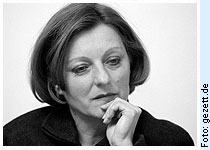 For me each journey to Romania is also a journey into another time, in which I never knew which events in my life were coincidence and which were staged. This is why I have, in each and every public statement I have made, demanded access to the secret files kept on me which, under various pretexts, has invariably been denied me. Instead, each time there was signs that I was once again, that is to say, still under observation.
In spring earlier this year I visited Bucharest, on the invitation of the NEC (New European College). On the first day I was sitting in the hotel lobby with a journalist and a photographer when a muscular security guard inquired about a permit and tried to tear the camera from the photographer's hands. “No photos allowed on the premises, nor of any people on the premises,” he bellowed. On the evening of the second day I had arranged to have dinner with a friend who, as we had agreed on the phone, came to pick me up from the hotel at six o'clock. As he turned into the street in which the hotel was situated, he noticed a man following him. When he asked to call me at the reception, the receptionist said he would have to fill in a visitor's form first. This frightened him because such a thing was unheard of, even under Ceausescu.
My friend and I walked to the restaurant. Again and again he suggested that we cross to the other side of the street. I thought nothing of it. Not until the following day did he tell Andrei Plesu, the Director of the NEC, about the visitor's form and that a man had followed him on his way to the hotel, and later the two of us to the restaurant.
More here.
From The Humanist:
 Inspired by the high profile of its Christian American counterpart, Muslim creationism is becoming increasingly visible and confident. On scores of websites and in dozens of books with titles like The Evolution Deceit and The Dark Face of Darwinism, a new and well-funded version of evolution-denialism, carefully calibrated to exploit the current fashion for religiously inspired attacks on scientific orthodoxy and “militant” atheism, seems to have found its voice. In a recent interview with The Times Richard Dawkins himself recognises the impact of this new phenomenon: “There has been a sharp upturn in hostility to teaching evolution in the classroom and it’s mostly coming from Islamic students.”
The patron saint of this new movement, the ubiquitous “expert” cited and referenced by those eager to demonstrate the superiority of “Koranic science” over “the evolution lie”, is the larger-than-life figure of Harun Yahya.
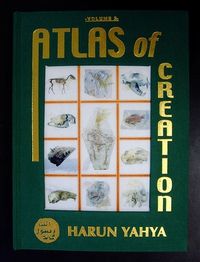
Operating from Istanbul, Yahya is the founder of the Science Research Foundation, an impressive publishing empire that boasts more than 60 websites dedicated to his writings. It provides documentary films and audio recordings in fifteen languages, including Turkish, English, Russian, Amharic and Arabic, and claims to sell more than half a million books a year, including the infamous 850-page, fully illustrated Atlas of Creation, which was sent free in two volumes to dozens of universities, libraries and prominent scientists (including Richard Dawkins) across the world. In painstaking detail, with a mass of photos, graphs and statistics interspersed with verses from the Koran, the Atlas purports to prove that Darwin was utterly mistaken, that each plant and animal was created intact, and that no modification through natural selection ever took place.
More here.
Natalie Angiers in The New York Times:
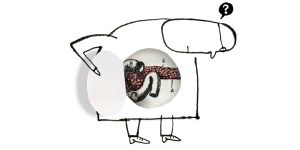 Should anybody in the reliably pestilent health care debate be casting about for a mascot organ to represent some of the biggest medical crises that we Americans face, allow me to nominate a nonobvious candidate: the pancreas. It may lie in the hidden depths of the abdominal cavity, and its appearance, size and purpose may be obscure to the average person. Yet the pancreas turns out to be a linchpin in two epidemics that are all too familiar. As the organ entrusted with the manufacture of insulin and other hormones that help control blood sugar, the pancreas gone awry is a source of diabetes, which afflicts more than 23 million people in this country, including the newest member of the Supreme Court.
And as the tireless brewer of digestive juices that help shear apart the amalgamated foodstuffs that we consume each day, the pancreas is at the frontlines of our expanding waistlines, the mass outbreak of fatness that has already claimed 60 percent of Americans and shows no sign of slackening.
More here.
Afif Sarhan and Jason Burke in The Guardian:
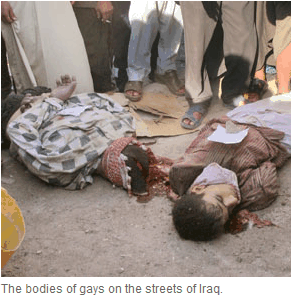 Sitting on the floor, wearing traditional Islamic clothes and holding an old notebook, Abu Hamizi, 22, spends at least six hours a day searching internet chatrooms linked to gay websites. He is not looking for new friends, but for victims.
“It is the easiest way to find those people who are destroying Islam and who want to dirty the reputation we took centuries to build up,” he said. When he finds them, Hamizi arranges for them to be attacked and sometimes killed.
Hamizi, a computer science graduate, is at the cutting edge of a new wave of violence against gay men in Iraq. Made up of hardline extremists, Hamizi's group and others like it are believed to be responsible for the deaths of more than 130 gay Iraqi men since the beginning of the year alone.
The deputy leader of the group, which is based in Baghdad, explained its campaign using a stream of homophobic invective. “Animals deserve more pity than the dirty people who practise such sexual depraved acts,” he told the Observer. “We make sure they know why they are being held and give them the chance to ask God's forgiveness before they are killed.”
More here.
We know you've been working very hard on your screenplay, but before you go looking for some professional feedback, you might keep in mind the following piece by A History of Violence screenwriter Josh Olson.
From The Village Voice:
 I will not read your fucking script.
That's simple enough, isn't it? “I will not read your fucking script.” What's not clear about that? There's nothing personal about it, nothing loaded, nothing complicated. I simply have no interest in reading your fucking screenplay. None whatsoever.
If that seems unfair, I'll make you a deal. In return for you not asking me to read your fucking script, I will not ask you to wash my fucking car, or take my fucking picture, or represent me in fucking court, or take out my fucking gall bladder, or whatever the fuck it is that you do for a living.
You're a lovely person. Whatever time we've spent together has, I'm sure, been pleasurable for both of us. I quite enjoyed that conversation we once had about structure and theme, and why Sergio Leone is the greatest director who ever lived. Yes, we bonded, and yes, I wish you luck in all your endeavors, and it would thrill me no end to hear that you had sold your screenplay, and that it had been made into the best movie since Godfather Part II.
But I will not read your fucking script.
More here.
David Byrne in the Wall Street Journal:
 There’s an old joke that you know you're in heaven if the cooks are Italian and the engineering is German. If it's the other way around you're in hell. In an attempt to conjure up a perfect city, I imagine a place that is a mash-up of the best qualities of a host of cities. The permutations are endless. Maybe I'd take the nightlife of New York in a setting like Sydney's with bars like those in Barcelona and cuisine from Singapore served in outdoor restaurants like those in Mexico City. Or I could layer the sense of humor in Spain over the civic accommodation and elegance of Kyoto. Of course, it's not really possible to cherry pick like this—mainly because a city's qualities cannot thrive out of context. A place's cuisine and architecture and language are all somehow interwoven. But one can dream.
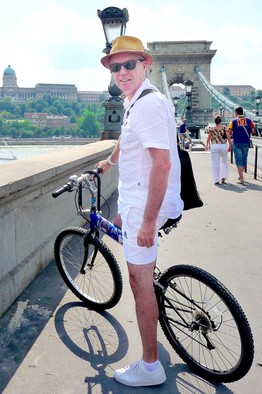
As someone who has used a bicycle to get around New York for about 30 years I've watched the city—mainly Manhattan, where I live—change for better and for worse. During this time I started to take a full-size folding bike with me when I traveled so I got to experience other cities as a cyclist as well. Seeing cities from on top of a bike is both pleasurable and instructive. On a bike one sees a lot more than from a freeway, and often it's just as fast as car traffic in many towns.
More here.
Monday, September 14, 2009
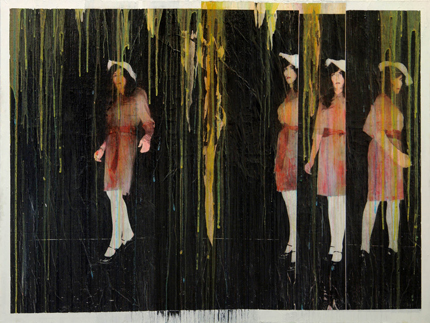
Matt Greene. Giallo 2007.
Acrylic, ink, collage on canvas.
More here.
Sunday, September 13, 2009
Anita Singh in The Telegraph:
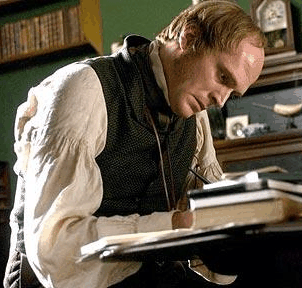 Creation, starring Paul Bettany, details Darwin's “struggle between faith and reason” as he wrote On The Origin of Species. It depicts him as a man who loses faith in God following the death of his beloved 10-year-old daughter, Annie.
The film was chosen to open the Toronto Film Festival and has its British premiere on Sunday. It has been sold in almost every territory around the world, from Australia to Scandinavia.
However, US distributors have resolutely passed on a film which will prove hugely divisive in a country where, according to a Gallup poll conducted in February, only 39 per cent of Americans believe in the theory of evolution.
Movieguide.org, an influential site which reviews films from a Christian perspective, described Darwin as the father of eugenics and denounced him as “a racist, a bigot and an 1800s naturalist whose legacy is mass murder”. His “half-baked theory” directly influenced Adolf Hitler and led to “atrocities, crimes against humanity, cloning and genetic engineering”, the site stated.
The film has sparked fierce debate on US Christian websites, with a typical comment dismissing evolution as “a silly theory with a serious lack of evidence to support it despite over a century of trying”.
More here.
Justin Gillis in the New York Times:
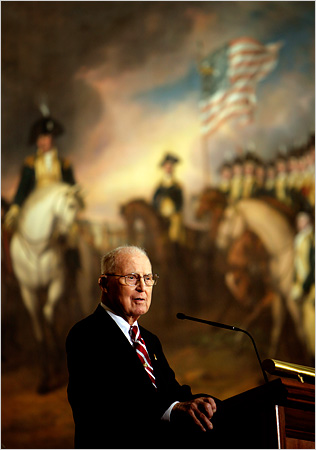 Norman E. Borlaug, the plant scientist who did more than anyone else in the 20th century to teach the world to feed itself and whose work was credited with saving hundreds of millions of lives, died Saturday night. He was 95 and lived in Dallas.
The cause was complications from cancer, said Kathleen Phillips, a spokeswoman for Texas A&M University, where Dr. Borlaug had served on the faculty since 1984.
Dr. Borlaug’s advances in plant breeding led to spectacular success in increasing food production in Latin America and Asia and brought him international acclaim. In 1970, he was awarded the Nobel Peace Prize.
He was widely described as the father of the broad agricultural movement called the Green Revolution, though decidedly reluctant to accept the title. “A miserable term,” he said, characteristically shrugging off any air of self-importance.
More here. [Thanks to Shabbir Kazmi.]
From lensculture:
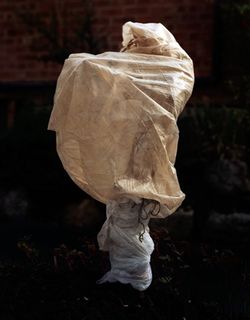 Covered, 2009 is a body of work that depicts a palm tree in my father’s garden wrapped in material to protect it from frost over the winter months. The project was completed at the start of spring just before the covering became redundant as a protection from the cold weather.
The domestic garden is a controlled and contrived space, one that often has ambiguous status. Here the natural world is explored but equally is a symbol of man’s continued desire to bend nature to human will. In this project I see the garden as a studio space or stage where I have documented sculptural forms created by my father. Inspired by Paul Nash’s late photographs in which he explored domestic landscapes in reference to ‘object-personages’ – curious or evocatively shaped forms that seemed to resemble or take on the personality of something else- I seek to highlight the way that space can function as a matrix of unnoticed possibilities.
Thus the interpretation of the object within the photograph is dependent on projection, as the viewer may be unaware of what lies beneath the wrapping. In the photographs the plant becomes a sculptural object, the folds in the material imply jellyfish or mushroom clouds, resemble mouths, noses and eyes: anthropomorphic, faceless and silent forms. Rooted to the spot the object comes out of the ground as if fixed to a plinth. Presented as a series the images may be read as exhibits within the tradition of ethnographic display. The documentation of a ritualistic process of a north London suburban garden within which an object becomes otherworldly: fetishised and surreal.
More here.
Ma Will Be Late
that I come back to you
tired and without memory
that the kitchen door is open I
shuffle in with suitcases hurriedly bought presents
my family’s distressed dreams
slink down the corridor the windows stained
with their abandoned language in the hard
bathroom light I brush my teeth
put a pill on my tongue: Thur
that I walk past where my daughter sleeps
her sheet neatly folded beneath her chin
on the dressing table silkworms rear in gold
that I can pass my sons
frowning like fists against their pillows
their restless undertones bruise the room
that I can rummage a nightie from the drawer
slip into the dark slit behind your back
that the warmth flows across to me
makes me neither poet nor human
in the ambush of breath
I die into woman
by Antjie Krog
from Down to my Last Skin; Random House,
South Africa, 2000
At this year’s Biennale, the most eloquent work on display is made from the blood, grime and detritus of violent crime. Kaelen Wilson-Goldie reports from Italy on the transformative work of Mexican artist Teresa Margolles, and on the dwindling usefulness of nationally-defined art.
From The National:
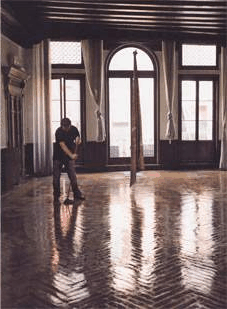 Once a day, a young man mops the floor of a dilapidated palazzo in Venice. With his head down and his two hands gripping a long handle, he pushes a damp lump of soiled rags from room to room. The rags have been soaked in the blood and filth of crime scenes in Mexico, dried, transported to Italy, and are then plunged into buckets of water and sloshed back and forth in half-moon patterns across the floor. Every day they leave behind a thin layer of grime and the unmistakable stench of death. This quotidian routine, which is more about accumulating residue than removing it, is part of an extended performance piece conceived by the artist Teresa Margolles, whose work comprises Mexico’s official participation in this year’s Venice Biennale.
One of the most controversial figures in the recent history of the Mexico City art scene, Margolles has been making work from the material traces of death for 20 years. In 1989, she joined a group of radical artists, musicians and performers to form SEMEFO, an acronym for Servicio Medico Forense, or Forensic Medical Service. The collective, which disbanded in 1999, used municipal morgues as studios and turned the refuse of crimes into an artistic medium. Along the way, the group created a template for artists to act as amateur detectives, picking up clues not for the purpose of solving individual crimes but rather to address the long-term damage that criminal activity does to a society when murders become commonplace.
More here.
From Prospect Magazine:
 Despite the contradictions within the west, mainstream Orientalism holds that all cultures are developing towards the universal—or, more specifically, globalised—model of secular modernity and the market. According to this view, the Muslim world experiences backwardness to the extent that it resists secularisation. The Crisis of Islamic Civilization, a subtle and erudite book by former Iraqi minister Ali A Allawi, challenges this thesis. Surveying the Muslim world’s social, economic and moral failures, and the terror espoused by certain Islamist groups, Allawi suggests the problem might not be too much Islam, but too little.
Islam is a civilisational framework that rests on the tripod of private ritual, public ethics and individual spiritual striving—and the legs of the tripod must balance each other. But, Allawi argues, the current Islamic “revival” is operating only in the field of religiosity: focusing on naked symbols and rules, proclaiming the superiority of Islam while adopting indiscriminately the technology, economics and cultural products of the west. It emphasises Sharia as a set of fixed punishments rather than as a framework of legislative principles. For the revivalists, the public sphere is too often reduced to the state—and their political project is simply to seize control of repressive state apparatuses.
More here.
Eugenie Scott in Panda's Thumb:
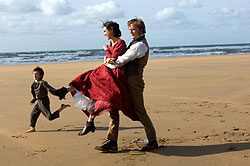 I and NCSE staff were invited to view the new Jon Amiel movie, Creation, starring Paul Bettany and Jennifer Connolly. I believe it to be a thoughtful, well-made film that will change many views of Darwin held by the public—for the good. The acting is strong, the visuals are wonderful, and it treats with loving care the Victorian details of the furnishings at Down house and other sites (such as Malvern), and the local church.
The movie takes place after Darwin has returned from the Beagle voyage, and has settled down with his wife, Emma. It concentrates on their relationship, on the growth of their family, and of course, on the production of his most famous scientific work, On the Origin of Species. It looks hard at Darwin’s growing disenchantment with Christianity, especially the concept of Providence, and how poorly it fits Darwin the naturalist’s knowledge of a very unpeaceable kingdom. Darwin’s frequent illness is portrayed with brutal honesty. Sometimes pale, nauseated, unable even to eat dinner with his family, much less work on his science, Darwin is shown suffering from vague symptoms which he attempts to cure with what we would recognize as quack treatments.
A centerpiece of the movie is the death of Annie, the Darwins’ beloved 10 year old daughter, and how it affected the relationship of Charles and Emma.
More here.
Herbert J. Gans in Transformations of the Public Sphere:
 Michael Burawoy’s dramatic reinvention of and powerful advocacy for public sociology at the ASA’s 2004 annual meetings has set off a process to incorporate public sociology into the current discipline. Although it is too early to determine what paths that process will take, so far there seems to be more discourse about public sociology than activity to advance it, or for that matter, a new outpouring of high quality public sociology. This essay argues that such activity–and outpouring–require some serious structural changes in the discipline and describes several urgent ones, both in the organization of the discipline and in sociological graduate education.
I emphasize urgent because the active development of public sociology is essential to the healthy future of the discipline. Although sociology is growing numerically in a variety of ways, its status in the social sciences and in American intellectual life has not kept up with that growth. Exciting intellectual work is being done in a number of sociology’s fields, but it does not show up often enough in the journals that speak for the entire discipline or in the now existing varieties of public sociology.
More here.
Saturday, September 12, 2009
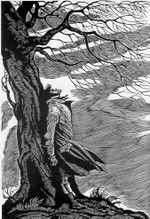
“I am Heathcliff,” the willful Cathy declares, but then she marries somebody else, the rich and weak Edgar Linton, then owner of Thrushcross Grange. Heathcliff flees and returns years later, intent on revenge and ruining everybody and taking their money. Cathy dies in childbirth, and Heathcliff calls down a curse, demanding that she haunt him forever. It’s wild, gothic stuff, but there’s much more going on. “Wuthering Heights,” as Joyce Carol Oates has pointed out, is a parable of innocence and loss, of “childhood’s necessary defeat.” But it presents too a contrasting tale, a story of education, maturing and affection — that happens in the novel’s present-day frame — observed by Lockwood and the glowering Heathcliff. This second romance, between Cathy’s daughter and the grandson of Heathcliff’s foster-father, thought by some critics and many readers to be but a pale reflection of what has gone before, is essential to the novel’s conception. Escape from family doom is possible, Brontë suggests, even though the shadow of that doom will always linger, out there on the moor.
more from Richard Rayner at the LA Times here.
