Harriet Beecher Stowe from Infoplease.com:
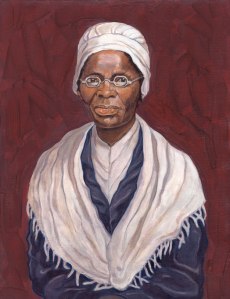 Many years ago, the few readers of radical Abolitionist papers must often have seen the singular name of Sojourner Truth, announced as a frequent speaker at Anti-Slavery meetings, and as travelling on a sort of self-appointed agency through the country. I had myself often remarked the name, but never met the individual. On one occasion, when our house was filled with company, several eminent clergymen being our guests, notice was brought up to me that Sojourner Truth was below, and requested an interview. Knowing nothing of her but her singular name, I went down, prepared to make the interview short, as the pressure of many other engagements demanded.
When I went into the room, a tall, spare form arose to meet me. She was evidently a full-blooded African, and though now aged and worn with many hardships, still gave the impression of a physical development which in early youth must have been as fine a specimen of the torrid zone as Cumberworth's celebrated statuette of the Negro Woman at the Fountain. Indeed, she so strongly reminded me of that figure, that, when I recall the events of her life, as she narrated them to me, I imagine her as a living, breathing impersonation of that work of art. I do not recollect ever to have been conversant with any one who had more of that silent and subtle power which we call personal presence than this woman. In the modern Spiritualistic phraseology, she would be described as having a strong sphere. Her tall form, as she rose up before me, is still vivid to my mind. She was dressed in some stout, grayish stuff, neat and clean, though dusty from travel. On her head, she wore a bright Madras handkerchief, arranged as a turban, after the manner of her race. She seemed perfectly self-possessed and at her ease,—in fact, there was almost an unconscious superiority, not unmixed with a solemn twinkle of humor, in the odd, composed manner in which she looked down on me. Her whole air had at times a gloomy sort of drollery which impressed one strangely.
“So this is YOU,” she said.
More here.
From Scientific American:
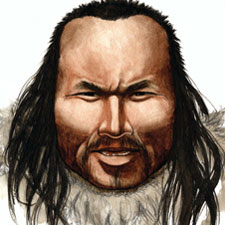 When a man died some 4,000 years ago in what is now western Greenland, he probably had no idea that his remains would provide the first genetic portrait of people of his era. This man, known now as “Inuk” (a Greenlandic term for “human” or “man”) left for posterity just four hairs and a few small fragments of bone frozen in permafrost, but that is now all researchers need to assemble a thorough human genome. And Inuk has just had his code cracked.
The researchers were able to sequence about 80 percent of the ancient genome, which is “comparable to the quality of a modern human genome,” Eske Willerslev, director of the Center for Ancient Genetics at the University of Copenhagen, said at a press conference held in the England February 9. He and his team, led by Morten Rasmussen, an assistant professor at the University, were able to sequence about three billion base pairs (the human genome includes just over this amount), which is a finer resolution than that of previous genetic work on Neandertals and mammoths. Their findings will be published February 11 in the journal Nature. (Scientific American is part of Nature Publishing Group.) At this level of resolution, the researchers noted, individual features and traits began to emerge. “The guy had most likely brown eyes, brown skin” as well as a genetic predisposition for baldness, Willerslev said. The presence of hair, then, might signal that he was rather young when he died and had yet to lose most of his hair, they noted. The genome also tells us Inuk had the recessive gene for dry earwax (as opposed to the more common wet form) and “a metabolism and body mass index commonly found in those who live in cold climates,” David Lambert and Leon Huynenboth of the School of Biomolecular and Physical Sciences at Griffith University in Queensland, Australia, wrote in a commentary that accompanies the study.
More here.
Larry Tohter in the New York Times Book Review:
 Zachary Mason’s critically praised first novel comes with a largely self-explanatory title: “The Lost Books of the Odyssey” purports to be a compilation of 44 alternate versions of Homer’s epic. What that title cannot possibly convey, though, is the unusual journey of Mr. Mason’s manuscript on its way to publication by Farrar, Straus & Giroux last week.
Mr. Mason, 35, a computer scientist specializing in search recommendation systems and keywords, once worked at Amazon.com. He avoided writing workshops and M.F.A. programs as a matter of principle, and produced “The Lost Books” at night, during lunch breaks and on weekends and vacations.
“I’ve been writing for many years, but just small stories or fragments of things that could become stories,” he said. “I decided after a long time that if I was going to be serious about writing, I had to do a book. So I started looking through my notes, looking for things I thought were worth preserving, and some things jumped out at me. And so I sort of extracted them from my notebooks, and they seemed to imply a shape, and the shape was this book of themes and variations.”
Early reviews of the book have been enthusiastic. Michiko Kakutani of The New York Times called it a “dazzling debut novel.”
More here.
Wednesday, February 10, 2010
 From the archives of the Paris Review:
INTERVIEWER: What are the worst lines you know—preferably by a great poet?
AUDEN: I think they occur in Thomas Hardy’s The Dynasts, in which Napoleon tries to escape from Elba. There’s a quatrain which goes like this:
Should the corvette arrive
With the aging Scotch colonel,
Escape would be frustrate,
Retention eternal.
That’s pretty hard to beat!
INTERVIEWER: How about Yeats’ “Had de Valera eaten Parnell’s heart” or Eliot’s “Why should the aged eagle stretch its wings”?
AUDEN: Those aren’t bad, really, just unintentionally comic. Both would have made wonderful captions for a Thurber cartoon. As an undergraduate at Oxford I came up with one: “Isobel with her leaping breasts / Pursued me through a summer . . .” Think what a marvelous cartoon Thurber could have done to that! Whoops! Whoops! Whoops!
INTERVIEWER: What’s your least favorite Auden poem?
AUDEN: “September 1, 1939.” And I’m afraid it’s gotten into a lot of anthologies.
INTERVIEWER: Of which poem are you proudest?
AUDEN: It occurs in my commentary on Shakespeare’s Tempest, a poem written in prose, a pastiche of the late Henry James— “Caliban’s Speech to the Audience.”
[H/t: Maeve Adams]
Over at WNYC:
 The wars in Afghanistan and Iraq have been well-documented. But composer Vijay Iyer and poet Mike Ladd, along with Iraq war vet Maurice Decaul, are telling war stories in a new way, using the images and scenes culled from their dreams.
“Holding It Down” is the third major collaboration between Iyer and Ladd. It's a commission from Harlem Stage, and very much a work-in-progress.
The score is stylistically similar to previous collaborations by the pair: ethereal vocals, piano, laptop, cello and percussion. “It has that same kaleidoscopic quality of dreams,” Iyer said. “Even a single dream can take you through a whole range of emotions.”
Maurice Decaul, a 29-year-old veteran, served in Iraq in 2003. Seven years later, his dreams are still littered with fragmented scenes from the country: the pop and crackle of artillery fire, an Iraqi woman's green dress, the anxiety of night patrols in Nasiriyah.
Ladd is a civilian, but a military buff. Growing up, he said he “mythologized” his father, a decorated World War II veteran who died just after his first birthday. He developed a “perverse obsession” with war in an effort to connect with his father, and said the project is about “me as a civilian deconstructing my fantasy of war in the face of these veterans reconstructing the reality of their lives.”
Ladd and Iyer want more young veterans — especially women — to contribute accounts of their dreams.
Via Henry Farrell, Scott McLemee in Inside Higher Ed:
Whatever else one may think of BHL [Bernard-Henri Lévy], he is certainly prolific. This week, he published in France both a hefty volume of his reportage and commentary called Identity Papers and a theoretical opus appearing under the title Of War in Philosophy. The latter volume seems to have created the bigger stir. It is another bid for the Sartrean mantle.
In this, he faces a great challenge, for philosophers have seldom been kind to his work. Gilles Deleuze suggested that Lévy was interesting chiefly as a symptom of mass marketing's expansion into new realms. Cornelius Castoriadis once said that the New Philosophers had been named by an act of double antiphrasis. BHL has enjoyed media prominence for a third of a century, but each volume of his philosophical speculation now carries the burden of demonstrating the existence of some steak amidst all the well-amplified sizzle.
To judge by an early report, his new book continues BHL’s combat against Hegel and Marx as founding fathers of totalitarianism. But with it, he take another step — pushing the fight deeper into philosophical history by attacking Kant. He draws on the scholarship of Jean-Baptiste Botul, whose lectures in Paraguay after World War II demonstrated that Kant, for all his talk of reason, was quite mad. Thanks to the courage of BHL in thinking through the implications of this analysis, we shall now be able to face reality with greater lucidity.
Or we might — if Jean-Baptiste Botul actually existed.
In fact, Botul is the pen name used for several books composed by a satirist named Frédéric Pagès. One might have guessed as much, given that the very title of the work BHL draws upon, La vie sexuelle d’Emmanuel Kant, sounds like a joke. (The philosopher made Steve Carrell’s character in The Forty Year-Old Virgin look like a libertine.)
BHL has subsequently appeared on television to admit that, yes, he fell for what was, after all, a terribly elegant hoax. And in any case, the critique of Kant limned there was – whatever the author's intent – very close to his own analysis, ground out over decades of careful meditation.

When that poor women recently fell into and tore Picasso’s “The Actor” at the Metropolitan Museum of Art, nobody questioned whether the painting should be repaired. The only issue seemed to be how — and as of right now, the Met either doesn’t know or isn’t revealing the answer. This is a no-brainer. The master paints the work, an adult-education student tumbles into it: Despite the power differential between the two, we’re still working in the realm of the human. Repairing nature, on the other hand, is a bit more jarring. This is likely why Richard Barnes’ photographs of natural history dioramas in various state of repair have drawn attention since they were collected in a book of his work Animal Logic, released in the fall.
more from Jesse Smith at The Smart Set here.

The headline reads “Haiti Looting Horror”; the photo says so much more. A girl, dressed in a pink-and-grey argyle sweater and pink skirt, face down over three wall hangings. A long stream of blood pours from a fatal bullet wound to her head. She is lying atop a shattered concrete building. Behind her, desolation. Only one of the pictures beneath her is visible: two purple flowers in bloom, sticking out of a simple vase. The girl was 15-years-old and her name was Fabienne. According to the report in last week’s Guardian, it wasn’t clear if police had shot to kill or scare Fabienne and the other looters around her. But the officers’ intentions didn’t much matter. Their sentence was final. In the aftermath of any disaster, in the eyes of outsiders, looters are the ultimate bad guys. They are the selfish, the lawless, the uncivilized, taking advantage of chaos, getting ahead while everyone else just tries to get by.
more from Stefany Anne Golberg at her blog here.
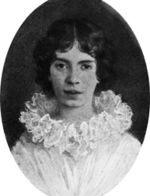
Posterity hasn’t had much trouble knowing what to do with Emily Dickinson; it has revered her as a poet and sentimentalised her life. The reclusive spinster published fewer than a dozen of almost 2,000 poems she had stashed in her room and after her death it was easy to mythologise her as an unworldly, unrecognised genius, an image that persisted right up to and beyond the 1976 stage show The Belle of Amherst. This view of Dickinson as the ultimate amateur predisposed the public to think well of her and to attend sympathetically to works of challenging unconventionality: the first selection of Dickinson’s verse that appeared posthumously, in 1890, was reprinted eleven times in its first year and by 1914, when almost all her poems and many of her letters were in print, she was firmly established as an American classic. Lyndall Gordon, the distinguished biographer of T S Eliot, Virginia Woolf, Henry James and Mary Wollstonecraft, takes Dickinson’s image of ‘a loaded gun’ as the central motif in this explosively revisionist book. Gone is the slightly daffy New England dreamer developing her genius in genteel solitude; Gordon takes the lid off the violent emotional life of the Dickinson family and its far-reaching effects on the poet’s work. What she exposes is a seething Peyton Place of adultery, betrayal and lifelong feuding.
more from Claire Harman at Literary Review here.
From Slaveryinamerica.org:
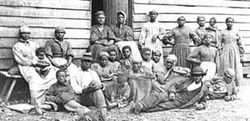 On the eve of the American Civil War approximately 4 million enslaved African Americans lived in the southern region of the United States of America. The vast majority worked as plantation slaves in the production of cotton, sugar, tobacco, and rice. Very few of these enslaved people were African born principally because the importation of enslaved Africans to the United States officially ended in 1808, although thousands were smuggled into the nation illegally in the 50 years following the ban on the international trade. These enslaved people were the descendants of 12 to 13 million African forbearers ripped from their homes and forcibly transported to the Americas in a massive slave trade dating from the 1400s. Most of these people, if they survived the brutal passages from Africa, ended up in the Caribbean (West Indies) or in South and Central America. Brazil alone imported around five million enslaved Africans. This forced migration is known today as the African Diaspora, and it is one of the greatest human tragedies in the history of the world.
From the beginnings of slavery in British North America around 1619, when a Dutch ship brought 20 enslaved Africans to the Virginia colony at Jamestown, nearly 240 years passed until the Thirteenth Amendment to the U. S. Constitution officially ended slavery in 1865. This means that 12 generations of blacks survived and lived in America as enslaved people-direct descendants of the nearly 500,000 enslaved Africans imported into North America by European traders. Some of the 180,000 African Americans who fought for their freedom as Union soldiers in the American Civil War could trace their families to the time of the Pilgrims. Some of their family histories in America predated those of Thomas Jefferson, George Washington, Abraham Lincoln, and most sitting members of Congress and the U. S. Senate in 1860.
More here.
From The New York Times:
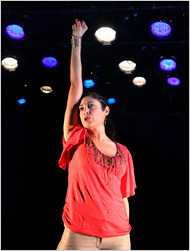 Najla Said’s “Palestine,” a one-woman Off Broadway show that began previews on Saturday, is a coming-of-age story about Ms. Said’s journey to become an Arab-American on her own terms. The daughter of Edward W. Said, the Columbia University professor who until his death in 2003 was the most prominent advocate in this country for the cause of Palestinian independence, Ms. Said guides the audience though her teenage years as a self-described politically agnostic Upper West Side princess to a vision of herself today, a 35-year-old woman who is deeply moved by the very word “Palestine.”
Ms. Said, a writer and actor, insists that she is not an especially political person. “Palestine,” which officially opens on Feb. 17 at the Fourth Street Theater in the East Village, offers no remedies for Mideast tensions or blanket assessments of a complex situation. Ms. Said just tells her tale (with generous helpings of humor), which includes attending an elite Manhattan prep school (Trinity), where she blended in with her Jewish friends; becoming anorexic at 15; and visiting the West Bank and Gaza, Jordan and Lebanon with her family, where her priority was often getting in some beach time rather than analyzing the geopolitical situation. “I worried about being pretty enough, smart enough and fitting in,” Ms. Said recalled during a recent interview about “Palestine” and the years before 9/11 cast a dark shadow. “In the way of many immigrant kids,” she added, “I just wanted all the questions about identity to go away.”
Those questions persisted, of course. And so on a minimalist stage, with shifts in mood and scene accomplished by an original soundtrack of Arabic and Western music, Ms. Said talks about them. Her trips to the Middle East with her family were sometimes a jumble of confusion, she says, with the smell of open sewage in Gaza, the stark separation of the sexes, the food and the language that seemed to have nothing to do with her cushy Upper West Side life.
More here. (Note: I saw the play…she is brilliant at telling a poignant story…some of the best parts are of course about her incomparable father, the magnificent Edward Said.)
Shadi Hamid and Amanda Kadlec at the website of the Project on Middle East Democracy:
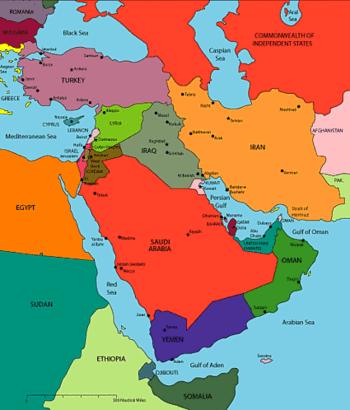 The time is ripe for a reassessment of current policies. Since the terrorist attacks of September 11, 2001, supporting Middle East democracy has assumed a greater importance for Western policymakers, who see a link between lack of democracy and political violence. Greater attention has been devoted to understanding the variations within political Islam. The new American administration is more open to broadening communication with the Muslim world. Meanwhile, the vast majority of mainstream Islamist organizations – including the Muslim Brotherhood in Egypt, Jordan’s Islamic Action Front (IAF), Morocco’s Justice and Development Party (PJD), the Islamic Constitutional Movement of Kuwait, and the Yemeni Islah Party – have increasingly made support for political reform and democracy a central component in their political platforms. In addition, many have signaled strong interest in opening dialogue with U.S. and EU governments.
The future of relations between Western nations and the Middle East may be largely determined by the degree to which the former engage nonviolent Islamist parties in a broad dialogue about shared interests and objectives. There has been a recent proliferation of studies on engagement with Islamists, but few clearly address what it might entail in practice. As Zoé Nautré, visiting fellow at the German Council on Foreign Relations, puts it, “the EU is thinking about engagement but doesn’t really know how.”1 In the hope of clarifying the discussion, we distinguish between three levels of “engagement,” each with varying means and ends: low-level contacts, strategic dialogue, and partnership.
More here.
Our own J. E. H. Smith in his eponymous blog:
 It has recently been brought to my attention that academic philosophers, along with saying 'human beings' instead of 'man' and 'they' instead of 'he', are expected to avoid the word 'seminal' altogether in their published work. This is of particular concern to me (I'm delighted, in contrast, to let 'man' go; as for 'they', I do regret that we were not able to come up with a gender-neutral pronoun that is not at the same time number-ambiguous), since I have just written an entire book on semen (or, more precisely, a book in which one of the central concerns is the variety of explanations given in the 17th century of the role of semen in the generation of animals and in the transmission of specific form), and I am fairly attached to this noun's adjectival form.
Beyond my personal need to go on talking about what I write about, and writing about what I know about, I am also fairly concerned about the way superficial changes, implemented in the name of eliminating bias from academic discourse, inadvertently impoverish that discourse. In the present case, it seems to me that anyone who does not like the word 'seminal' must be a monolingual speaker of English, or at least must not know that, while 'seminal' is the adjectival form of 'semen', 'semen' itself just means 'seed', and the term was likely extended by analogy in the first place from the domain of agriculture to describe the fluid emitted by male animals. When the term is extended by even further analogy to describe abstract principles, e.g., when Augustine speaks of rationes seminales or 'seminal reasons', it is fairly clear that he has in mind plain old seeds –as in the seeds of a pear from which a pear tree might grow, and which are found within the closest thing a pear tree has to ovaries– and not the fluid he so regrets being tempted to eject.
More here.
Marvin J. Cetron with David A. Patten in NewsMax Magazine:
 “CrazybOy” — the “handle” of programmer Bin Jin, a remarkable 18-year-old high school student from Shanghai — bested 4,200 other competitors (many of them code-writing pros with masters degrees and Ph.D.s) to win TopCoder's annual algorithm contest. He and others delivered a
Sputnik-style beat-down to the United States in the process.
Of the 70 finalists, 20 were Chinese. Ten were Russian. Six were Indonesian. Six more came from Ukraine. Four of the finalists were Canadian. Poland (population 38 million), the Philippines (92 million), and Argentina (40 million) placed three programmers apiece in the finals. The number of U.S. finalists: two. The number of U.S. champions in the nine events: none.
Experts say it's further proof that science and math illiteracy are endangering U.S. global competitiveness, and could even threaten U.S. national security. After all, it's no accident the
contest was sponsored by the super-secret National Security Agency (NSA) — the cryptographic “puzzle palace” in Fort Meade, Md.
Increasingly, science and national security are one. Officers in trailers at U.S. air bases pilot unmanned drones to seek and destroy terrorists in Afghanistan. (In fact, Creech Air Force Base, only 35 miles northwest of the Las Vegas resort where the TopCoder Open was held, conducts such missions daily.)
The bottom line: Lamentations about the state of U.S. science are more than fodder for PTA meetings.
More here.
Tuesday, February 9, 2010
 Clay Risen in the Boston Review:
the SPD’s leadership problems are just the surface, and the deeper issues extend well beyond Germany. Like center-left parties in France, Italy, the Netherlands, and most of Scandinavia, the SPD suffers from the crisis of purpose that the late political scientist and parliamentarian Ralf Dahrendorf predicted a quarter-century ago: it has become the victim of its own success, fighting for a social democracy that Europe has already achieved. Which is not to say that new challenges do not exist—the IT revolution, globalization, European integration, and the splintering of the working class are rewriting the terms of the European social contract, the very heart of the social-democratic movement. But the SPD is stuck fighting the battles of a previous war. “The SPD still wants to protect workers and jobs, but we’re in a post-social democratic party period,” Jackson Janes, executive director of the American Institute for Contemporary German Studies, said.
Even worse for the SPD, voters now believe that the center-right CDU, at least with Merkel at the helm, is the more competent defender of the welfare state. Schröder fought for, and won, painful labor-market reforms in the early 2000s, which introduced greater workplace flexibility but also exacerbated the gap between rich and poor, driving hundreds of thousands of Germans into poverty. It was Merkel who insisted, in response, on shoring up the welfare state, and it is Merkel who, in the current governing coalition with the free-market Free Democrats, is resisting pressure to cut taxes (though she did accept some cuts as part of the coalition deal). “Angela Merkel is the opposite of the typical CDU member in many ways,” said Daniel Friedrich Sturm, a correspondent for the national newspaper Die Welt and the author of Where Is the SPD Headed? If Merkel has an American analog, it is New York Mayor Michael Bloomberg, a conservative by convenience who wins by tacking to the left of his left-wing opponents.
Toril Moi on de Beauvoir's The Second Sex in the LRB:
In June 1946 Simone de Beauvoir was 38. She had just finished The Ethics of Ambiguity, and was wondering what to write next. Urged by Jean Genet, she went to see the Lady and the Unicorn tapestries, on show for the first time after the war. Citizen Kane was also being shown in Paris for the first time, and Beauvoir was impressed: Orson Welles had revolutionised cinema. Politics was not an all-encompassing consideration, for the Occupation was over, and the Cold War had not quite begun. In the short space of time since the Liberation, Beauvoir had established herself as a writer and intellectual. Her first philosophical essay, Pyrrhus et Cinéas, had been well received, and in 1945, her second novel, The Blood of Others, had been praised as the first novel of the Resistance. In the public realm, her name was firmly linked to Jean-Paul Sartre’s, and to existentialism, which was becoming so fashionable that Sartre had to hire a secretary. No longer a beginner, no longer unknown, Beauvoir had nothing to prove; she could write about anything.
She decided to write about herself. She was inspired by Michel Leiris’s Manhood, which had just been reissued in Paris with a new introduction comparing writing to bullfighting (the torero and the writer need the same kind of courage). She would write a confession. Thinking about the project, she realised she had to begin by asking: ‘What has it meant to me to be a woman?’ At first, she thought of the question as a formality, a preliminary exercise to get her into the real work: ‘I had never had any feeling of inferiority, no one had ever said to me, “You think that way because you are a woman”; my femaleness had never bothered me in any way. “In my case,” I said to Sartre, “it hasn’t really mattered.”’ Sartre urged her to think again: ‘But still, you weren’t brought up in the same way as a boy: you should take a closer look.’ She did, and was amazed:
It was a revelation. This world was a masculine world, my childhood was nourished by myths concocted by men, and I hadn’t reacted to them in the same way I should have done if I had been a boy. I became so interested that I gave up the project of a personal confession in order to focus on women’s condition in general. I went to do some reading at the Bibliothèque nationale and studied myths of femininity.
The roots of The Second Sex are here, in Beauvoir’s realisation that her life had been affected in countless ways by her having been born a girl.
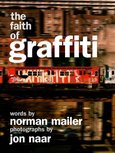
As a major serving in the British military during World War II, Jon Naar witnessed a way of life reduced to rubble. In the winter of 1973, as a fifty-something photojournalist living and working in New York, Naar once again saw a devastated landscape. But here the names of the young and dispossessed—often no more than a handle and maybe a number corresponding to the street the kid lived on, like Junior 161 or Stay High 149—were being spray-painted everywhere: bus shelters, handball courts, ice-cream trucks, subway trains, bridges, even trees. This was evidence of a citywide referendum on the American dream, he believed, with votes of no confidence tagged on every surface possible. Naar spent twelve days in crumbling neighborhoods of the Bronx, Manhattan, Queens, and Brooklyn with a Nikon FM and a Leica M-4, taking more than three thousand Kodachrome photographs of the burgeoning graffiti movement. He edited his trove down to forty-four gems, which he intended for a book, the first major work on this emergent subculture.
more from Hua Hsu at Bookforum here.
The fame of Howard Zinn, who died a week and a half ago, rested on his long record of challenging the status quo. As a young professor, he was a leader of the civil rights and antiwar movements, and throughout his career he was an inveterate demonstrator and speaker at rallies and strikes. His writings brought formerly obscure events like Bacon’s Rebellion, the Great Railroad Strike of 1877, and the Philippine-American War into the light, arguing that such popular uprisings – and their brutal suppression – were central to the American story. It’s a vision that resonated with readers: Zinn’s 1980 book, “A People’s History of the United States,” has sold more than 2 million copies. Zinn was an unabashed political radical, but much of the appeal of his work stemmed from something conceptual: He took a story that generations of American schoolchildren had had drilled into them and he turned it on its head. Rather than the Founding Fathers or politicians and generals, he saw the nation’s fed-up farmers, rebellious slaves, women’s libbers, labor leaders, and other agitators as our national heroes. By taking history outside the halls where treaties are signed and bills debated and instead writing the story from the streets, he cast a new light on a familiar narrative, exposing elements – about the costs of the country’s expansion, the mixed motives of its founders, and the role of its suppressed dissenters – that the traditional narrative had left in shadow.
more from Drake Bennett at the Boston Globe here.
