
Sameer Rahim in The Telegraph:
In June 1958 William Heinemann published a first novel by a Nigerian radio producer called Chinua Achebe. Things Fall Apart was immediately recognised for its subtle portrayal of tribal life in Igboland, the area of south-east Nigeria where Achebe was born and raised. After 52 years that book has become a classic of world literature. In an essay in Achebe’s new book, The Education of a British-Protected Child, the author reflects on the appreciative letters he has received from readers of all backgrounds. “In spite of serious cultural differences,” he writes, “it is possible for readers in the West to identify, even deeply, with characters and situations in an African novel.”
The novel’s title is taken from Yeats’s “The Second Coming”: “Things fall apart; the centre cannot hold; / Mere anarchy is loosed upon the world.” At the novel’s centre is the village of Umuofia and its strongest personality, Okonkwo. We see his life destroyed by a series of calamities, the most significant of which is the British arrival in Igboland. He is impotent when his son abandons his tribal religion to attend a mission school. When it emerges that the British have brought not only a religion, but also a government and a queen, Okonkwo’s refusal to compromise leads to his tragic end.
More here.










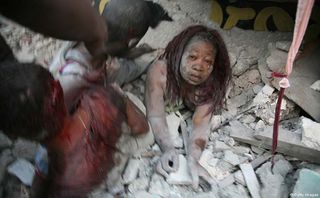

Here's the bottom line: If things don't start improving very rapidly, then life and limb-threatening infections and deadly dehydration and unnecessary conflict will likely emerge within the affected population on a scale that has the potential of becoming rampant and widespread, resulting in more death and injury that could still be avoided, though time is fast running out. The current path to giving Haiti the relief it desperately needs is simply taking way too long in developing in order to be a reasonable and defensible short term emergency strategy. Each country should, by now, be realizing that it is very much the correct option would be to stage multiple and overwhelmingly robust and well managed multi-national supply lines and helicopter sorties using locations and bases other than Port Au Prince Airport, particularly from the Dominican Republic through the border near Jumani, D.R. It's 7-10 hours by road (depending on the kind of vehicle and size of the load), but it's a darn good road compared to the roads in the Pakistan earthquake affected areas that I've been traveling on for the past four years. Distributing aid from several points over a more widespread area can reach far more people far more quickly.