
James Goodwin in the Boston Review:
 The week after taking office in 2017, Donald Trump announced his administration’s signature policy on the administrative state—the constellation of agencies, institutions, and procedures that Congress has created to help the president implement the laws it passes—when he signed Executive Order 13771. The directive purported to create a “regulatory budget” scheme that prohibited agencies from issuing a new rule unless they first repealed two existing rules and ensured that the resulting cost savings offset any costs the new rule might impose.
The effort failed. While federal agencies reduced their regulatory output during the Trump administration, they made little lasting progress in repealing existing rules. The Administrative Procedure Act, which governs much of how the administrative state operates, makes it hard to do so. Most of the Trump administration’s repeal attempts were met with rejection by federal courts for failing to abide by basic procedural requirements.
Still, Executive Order 13771 perfectly encapsulated conservative thinking about regulatory policy at the time. The goal was to bring about the “deconstruction of the administrative state,” as former Trump advisor Steve Bannon famously put it.
More here.
Enjoying the content on 3QD? Support our website by donating now and keep 3QD going.
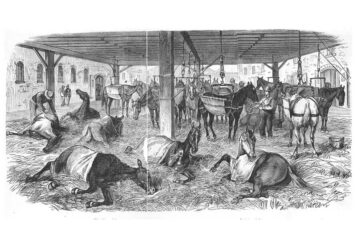 Before the automobile, cities were powered by horses. These urban equines ferried passengers in streetcars and carriages; they pulled fire engines and ambulances. They delivered everything from milk and ice to mail. They hauled the coal for locomotive and steam engines.
 I
I What kind of world is this? That’s the question prompted over and over by Joseph O’Neill’s new novel
  Amongst the many energy-hungry technologies supporting modern society, artificial intelligence (AI) is emerging as a major driver of energy demand. Data centers—the physical infrastructure enabling AI—are becoming larger, multiplying, and consuming more energy. Environmental organizations such as Greenpeace are
  When Henderson got to Yale on the G.I. Bill, he was shocked by the differences between him and his classmates. As he explains in the video above, he learned it was popular for his classmates to hold strong, seemingly progressive views about many of the concerns that shaped his life — drugs, marriage, crime. But they were largely insulated from the consequences of their views. Henderson found that these ideas came to serve as status symbols for the privileged while they, ironically, kept the working class down. He came to call these ideas luxury beliefs.
 Alice Munro, considered one of the greatest short-story writers of modern times, was a monster.
 O
O D
D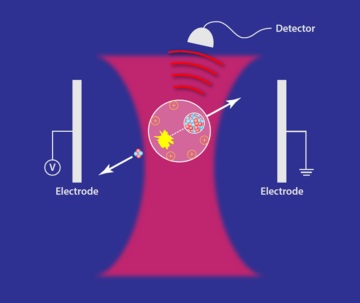 For centuries, physicists have exploited momentum conservation as a powerful means to analyze dynamical processes, from billiard-ball collisions to galaxy formation to subatomic particle creation in accelerators. David Moore and his research team at Yale University have now put this approach to work in a new setting: they used momentum conservation to determine when a radioactive atom emitted a single helium nucleus, known as an alpha particle (Fig.
 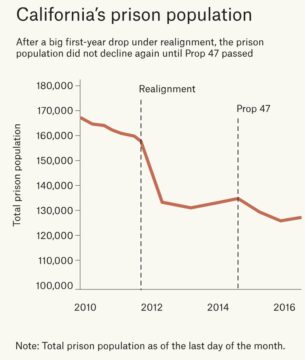 Asterisk: You’re responsible for managing one of the most comprehensive data sets of criminal outcomes for various criminal justice systems in California. It includes 12 counties and 60% of the state population. How did you put this resource together, and what kinds of outcomes you are tracking with it?
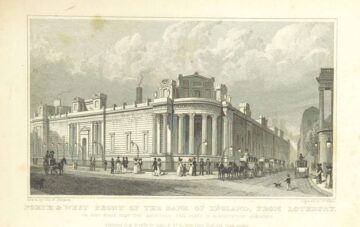 In 1916 the Bank of England committed what Nikolaus Pevsner was to call the greatest architectural crime to befall London in the 20th century. It decided to demolish much of its own building, designed by the great Georgian neoclassical architect John Soane.
 W
W In recent years, MIT physicist Jeremy England (pictured above) has gained media attention for proposing a thermodynamic energy-dissipation model of the origin of life. England’s view was summarized when he famously said that the origin and evolution of life “should be as unsurprising as rocks rolling downhill.” He continued, “You start with a random clump of atoms, and if you shine light on it for long enough, it should not be so surprising that you get a plant.”1Another physicist, ID theorist Brian Miller, has responded to England’s research.