
Category: Recommended Reading
Obama in Chains

It is hard for international observers of the United States to grasp the political paralysis that grips the country, and that seriously threatens America’s ability to solve its domestic problems and contribute to international problem solving. America’s governance crisis is the worst in modern history. Moreover, it is likely to worsen in the years ahead.
The difficulties that President Barack Obama is having in passing his basic program, whether in health care, climate change, or financial reform, are hard to understand at first glance. After all, he is personally popular, and his Democratic Party holds commanding majorities in both houses of Congress. Yet his agenda is stalled and the country’s ideological divisions grow deeper.
Among Democrats, Obama’s approval rating in early November was 84%, compared with just 18% among Republicans. Fifty-eight percent of Democrats thought the country was headed in the right direction, compared with 9% of Republicans. Only 18 % of Democrats supported sending 40,000 more troops to Afghanistan, while 57% of Republicans supported a troop buildup. In fact, a significant majority of Democrats, 60%, favored a reduction of troops in Afghanistan, compared with just 26% of Republicans. On all of these questions, a middle ground of independents (neither Democrats nor Republicans) was more evenly divided.
Part of the cause for these huge divergences in views is that America is an increasingly polarized society. Political divisions have widened between the rich and poor, among ethnic groups (non-Hispanic whites versus African Americans and Hispanics), across religious affiliations, between native-born and immigrants, and along other social fault lines. American politics has become venomous as the belief has grown, especially on the vocal far right, that government policy is a “zero-sum” struggle between different social groups and politics.
Sunday Poem
Splitting Wood
…………………..
Remembering my brother
…………………..
October seems too swift
mushrooms melt into the soil
and salamanders rise from beneath the earth
like the dead doing a dance
…………………..
and time itself is a wedge forced into heartwood
splitting decades into neat bundles
…………………..
……but the cords
stacked with the promise of heat
are never enough
…………………..
……there’s still that chill
that certain need for another autumn
…………………..
for days my muscles still ache
with the memory of motion
…………………..
for days I remember one chunk
splitting into two
falling open like books
like arms of a dead brother
…………………..
and the perfume of cedar
……rising
…………………..
it’s in this space between two seasons
deftly blended with the flat of a thumb
as languid as a plush cat stretching before
the incessant heat of a woodstove
…………………..
when sky and land fuse
into the same bottomless gray
…………………..
the entire world becomes a sponge
and each step squeezes juice
from its pores
…………………..
when losses splinter off like kindling
when I turn back to kiss this blank page
……of fog
whispering politely.
…………………..
…………………..
by Patrick Loafman
from The Poetry Journal; Issue 1, Spring 2008
Survival of the kindest
From Salon:
In a fitting metaphor, the most recent experiment with social darwinism resulted in mass extinction. Former Enron CEO Jeffrey Skilling claimed he was inspired by Richard Dawkins’ book The Selfish Gene when he implemented a system known as “rank and yank” that sought to apply nature’s lessons to the energy industry. Skilling had all employees in the company ranked every six months. Then he offered lavish bonuses to the top 5 percent while the bottom 15 percent were relocated or fired. This system of ruthless competition advanced just the type of personalities that one would expect: crazy people. As one Enron employee put it, “If I’m going to my boss’s office to talk about compensation, and if I step on some guy’s throat and that doubles it, then I’ll stomp on that guy’s throat.” However, what was perhaps most disturbing is that according to Time magazine, 20 percent of US companies were following the same business model at the time of Enron’s collapse. Enron’s self-destruction was only the first in a nationwide trend. But what, if anything, does this say about nature?
In his latest book, The Age of Empathy: Nature’s Lessons for a Kinder Society, primatologist Frans de Waal argues that social darwinists like Skilling have learned the wrong lessons about the natural world. The nasty, brutish existence dominated by “savage competition, ruthless exploitation, and deceit” that Dawkins describes is far from the norm for animals that live in social groups. They thrive because of the cooperation, conciliation, and, above all, the empathy that they display towards fellow members. The support and protection they receive from living in a group more than compensates for any selfish advantage they might have achieved on their own. In other words, the “selfish gene” has discovered that the most successful approach is to behave unselfishly. De Waal thus argues that the age of empathy is far older than our own species and that we must keep this in mind as we try to apply these lessons ourselves.
More here.
36 ARGUMENTS FOR THE EXISTENCE OF GOD
From Edge:
“What is this stuff, you ask one another,” says the narrator in Rebecca Newberger Goldstein's new novel 36 Arguments for the Existence of God: A Work of Fiction, “and how can it still be kicking around, given how much we already know?” We have very short memories. It was in April 2006 that President George W. Bush, Senate Majority Leader Bill Frist, and Senator John McCain all announced their support of teaching Intelligent Design in public schools. This assault on science and on the separation of church and state was a mobilizing moment for the Edge community which responded to this initiative with book of essays by 16 eminent scientists entitled Intelligent Thought, excerpts from which appeared on Edge. At the time, three and a half years ago, no one was using the phrase “the new atheists”. In fact, in early 2006 only Sam Harris's book The End of Faith (2004), and Daniel C. Dennett's Breaking the Spell (February, 2006) had been published. It was in response to the highly organized and well-financed campaign by the religious right that led champions of rational thinking such as Jerry Coyne, Richard Dawkins, Daniel C. Dennett, Sam Harris, Christopher Hitchens, A.C. Grayling, and P.Z. Myers to mount an unrelenting campaign against the purveyors of superstition, supernaturalism, ignorance … and their apologists (the self-proclaimed “moderates”, or to use more apt terms, the “accommodationists”, or the “faitheists”).
The term “the new atheists” came into play in early 2007, followed by “I am an atheist, but”. This is hardly the lingo of the far right. In fact, you don't have to leave the pages of Edge to read variations on this meme from some very distinguished and respected scientists. But what some appear to be saying is “I am an atheist but… other people, not as smart as I am, require religion (a) to get through the day, (b) to create sustainable societies, (c) to have moral values, etc. Others, intellectually lazy, afraid, or unable to invent their own personal narratives, simply wear their parents' old ideas like a hand-me-down suit, defaulting to the maudlin sentimentality that is the soundtrack to the American mind. Now, Rebecca Newberger Goldstein, known to Edge readers as a philosopher who has interesting things to say about Gödel and Spinoza, among others, enters into this conversation, taking on these and wider themes, and pushing the envelope by crossing over into the realm of fiction.
More here.
Protocols of the Elders of Sodom
Tariq Ali momentarily puts his politics aside, to write of books, films and sticky wickets.
David Renton in The Independent:
This book is a collection of 36 mid-length articles written by Tariq Ali over the past three decades. It contains book reviews, diary pieces and even the transcripts of conversations between Ali and other writers. It is not a “selected works”. Rather, if anything binds the collection together it is a decision generally to eschew overtly political writing (for example, about the current crisis in Pakistan, about which Ali has written elsewhere), in favour of reviews and literary polemics.
Not all of the pieces in the collection succeed. Although it gives the book its memorable title, the opening chapter is an over-long satire to the effect that gay men as well as Zionists might contemplate a return to Israel. (Ali's longer satires, like his worst novel, Redemption, ache. His short jokes sizzle).
Also included is the text of three public dialogues between Ali and Salman Rushdie, Maria Vargas Llosa and Juan Goytisolo. The Rushdie conversation took place at the ICA in London after the publication of Midnight's Children and Shame, when Rushdie was at the top of his game. But large parts of the debate seem to have been conducted between the two writers at monologue length, and the questions from the audience are forgettable. If anything, the exchange detracts from an intelligent review by Ali of Midnight's Children, which is included just 17 pages before.
Other, sharper, essays find as much in Kipling and as little in War and Peace as each deserves. There is also a moving piece in which Ali attends an event in his honour in Diyarbakir in Turkish Kurdistan, only to find that voices which previously advocated self-liberation now pin their hopes on American intervention.
More here.
Saturday, November 21, 2009
crucified in the drawing room

“Practically, one crucifies oneself and entertains drawing rooms and lounges.” This sentence by T S Eliot on the reception of his extraordinary, agonised poem, The Waste Land (1922), is a thrilling moment in the long-awaited second volume of his letters. It rings like a line from one of his earlier poems, in which suffering figures suddenly see themselves in the absurd light of polite society. “I have measured out my life with coffee spoons,” rued Eliot’s alter ego J Alfred Prufrock in 1917. Eight years later, he might have added: “and headed notepaper”. The first volume of Eliot’s letters, which covered the period from early youth up to both “Prufrock” and The Waste Land, appeared 21 years ago. It was edited, as he requested, by his second wife, Valerie Eliot, formerly his secretary at Faber & Faber. The sequel only covers another three years, up to Eliot’s professional move from Lloyd’s Bank to the publishing house. But it was evidently proving an overwhelming task, and she has now been joined by the scholar Hugh Haughton, who has also revised and expanded the first volume by about 200 pages.
more from Jeremy Noel-Tod at The Telegraph here.
time

“When you are courting a nice girl, an hour seems like a second,” Albert Einstein said, by way of explaining relativity. “When you sit on a red-hot cinder, a second seems like an hour.” Such a notion resonates throughout Eva Hoffman’s slender reflection on the chronological conundrum, “Time.” Not because Hoffman deals much with Einstein (he merits only two references), but because at the heart of her book is the idea that time is what we make it, that it is not just fluid but impossible to pin down. “[O]ur existence is but a brief crack of light between two eternities of darkness,” she notes, quoting Nabokov, yet all the same, she continues, “we live in time.” How we reconcile those two opposing visions — the abstract and the concrete, the cosmic and the quotidian — says a lot about who we are, not just as individuals, but as members of a species that has never fully come to grips with evanescence, with the discomforting reality that, in the flicker of an instant, each of us will be gone. If that sounds like a philosophical conversation, it is and it isn’t, which is one of the peculiar tensions of Hoffman’s book. By turns meditation and social commentary, essay and observation, “Time” is a work that, like its subject, is difficult to categorize. Hoffman begins by noting the ways time works differently in different societies, comparing the anxieties of the industrialized West to the “slower tempo” of life in Eastern Europe, where she grew up in, as poet Carmen Firan has written, “the opaque world of communism, where time had no value.”
more from David L. Ulin at the LA Times here.
Writing About Writers
Bob Thompson in The American Scholar:
When I first encountered Joan Didion, I was on a bus heading back to my apartment in the middle of the night. This was in Cambridge, Mass., in 1975, and I had picked up a paperback copy of Slouching Towards Bethlehem, Didion’s first nonfiction collection. The opening piece, “Some Dreamers of the Golden Dream,” begins with a description of the San Bernardino Valley, east of Los Angeles, and of “the hot dry Santa Ana wind that comes down through the passes at 100 miles an hour and whines through the eucalyptus windbreaks and works on the nerves.” Three pages later, with an October Santa Ana bearing witness, a dentist’s wife named Lucille Miller watches her husband burn to death in the family Volkswagen. By the time I emerged from this sinister dreamscape, I had overshot my bus stop by a mile.
Three decades later, as I could not possibly have imagined in 1975, I found myself in Didion’s Manhattan living room, interviewing her for The Washington Post.
I was an aging rookie on the Post’s book beat, which I’d recently been asked to take over. I was also quietly terrified, as I would be many times when talking with writers I admired. Fear isn’t a bad thing for a reporter. It forces you to prepare and keeps you alert. But in retrospect, I put this interview in a category of its own.
That’s because preparing to talk with Didion — though I was scarcely conscious of this at the time — taught me how to think about my job.
Didion had just published The Year of Magical Thinking, her memoir of the sudden death of her husband and the simultaneous, life-threatening illness of their only child.
More here.
king on carver

Raymond Carver, surely the most influential writer of American short stories in the second half of the 20th century, makes an early appearance in Carol Sklenicka’s exhaustive and sometimes exhausting biography as a 3- or 4-year-old on a leash. “Well, of course I had to keep him on a leash,” his mother, Ella Carver, said much later — and seemingly without irony. Mrs. Carver might have had the right idea. Like the perplexed lower-middle-class juicers who populate his stories, Carver never seemed to know where he was or why he was there. I was constantly reminded of a passage in Peter Straub’s “Ghost Story”: “The man just drove, distracted by this endless soap opera of America’s bottom dogs.”
more from Stephen King at the NYT here.
The Real Price of Trying Khalid Sheikh Mohammed
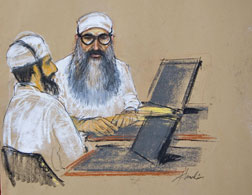
Good criminal defense attorneys are seldom deterred by futility, so it's reasonable to expect that KSM's lawyers will make all the arguments there are to make: They'll allege a violation of KSM's right to a speedy trial, claiming that the years he spent in CIA detention and Gitmo violated this constitutional right. They'll seek suppression of KSM's statements, arguing (persuasively) that the torture he endured—sleep deprivation, noise, cold, physical abuse, and, of course, 183 water-boarding sessions—make his statements involuntary. They will insist that everything stemming from those statements must be suppressed, under the Fourth Amendment, as the fruit of the wildly poisonous tree. They will demand the names of operatives and interrogators, using KSM's right to confront the witnesses against him to box the government into revealing things it would prefer to keep secret—the identities of confidential informants, the locations of secret safe houses, the names of other inmates and detainees who provided information about him, and a thousand other clever things that should make the government squirm. The defense will attack the CIA, FBI, and NSA, demanding information about wiretapping and signal intelligence and sources and methods. They'll move to dismiss the case because there is simply no venue in the United States in which KSM can get a fair trial.
All of these motions and three dozen more will be either denied or denuded of any significant impact on the disposition of the case. The speedy-trial argument will fail. Important documents will be scrubbed and redacted to the point of unintelligibility or will be ruled irrelevant. The motions to dismiss will all be denied. And though some of KSM's statements will be suppressed in order to preserve the appearance of impartiality and integrity, plenty of the most damming ones will remain admissible. While condemning in stern language the terrible treatment of KSM and denouncing water-boarding as beneath the high standards of our justice system, the trial judge will nonetheless admit into evidence statements made by KSM in subsequent military tribunals, along with those made to a so-called “clean team” of interrogators, rendering all the suppressed evidence utterly insignificant.
In an idealized view, our judicial system is insulated from the ribald passions of politics. In reality, those passions suffuse the criminal justice system, and no matter how compelling the case for suppressing evidence that would actually effect the trial might be, given the politics at play, there is no judge in the country who will seriously endanger the prosecution. Instead, with the defense motions duly denied, the case will proceed to trial, and then (as no jury in the country is going to acquit KSM) to conviction and a series of appeals. And that's where the ultimate effect of a vigorous defense of KSM gets really grim.
At each stage of the appellate process, a higher court will countenance the cowardly decisions made by the trial judge, ennobling them with the unfortunate force of precedent.
Inflation, Strings and the Anthropic Principle

Have you ever wondered what went on in the universe when it was just 10-35 s old — and how this could be related to our special pocket in the multiverse?
If so, you might want to watch a video of the 2009 Newton lecture, which is now available on the Institute of Physics (IOP) website.
The lecture was given in London on 14 October by Alan Guth, who was in town to receive the IOP’s Isaac Newton Medal for his pioneering work on cosmic inflation — a theory that changed the way we think of the early universe.
Entitled “Inflationary Cosmology: Is Our Universe Part of a Multiverse?”, Guth’s talk lasts about one hour. He starts with an explanation of how inflation provides a “simple and natural” explanation for how the universe became what it is today.
The Age of the Informavore: A Talk With Frank Schirrmacher

Introduction
by John BrockmanThe most significant intellectual development of the first decade of the 21st Century is that concepts of information and computation have infiltrated a wide range of sciences, from physics and cosmology, to cognitive psychology, to evolutionary biology, to genetic engineering. Such innovations as the binary code, the bit, and the algorithm have been applied in ways that reach far beyond the programming of computers, and are being used to understand such mysteries as the origins of the universe, the operation of the human body, and the working of the mind.
Enter Frank Schirrmacher, Editorial Director the editorial staff of the FAZ Feuilleton, a supplement of the FAZ on the arts and sciences. He is also one of the five publishers of the newspaper, responsible for the Feuilleton, and he has actively expanded science coverage in this section. He has been referred to as Germany's “Culture Czar”, which may seem over the top, but his cultural influence is undeniable. He can, and does, begin national discussions on topics and ideas that interest him, such as genomic research, neuroscience, aging, and, in this regard, he has the ability to reshape the national consciousness.
I can provide a first-hand account of “the Schirrmacher treatment”.
In May of 2000, he published a manifesto in FAZ, a call-to arms,entitled “Wake-Up Call for Europe Tech”, in which he called for Europe to adopt the ideas of the third culture. His goal: to change the culture of the newspaper and to begin a process of change in Germany and Europe. “Europe should be more than just a source for the software of ego crisis, loss of identity, despair, and Western melancholy,” he wrote. We should be helping write the code for tomorrow.”
The Manifesto, and Schirrmacher's publishing program, was a departure for FAZ which has a somewhat conservative profile, and it was widely covered in the German press and made waves in intellectual circles. And a decade later, the national conversation continues. (See this week's Stuttargarter Zeitung).
Within weeks following publication of his manifesto, Schirrmacher began publishing articles by notable third culture thinkers such as Bill Joy, Ray Kurzweil, V.S. Ramachandran, Patrick Bateson, James Watson, Craig Venter, David Gelernter, among others. Soon after, he devoted an entire edition of the Feuilleton to a printout the Human Genome code published by Craig Venter, which caused a sensation in Germany.
Then came 9/11. And everything changed. Schirrmacher was on to the next story.
Chomsky Half Full
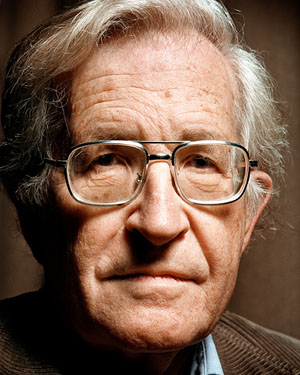
Guernica:…Utne characterized your work as having “an unflagging sense of outrage.” I’m wondering, when you diligently dissect exactly what your country has done in places like Chile, Vietnam, Iraq, and elsewhere, when you log numbers of innocent civilians killed, and carefully present these outrageous quotes from members of government or heads of corporations, what you’re feeling. I believe the anger comes through. What else is going on? Shame? Guilt?
Noam Chomsky: All of them. Shame and guilt, of course, because there’s much that we can do about it, that I haven’t done. And outrage because, yes, it’s outrageous. And disgust at the hypocrisy in which it’s veiled. But there’s no point in revealing those emotions. You know, maybe I can talk about them with my wife or something. But what’s the point of going public with them? Doesn’t do any good.
Guernica: Yet those emotions come through in your work as a subtext.
Noam Chomsky: Maybe. And it very much angers supporters of state violence; in fact, they’re infuriated by it, when it comes out.
Guernica: What do you mean?
Noam Chomsky: When it comes out, they are sometimes infuriated by it. I happened to be in England a couple of days ago [for] an interview at BBC. One of the things the interviewer brought up is a statement of mine showing how incomparably awful I am. The statement is “One has to ask whether what the United States needs is dissent or denazification.” And that’s so utterly outrageous; it shows I’m kind of a maniac from outer space. So I asked him what I always do when somebody brings it up. I said, “Did you read the context?” And of course he hadn’t. So I said, “Okay, here’s the context.” During the Vietnam War, the Chicago Museum of Science set up a diorama of a Vietnamese village in which children could be on the outside with guns and shoot into the village and try to kill people. And there was a protest by a group of mothers, a quiet protest, protesting this thing. There was an article in the New York Times condemning—not the exhibit, but the mothers—because they were trying to take away fun from the kiddies. And in that context I said, “Sometimes you have to wonder whether what’s needed is dissent or denazification.” I think it’s just the right thing to say.
An essay is an act of imagination. It still takes quite as much art as fiction
Zadie Smith in The Guardian:
Suffering from 'novel nausea', Zadie Smith wonders if the essay lives up to its promise.
Why do novelists write essays? Most publishers would rather have a novel. Bookshops don't know where to put them. It's a rare reader who seeks them out with any sense of urgency. Still, in recent months Jonathan Safran Foer, Margaret Drabble, Chinua Achebe and Michael Chabon, among others, have published essays, and so this month will I. And though I think I know why I wrote mine, I wonder why they wrote theirs, and whether we all mean the same thing by the word “essay”, and what an essay is, exactly, these days. The noun has an unstable history, shape-shifting over the centuries in its little corner of the OED.
For Samuel Johnson in 1755 it is: “A loose sally of the mind; an irregular undigested piece; not a regularly and orderly composition.” And if this looks to us like one of Johnson's lexical eccentricities, we're chastened to find Joseph Addison, of all people, in agreement (“The wildness of these compositions that go by the name of essays”) and behind them both three centuries of vaguely negative connotation. Beginning in the 1500s an essay is: the action or process of trying or testing; a sample, an example; a rehearsal; an attempt or endeavour; a trying to do something; a rough copy; a first draft. Not until the mid 19th century does it take on its familiar, neutral ring: “a composition more or less elaborate in style, though limited in range.” Which is it, though, that attracts novelists – the comforts of limit or the freedom of irregularity?
More here.
Haleh Esfandiari: Prisoner of Tehran
From The New York Times:
In 2007, Haleh Esfandiari, the Iranian-American director of the Woodrow Wilson Center’s Middle East Program, told Iranian intelligence everything she knew. She was interrogated for almost eight months, nearly four of them inside Tehran’s notorious Evin prison. During that time, she explained the institutional structure of the Wilson Center, identified its board members and described her work organizing conferences. She translated reams of material from the center’s Web site into Farsi. But it was a dialogue of the deaf.
More here.
Friday, November 20, 2009
Sixty Hours of Terror

Sadanand Date, an additional commissioner of police for central Mumbai, was not supposed to be at Cama. The attacks were taking place out of his jurisdiction. But he was asked to go to CST and headed to the hospital as soon as he heard the gunmen had moved on, stopping on the way at a police station to get a carbine issued. It was his team that penetrated the hospital to face heavy fire and grenades from Kasab and Ismail, who they had isolated on the sixth floor. At 11:19 he made his first call to control for backup. Six more calls were made, with no response. The seventh, at 11:28, went through moments after a grenade blast critically injured two men; Date’s right eye was blinded by shrapnel. “Central Region walkie-talkie sends out an SOS: Heavy firing. We are all injured. Need help. Please send reinforcements.” Date traded fire with the gunmen until midnight. He was hit again, this time by a bullet to his left leg. Khan and Kasab decided to abandon their position. They released a hostage to provide cover, lobbed another grenade, and rushed toward the exit. In their hurry, Kasab dropped his rucksack, which contained several magazines and the satellite phone, but they had made it outside. The gunmen fled through the front entrance and headed north, under cover of darkness, past the stone archways of St. Xavier’s College and down an alley. They ducked into some bushes when they saw the headlights of a Qualis police SUV on patrol coming their way.
Part II of Jason Motlagh’s definitive narrative of the Bombay attacks at VQR here.
1969: Spiritual hair shirts were in fashion

In 1969, we were very free. I turned twenty-seven—too old to be a hippie, after having been too young to pull off being a beatnik—and was so free as to be practically useless, writing just enough to finance days abed in a tiny Sullivan Street apartment, where I convalesced from many drugs, a broken marriage, and other ills of frenetic years on the downtown poetry and art scenes. I almost roused myself to attend Woodstock. Nixon became President. Vietnam churned on. Tidings of the Manson family and the Weathermen intensified a sense of concatenating disaster. Black Power, nascent feminism, and Stonewall discomfited straight white guys like me. (Being on the side of the angels is hard when the angels are mad at you.) In the art world, “New York Painting and Sculpture: 1940-1970,” which opened in 1969, at the Metropolitan Museum, and was curated by the owlish hipster Henry Geldzahler, summarized swiftly receding glories. Philip Guston, whose hypersensitive abstractions I had revered, was painting R. Crumb-like goofball imagery, for which it would take me more than a decade to forgive him. After a psychedelic efflorescence, color died. This I’ve confirmed on visits to “1969,” a huge show of works from the Museum of Modern Art’s collections, at P.S. 1, the museum’s affiliate in Long Island City. A grayer affair, in mood as in hue, cannot be imagined. It vivifies a reign of asceticism that followed upon our surfeit of freedom. Spiritual hair shirts were in fashion.
more from Peter Schjeldahl at The New Yorker here.
I suffer from the fear of what has happened

‘To write,’ Barthes suggested in Criticism and Truth (1966), ‘is to engage in a difficult relationship with our own language.’ This is not exactly Cole Porter’s tone, but Barthes liked difficulty, talked about the work and the pleasure of writing in the same breath. Of course, our relationships with language change over time, and it has often seemed as if there were two Roland Barthes, early and late, with not much in between. One was theoretical, analytic, systematic and everyone’s favourite structuralist. The other was impressionistic, allusive and anecdotal, a writer rather than a thinker. The first was the author of Elements of Semiology (1965), The Fashion System (1967) and many essays; the second the author of all the later, more discursive, more autobiographical works, like A Lover’s Discourse (1977) and Camera Lucida (1980). Fans of the first, theoretical Barthes tend not to be too keen on the later, looser model; and they often think the decline set in soon after S/Z (1970), and was especially noticeable in Roland Barthes by Roland Barthes (1975). This last work was a kind of critical and publishing joke. Barthes’s second book (after Writing Degree Zero, 1953) was a study of the historian Michelet in a series called Ecrivains de toujours, timeless writers. Because the books contained large selections from the authors’ own texts, they were called Michelet (for example) par lui-même, or in his own words. Barthes was the first living writer to appear in the series (the others weren’t so timeless after all), and his book was the first one to be literally by himself – he wrote it, composed a sort of autobiography in photographs and epigrams, rather than making a selection from his earlier published writing. He even reviewed the book in the Quinzaine littéraire.
more from Michael Wood at the LRB here.
In Cold Blood, half a century on
From The Guardian:
Fifty years ago, Holcomb, Kansas was devastated by the slaughter of a local family. And then Truman Capote arrived in town .
River Valley farm stands at the end of an earth road leading out of Holcomb, a small town on the western edge of Kansas. You can see its pretty white gabled roof floating above a sea of corn stubble. The house is famous for the elm trees which line the drive, giving it the tranquil air of a French country lane. The trees are in poor shape though, and desperately in need of pruning; their branches, leafless now, protrude at wild angles. There's something else not quite right about the setting. There is a large “stop” sign at the entrance to the road, backed up by a metal barrier and a hand-written poster in red paint proclaiming: “No Trespassing. Private Drive.” The warnings seem belligerent for such a peaceful spot. The explanation for these warnings lies about half a mile away in Holcomb's local park. A memorial plaque was unveiled there two months ago in honour of the former occupants of River Valley farm: the Clutter family, who lived in that house at the end of the elm drive until one tragic night half a century ago. The plaque carries a lengthy eulogy to the family, recording the many accomplishments of the father, Herb Clutter, and telling us that the family's leisure activities included “entertaining friends, enjoying picnics in the summer and participating in school and church events”.
Towards the end of the inscription it says that Herb, his wife Bonnie, and two of his four children Nancy and Kenyon, “were killed November 15 1959 by intruders who entered their home with the intent of robbery”. That is a very minimalist way of describing a multiple murder that devastated the town of Holcomb, inspired one of the great books of American 20th-century literature and spawned a stack of Hollywood films on that fateful night exactly 50 years ago this Sunday.
More here.