Thursday Poem

Alhazen of Basra

If I could travel a thousand years back
to August 1004, to a small tent
where Alhazen has fallen asleep among books
about sunsets, shadows, and light itself,
I wouldn’t ask whether light travels in a straight line,
or what governs the laws of refraction, or how
he discovered the bridgework of analytical geometry;
I would ask about the light within us,
what shines in the mind’s great repository
of dream, and whether he’s studied the deep shadows
daylight brings, how light defines us.

by Brian Turner

from Here, Bullet; Alice James Books, 2005
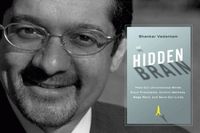
Behind your secret racism

From Salon:

Book Of the many viral-video meltdowns pop culture has endured, few are as viscerally disturbing, as painful to watch, as Michael Richards' racist rant during a 2006 stand-up appearance. As you'll no doubt remember, the man better known as Kramer lashed out at a heckler in his audience with a shocking string of slurs, including the brutally memorable line, “Fifty years ago, we'd have you upside down with a fork up your ass.” The breakdown so outraged the general public that even today, if you Google “Michael Richards,” it auto-completes to “Michael Richards racist.”

Shankar Vedantam, a science writer with the Washington Post, uses the Michael Richards incident in his new book, “The Hidden Brain,” to illustrate the way he believes our unconscious can betray us — and reveal biases we wouldn't even acknowledge to ourselves. Vedantam uses a wide array of vivid true stories to make his point: The tragic tale of a woman who is brutally beaten in front of dozens of onlookers illustrates how a crowd's inaction can trick our brain into ignoring pleas for help; two transsexuals who've experienced both sides of the gender divide help illuminate how unconscious sexism can change lives.

More here.

Your Brain’s Got Game

From Science:

Brain Always stunk at video games? Perhaps you've been cursed with a small striatum, a region of the brain involved in learning and memory. Researchers have found that college students with relatively large striatums learned how to play a challenging video game faster than their small-striatum peers. Large-striatum individuals were also better at shifting priorities from, say, shooting a target to outrunning an enemy–abilities that could translate to the real world.

The game isn't exactly Halo or Assassin's Creed. Instead, Space Fortress looks a lot like the very first arcade games, with geometric shapes subbing for spaceships and buildings. “The graphics stink,” admits Arthur Kramer, a psychologist at the University of Illinois, Urbana-Champaign, who designed the game in the early 1980s. Gameplay is fairly complex, however: Players must shoot down a fortress with their ship while avoiding enemies, the bad guys look a lot like the good guys, and the ship has no brakes. Over the years, researchers have used the game to study memory, motor control, and learning speed. The U.S. Air Force and the Israeli air force have even changed their training regimens based on how cadets fared as players. Recent studies have suggested that players appear to heavily utilize their striatum during gameplay. So Kramer and Kirk Erickson, a psychologist at the University of Pittsburgh in Pennsylvania, decided to investigate whether the size of the striatum alone might be responsible for these abilities.

More here.

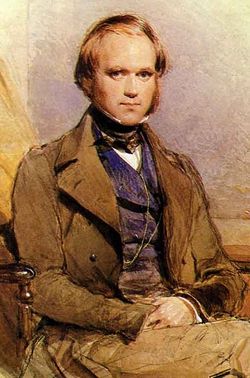
The Darwin Show

Steven Shapin in the London Review of Books:

397px-Charles_Darwin_by_G__Richmond Even conceding the more expansive claims for Darwin’s genius and influence, we’re still some way from understanding what the festivities have been about. There are other claimants for the prize of towering scientific genius, and for ‘making the modern world’, but none of them has been the occasion for global festivities on anything like this scale. The 400th anniversary of Galileo’s birth was 1964, and Descartes’s 1996; Newton’s Principia turned 300 in 1987; Einstein’s Wunderjahr papers in Annalen der Physik, changing the way physicists think about space, time and matter, had their centenary in 2005. All were duly marked, mainly by historians, philosophers and physicists, but there was nothing remotely approaching Darwin 200. Even if we had an unambiguous metric for ranking scientific genius and modernity-making – one by which Galileo, Descartes, Newton and Einstein were chopped liver compared to Darwin – neither genius nor influence would be a sufficient explanation for the events of 2009.

The very idea of paying homage to the great scientists of the past is problematic. Scientists are not widely supposed either to be heroes or to have heroes. Modern sensibilities insist on scientists’ moral equivalence to anyone else, and notions of an impersonal Scientific Method, which have gained official dominance over older ideas of scientific genius, make the personalities of scientists irrelevant in principle. Honouring past scientists is therefore a different sort of thing from, say, paying homage to history’s generals, politicians or, indeed, imaginative artists.

More here.

Diamond Oceans Possible on Uranus

Eric Bland in Discovery News:

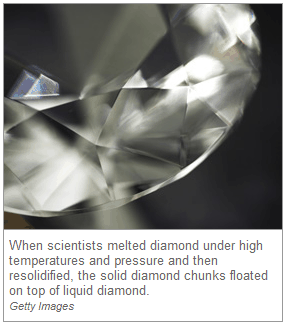
ScreenHunter_01 Jan. 21 09.03 Oceans of liquid diamond, filled with solid diamond icebergs, could be floating on Neptune and Uranus, according to a recent article in the journal Nature Physics.

The research, based on the first detailed measurements of the melting point of diamond, found diamond behaves like water during freezing and melting, with solid forms floating atop liquid forms. The surprising revelation gives scientists a new understanding about diamonds and some of the most distant planets in our solar system.

“Diamond is a relatively common material on Earth, but its melting point has never been measured,” said Eggert. “You can't just raise the temperature and have it melt, you have to also go to high pressures, which makes it very difficult to measure the temperature.”

Other groups, notably scientists from Sandia National Laboratories, successfully melted diamond years ago, but they were unable to measure the pressure and temperature at which the diamond melted.

Diamond is an incredibly hard material. That alone makes it difficult to melt. But diamond has another quality that makes it even harder to measure its melting point. Diamond doesn't like to stay diamond when it gets hot. When diamond is heated to extreme temperatures it physically changes, from diamond to graphite.

More here. [Thanks to Sean Carroll.]

Wednesday, January 20, 2010

Moscow’s stray dogs

Suzanne Sternthal in the Financial Times:

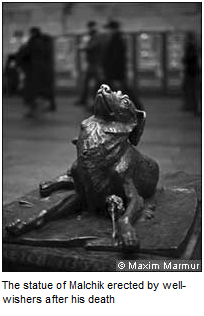
ScreenHunter_02 Jan. 21 09.44 Russians can go nutty when it comes to dogs. Consider the incident a few years ago that involved Yulia Romanova, a 22-year-old model. On a winter evening, Romanova was returning with her beloved Staffordshire terrier from a visit to a designer who specialises in kitting out canine Muscovites in the latest fashions. The terrier was sporting a new green camouflage jacket as he walked with his owner through the crowded Mendeleyevskaya metro station. There they encountered Malchik, a black stray who had made the station his home, guarding it against drunks and other dogs. Malchik barked at the pair, defending his territory. But instead of walking away, Romanova reached into her pink rucksack, pulled out a kitchen knife and, in front of rush-hour commuters, stabbed Malchik to death.

Romanova was arrested, tried and underwent a year of psychiatric treatment. Typically for Russia, this horror story was countered by a wellspring of sympathy for Moscow’s strays. A bronze statue of Malchik, paid for by donations, now stands at the entrance of Mendeleyevskaya station. It has become a symbol for the 35,000 stray dogs that roam Russia’s capital – about 84 dogs per square mile. You see them everywhere. They lie around in the courtyards of apartment complexes, wander near markets and kiosks, and sleep inside metro stations and pedestrian passageways. You can hear them barking and howling at night. And the strays on Moscow’s streets do not look anything like the purebreds preferred by status-conscious Muscovites. They look like a breed apart.

More here.

i am from the future

19_fm_05

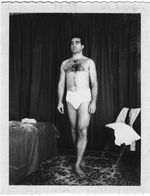
On September 4, 1972, the novelist and futurist Fereidoun M. Esfandiary published an editorial on the op-ed page of The New York Times concerning the Arab-Israeli conflict. Titled “A Plague on Both Your Tribes,” it announced that the situation had become a “monumental bore”: that the leadership had failed, and the antagonists, “acting like adolescents, refuse to resolve their wasteful 25-year-old brawl,” even as other nations of the world were “rapidly patching up their differences.” Esfandiary decried the violent stalemate over territory, especially since the world was, in any case, “irreversibly evolving beyond the concept of national homeland.” Citing a recent United Nations study on global youth, he extolled a “new kind of population, more resilient and adaptable than their elders,” with a “feeling of world solidarity and a sense of common responsibility to achieve peace.” In a future that was just around the corner, today’s youth would take care of the Arab-Israeli problem—in part by realizing that it was already obsolete. He concluded the piece with an exasperated injunction: “Let us get on with it.”

more from Benjamin Tiven at Bidoun here.

pynchon: california man

Pynchon+Peter+Saul+The+Government+of+California+1969

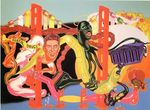
Since Thomas Pynchon’s recently published seventh novel, Inherent Vice, arrives as his third fictional representation of California in the period 1964-70 (following The Crying of Lot 49 (1966) and Vineland (1990)), it’s fair to ask: Why does Pynchon keep coming back here? I’m among those who have long considered Pynchon’s California novels as “lesser works” in his corpus—indeed, in the years between Gravity’s Rainbow (1973) and Vineland it was common to consider Lot 49 as a slight work, maybe not even a novel by Pynchon’s standards, a view the author himself gave voice to in 1984 in his introduction to Slow Learner, a collection of his early stories. That’s the year, as it happens, in which Vineland is set, and it’s possible that the latter novel was aimed to offer a “real Pynchon novel” on the period in question, as it flashed back to c. 1969, with student unrest, widespread drug use, endemic rock’n’roll, and counter-cultural attitudes deeply ingrained into its worldview—matters which were all present in Lot 49 as setting, but not so deliberately evoked as what Vineland calls “geist that could’ve been polter along with zeit.” In other words, Vineland returned to those days with something of the skeptical, jaundiced eye that four years of conservative Reagandom had made somewhat de rigeur, playing havoc with pipedreams of revolution as a poltergeist might, but also, as zeitgeist, reminding its readers that those glory days of Californian unrest occurred when Reagan was governor, thus, arguably, running the freak flag back up the pole to assert that “the geist” was still unbowed.

more from Donald Brown at The Quarterly Conversation here.

among the filthy filthy too

TLS_OBrien_674760a

There are those who would claim that the crime novel and the thriller have a more direct power than their literary cousin to depict a society’s ills. According to this view, the crime novelist has the greater capacity to be, in W. H. Auden’s words, “among the filthy filthy too”. The sphere of crime, it is implied, is more powerful, more influential, in some sense more “real” than the ordinary life which most readers (and writers) occupy. The fact that it is also easier to read Ian Rankin than James Kelman tends to be set aside, and the tilt towards the dominance of genre fiction seems to grow steeper, a preference turning into its own justification. Generally speaking, however, the distinction between crime and thrillers on the one hand and “literary” fiction on the other lies in their attitude to language. Many crime novelists seem indifferent or unaware that it might be a good idea to have a view of the matter at all, and the result is work that suggests that the writer believes he or she can operate in some medium which exists prior to, or instead of, language.

more from Sean O’Brien at the TLS here.

Wednesday Poem

Age Sixty-nine

I keep waiting without knowing
what I'm waiting for.
I saw the setting moon at dawn
roll over the mountain
and perhaps into the dragon's mouth
until tomorrow evening.

There is this circle I walk
that I have learned to love.
I hope one day to be a spiral
but to the birds I'm a circle.

A thousand Spaniards died looking
for gold in a swamp when it was
in the mountains in clear sight beyond.

Here, though, on local earth my heart
is at rest as a groundling, letting
my mind take flight as it will,
no longer waiting for good or bad news.

Often, lately, the night is a cold maw
and stars the scattered white teeth of the gods,
which spare none of us. At dawn I have birds,
clearly divine messengers that I don't understand
yet day by day feel the grace of their intentions.

by Jim Harrison

from In Search of Small Gods;
Copper Canyon Press

How to Live: a Life of Montaigne in One Question and 20 Attempts at an Answer

From The Telegraph:

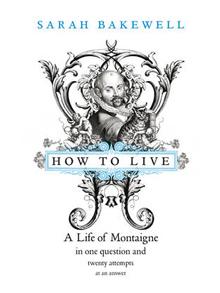
Book In the third quarter of the 16th century, on the border of Bordeaux and Périgord, a provincial nobleman invented a literary form. Michel de Montaigne took refuge from a difficult mother and wife in the library tower of his family chateau, overlooking an estate which, then as now, was devoted chiefly to producing wine. In his Essays, first published to instant acclaim in 1580 and in print ever since, Montaigne asked a number of questions concerning life and how we live it. He also digressed on an impressive scale. Most of all, unabashed, he contradicted himself.

His contradictions supply the format for Sarah Bakewell’s account of Montaigne. Her book explores 20 different, occasionally contradictory, answers to the question of how to live, all inspired by Montaigne’s life and work, to arrive at an overview of the essayist. The answers are as diverse as “use little tricks” and “be ordinary and imperfect”. Bakewell also unravels aspects of Montaigne’s personal history and his flexible philosophy, alongside centuries of readers’ responses to that philosophy.

More here.

Human Ancestors Were an Endangered Species

From Science:

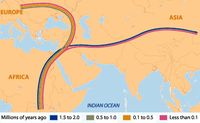
Route With 6.8 billion people alive today, it's hard to fathom that humans were ever imperiled. But 1.2 million years ago, only 18,500 early humans were breeding on the planet–evidence that there was a real risk of extinction for our early ancestors, according to a new study. That number is smaller than current figures for the effective population size (or number of breeding individuals) for endangered species such as chimpanzees (21,000) and gorillas (25,000). In fact, our toehold on the planet wasn't secure for a long time–at least 1 million years, because our ancestral stock was winnowed with the emergence of our species, Homo sapiens, 160,000 years ago or so and, again, with the migration of modern humans out of Africa. “There's this history of a precarious existence not just for our species but for our ancestors,” says co-author Lynn Jorde, a human geneticist at the University of Utah in Salt Lake City.

Researchers have long known that modern humans lack the genetic variation found in other living primates, such as chimpanzees or gorillas, even though our current population size is so much larger. One explanation for this lack of variation is that our species underwent recent bottlenecks–events where a significant percentage were killed or otherwise prevented from reproducing. Some researchers proposed that the lack of variation in our maternally inherited mitochondrial DNA suggested these bottlenecks took place as our ancestors spread out of Africa relatively recently.

More here.

Wilson Alwyn Bentley’s Snowflake 892

Our own Morgan Meis in The Smart Set:

ScreenHunter_04 Jan. 20 11.01 Wilson Alwyn Bentley was a snowflake man. So much so that he came to be known as “Snowflake.” Bentley was a Vermont man; it’s easy to understand his fascination with snow. I was just in Montpelier, the capital of Vermont, last weekend. Driving down Route 2 at night with the high beams on as the light catches the white flakes rushing horizontally at the windshield creates the feeling of warp speed.

A couple of years ago, you could hardly get through a winter week without someone telling a version of the Eskimos-words-for-snow story. We've only got one word for snow, the story went, but those Eskimos have 20, or a hundred, or a thousand, depending on the yarn-spinning skills of the teller. Hm, we'd say, ain’t it interesting how much language determines experience and vice versa. It turns out, unfortunately, that this story isn't true. As Steven Pinker pointed out in The Language Instinct, Inuit languages have about a dozen words for snow, roughly the same as English: snow, sleet, slush, and so forth.

But it makes sense that stories about snow have come to stand as metaphors for the variety of experience in general. Snow changes everything. It is a world-cloaker and a land-blanketer. When the snow comes, everything gets slower and more deliberate. Just look at how it falls, meandering without a care in the world. Contrast this with the rain, which quickens things most of the time.

More here.

Cliff Landis, Librarian

From the Partners In Health website:

Cliff Landis is a librarian in Valdosta, Georgia who, until last week, was planning on a post-holiday replenish of his savings account. However, upon hearing about the suffering the earthquake has wrought, he decided to further deplete his own savings in favor of contributing to PIH’s relief efforts in Haiti.

But Cliff didn’t stop there. He also encouraged friends, family, and readers of his blog to give, promising them he would match every gift up to $10,000. Watch a video of what happened next:

Support from Cliff and his readers will enable us to continue our work to help Haiti recover from the devastating earthquake, including transporting desperately needed food, fuel, and medical supplies to our surgical teams treating patients around the clock. Thank you, Cliff, and thank you to all your supporters, and to all our partners in health.

Donate to Partners In Health here.

Ardi redefines the branch between apes and hominins

Pat Shipman in American Scientist:

7619-20091271437527619-2010-01ShipmanFA The best thing about paleontology is the surprises.

No matter how carefully you have analyzed the fossils, no matter how insightful your understanding of the links between anatomical form and function, Mother Nature always comes up with something totally unpredicted.

Surprises certainly have been sprung by, and on, the international team of paleoanthropologists and paleontologists that looks for fossils in the remote Aramis region of Ethiopia where the Afar people live. The team is co-led by Berhane Asfaw of the Rift Valley Research Service in Addis Ababa, Ethiopia; Yonas Beyene of the Ministry of Youth, Sports and Culture in Ethiopia;the late J. Desmond Clark, formerly of the University of California, Berkeley; Giday Woldegabriel of the Los Alamos National Laboratory; and Tim White of the University of California, Berkeley. With a nice touch of delicacy, White refers to Clark as “inspiring but no longer making decisions” about the project.

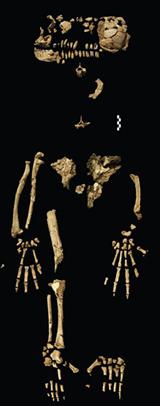
On October 2, 2009, the team published in Science their analyses of a hominin (member of the human lineage) called Ardipithecus ramidus. The best representative of the species is a partial female skeleton nicknamed Ardi; she is 4.4 million years old and is certainly astonishing and noteworthy. There are parts of at least 35 other individuals in the collection, in addition to thousands of specimens of plants, invertebrates, fish and assorted nonprimate mammals from the same location.

More here.

Tuesday, January 19, 2010

the two kinds of American hunger

Lange4

“Let me tell you about the very rich,” F. Scott Fitzgerald wrote in a story of 1926, at the height of the economic boom and his own creative powers. “They are different from you and me.” Rich people “possess and enjoy early,” he explained, which makes them cynical and haughty. “Even when they enter deep into our world or sink below us, they still think that they are better than we are.” The passage is best known not for its psychological insight, but for Ernest Hemingway’s withering rejoinder. Yes, the rich are different, he conceded: “They have more money.” As with so many of their recorded exchanges, Hemingway is supposed to have come out on top. We are meant to feel that Fitzgerald, in his usual romantic way, believed that the rich really were better, and that he needed Hemingway’s bracing realism to bring him back to earth. But what if Fitzgerald had claimed instead that the poor are different? Even Hemingway entertained the idea that poverty–at least the bohemian frisson of being momentarily poor–might carry with it certain advantages.

more from Christopher Benfey at TNR here.

Drive my dead thoughts over the universe

Kuspit1-14-10-5s

John Millei’s “Maritime” paintings (2004–07) and “White Squalls” (2005) are enormous, magnificent paintings, mural-like in their panoramic scope and imposing scale, and executed in what can only be called a grand Abstract-Expressionistic manner. Full of the raw, turbulent energy characteristic of what Harold Rosenberg called “action painting,” they have its famously “unfinished” look, suggestive of unfinished revolutionary business — the “revolution against the given, in the self and the world,” bringing with it a sense of “open possibility,” which he thought was the substance of avant-garde art.(5) For Rosenberg action painting is its climactic statement — a final Sturm und Drang enactment of primordial emotion breaking through the social facade, an instinctive cri de coeur against indifference, a release from everyday conventions of communication to express the incommunicado core of the self. Action painting is rebellious romanticism carried to its existential conclusion. It is a plea for authenticity in the midst of inauthenticity. Kandinsky, the first abstract expressionist painter, said that it was an assertion of spiritual freedom in a world that had become a materialistic prison, a rejection of its naive objectivity in the name of the radical subjectivity that he called “inner necessity, the all-important spark of inner life.”(6)

more from Donald Kuspit at Artnet here.

the end of work

Cubes__1263664041_5641

By the end of the month, a company called txteagle will be the largest employer in Kenya. The firm, started in its original form in 2008 by a young computer engineer named Nathan Eagle and, as of this coming June, based in Boston, will have 10,000 people working for it in Kenya. Txteagle does not rent office space for these workers, nor do the company’s officers interview them, or ever talk to most of them. And, in a sense, the labor that the Kenyan workforce does hardly seems like work. The jobs – short stretches of speech to be transcribed or translated into a local dialect, search engine results to be checked, images to be labeled, short market research surveys to be completed – come in over a worker’s own cellphone and the worker responds either by speaking into the phone or texting back the answer. The workers can be anyone with a cellphone – a secretary waiting for a bus, a Masai tribesman herding cattle, a student between classes, a security guard on a slow day, or one of Kenya’s tens of millions of unemployed. The jobs take at most a few minutes and pay a few cents each (payment is sent by cellphone as well), but a dedicated worker can earn a few dollars a day in a part of the world where that is a significant sum.

more from Drake Bennett at The Boston Globe here.

Translating David Brooks

Matt Taibbi in True/Slant:

Matttaibbi_136 A friend of mine sent a link to Sunday’s David Brooks column on Haiti, a genuinely beautiful piece of occasional literature. Not many writers would have the courage to use a tragic event like a 50,000-fatality earthquake to volubly address the problem of nonwhite laziness and why it sometimes makes natural disasters seem timely, but then again, David Brooks isn’t just any writer.

Rather than go through the Brooks piece line by line, I figured I’d just excerpt a few bits here and there and provide the Cliff’s Notes translation at the end. It’s really sort of a masterpiece of cultural signaling — if you live anywhere between 59th st and about 105th, you can hear the between-the-lines messages with dog-whistle clarity.

More here. [Thanks to Kris Kotarski, and dedicated to Linta Varghese.]