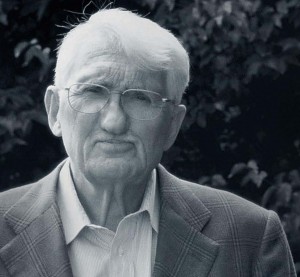
Eduardo Mendieta Interviews Jurgen Habermas

Habermas_A2_5-300x277 Over at The Immanent Frame (excerpt can be found here):

EM: Over the last couple of years you have been working on the question of religion from a series of perspectives: philosophical, political, sociological, moral, and cognitive. In your Yale lectures from the fall of 2008, you approached the challenge of the vitality and renewal of religion in world society in terms of the need to rethink the link between social theory and secularization theory. In those lectures, you suggest that we need to uncouple modernization theory from secularization theory. Does this mean that you are taking distance from the dominant trends in social theory in the West, which began with Pareto, continued through Durkheim, and reached their apogee in Weber, and thus also from its explicit and avowed Eurocentrism?

JH: We should not throw out the baby with the bathwater. The debate over the sociological thesis of secularization has led to a revision above all in respect to prognostic statements. On the one hand, the system of religion has become more differentiated and has limited itself to pastoral care, that is, it has largely lost other functions. On the other hand, there is no global connection between societal modernization and religion’s increasing loss of significance, a connection that would be so close that we could count on the disappearance of religion. In the still undecided dispute as to whether the religious USA or the largely secularized Western Europe is the exception to a general developmental trend, José Casanova for example has developed interesting new hypotheses. In any case, globally we have to count on the continuing vitality of world religions.

In view of the consequences of which you speak, I consider the program of the group around Shmuel Eisenstadt and its comparative research on civilizations promising and informative. In the emerging world society, and concerning the social infrastructure, there are, as it were, by now only modern societies, but these appear in the form of multiple modernities because the great world religions have had a great culture-forming power over the centuries, and they have not yet entirely lost this power. As in the West, these “strong” traditions paved the way in East Asia, in the Middle East, and even in Africa for the development of cultural structures that confront each other today—for example, in the dispute over the right interpretation of human rights. Our Western self-understanding of modernity emerged from the confrontation with our own traditions. The same dialectic between tradition and modernity repeats itself today in other parts of the world.
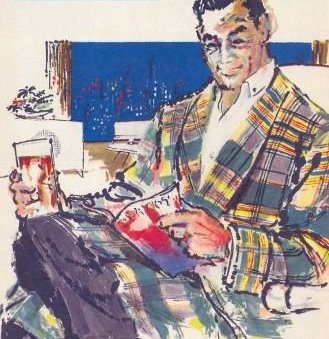
The Playboy Book

Playboy_book Jason Zasky in Failure magazine:

In “Playboy and the Making of the Good Life in Modern America” (Oxford University Press), Elizabeth Fraterrigo—assistant professor of history at Loyola University in Chicago—examines the magazine’s place in postwar America, a time in which sexual mores, gender roles, marriage and family life were evolving, at least in small part due to Playboy’s urging. Though the Playboy brand may be in the midst of a long, slow decline, Fraterrigo’s measured academic analysis (there are 47 pages of footnotes), reminds the reader how Playboy both molded and mirrored American culture in the mid to late twentieth century.

Failure interviewed Fraterrigo by phone to discuss: what readers can expect to learn from her book, what made Playboy so successful, and a handful of Hefner’s pre-Playboy business failures, which in hindsight seem to have been quite fortuitous…

What was Playboy’s agenda in the postwar period?

The kernel of that agenda was there from the very beginning but it really came to fruition by the late 1950s and early ’60s. From the get-go, Hefner was trying to create a magazine that he felt didn’t really exist in American culture. He felt that most of what you saw—whether it be in popular magazines or literature or television—was geared toward families. There wasn’t anything that spoke to the kinds of things in which men were interested. Hefner wanted to create a magazine for adult men but he also wanted to create a vision of a lifestyle that showcased the pleasures one could enjoy in a blooming, blossoming postwar consumer society. So that it wasn’t just about showing up for your job every day and bringing home a paycheck to support a wife and kids. He wanted to have this alternative world where one could indulge in pleasure and materialism.

In the American Grain

Scott McLemee in Inside Higher Ed:

Howard Zinn — whose A People’s History of the United States, first published by Harper & Row in 1980, has sold some two million copies — died last week at the age of 87. His passing has inspired numerous tributes to his role in bringing a radical, pacifist perspective on American history to a wide audience.

It has also provoked denunciations of Zinn as “un-American,” which seems both predictable and entirely to his credit. One of Zinn’s lessons was that protest is a deeply American inclination. The thought is unbearable in some quarters.

One of the most affectionate tributes came from the sports writer Dave Zirin. As with many other readers, he found that reading Zinn changed his whole sense of why you would even want to study the past. “When I was 17 and picked up a dog-eared copy of Zinn’s book,” he writes, “I thought history was about learning that the Magna Carta was signed in 1215. I couldn’t tell you what the Magna Carta was, but I knew it was signed in 1215. Howard took this history of great men in powdered wigs and turned it on its pompous head.” Zirin went on to write A People’s History of Sports (New Press, 2008), which is Zinnian down to its cells.

Another noteworthy commentary comes from Christopher Phelps, an intellectual historian now in the American and Canadian studies program at the University of Nottingham. He assesses Zinn as a kind of existentialist whose perspective was shaped by the experience of the civil rights struggle. (He had joined the movement in the 1950s as a young professor at Spelman College, a historically black institution in Atlanta.)

An existentialist sensibility — the tendency to think in terms of radical commitment, of decision making as a matter of courage in the face the Absurd — was common to activists of his generation. That Phelps can hear the lingering accent in Zinn’s later work is evidence of a good ear.

Zinn “challenged national pieties and encouraged critical reflection on received wisdom,” writes Phelps. “He understood that America’s various radicalisms, far from being ‘un-American,’ have propelled the nation toward more humane and democratic arrangements…. He urged others to seek in the past the inspiration to dispel resignation, demoralization, and deference, the foundations of inertia. The past meant nothing, he argued, if severed from present and future.”

My Escape from Slavery

Frederick Douglass in a moving essay writes:

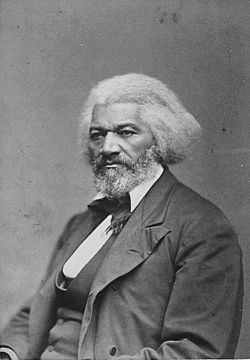
Frederick-douglass I afterward got steady work at the brass-foundry owned by Mr. Richmond. My duty here was to blow the bellows, swing the crane, and empty the flasks in which castings were made; and at times this was hot and heavy work. The articles produced here were mostly for ship work, and in the busy season the foundry was in operation night and day. I have often worked two nights and every working day of the week. My foreman, Mr. Cobb, was a good man, and more than once protected me from abuse that one or more of the hands was disposed to throw upon me. While in this situation I had little time for mental improvement. Hard work, night and day, over a furnace hot enough to keep the metal running like water, was more favorable to action than thought; yet here I often nailed a newspaper to the post near my bellows, and read while I was performing the up and down motion of the heavy beam by which the bellows was inflated and discharged. It was the pursuit of knowledge under difficulties, and I look back to it now, after so many years, with some complacency and a little wonder that I could have been so earnest and persevering in any pursuit other than for my daily bread. I certainly saw nothing in the conduct of those around to inspire me with such interest: they were all devoted exclusively to what their hands found to do. I am glad to be able to say that, during my engagement in this foundry, no complaint was ever made against me that I did not do my work, and do it well. The bellows which I worked by main strength was, after I left, moved by a steam-engine.

More here.

From Footnote to Fame in Civil Rights History

From The New York Times:

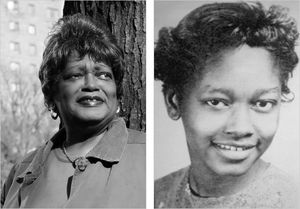
Colvin On that supercharged day in 1955, when Rosa Parks refused to give up her bus seat to a white passenger in Montgomery, Ala., she rode her way into history books, credited with helping to ignite the civil rights movement. But there was another woman, named Claudette Colvin, who refused to be treated like a substandard citizen on one of those Montgomery buses — and she did it nine months before Mrs. Parks. The Rev. Dr. Martin Luther King Jr. made his political debut fighting her arrest. Moreover, she was the star witness in the legal case that eventually forced bus desegregation.

Yet instead of being celebrated, Ms. Colvin has lived unheralded in the Bronx for decades, initially cast off by black leaders who feared she was not the right face for their battle, according to a new book that has plucked her from obscurity. Last week Phillip Hoose won the National Book Award for Young People’s Literature for “Claudette Colvin: Twice Toward Justice,” published by Farrar, Straus & Giroux. The honor sent the little-selling title shooting up 500 spots on Amazon.com’s sales list and immediately thrust Ms. Colvin, 70, back into the cultural conversation. “Young people think Rosa Parks just sat down on a bus and ended segregation, but that wasn’t the case at all,” Ms. Colvin said in an animated interview at a diner near her apartment in the Parkchester section of the Bronx. “Maybe by telling my story — something I was afraid to do for a long time — kids will have a better understanding about what the civil rights movement was about.”

More here.

Saturday, February 6, 2010

No Exit

Via John Quiggin at Crooked Timber, Andrew Bacevich in The American Conservative:

A seesawing contest for the Korean peninsula ended in a painfully expensive draw. Kennedy’s Bay of Pigs managed only to pave the way for the Cuban Missile Crisis. Vietnam produced stupendous catastrophe. Jimmy Carter’s expedition to free American hostages held in Iran not only failed but also torpedoed his hopes of winning a second term. Ronald Reagan’s 1983 intervention in Beirut wasted the lives of 241 soldiers, sailors, and Marines for reasons that still defy explanation. Reagan also went after Muammar Qaddafi, sending bombers to pound Tripoli; the Libyan dictator responded by blowing up Pan Am flight 103 over Lockerbie, Scotland—and survived to tell the tale. In 1991, George H.W. Bush portrayed Operation Desert Storm as a great victory sure to provide the basis for a New World Order; in fact the first Gulf War succeeded chiefly in drawing the United States more deeply into the vortex of the Middle East—it settled nothing. With his pronounced propensity for flinging about cruise missiles and precision-guided bombs, Bill Clinton gave us Mogadishu, Haiti, Bosnia, and Kosovo —frenetic activity with little to show in return. As for Bush and his wars in Afghanistan and Iraq, the less said the better.

What are we to make of this record? For Krauthammer, Boot, and Barnes, the lessons are clear: dial up the rhetoric, increase military spending, send in more troops, and give the generals a free hand. The important thing, writes William Kristol in his own assessment of Obama’s Afghanistan decision, is to have a commander in chief who embraces “the use of military force as a key instrument of national power.” If we just keep trying, one of these times things will surely turn out all right.

An alternative reading of our recent military past might suggest the following: first, that the political utility of force—the range of political problems where force possesses real relevance—is actually quite narrow; second, that definitive victory of the sort that yields a formal surrender ceremony at Appomattox or on the deck of an American warship tends to be a rarity; third, that ambiguous outcomes are much more probable, with those achieved at a cost far greater than even the most conscientious war planner is likely to anticipate; and fourth, that the prudent statesman therefore turns to force only as a last resort and only when the most vital national interests are at stake. Contra Kristol, force is an “instrument” in the same sense that a slot machine or a roulette wheel qualifies as an instrument.

To consider the long bloody chronicle of modern history, big wars and small ones alike, is to affirm the validity of these conclusions.

Quiggins' and his readers' comments are also worth reading.

Thus we’re left, appropriately, in suspension

6a00d83452446c69e201127938164028a4-800wi

For any serious French writer who has come of age during the last 30 years, one question imposes itself above all others: what do you do after the nouveau roman? Alain Robbe-Grillet, Claude Simon et compagnie redrew the map of what fiction might offer and aspire to, what its ground rules should be – so much so that some have found their legacy stifling. Michel Houellebecq’s response has been one of adolescent rejection, or, to use the type of psychological language that the nouveaux romanciers so splendidly shun, denial: writing in Artforum in 2008, he claimed never to have finished a Robbe-Grillet novel, since they ‘reminded me of soil cutting’. Other legatees, such as Jean Echenoz, Christian Oster and Olivier Rolin, have come up with more considered answers, ones that, at the very least, acknowledge an indebtedness – enough for their collective corpus to be occasionally tagged with the label ‘nouveau nouveau roman’. Foremost among this group, and bearing that quintessentially French distinction of being Belgian, is Jean-Philippe Toussaint. Born in 1957, Toussaint was out of the blocks quickly: by the age of 35 he’d published four novels. It’s the last of these, the so far untranslated La Réticence, which most blatantly betrays his generation’s haunting by its predecessor. With its setting in an off-season fishing village, its quasi-repeating narrative loops that see an eminently unreliable narrator trace and retrace circuits through the corridors of a hotel or to and from the house of an absent friend-cum-rival whom he may or may not have murdered, its obsessive attention to surfaces and objects, or the geometric pulsing of a lighthouse’s ‘cône fulgurant de clarté’ through the black night, over and over – in all these aspects, the book reads like an apprentice’s studied emulation of Robbe-Grillet’s masterpiece The Voyeur.

more from Tom McCarthy at the LRB here.

water

52023314-04190354

It’s not news to residents of Southern California that the management of water resources has far-reaching economic and political ramifications, but even they may be surprised by the pivotal role journalist Steven Solomon assigns to water throughout human history. It is “Earth’s most potent agent of change,” Solomon asserts in his sweeping book, which begins with the birth of civilization, is midwifed by large-scale, irrigated agriculture, and closes in our current “age of water scarcity, [when] water’s always paramount, but usually discreet role in world history is visibly taking its place at center stage.” Solomon’s intelligent, well-informed assessment of the challenges we face today grows naturally from the comprehensive analysis that precedes it in the first three sections: “Water in Ancient History,” “Water and the Ascendancy of the West,” “Water and the Making of the Modern Industrial Society.” The author astutely synthesizes a vast amount of scholarship to spotlight recurring patterns.

more from Steven Solomon at the LAT here.

Saturday Poem

The Quarter

Maybe the problem is that I got involved with the wrong crowd of gods when I was seven. At first they weren't harmful and only showed themselves as fish, birds, especially herons and loons, turtles, a bobcat and a small bear, but not deer and rabbits who only offered themselves as food. And maybe I spent too much time inside the water of lakes and rivers. Underwater seemed like the safest church I could go to. And sleeping outside that young might have seeped too much dark into my brain and bones. It was not for me to ever recover. The other day I found a quarter in the driveway I lost at the Mecosta County Fair in 1947 and missed out on five rides including the Ferris wheel and the Tilt-A-Whirl. I sat in anger for hours in the bull barn mourning my lost quarter on which the entire tragic history of earth is written. I looked up into the holes of the bulls' massive noses and at the brass rings puncturing their noses which allowed them to be led. It would have been an easier life if I had allowed a ring in my nose, but so many years later I still find the spore of the gods here and there but never in the vicinity of quarters.

by Jim Harrison

from In Search of Small Gods;
Copper Canyon Press

The Troubled (Black) History of the Oscars

From The Root:

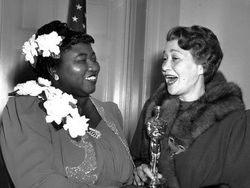
Hattie-McDaniels- When Hattie McDaniel, the first African American ever nominated for an Academy Award, arrived at the Ambassador Hotel for the 1940 ceremony, she was seated at a table on the extreme periphery of the auditorium. McDaniel had been nominated for Best Supporting Actress based on her role as Mammy in Gone With the Wind (1939). Though this seating assignment was quite insulting, such slights were not uncommon, as McDaniel had also been forced to miss the film’s Atlanta premiere due to southern Jim Crow laws. McDaniel would go on to win the Academy Award that evening in 1940, becoming the first African American to ever win the prestigious award. It would be 24 years before another African American would be declared an Oscar winner. In the 61-year time span from 1940-2001, only five other African Americans—Sidney Poitier, Lou Gossett, Denzel Washington, Whoopi Goldberg and Cuba Gooding (can we put an asterisk next to this one?)—won the distinct gold statuette in the prestigious acting categories. Of those six total awards, Sidney Poitier is the only one to have won in the Best Actor category for his role in Lilies of the Field (1963); all the others were for supporting roles.

So when Eddie Murphy stood up to present the award for Best Picture at the 1988 awards ceremony, the troubled racial history of Hollywood loomed large. Murphy, a comedian whose persona was generally apolitical, decided that the incongruity of his prominent presence at the 1988 ceremony, set against the lack of recognition for African Americans in Hollywood historically, was just too insulting to ignore. Murphy “went off,” chastising the gathered industry figures regarding Hollywood’s racism. He said that if one looked closely at the scattered history of African Americans receiving Oscars, that at the rate things were going, another African American probably would not be receiving an award until the year 2004. Reports after the show were that the program’s producers, along with some of the celebrities at the event, vocalized their displeasure to Murphy, saying that his critique was both rude and inappropriate. Murphy is said to have responded to these criticisms the way that one would expect to him respond—shall we say, by loudly declaring that he was aggressively indifferent to their objections.

More here.

Some Fun Tonight

From The New York Times:

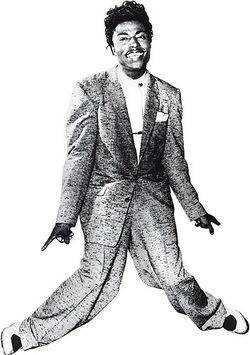
Richard David Kirby’s brief biography of Little Richard reads the way Richard’s shows of the past few decades have played. It’s an engaging, intermittently exciting but ultimately frustrating mix of assertion, reminiscence, free association, repetition, clowning and showing off, with just enough talent on display to keep you from walking out. Kirby, a poet and critic who teaches English at Florida State University, has plenty to say about the rock ’n’ roll “originator,” as Little Richard likes to call himself. It’s carving the good bits out from everything surrounding them that’s the problem. Kirby would probably argue that his spirited digressions — on the banana pudding in Macon, Ga., Little Richard’s hometown; on Southern stereo­typing in the television series “Friday Night Lights”; on Kirby’s African-American playmates when he was growing up in Louisiana in the 1940s and ’50s — are as essential to understanding the importance of Little Richard as the music itself. A more straightforward discussion of his career, in this view, has ­either been done or would be too staid.

Fair enough — to a degree. Charles White’s “Life and Times of Little Richard,” from which Kirby draws liberally, is a riveting book and would be nearly impossible to displace as the definitive biography. But one of Kirby’s stated motivations for writing “Little Richard” is that his subject, who is 77, is a vastly underrated, if not forgotten, figure. It seems disingenuous to maintain simultaneously that Little Richard has fallen off the cultural radar but is also too well documented to warrant a more comprehensive examination.

More here.

Israeli report claims $2bn stolen from Palestinians

Jonathan Cook in The National:

ScreenHunter_01 Feb. 06 12.25 Over the past four decades Israel has defrauded Palestinians working inside Israel of more than US$2 billion (Dh7.4bn) by deducting from their salaries contributions for welfare benefits to which they were never entitled, Israeli economists revealed this week.

A new report, “State Robbery”, says the “theft” continued even after the Palestinian Authority was established in 1994 and part of the money was supposed to be transferred to a special fund on behalf of the workers.

According to information supplied by Israeli officials, most of the deductions from the workers’ pay were invested in infrastructure projects in the Palestinian territories – a presumed reference to the massive state subsidies accorded to the settlements.

After the recent easing of restrictions on entering Israel under the “economic peace” promised by Benjamin Netanyahu, the Israeli prime minister, nearly 50,000 Palestinians from the West Bank are working in Israel and continue to have such contributions docked from their pay.

Complicit in the deception, the report adds, is the Histadrut, the Israeli labour federation, which levies a monthly fee on Palestinian workers, even though they are not entitled to membership and are not represented in labour disputes.

More here.

The cutaneous rabbit illusion hops out of the body

From Neurophilosophy:

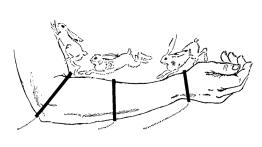
Saltation If a rapid series of taps are applied first to your wrist and then to your elbow, you will experience a perceptual illusion, in which phantom sensations are felt along the skin connecting the two points that were actually touched. This feels as if a tiny rabbit is hopping along your skin from the wrist to the elbow, and is therefore referred to as the “cutaneous rabbit”. The illusion indicates that our perceptions of sensory inputs do not enter conscious awareness until after the integration of events occuring within a certain time window, and that the sensory events taking place at a certain point can be influenced by future events.

A group of Japanese researchers now shows that this illusion is not just confined to the body. In a new study published today in the Journal of Neuroscience, they report that the cutaneous rabbit can easily be induced to “hop out” of the body, so that the illusory sensations are perceived to originate not from the body itself, but from external objects that interact with it.

More here.

Pakistan attacked. Again.

Kar-blast-dawn

Adil Najam in All Things Pakistan:

Day in, day out, they kill and maim and terrorize Pakistanis all across Pakistan. No city is safe. No Pakistani is safe. The ritual is now well entrenched. We mourn our dead. We cry. And just as the tears begin to dry, we are called upon to mourn some more. To cry, again.

The tears are unavoidable, and maybe even necessary. But they are no longer sufficient.

Let us begin, at least, by refusing to tolerate any excuse, any justification, any argument for such violence. Denial must no longer be an option. Yes, there may be forces great and small that are against us. Yes, Pakistanis are being killed also by outsiders too. Yes, the world is an unfair and unjust place. Yes, the wheels of history are complicated. All that, and more, may be as it is. But it is our children who are doing the dying. Everyday. Everywhere.

Those who train themselves to commit such acts – in whose ever name and for whatever purpose they do so – make no excuses for what they do. No excuses must be made for them either.

Let us listen, once again, to how the enemies of Pakistan justify this murder and mayhem:

More here.

Friday, February 5, 2010