Drone attacks in Pakistan: Challenging some fabrications

Farhat Taj in the Daily Times:

ScreenHunter_01 Jan. 05 09.53 There is a deep abyss between the perceptions of the people of Waziristan, the most drone-hit area and the wider Pakistani society on the other side of the River Indus. For the latter, the US drone attacks on Waziristan are a violation of Pakistani’s sovereignty. Politicians, religious leaders, media analysts and anchorpersons express sensational clamour over the supposed ‘civilian casualties’ in the drone attacks. I have been discussing the issue of drone attacks with hundreds of people of Waziristan. They see the US drone attacks as their liberators from the clutches of the terrorists into which, they say, their state has wilfully thrown them. The purpose of today’s column is, one, to challenge the Pakistani and US media reports about the civilian casualties in the drone attacks and, two, to express the view of the people of Waziristan, who are equally terrified by the Taliban and the intelligence agencies of Pakistan. I personally met these people in the Pakhtunkhwa province, where they live as internally displaced persons (IDPs), and in the Federally Administered Tribal Areas (FATA).

More here. [Thanks to David Schneider.]
James Cameron’s Avatar

Our own Morgan Meis in The Smart Set:

Morgan Vampire In retrospect, it was fitting that I saw James Cameron's new film Avatar at an IMAX 3-D theater in Las Vegas. Las Vegas is not a place for those with any nostalgia for simpler times. In Vegas, reality is something to be fabricated, played with, and reproduced in as many ridiculous ways as someone is willing to pay for. Robert Venturi, the architect who penned the famous postmodern manifesto Learning from Las Vegas, was never a fan of Minimalism or austerity. In response to Mies van der Rohe's architectural dictum “less is more,” Venturi quipped that “less is a bore.”

Likewise, Cameron has never been a prophet of restraint. From Terminator to Titanic, he likes things big, expensive, messy, and new. It was, thus, fully expected when Cameron told Dana Goodyear of The New Yorker that Avatar is, “the most complicated stuff anyone’s ever done.” Cameron's goal, in short, is to completely revolutionize cinema. He also thinks of cinema as largely a visceral and visual thing. Emotional complexity is not his strong suit. He wants people to see something new, like when they first discovered the moving image.

More here.

Monday, January 4, 2010

Sunday, January 3, 2009

Stephen Toulmin, 1922-2009

ToulminI appear to have missed this death a month ago. In the NYT:

Stephen Toulmin, an influential philosopher who conducted wide-ranging inquiries into ethics, science and moral reasoning and developed a new approach to analyzing arguments known as the Toulmin model of argumentation, died on Dec. 4 in Los Angeles. He was 87.

The cause was heart failure, said his son Greg.

Mr. Toulmin, a disciple of Ludwig Wittgenstein, earned his undergraduate degree in mathematics and physics, and throughout his long philosophical career showed a marked inclination to ground his ideas in real-world situations.

In the introduction to a 1986 edition of his first book, “An Examination of the Place of Reason in Ethics” (1950), he wrote that “having been trained as a natural scientist, I had always hoped to relate philosophical issues to practical experience, and could never wholly side with Hume the philosopher against Hume the backgammon player.” His bent, he wrote, was toward “practical moral reasoning.”

Although he wrote on disparate topics like the history of science, international relations, medical ethics and Wittgenstein’s Vienna, he was best known for “The Uses of Argument,” published in 1958. In it, he criticized formal logic as an overly abstract, inadequate representation of how human beings actually argue. He also challenged its claims to universality, as well as its faith in absolute truth and moral certainty.

Still terminally ill: Outdated materials and obsolete techniques characterise Pakistan’s school system

Zakia Sarwar in Himal Southasian:

MichaelBlue In accordance with a traditional understanding that continues to be widely followed in our region by many educationists, the process of learning in Southasia today is still largely by rote. As such, there is little or no understanding on the part of most students of what exactly they are studying, nor why. It is critical to realise, however, that education in the 21st century is far more demanding and competitive than it was in the past, due to the vast and growing knowledge base, developments in technology and an increasingly globalised perspective. It is imperative, then, to make students into active rather than passive learners to deal with this changing context – but this is a lesson that many in Southasia, and particularly in Pakistan, have yet to appreciate.

Around the world, the idea of ‘quality’ education has itself been forced to evolve in recent years, in three particular ways. First, in terms of the education process itself, students must be taught how to relate their learning to their day-to-day lives, with a focus on how to learn rather than depending solely on teachers and textbooks. Second, the goal of quality education has also changed, with an eye to enabling students to perform well academically and socially, and to become thinking, caring and tolerant global citizens. The third aspect is facilitating learners not only to perform well academically, but also to groom them to think for themselves. In short, we hope that they will be adaptive, mature and tolerant; and to respect ideological, cultural and religious diversity. Indeed, such skills – quite removed from the central tenets of the traditional curricula in this region’s countries – have become important for a student’s very survival in the globalised world. Quality education assumes the pivotal role of trained teachers who have a solid knowledge base, and have control over what to teach and how to teach it. The teachers themselves, therefore, need to be allowed to develop the expertise and self-confidence to show students the path to independent thinking and learning – and without feeling threatened themselves.

More here.

What a Colored Square Taught Me About Defeating Fear

From Scientific American:

Fear-conditioning-memory-extinction-therapy_1 Every time that a colored square appeared on the monitor in front of me, I braced for pain. Early into the 10-minute session as a subject of this experiment, I learned that about half of the times that I saw that square, I received a low-voltage shock, via a bar strapped to my right wrist. I also learned that every time I saw a square of a different, “good” color, I could momentarily breathe easy. But in the second day's session, as I watched the squares appear in random order, no shocks punctuated either the “bad” or “good” colors. After several minutes I started to relax.

The researcher conducting this fear conditioning experiment at New York University's Department of Psychology, David Bosch, was monitoring my fear responses. Changes in how much I was sweating, which he gauged by measuring the electrical conductance of the skin on my left middle finger, indicated my fear level. On the first day I was conditioned, like Pavlov's dog, to sweat at the sight of the “bad” color. But that response faded over the course of the second, shock-free session as my fear was “extinguished,” a process known as extinction. As Bosch explains, “extinction is learning a new contingency.”

More here.

Saturday, January 2, 2009

Confessions of a Jane Austen-Spinoff Addict

091209_XX_janeAustenASara Dabney Tisdale in doubleX:

Will the real Jane Austen fans please stand up? Stand up, that is, if you love Jane Austen but are sick and tired of Jane Austen spinoffs. Stand up if you thought Pride and Prejudice and Zombies, a mash-up of Austen’s Pride and Prejudice with “all-new scenes of bone-crunching zombie action,” was a terrible idea. If you cringe in horror every time you see sexed-up paperback titles like Mr. Knightley’s Diary on Austen-themed display tables at your local bookstore. If you are fed up with Austen-mania—the fan fiction, the movies and miniseries, the romance advice books and etiquette guides and detective novels and vampire riffs and cookbooks and choose-your-own-adventures. If you, like me, are a real Jane Austen fan, and you don’t think Sense and Sensibility and Sea Monsters is funny—you think it’s a crime.

Dear reader, there is hope, and it comes in the form of Susannah Carson’s new book, A Truth Universally Acknowledged: 33 Great Writers on Why We Read Jane Austen. Carson, a doctoral candidate at Yale University, has culled a collection of essays by literary greats such as E.M. Forster, Virginia Woolf, C.S. Lewis, Kingsley Amis, Eudora Welty, and Lionel Trilling, all on the subject of why Jane Austen is not only worth reading but worth reading over and over again. The book is a refreshing triumph over the muck of Jane Austen spinoffs that blight our current culture.

Or is it? After all, every fan of Jane Austen fan thinks she is a real fan of Jane Austen – that her understanding of and empathy with Austen surpasses that of other readers, that she and she alone fully appreciates and savors Austen’s merits.

The Best Fiction of the Millennium (So Far)

In The Millions (I'm partial to number 2 on the list):

[W]e’ve conducted a poll of our regular contributors and 48 of our favorite writers, editors, and critics (listed below), asking a single question: “What are the best books of fiction of the millennium, so far?” The results were robust, diverse, and surprising.

…The List

#20: Gilead by Marilynne Robinson
#19: American Genius, A Comedy by Lynne Tillman
#18: Stranger Things Happen by Kelly Link
#17: The Fortress of Solitude by Jonathan Lethem
#16: Middlesex by Jeffrey Eugenides
#15: Varieties of Disturbance by Lydia Davis
#14: Atonement by Ian McEwan
#13: Mortals by Norman Rush
#12: Twilight of the Superheroes by Deborah Eisenberg
#11: The Brief, Wondrous Life of Oscar Wao by Junot Díaz
#10: Never Let Me Go by Kazuo Ishiguro

The Kids Are Alright

Irankids377

Evidence already suggests that the contemporary student movement in Iran is prepared to make full use of its political potential. Within the first week of its opening in late September, the Islamic Students Association of Amir Kabir University posted a statement on their website condemning post-election attacks on university residences and declaring that “the will for change is now epidemic and students… are full of passion and hope.” Then, on September 28th, Radio Zamaaneh, a Persian language radio station based in Holland, reported that more than a thousand students at the University of Tehran protested the presence of Minister of Science Kamran Daneshjoo at the university’s opening ceremonies. Several weeks later, the opposition website Mowj camp posted a video that showed a speech given by Ahmadinejad’s former minister of Culture and Islamic Guidance during which he was interrupted by students shouting pro-opposition slogans (the Minister was also pelted with a shoe). Opposition leader Mir Hossein Mousavi’s Facebook page also displayed videos of over two thousand students at Azad University as they staged a demonstration against Ahmadinejad’s coup d’etat as well as the brutal reprisal against student activists by the Basij militia in the post-election crackdown.

more from Sara Irani at Guernica here.

dear Mr. Gorbachev

Mikhail-Gorbachev

In entries like these Borokowski’s ironic humor almost seems to fail him as he confronts phenomena in and outside him that he is unable to make sense of, though the author usually regains his casual humor: The thing is, Mr. Gorbachev –this is what the lady at the garden store told me—YOU’RE NOT ALLOWED TO PLANT TREES IN THE FOREST. Other kinds of glimpses into the blogger’s interests and perceptions are also afforded, such as his vision of poetry (which he considers the heart of his own writing). In another entry he provides humorous insight into his approach and attitudes towards the genre: This evening, Mr. Gorbachev, I’d like to share with you some of my ideas about poetry, though I greatly fear you will find everything I have to say about this strange, outdated genre ridiculous. In truth poetry isn’t one thing and it isn’t another. Take the French. For Rimbaud it was an obsession and an insanity—he said poetry was destroying him and we must believe him. Baudelaire spent a lot of time with prostitutes. Verlaine spent a lot of time in prison, as did Jean Genet. Genet also masturbated a lot and his mentor Sartre posited that poetry was closely related to this most shameful act. I would rather not get into your Russians—suffice it to say that they were a kind of suicide circus, so that when they weren’t writing poetry they were thinking of ways to kill themselves, and in fact often combined these activities by writing poems about the different ways of killing themselves. . . . As far as way over there on the other side—let’s just leave it at that Jack Henry Abbot was a homicidal maniac.

more from Chris Michalski at The Quarterly Conversation here.

the endlessly rewiring brain

ArticleInline

At this very moment, you are actually moving your eyes over a white page dotted with black marks. Yet you feel that you are simply lost in the universe of The New York Times Book Review, alert to the seductive perfume of a promising new novel and the acrid bite of a vicious critical attack. That transformation from arbitrary marks to vivid experience is one of the great mysteries of the human mind. It’s especially mysterious because reading is a relatively recent invention, dating to some 5,000 to 10,000 years ago. Our brains didn’t evolve to read. Stanislas Dehaene, a distinguished French cognitive scientist, has helped unravel that mystery. His gifts, on display in “Reading in the Brain,” include an aptitude for complex experiments and an appetite for detail. This makes for excellent science but not, paradoxically, easy reading. Still, his book will repay careful study, even if it doesn’t inspire blissful absorption.

more from Alison Gopnik at the NYT here.

Saturday Poem

No Snow Fell on Eden

as i remember it – there was no snow,

so no thaw or tao as you say

no snowmelt drooled down the brae;

no human footfall swelled into that of a yeti

baring what it shoulda kept hidden;

no yellow ice choked bogbean;

there were no sheepskulls

in the midden –

it was no allotment, eden –

they had a hothouse,

an orangery, a mumbling monkey;

there was no cabbage-patch

of rich, roseate heads;

there was no innuendo

no sea, no snow

There was nothing funny

about a steaming bing of new manure.

There was nothing funny at all.

Black was not so sooty. No fishboat revolved redly

on an eyepopping sea.

Eve never sat up late drinking and crying.

Adam knew no-one who was dying.

That was yet to come, In The Beginning.


by Jen Hadfield

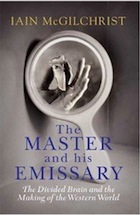
The Divided Brain and the Making of the Western World

From The Guardian:

The-Master-and-His-Emissary- This is a very remarkable book. It is not (as some reviewers seem to think) just one more glorification of feeling at the expense of thought. Rather, it points out the complexity, the divided nature of thought itself and asks about its connection with the structure of the brain.

McGilchrist, who is both an experienced psychiatrist and a shrewd philo–sopher, looks at the relation between our two brain-hemispheres in a new light, not just as an interesting neurological problem but as a crucial shaping factor in our culture. He questions the accepted doctrine that the left hemisphere (Left henceforward) is necessarily dominant, the practical partner, while the right more or less sits around writing poetry. He points out that this “left-hemisphere chauvinism” cannot be correct because it is always Right's business to envisage what is going on as a whole, while Left provides precision on particular issues. Moreover, it is Right that is responsible for surveying the whole scene and channelling incoming data, so it is more directly in touch with the world. This means that Right usually knows what Left is doing, but Left may know nothing about concerns outside its own enclave and may even refuse to admit their existence.

More here.

The Naked and the Conflicted

Katie Rophie in The New York Times:

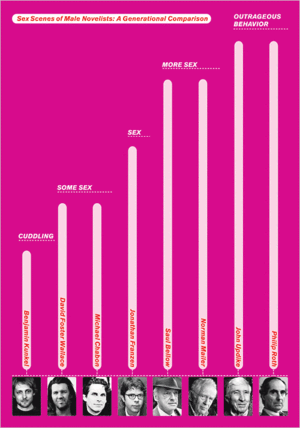
Popup For a literary culture that fears it is on the brink of total annihilation, we are awfully cavalier about the Great Male Novelists of the last century. It has become popular to denounce those authors, and more particularly to deride the sex scenes in their novels. Even the young male writers who, in the scope of their ambition, would appear to be the heirs apparent have repudiated the aggressive virility of their predecessors.

After reading a sex scene in Philip Roth’s latest novel, “The Humbling,” someone I know threw the book into the trash on a subway platform. It was not exactly feminist rage that motivated her. We have internalized the feminist critique pioneered by Kate Millett in “Sexual Politics” so completely that, as one of my students put it, “we can do the math ourselves.” Instead my acquaintance threw the book away on the grounds that the scene was disgusting, dated, redundant. But why, I kept wondering, did she have to throw it out? Did it perhaps retain a little of the provocative fire its author might have hoped for? Dovetailing with this private and admittedly limited anecdote, there is a punitive, vituperative quality in the published reviews that is always revealing of something larger in the culture, something beyond one aging writer’s failure to produce fine enough sentences. All of which is to say: How is it possible that Philip Roth’s sex scenes are still enraging us?

More here.

Friday, January 1, 2009

The Bolaño Myth and the Backlash Cycle

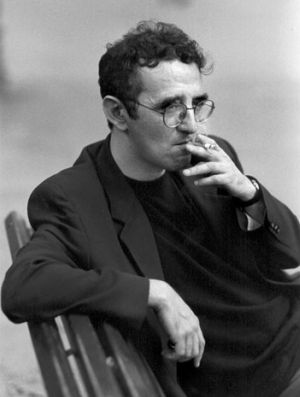
Bolano_41 Garth Risk Hallberg in The Millions:

If you’ve been tooling around the cross-referential world of Anglo-American literary blogs this fall, chances are you’ve come across an essay from the Argentine paper La Naçion called “Bolaño Inc.” Back in September, Scott Esposito of Conversational Reading linked to the original Spanish. When Guernica published an English translation this month, we mentioned it here. The Guardian followed suit (running what amounted to a 500-word paraphrase). Soon enough, Edmond Caldwell had conscripted it into his ongoing insurgency against the critic James Wood. Meanwhile, the literary blog of Wood’s employer, The New Yorker, had posted an excerpt under the title: “Bolaño Backlash?”

The basic premise of “Bolaño Inc.” – that Roberto Bolaño, the late Chilean author of the novels The Savage Detectives and 2666, has become a kind of mythological figure hovering over the North American literary landscape – was as noteworthy as it was unobjectionable. One had only to read reports of overflow crowds of galley-toting twentysomethings at the 2666 release party in New York’s East Village to see that the Bolaño phenomenon had taken on extraliterary dimensions. Indeed, Esposito had already pretty thoroughly plumbed the implications of “the Bolaño Myth” in a nuanced essay called “The Dream of Our Youth.” But when that essay appeared a year ago in the online journal Hermano Cerdo, it failed to “go viral.”

So why the attention to “Bolaño Inc.?” For one thing, there was the presumable authority of its author, Horacio Castellanos Moya. As a friend of Bolaño’s and as a fellow Latin American novelist (one we have covered admiringly), Castellanos Moya has first-hand knowledge of the man and his milieu. For another, there was the matter of temperament. A quick glance at titles – the wistful “The Dream of Our Youth,” the acerbic “Bolaño Inc.” – was sufficient to measure the distance between the two essays. In the latter, as in his excellent novel Senselessness, Castellanos Moya adopted a lively, pugnacious persona, and, from the title onward, “Bolaño Inc.” was framed as an exercise in brass-tacks analysis. “Roberto Bolaño is being sold in the U.S. as the next Gabriel García Marquez,” ran the text beneath the byline,

a darker, wilder, decidedly un-magical paragon of Latin American literature. But his former friend and fellow novelist, Horacio Castellanos Moya, isn’t buying it.

Beneath Castellanos Moya’s signature bellicosity, however, beats the heart of a disappointed romantic (a quality he shares with Bolaño), and so, notwithstanding its contrarian ambition, “Bolaño Inc.” paints the marketing of Bolaño in a pallette of reassuring black-and-white, and trots out a couple of familiar villains: on the one hand, “the U.S. cultural establishment;” on the other, the prejudiced, “paternalistic,” and gullible American readers who are its pawns.