What is Popular Philosophy?

Jonny Thakkar in The Point:

ScreenHunter_02 Feb. 20 10.50 Popular science is part of popular culture: our shelves teem with tomes that flatter and patronize us in equal measure, and every fallen senator is the victim of his genes. But what about popular philosophy? Is there a philosophical version of Steven Pinker? Various names spring to mind—Simon Blackburn, A.C. Grayling and Alain de Botton among them1—but despite impressive sales it seems fair to say that none has achieved the cultural significance of a Richard Dawkins or Steven Levitt. Moreover, their work has done little to appease critics who charge that in a time of “culture wars” philosophers have abandoned their posts, retreating to the crusty comforts of academic armchairs rather than facing up to the avarice and fundamentalism around them. Contemporary philosophy, these critics allege, has next to nothing to say about the nature of the contemporary world. The makers of Examined Life, a 2008 documentary, concur; they claim their film “pulls philosophy out of academic journals and classrooms, and puts it back on the streets.” This suggests that philosophy is supposed to be popular, but has somehow ended up the exclusive province of eggheads and boffins. But how can such an intricate, elusive, arduous discipline ever be popular?

More here.

How slums can save the planet

Sixty million people in the developing world are leaving the countryside every year. The squatter cities that have emerged can teach us much about future urban living.

Stewart Brand in Prospect:

ScreenHunter_01 Feb. 20 10.45 There are plenty more ideas to be discovered in the squatter cities of the developing world, the conurbations made up of people who do not legally occupy the land they live on—more commonly known as slums. One billion people live in these cities and, according to the UN, this number will double in the next 25 years. There are thousands of them and their mainly young populations test out new ideas unfettered by law or tradition. Alleyways in squatter cities, for example, are a dense interplay of retail and services—one-chair barbershops and three-seat bars interspersed with the clothes racks and fruit tables. One proposal is to use these as a model for shopping areas. “Allow the informal sector to take over downtown areas after 6pm,” suggests Jaime Lerner, the former mayor of Curitiba, Brazil. “That will inject life into the city.”

The reversal of opinion about fast-growing cities, previously considered bad news, began with The Challenge of Slums, a 2003 UN-Habitat report. The book’s optimism derived from its groundbreaking fieldwork: 37 case studies in slums worldwide. Instead of just compiling numbers and filtering them through theory, researchers hung out in the slums and talked to people. They came back with an unexpected observation: “Cities are so much more successful in promoting new forms of income generation, and it is so much cheaper to provide services in urban areas, that some experts have actually suggested that the only realistic poverty reduction strategy is to get as many people as possible to move to the city.”

More here.

Friday, February 19, 2010

Terrorism: the Most Meaningless and Manipulated Word

Greenwald_artGlenn Greenwald in Salon:

Yesterday, Joseph Stack deliberately flew an airplane into a building housing IRS offices in Austin, Texas, in order to advance the political grievances he outlined in a perfectly cogent suicide-manifesto. Stack's worldview contained elements of the tea party's anti-government anger along with substantial populist complaints generally associated with “the Left” (rage over bailouts, the suffering of America's poor, and the pilfering of the middle class by a corrupt economic elite and their government-servants). All of that was accompanied by an argument as to why violence was justified (indeed necessary) to protest those injustices:

I remember reading about the stock market crash before the “great” depression and how there were wealthy bankers and businessmen jumping out of windows when they realized they screwed up and lost everything. Isn't it ironic how far we've come in 60 years in this country that they now know how to fix that little economic problem; they just steal from the middle class (who doesn't have any say in it, elections are a joke) to cover their asses and it's “business-as-usual” . . . . Sadly, though I spent my entire life trying to believe it wasn’t so, but violence not only is the answer, it is the only answer.

Despite all that, The New York Times' Brian Stelter documents the deep reluctance of cable news chatterers and government officials to label the incident an act of “terrorism,” even though — as Dave Neiwert ably documents — it perfectly fits, indeed is a classic illustration of, every official definition of that term. The issue isn't whether Stack's grievances are real or his responses just; it is that the act unquestionably comports with the official definition. But as NBC's Pete Williams said of the official insistence that this was not an act of Terrorism: there are “a couple of reasons to say that . . . One is he’s an American citizen.” Fox News' Megan Kelley asked Catherine Herridge about these denials: “I take it that they mean terrorism in the larger sense that most of us are used to?,” to which Herridge replied: “they mean terrorism in that capital T way.”

All of this underscores, yet again, that Terrorism is simultaneously the single most meaningless and most manipulated word in the American political lexicon. The term now has virtually nothing to do with the act itself and everything to do with the identity of the actor, especially his or her religious identity.

Sri Lanka Wins a War and Diminishes Democracy

Barbara Crossette in The Nation:

ScreenHunter_01 Feb. 19 15.02 In its 62 years of independence, Sri Lanka has never had a better chance than it has now to stamp out the last fires of ethnic hatred, violence and mindless chauvinisms that have left over 80,000 people dead in civil wars across one of the most physically beautiful countries in Asia.

Tragically for all Sri Lankans, it looks as if its increasingly autocratic president, reelected in January on a surge of Sinhala triumphalism following the defeat of a Tamil rebel army, is determined to let this hopeful moment pass. Not only a lasting peace between the Tamils and Sinhalese is at stake but also the multiparty democracy that set the country apart from many of its neighbors.

Why should a descent into misgovernment in a nation of 21.3 million people on a relatively small island off the coast of India matter to people anywhere else? This isn't Zimbabwe or Bosnia or Haiti. Not yet. But it is one of the newest examples — streamed live on the Web if not much present in the American media — of a post colonial collapse. Kenya is another. It is a phenomenon worth study.

Sri Lanka was once the most advanced nation in South Asia by measures of human development. Literacy, education levels and social services are all still higher than in neighboring Pakistan, India, Bangladesh and Nepal. The country has no external enemies. Women have held high office for decades. There was a lively press and a functioning two-party system, albeit dominated by mostly people drawn from elite families.

Now journalists live in fear, are killed, disappear or flee.

More here.

The Evolution of Illumination

Dave Munger in Seed Magazine:

MungerBioluminescence2_HP One of the most alluring visual feasts in the movie Avatar was its alien biosphere of glowing plants and animals. Nearly every living thing on the moon Pandora seemed to shimmer and sparkle—sometimes in response to touch, other times as an expression of emotion. It’s something that separates this magical world of make-believe from the real world here on Earth.

Or is it? While bioluminescent organisms are perhaps not as common in the real world as they are in science fiction, they do exist, in a surprising variety of places. I first encountered them at night on a dock near my childhood home in Seattle. Initially the waters of Puget Sound seemed dark, but dipping a hand revealed a luminous surprise—tiny glowing bits appeared, like underwater sparks, wherever my hand disturbed the water. Then I saw a glowing fish swim by, leaving a luminous trail. The fish wasn’t actually glowing; rather, it was causing tiny bioluminescent dinoflagellates to glow as it passed them. This may be a defense mechanism for the dinoflagellates. Since any movement by their predators causes them to glow, this light may attract other, larger predators that could then do away with the danger.

More here.

Lessons Learned and Open Questions: Claus Offe on Welfare State Building in Post-Communist States

Offe_460w In Transit, translated in Eurozine:

All the new member states that joined the EU in 2004 and 2007 – apart from the one and a half small Mediterranean islands of Malta and the southern part of Cyprus – share the quality of having emerged, after 1989, from the economic, social, and political regime of state socialism. One of the recurrent themes throughout the chapters of this volume are the following questions: To what extent can the evolution of CEE welfare states be accounted for in terms of path dependency and the continuity of state socialist as well as those institutional patterns that were adopted in the region during the interwar period? And to what extent do we encounter path departures that were conditioned by the two dominant novelties of (a) the breakdown of state socialism with the subsequent deep transformation crisis and (b) the accession of the new members to the European Union and its patterns of capitalist democracy, as well as the conditionalities governing eastern enlargement? In dealing with these questions, the authors share an analytical frame that dominates much of the academic literature on current affairs in CEE. Stated at the most general level, this frame suggests that what we see happening in the region must be accounted for in terms of a joint outcome of “the past” and “the West”.

As far as the past is concerned, the vanished state socialist institutional system nurtured, during its rule of roughly 40 years, expectations and notions of social justice that persisted after its demise, most importantly the expectation that government must take responsibility for high levels of employment. “Well after the transition, expectations about an expansive role for the state remained extremely high”. Moreover, institutional legacies, most importantly a strongly “Bismarckian” pattern of providing for social security, were inherited by countries of the region from the interwar period. Concerning “western” determinants of the shape of welfare state transformations in the region, there are also two factors of influence. One is the role of international financial institutions, such as the World Bank, in making strong and “conditionalist” suggestions as to how post-socialist states must adjust their pension and health systems. This was particularly the case when they were facing huge revenue deficits under the impact of the transformation crises of the first half of the 1990s. The other western factor is the European Union and the eastward diffusion of the various welfare state models of its member states. This role has been interpreted as following a “push” and “pull” mechanism. The push mechanism, originating with the EU Commission and the treaties of Maastricht (1992) and Amsterdam (1997), became effective when the prospects for eastern enlargement began to necessitate the “rationalization of social expenditure” in what were becoming candidate countries. But at least equally strong was a pull factor, which consisted in CEE political elites looking for templates in western European welfare states and drawing upon proposals coming from international organizations (the World Bank, ILO, Council of Europe, OECD) in order to adjust their own systems accordingly (Schimmelfennig and Sedelmeier, 2005).

Friday Poem

The Unknown Citizen

He was found by the Bureau of Statistics to be
One against whom there was no official complaint,
And all the reports on his conduct agree
That, in the modern sense of an old-fashioned word,
…..he was a saint,
For in everything he did he served the
…..Greater Community.
Except for the war till the day he retired
He worked in a factory and never got fired,
But satisfied him employers, Fudge Motors, Inc.
Yet he wasn't a scab or odd in his views,
For his union reports that he paid his dues,
(Our report on his union shows it was sound)
And our Social Psychology workers found
That he was popular with his mates and liked a drink.
The press are convinced he bought a paper evey day
And that his reactions to advertisements were normal
…..in every way.
Policies taken out in his name prove that he was
…..fully insured,
And his Health-card shows he was once in hospital
…..but left it cured.
Both producers Research and High Grade Living declare
He was fully sensible to the advantages of the
…..Installment Plan
And had everything necessary to the Modern Man,
A gramophone, a radio, a car and a Frigidaire.
Our researchers into Public Opinion are content
That he held the proper opinion for the time of year;
When there was peace, he was for peace;
…..when there was war, he went.
He was married and added five children to
…..the population,
Which our Eugenist says was the right number for
…..a parent of his generation,
And our teachers report that he never interfered
…..with their education.
Was he free? Was he happy? The question is absurd:
Had anything been wrong, we should certainly
…..have heard.

by W.H. Auden

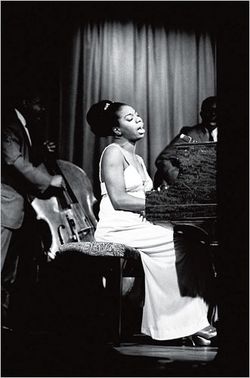
Under a Strange, Soulful Spell: Nina Simone 1933-2003

From The New York Times:

Nina In 1960, one year after Nina Simone’s first album, “Little Girl Blue,” was released, the poet Langston Hughes struggled to put the appeal of Simone’s music and presence — that dusky voice, that unblinking gaze — into words. “She is strange,” Hughes wrote in The Chicago Daily Defender. “So are the plays of Brendan Behan, Jean Genet and Bertolt Brecht. She is far out, and at the same time common. So are raw eggs in Worcestershire.” Hughes was just getting warmed up. “She is different. So was Billie Holiday, St. Francis and John Donne. So is Mort Sahl, so is Ernie Banks.” He continued: “You either like her or you don’t. If you don’t, you won’t. If you do — wheee-ouuueu! You do!”

Simone soon befriended Hughes, and through him she dove into the beating heart of that era’s young black intelligentsia, becoming close to both James Baldwin and Lorraine Hansberry, who would become godmother to Simone’s daughter. That Simone was absurdly talented was already clear. But her new friends helped crystallize her inchoate political thinking. One result was a stunning song, “Mississippi Goddam,” written by Simone in the wake of the 1963 Birmingham church bombings and the killing of the civil rights advocate Medgar Evers. In many respects it represented the pinnacle of what would become a long and tangled career. “Alabama’s got me so upset,” Simone sang. “Tennessee made me lose my rest./But everybody knows about Mississippi Goddam.”

More here.

The sweet smell of morality

From The Boston Globe:

Smell__1266080433_0332 Can a clean smell make you a better person?

That’s the provocative suggestion of a recent study in the journal Psychological Science. A team of researchers found that when people were in a room recently spritzed with a citrus-scented cleanser, they behaved more fairly when playing a classic trust game. In another experiment, the smell of cleanser made subjects more likely to volunteer for a charity. The findings suggest that simply smelling something clean makes people clean up their behavior – that a smell can provoke a mental leap between cleanliness and morality, making people think differently about the world around them. The authors even suggested that clean smells could be employed as a tool to influence how people act.

The idea that a smell can affect something as complex as ethical behavior seems surprising, not least because smell has long been seen as a “lower” sense, playing on our emotions and instincts while our reason and judgment operate on another plane. But research increasingly shows that smell doesn’t just affect how we feel: It affects how we think, in ways that are just beginning to be understood.

Other studies have confirmed that scents can trigger generosity, and that they affect our decision-making processes and judgments rather than just emotions. Even when smells aren’t on the forefront of our consciousness, our minds are trying to match them with other sensory information to interpret our surroundings.

More here.

NYU Media Workshop

Denis Pelli at his NYU website:

ScreenHunter_01 Feb. 19 11.13 Sometimes, seeking publicity is condemned as self centered. I think this criticism misses the point. It’s good to like one’s work, and it’s a mistake to suggest that getting publicity is selfish. Today, more and more, we need to convince the public of the merit of our work. For example, if we are to help recruit undergraduates, they and their parents need to hear of us. When we publish in journals, we reach only our professional colleagues. To reach the rest of the public, we must go beyond the journals: either through publicity about our articles or by publishing in other media.

In my own experience, trying to get noticed beyond journals has been scary, frustrating, and hard. Which efforts matter, and which don’t? With journals, we’re insiders. With other media, we’re outsiders knocking at the door. And the rules are very different.

Twitter has many fans and many critics. I wrote an article in Seed about the future of literacy and publishing which was widely tweeted, attracting ten thousand visitors and a thousand Twitter and blog links (including the New York Times). That’s a lot of people reacting to my work, but, of course, it’s mostly the lay public, not university colleagues. So, it was exciting, but I couldn’t figure out the equivalent in the real currency of journal citations. I finally realized that I was asking the wrong question.

More here.

One long summer in Lebanon

Palestine,” from which this is excerpted, is a memoir in monologue by writer and actress Najla Said, daughter of the late Palestinian American scholar Edward Said. Produced by Twilight Theatre Company in association with New York Theatre Workshop, it opens Wednesday at the 4th Street Theatre in New York and runs through March 21.

From the Los Angeles Times:

Najla Said Tuesday, July 11, 2006: I am in Beirut. My friend Alex calls and asks if I want to spend the day at the beach in Tyre with him and some other friends. A day on the most beautiful beach in Lebanon — why would I ever say no? We get down to Tyre and swim in the bluest water you can imagine.

The next day I stop in an Internet cafe. Out of the corner of my eye, I notice that more than a few people have their computers on the CNN home page and are looking at “breaking news.” I ask that most common question in Lebanon — “Fee shee?” — which means, literally, “Is there something?” I'm told that it is no big deal; it's in the south, near the border; Hezbollah has captured some Israeli soldiers again. This is a common occurrence down south: Israelis capture Hezbollah soldiers, Hezbollah captures Israeli soldiers, back and forth and on and on. Figuring out “who started it” is like playing the chicken-or-the-egg game.

I go home early. I wake at 6 a.m to the familiar sound of bombs. There goes the airport. I guess I'm not going home.

The Israeli invasion of 2006 has officially begun. And I am here again, totally alone. My Lebanese family members are so accustomed to the sounds of war that they aren't much help. THEY can tell exactly how far away a bomb is and what kind of bomb it is; I can only hear that it sounds like it is downstairs.

“No, that's an echo over the mountain; it sounds like it's near Sidon,” my uncle might say.

But how can he tell???!!

“They're bombing the south; they are completely destroying Tyre; they're not bombing us.”

I think of the families I swam near the day before — they must all be either dead . . . or at least homeless.

“OH MY GOD . . . but I was JUST THERE.”

“Good thing you went on Tuesday and not Wednesday. HA HA HA HA HA.”

(This is Lebanese humor.)

More here.

Thursday, February 18, 2010

Gwendolyn Elizabeth Brooks 1917-2000

From PoetryFoundation:

The Pool Players.
Seven at the Golden Shovel
By Gwendolyn Brooks

We real cool. We
Left school. We
Lurk late. We
Strike straight. We
Sing sin. We
Thin gin. We
Jazz June. We
Die soon.
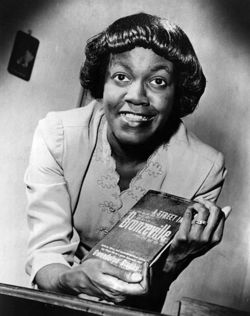
Gbrooks Gwendolyn Elizabeth Brooks (June 7, 1917 – December 3, 2000) was an American writer. She was appointed Poet Laureate Consultant in Poetry to the Library of Congress in 1985. Gwendolyn Elizabeth Brooks was born on June 7, 1917, in Topeka, Kansas to David Anderson Brooks and Keziah Wims, their first child. Her mother was a former school teacher who left teaching for marriage and motherhood, and her father, the son of a runaway slave who fought in the Civil War, had given up his ambition to become a doctor to work as a janitor because he could not afford to attend medical school. When Brooks was only six weeks old, her family moved to Chicago, Illinois, where she grew up. Her home life was stable and loving, although she encountered racial prejudice in her neighborhood and in her schools. She attended Hyde Park High School, the leading white high school in the city, before transferring to all-black Wendell Phillips. Brooks eventually attended an integrated school, Englewood High School. In 1936, she graduated from Wilson Junior College. These four schools gave her a perspective on racial dynamics in the city that continued to influence her work.

Her enthusiasm for reading and writing was encouraged by her parents. Her father provided a desk and bookshelves, and her mother took her, when she was in high school, to meet Harlem Renaissance poets Langston Hughes and James Weldon Johnson.

More here.

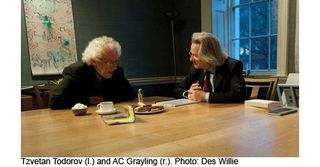
How to Defend the Enlightenment: A Conversation Between A. C. Grayling and Tzvetan Todorov

Grayling-Todorov-460_w In Eurozine:

AC Grayling: We are in profound agreement on many things; you and I share the much same premises, the same desires and ambitions, the same sentiments. I regard us as comrades in the same line of inquiry. But, for the purposes of discussing your book with you, I will at times play the devil’s advocate. However, there are one or two points where we have a real difference of view. That is the background against which I shall be asking you the following questions. First, a point about deism in the eighteenth century. Many people who were then atheist couldn’t say so, because it was socially unacceptable. So they assumed the label of deist. Some people who did so were probably serious about it, for example Voltaire. But a lot of other people were probably atheists. Is that your understanding?

Tzvetan Todorov: Definitely. But some of the important thinkers of the Enlightenment I think were deists. And there is one character who plays a central role for me, biographically, and this is Rousseau. He is a very singular representative of the Enlightenment, since his point was fighting against the philosophes, the extreme of the Enlightenment. He always claimed that he had to fight on two fronts, against the fanatics on one side and atheists on the other. He had a certain sort of deism, theism.

Remembering Joseph Brodsky’s Представление (Presentation)

Brodsky Photo0001 Ta-Nehisi Coates posts a poem by Joseph Brodsky and says, “I missed out on Brodsky, and what it means to memorize a poem, and walk around with those lines in my head.” I did have the good fortune of taking a few classes from Brodsky and knowing him socially. He was pretty insistent on every one of us memorizing the poem for the day, at least in the lyric poetry class if not the Russian poetry class. I can still recite most of the poems in class by heart. One of the commenters on Coates’ post notes how much the poem “May 24, 1980” reads like a narrative. Funnily, I was reminded yesterday and today, well before I read Coates’ post, of Brodsky’s poem Представление (Presentation) by the discussion on Tony Judt’s NYRB blog piece on 1960s radicals in Europe and the Communist East. I don’t know of a translation of the poem and would butcher it if I tried one myself, but those who read Russian may find it quite remarkable and an insightful commentary on the experiment, nightmare, farce that happened in Eastern Europe in the last century.  

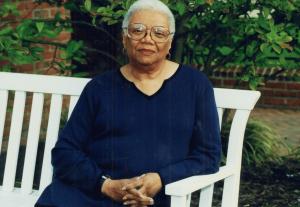
Lucille Clifton, 1936-2010

08LucilleClifton-thumb-300x207-25921Elizabeth Alexander in The New Yorker:

Clifton was born in Depew, New York, in 1937. She published her first book of poems, “Good Times,” in 1969, and in the early seventies began publishing what eventually amounted to twenty-two children’s books, most which imagined a boy named Everett Anderson. She taught for many years at St. Mary’s College of Maryland, and from 1979 to 1985 was the state’s poet laureate. Among many prestigious awards, she won the National Book Award, for “Blessing the Boats: New and Selected Poems, 1988-2000”; the 2007 Ruth Lilly Poetry Prize; and, just a few weeks ago, the Frost Prize, from the Poetry Society of America. Many readers were familiar with Clifton’s work from the Dodge Poetry Festival and from Bill Moyers’s “Life of the Mind” series.

No matter how elaborate the words they use, poets strive to tell elemental truths. As Clifton often reminded her acolytes, “truth and facts are two different things.” Time and again, she made luminous poems premised on clear truth-telling, but always with a twist, and with space for evocation and mystery. Her style was as understated as the lowercase type of her poems, a quiet, even woman’s voice telling sometimes terrible truths. Like psalms, koans, and old folks’ proverbs, Clifton’s poems invite meditation and return.

That pure distillation is one of the remarkable technical accomplishments of the work. She wrote physically small poems with enormous and profound inner worlds. Of great poets whose poems are kin to Clifton’s, I think of Emily Dickinson; to Dickinson’s intense compression Clifton adds explicit historical consciousness. And of Pablo Neruda: Clifton subtracts hyperbole from his elemental clarity.

Clifton’s poems are committed to truth-telling in the face of silence.

How Illegal Immigration Hurts Black America

Immigration Cord Jefferson makes the case in The Root:

In October 2008, amidst claims that one of its subsidiaries was knowingly hiring illegal immigrants, North Carolina poultry producer House of Raeford Farms initiated a systematic conversion of its workforce.

Following a U.S. Immigration and Customs Enforcement raid that nabbed 300 undocumented workers at a Columbia Farms processing plant in Columbia, S.C., a spooked House of Raeford quietly began replacing immigrants with native-born labor at all of its plants. Less than a year later, House of Raeford’s flagship production line in Raeford, N.C., had been transformed, going from more than 80 percent Latino to 70 percent African-American, according to a report by the Charlotte Observer.

Under President George W. Bush, showy workplace raids like the one that befell Raeford were standard—if widely despised—fare. And though the Obama administration has committed itself to dialing down the practice, Homeland Security Secretary Janet Napolitano has occasionally found herself the bearer of bad news to immigration activists who expected the raids to end entirely under her watch.

For the most part, the workplace crackdowns themselves are unremarkable—gaudy, ad hoc things that mitigate America’s immigration problem the way a water balloon might a forest fire. Increasingly however, their immediate aftermaths—in which dozens of eager African-American job applicants line up to fill vacancies—call into question a familiar refrain from the nation’s more vocal immigration proponents: Illegal immigrants do work American citizens won’t. Even former Mexican President Vicente Fox fell victim to the hype, infamously declaring in 2006 that Mexican immigrants perform the jobs that “not even blacks want to do.”

Four years later, with national unemployment hovering around 10 percent and black male unemployment at a staggering 17.6 percent, it seems even less likely that immigrants are filling only those jobs that Americans won’t deign to do. Just ask Delonta Spriggs, a 24-year-old black man profiled in a November Washington Post piece on joblessness, who pleaded, “Give me a chance to show that I can work. Just give me a chance.”

Thursday Poem

Bequest

In every Catholic home there's a picture
of Christ holding his bleeding heart
in his hand.
I used to think, ugh.

The only person with whom
I have not exchanged confidences
is my hairdresser.

Some recommend stern standards.
Others say float along.
He says, take it as it comes,
meaning, of course, as he hands it out.

I wish I could be a
Wise Woman
smiling endlessly, vacuously
like a plastic flower,
saying Child, learn from me.

It's time to perform an act of charity
to myself,
bequeath the heart, like a
spare kidney–
preferably to an enemy.

by Eunice de Souza
from Ways of Belonging: Selected Poems
publisher: Polygon, Edinburgh, 1990