Human Culture, an Evolutionary Force

Nicholas Wade in The New York Times:

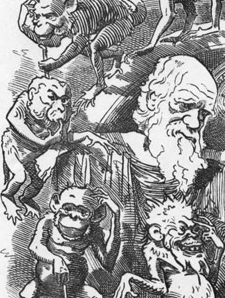
Culture As with any other species, human populations are shaped by the usual forces of natural selection, like famine, disease or climate. A new force is now coming into focus. It is one with a surprising implication — that for the last 20,000 years or so, people have inadvertently been shaping their own evolution. The force is human culture, broadly defined as any learned behavior, including technology. The evidence of its activity is the more surprising because culture has long seemed to play just the opposite role. Biologists have seen it as a shield that protects people from the full force of other selective pressures, since clothes and shelter dull the bite of cold and farming helps build surpluses to ride out famine.

Because of this buffering action, culture was thought to have blunted the rate of human evolution, or even brought it to a halt, in the distant past. Many biologists are now seeing the role of culture in a quite different light. Although it does shield people from other forces, culture itself seems to be a powerful force of natural selection. People adapt genetically to sustained cultural changes, like new diets. And this interaction works more quickly than other selective forces, “leading some practitioners to argue that gene-culture co-evolution could be the dominant mode of human evolution,” Kevin N. Laland and colleagues wrote in the February issue of Nature Reviews Genetics. Dr. Laland is an evolutionary biologist at the University of St. Andrews in Scotland.

More here.
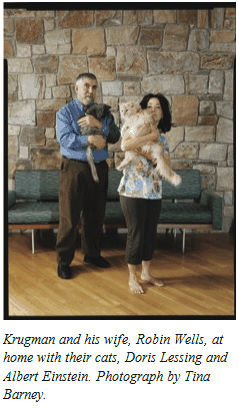
How Paul Krugman found politics

Larissa MacFarquhar in The New Yorker:

ScreenHunter_04 Mar. 02 10.20 For the first twenty years of Krugman’s adult life, his world was divided not into left and right but into smart and stupid. “The great lesson was the low level of discussion,” he says of his time in Washington. “The then Secretary of the Treasury”—Donald Regan—“was not that bright, and you could have angry exchanges where neither side understood the policy.” Krugman was buoyed and protected in his youth by an intellectual snobbery so robust that distractions or snobberies of other sorts didn’t stand a chance. “When I was twenty-eight, I wouldn’t have had the time of day for some senator or other,” he says.

Krugman’s tribe was academic economists, and insofar as he paid any attention to people outside that tribe, his enemy was stupid pseudo-economists who didn’t understand what they were talking about but who, with attention-grabbing titles and simplistic ideas, persuaded lots of powerful people to listen to them. He called these types “policy entrepreneurs”—a term that, by differentiating them from the academic economists he respected, was meant to be horribly biting. He was driven mad by Lester Thurow and Robert Reich in particular, both of whom had written books touting a theory that he believed to be nonsense: that America was competing in a global marketplace with other countries in much the same way that corporations competed with one another. In fact, Krugman argued, in a series of contemptuous articles in Foreign Affairs and elsewhere, countries were not at all like corporations. While another country’s success might injure our pride, it would not likely injure our wallets. Quite the opposite: it would be more likely to provide us with a bigger market for our products and send our consumers cheaper, better-made goods to buy. A trade surplus might be a sign of weakness, a trade deficit a sign of strength. And, anyway, a nation’s standard of living was determined almost entirely by its productivity—trade was just not that important.

When Krugman first began writing articles for popular publications, in the mid-nineties, Bill Clinton was in office, and Krugman thought of the left and the right as more or less equal in power. Thus, there was no pressing need for him to take sides—he would shoot down idiocy wherever it presented itself, which was, in his opinion, all over the place.

More here.

Steampunk tries to capture that Edwardian moment when steam power still ruled

Stefany Anne Golberg in The Smart Set:

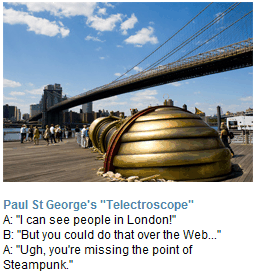
ScreenHunter_03 Mar. 02 10.11 The aesthetic movement Steampunk wants to bring the wonder back into our relationship with machines. Its tack is to fully embrace (and affect) an Edwardian orientation to the world. Though Steampunk has been a growing cultural trend for a few decades, it really came into its own in the aughts and is now a full-fledged phenomenon. Steampunks dress like the Wright Brothers and Arctic explorers. They write alternate history fantasies in which alien clones ride around in dirigibles by the light of gas lamps. Steampunks are fascinated by mechanics, and Steampunk art, jewelry, and fashion often involve gears, wheels, pulleys, and, of course, steam: a laptop computer fused with a rickety typewriter; an arcade game redesigned to look like a mini-submarine. What most defines Steampunk as a culture, however, is attitude. The “punk” in Steampunk confronts technology's alienating qualities with messy DIY defiance. The “steam” (besides its literal connotations) is almost like another word for magic: brute, utilitarian contraptions powered by clouds, and breath — ephemeral energy.

Steampunk tries to capture that Edwardian moment when steam power still ruled and the romance of technology lay precisely in the line it toed between destruction and possibility. Equally fascinated by flying machines and trench warfare, Steampunk is both optimistic and nihilistic. I like to think of this attitude as Gleehilism. It's this Gleehilism that makes Steampunk one of the defining aesthetic movements of the early 21st century.

More here.

Daniel Kahneman: The riddle of experience vs. memory

“Widely regarded as the world’s most influential living psychologist, Daniel Kahneman won the Nobel in Economics for his pioneering work in behavioral economics.”

“Using examples from vacations to colonoscopies, Nobel laureate and founder of behavioral economics Daniel Kahneman reveals how our “experiencing selves” and our “remembering selves” perceive happiness differently. This new insight has profound implications for economics, public policy — and our own self-awareness.”

Furious backlash from Simon Singh libel case puts chiropractors on ropes

Martin Robbins in The Guardian:

Chiropractor-manipulates--002 As the British Chiropractic Association's battle with Simon Singh continues to work its way through the legal system, chiropractors are counting the financial costs of a major backlash resulting from a libel action that has left the Lord Chief Justice “baffled”. What was originally a dispute between the BCA and one science writer over free speech has become a brutally effective campaign to reform an entire industry.

A staggering one in four chiropractors in Britain are now under investigation for allegedly making misleading claims in advertisements, according to figures from the General Chiropractic Council.

The council, which is responsible for regulating the profession and has 2,400 chiropractors on its books, informs me that it has had to recruit six new members of staff to deal with a fifteenfold increase in complaints against its members – from 40 a year to 600. While it declined to comment directly on the costs inflicted by the reaction to the BCA's actions, it is clear that a six-figure sum will be involved for the extra staffing costs alone, to which will have to be added the considerable costs of any misconduct hearings.

More of this heartwarming report here.

Monday, March 1, 2010

3 Quarks Daily 2010 Arts & Literature Prize: Vote Here

Dear Reader,

ScreenHunter_04 Mar. 01 09.45 Thanks very much for participating in our contest. For details of the prize you can look at the announcement here, and to read the nominated posts you can go here for a complete list with links.

If you are new to 3 Quarks Daily, we welcome you and invite you to look around the site after you vote. Learn more about who we are and what we do here, and do check out the full site here. Bookmark us and come back regularly, or sign up for the RSS feed. If you have a blog or website, and like what you see here, we would very much appreciate being added to your blogroll. Please don’t forget!

Results of the voting round (the top twenty most voted for posts) will be posted on the main page on March 8, 2010. Winners of the contest, as decided by Robert Pinsky, will be announced on March 20, 2010.

Now go ahead and submit your vote below!

Cheers,

Abbas

P.S. If you notice any problems, such as, a nominee is missing from the list below, please leave a comment on this page. Thanks.

BEWARE: We have various independent ways of keeping track of attempts at voting multiple times, which I am deliberately not revealing publicly. Any attempts at fraud will be thoroughly investigated, and anyone caught trying to vote multiple times will be instantly disqualified.

A Fetish Object of the World Itself

Justin E. H. Smith

Bird-eggs3 In sixth grade I was made along with my classmates to undertake a project that, we were told, would teach us something about science. Our task was to obtain a large metal coffee can (Folgers or Yuban, most likely), and to obtain an egg (chicken, white), and to find something (anything) of our choice to serve as padding for the egg in the can. Next, at a specified date and time, the principal of Pasadena Elementary School (which was in Sacramento, not in Pasadena), Mr. King, took all the cans up to the top of the school gym and threw them off one by one as the sixth-graders watched from below. Those kids whose eggs remained integral 'won', and those whose eggs broke 'lost'. The lesson had something to do with materials science, or gravity, or some other feature of the physical world whose importance escaped me.

What went into my can? Some flour, some maple syrup, some yogurt, a sock, a dog's chew-toy, some Jell-O, a clump of hair from the bathroom sink, some peanut butter, some celery, some chewed BubbleYum, a bit of bubble wrap, some apple wedges. I would not be surprised to be reminded that I had peed in the can before sealing it up, though I have no recollection of having done so.

I think I wanted the inside of the can to be a sort of microcosm, to duplicate the outer world of qualitative variety and complexity in which eggs thrive. I seem to have believed that if one of the ingredients could not come to the egg's rescue, another surely would, and that that saving ingredient, whether the peanut butter or the sock, needed only to be represented in a token amount. To say that this was a primitive sort of thinking would not be the half of it. It bore obvious affinities to voudun and like practices, but rather than creating a double of some particular person or thing, I wanted nothing less than to bring into being a fetish object of the world itself.

Read more »

Sunday, February 28, 2010

The Heroic Life of the Atlantic Salmon

Richard Hamblyn in the London Review of Books:

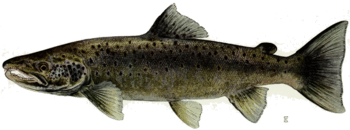
ScreenHunter_03 Mar. 01 09.03 Salmon – the name, it’s thought, derives from the Latin salire, ‘to leap’ – has always been a fish apart, marked by its unusual capacity to migrate between the distinct worlds of salt and fresh water. According to William Camden’s Britannia (1586), the salmon leaps of Pembrokeshire were Britain’s first tourist attractions, at which scores of people would gather to ‘stand and wonder at the strength and sleight by which they see the Salmon get out of the Sea into the said River’. The spectacle remains one of the great sights of autumn, and people still crowd the banks of the Teifi to watch the returning salmon launch themselves at the cascading waters in brute determination to reach their ancestral spawning grounds upstream. Many don’t make it, but for those that do, it marks the end of an extraordinary circular migration that begins and ends in the same shallow gravel-beds to which every sea-run adult will seek to return at least once in its life: an impulse that was confirmed by Francis Bacon in the 1620s, when he tied ‘a Ribband or some known tape or thred’ around the tail of a sea-bound smolt, retrieving it the following year when the fish returned as a splendid silver grilse.

‘Smolt’, ‘grilse’: as Richard Shelton observes, salmon are spoken of in a ‘stained-glass language’ of their own, their life stages marked by an ichthyological lexicon unchanged since Chaucer’s time.

More here. [Thanks to J. E. H. Smith.]

animals can instinctively solve navigational problems that have baffled humans for centuries

Dave Munger in Seed Magazine:

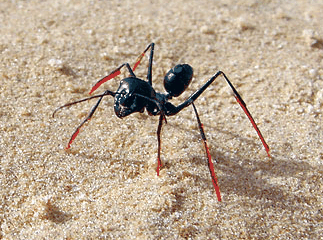
ScreenHunter_02 Mar. 01 08.56 The nervous system of the desert ant Cataglyphis fortis, with around 100,000 neurons, is about 1 millionth the size of a human brain. Yet in the featureless deserts of Tunisia, this ant can venture over 100 meters from its nest to find food without becoming lost. Imagine randomly wandering 20 kilometers in the open desert, your tracks obliterated by the wind, then turning around and making a beeline to your starting point—and no GPS allowed! That’s the equivalent of what the desert ant accomplishes with its scant neural resources. How does it do it?

More here.

The Attack on Climate-Change Science

Bill McKibben in The Nation:

Twenty-one years ago, in 1989, I wrote what many have called the first book for a general audience on global warming. One of the more interesting reviews came from the Wall Street Journal. It was a mixed and judicious appraisal. “The subject,” the reviewer said, “is important, the notion is arresting, and Mr. McKibben argues convincingly.” And that was not an outlier: around the same time, the first President Bush announced that he planned to “fight the greenhouse effect with the White House effect.”

I doubt that's what the Journal will say about my next book when it comes out in a few weeks, and I know that no GOP presidential contender would now dream of acknowledging that human beings are warming the planet. Sarah Palin is currently calling climate science “snake oil,” and last week the Utah legislature, in a move straight out of the King Canute playbook, passed a resolution condemning “a well-organized and ongoing effort to manipulate global temperature data in order to produce a global warming outcome” on a nearly party-line vote.

And here's what's odd. In 1989, I could fit just about every scientific study on climate change on top of my desk. The science was still thin. If my reporting made me think it was nonetheless convincing, many scientists were not yet prepared to agree.

Now, you could fill the Superdome with climate-change research data. (You might not want to, though, since Hurricane Katrina demonstrated just how easy it was to rip holes in its roof.) Every major scientific body in the world has produced reports confirming the peril. All fifteen of the warmest years on record have come in the two decades that have passed since 1989. In the meantime, the Earth's major natural systems have all shown undeniable signs of rapid flux: melting Arctic and glacial ice, rapidly acidifying seawater and so on.

Somehow, though, the onslaught against the science of climate change has never been stronger, and its effects, at least in the United States, never more obvious: fewer Americans believe humans are warming the planet.

More here.

Do you have to be Jewish to report on Israel for the New York Times?

Jonathan Cook in Mondoweiss:

ScreenHunter_01 Mar. 01 08.44 Shortly after I wrote an earlier piece on Bronner, pointing out that most Western coverage of the Israel-Palestine conflict is shaped by Jewish and Israeli journalists, and that Palestinian voices are almost entirely excluded, a Jerusalem-based bureau chief asked to meet. Over a coffee he congratulated me, adding: “I’d be fired if I wrote something like that.”

This reporter, who, unlike me, spends lots of time with the main press corps in Jerusalem, then made some interesting points. He wishes to remain anonymous but has agreed to my passing on his observations. He calls Bronner’s situation “the rule, not the exception”, adding: “I can think of a dozen foreign bureau chiefs, responsible for covering both Israel and the Palestinians, who have served in the Israeli army, and another dozen who like Bronner have kids in the Israeli army.”

He added that it is very common to hear Western reporters boasting to one another about their “Zionist” credentials, their service in the Israeli army or the loyal service of their children. “Comments like that are very common at Foreign Press Association gatherings [in Israel] among the senior, agenda-setting, elite journalists.”

More here.

Barack Hussein Obama, Jr.

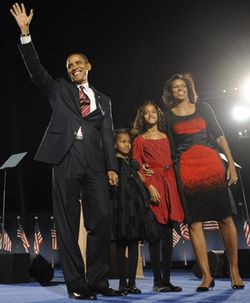
Every year, we celebrate Black History Month by linking at least one relevant story every day. Along with Abbas, I am elated to end this unspeakably tragic journey on a high note which has restored the concept of the American Dream. Barack Obama summarized the unique potential that America offers to its citizens with eloquence: “My parents shared not only an improbable love, they shared an abiding faith in the possibilities of this nation. They would give me an African name, Barack, or blessed, believing that in a tolerant America your name is no barrier to success.” Barack Obama ZINDABAD!

From biography.com:

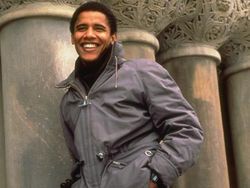
Obama-young President of the United States. Born Barack Hussein Obama on August 4, 1961, in Honolulu, Hawaii. Obama’s mother, Ann Dunham, grew up in Wichita, Kansas, where her father worked on oil rigs during the Depression. After the Japanese attack on Pearl Harbor, Dunham’s father, Stanley, enlisted in the service and marched across Europe in Patton’s army. Dunham’s mother, Madelyn, went to work on a bomber assembly line. After the war, the couple studied on the G.I. Bill, bought a house through the Federal Housing Program and, after several moves, landed in Hawaii. Obama’s father, Barack Obama, Sr., was born of Luo ethnicity in Nyanza Province, Kenya. The elder Obama grew up herding goats in Africa, eventually earning a scholarship that allowed him to leave Kenya and pursue his dreams of college in Hawaii. While studying at the University of Hawaii in Manoa, Obama, Sr. met fellow student, Ann Dunham. They married on February 2, 1961. Barack was born six months later.

Barack_obama_inauguration Obama’s parents separated when he was two years old, later divorcing. Obama, Sr. went on to Harvard to pursue Ph.D. studies, and then returned to Kenya in 1965. In 1966, Dunham married Lolo Soetoro, another East–West Center student from Indonesia. A year later, the family moved to Jakarta, Indonesia, where Obama’s half-sister Maya Soetoro Ng was born. Several incidents in Indonesia left Dunham afraid for her son’s safety and education so, at the age of 10, Barack was sent back to Hawaii to live with his maternal grandparents. His mother and sister later joined them.

While living with his grandparents, Obama enrolled in the esteemed Punahou Academy, excelling in basketball and graduating with academic honors in 1979. As one of only three black students at the school, Obama became conscious of racism and what it meant to be African-American. He later described how he struggled to reconcile social perceptions of his multiracial heritage with his own sense of self. “I began to notice there was nobody like me in the Sears, Roebuck Christmas catalog…and that Santa was a white man,” he said. “I went to the bathroom and stood in front of the mirror with all my senses and limbs seemingly intact, looking the way I had always looked, and wondered if something was wrong with me.”

More here. 

“We’ve Got Issues”: Big Pharma might not be lying

From Salon:

Md_horiz A hundred years ago it was rarely diagnosed in children. In the intervening timespan the number and type of diagnoses have exploded. Moreover, the number and type of treatments have also exploded. The favored treatment usually involves powerful medications with serious side effects. Big Pharma has made a fortune from these medications and is constantly searching for new variations to patent and sell.

I'm talking about childhood cancer, but I bet you thought I was talking about childhood mental illness. After all, everyone in contemporary society knows that childhood mental illness is over-diagnosed, that drugging children is the preferred method for dealing with the normal problems of childhood, and that normal children are being treated with powerful psychotropic medications simply because they are quirky and authentic.

That's what Judith Warner (author of “Perfect Madness”) thought, too, when she sold a proposal back in 2004 for a book that would explore the over-diagnosis of mental illness and over-treatment of children with psychiatric medication. She knew it for all the reasons listed above: Childhood mental illness was rarely diagnosed in children 100 years ago; since then the number and type of diagnoses have exploded; the number and type of treatments have also exploded; the medications used to treat childhood mental illness are powerful and can have serious side effects; Big Pharma has made a fortune from these medications and is constantly searching for new variations to patent and sell.

More here.

The fundamental austerity of the secularist worldview

Warren Breckman in Lapham's Quarterly:

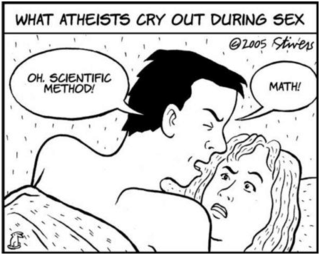
ScreenHunter_05 Feb. 28 11.57 One standard image of the nonbelieving secularist is of a hedonistic immoralist—as Fyodor Dostoevsky feared, if God is dead, everything is permitted. But to the contrary, it may be that secularism does not escape the dynamic that Freud believed is the motor of religion: the repression of instinct followed by a sublimation into other satisfactions—in other words, precisely the process that turns religion into an obsessional neurosis. Even among champions of the secular worldview, we sometimes find worries that secularism lacks magic and emotional depth, that it is a hyperrationalist creed that preserves the internal compulsions of religion without its animating beliefs or its consoling message of cosmic meaning and personal redemption. Frequently, the counsel of the secularist is to be brave, buck up, and face the world as a heroic pessimist. Defenders of religion are all too ready to claim that secularism offers at best a wizened form of experience and sensation. Such a view has us moderns living within a purely immanent world, blocked from any relation to a truly transcendent sphere. In such a world, the colors are a shade paler, the sounds a tone flatter than in a world touched by the divine. A host of religiously minded writers would warn that where our belief in the transcendent has vanished, we seek impoverished substitute sources of transport: in artistic experience, sport, love, or at the extreme, drugs. There will be many secularists, myself among them, who believe that the emotional and sensory scale is not so irretrievably tilted in favor of religious experience. And I would challenge secularists to reaffirm the depth and authenticity of their nonreligious experience. Nonetheless, it may be that the fundamental austerity of the secularist worldview helps account for religion’s obstinate refusal to go away.

More here.

Liberals and Atheists Smarter?

From Science Daily:

ScreenHunter_04 Feb. 28 11.45 More intelligent people are statistically significantly more likely to exhibit social values and religious and political preferences that are novel to the human species in evolutionary history. Specifically, liberalism and atheism, and for men (but not women), preference for sexual exclusivity correlate with higher intelligence, a new study finds.

The study, published in the March 2010 issue of the peer-reviewed scientific journal Social Psychology Quarterly, advances a new theory to explain why people form particular preferences and values. The theory suggests that more intelligent people are more likely than less intelligent people to adopt evolutionarily novel preferences and values, but intelligence does not correlate with preferences and values that are old enough to have been shaped by evolution over millions of years.”

“Evolutionarily novel” preferences and values are those that humans are not biologically designed to have and our ancestors probably did not possess. In contrast, those that our ancestors had for millions of years are “evolutionarily familiar.”

More here.

I am the son of a black man from Kenya

On this, the last day of Black History Month, which my sister Azra is foremost in celebrating here at 3QD, I am posting what I think of as the best political speech of my lifetime. This is Barack Hussein Obama on race, in America:

ScreenHunter_01 Feb. 27 21.24 “We the people, in order to form a more perfect union.”

Two hundred and twenty one years ago, in a hall that still stands across the street, a group of men gathered and, with these simple words, launched America’s improbable experiment in democracy. Farmers and scholars; statesmen and patriots who had traveled across an ocean to escape tyranny and persecution finally made real their declaration of independence at a Philadelphia convention that lasted through the spring of 1787.

The document they produced was eventually signed but ultimately unfinished. It was stained by this nation’s original sin of slavery, a question that divided the colonies and brought the convention to a stalemate until the founders chose to allow the slave trade to continue for at least twenty more years, and to leave any final resolution to future generations.

Of course, the answer to the slavery question was already embedded within our Constitution – a Constitution that had at its very core the ideal of equal citizenship under the law; a Constitution that promised its people liberty, and justice, and a union that could be and should be perfected over time.

And yet words on a parchment would not be enough to deliver slaves from bondage, or provide men and women of every color and creed their full rights and obligations as citizens of the United States. What would be needed were Americans in successive generations who were willing to do their part – through protests and struggle, on the streets and in the courts, through a civil war and civil disobedience and always at great risk – to narrow that gap between the promise of our ideals and the reality of their time.

More here. And/or see the video:

Saturday, February 27, 2010

The Nominees for the 2010 3QD Prize in Arts & Literature Are:

Alphabetical list of blog names followed by the blog post title:

(Please report any problems with links in the comments section below.)

For prize details, click here.

And after looking around, click here to vote.

  1. 3 Quarks Daily: How to Photograph the Heart
  2. 3 Quarks Daily: How to Search for Aliens
  3. 3 Quarks Daily: James Ensor: Keepin’ It Surreal
  4. 3 Quarks Daily: Knifers
  5. 3 Quarks Daily: Mapping the Cracks: Art-Objects in Motion
  6. 3 Quarks Daily: Rumination on the Life, Death, and Particularly the Legacy of a Man Barely Necessary to Introduce to Y’All, Beyond Mentioning (1) His Initials, D, F, and W, and (2) The Fact That This Very Headline Owes Him, Obviously, Everything
  7. 3 Quarks Daily: Somebody Nailed My Dress To The Wall
  8. 3 Quarks Daily: Stamp Your Feet. Hard.
  9. 3 Quarks Daily: The Bitter Taste of Life
  10. 3 Quarks Daily: The DMV
  11. 3 Quarks Daily: The Poetry of Jason Boone (1971-2008)
  12. A Piece of Monologue: Re Joyce
  13. All Things Pankish: Ask the Editor: Johnathon Williams
  14. Amitava Kumar: Postmortem
  15. Baroque in Hackney: A Christmas Play
  16. Baroque in Hackney: Cycling: the healthy mode of transport
  17. Baroque in Hackney: Finders keepers? the clash of intellectual property and a venerable poetic tradition
  18. Baroque in Hackney: Poetry wins book of the year, becomes accessible
  19. Chapati Mystery: Nine Lives
  20. Chicks Dig Poetry: Greatness
  21. Cognition and Culture: The universality of music: Cross-cultural comparison, the recognition of emotions, and the influence of the the Backstreet Boys on a Cockatoo
  22. Digital Emunction: A Lume Spento
  23. Digital Emunction: Fake Book Review 9
  24. Do You See?: About Aribam
  25. Do You See?: Cityspeak
  26. Flawnt: The Last Story
  27. Geoffrey Philp’s Blogspot: You’re Not My Son Anymore
  28. HTML Giant: Surfing for Writers
  29. Humorless Bitch: The Wheels On The Bus
  30. Imaginary Boundaries: To Live Outside the Law, You Must Be Honest
  31. Infrequent Thoughts, Haphazardly Published: Lucky
  32. In This Light: Lens and Pen as Mirrors
  33. Jabberwock: Stranger to History: Aatish Taseer on Islam’s ‘enclosed world’
  34. Jacob Russell’s Barking Dog: Two Poems
  35. Known Turf: My God!
  36. Letters From Exile: Letters From Exile IV
  37. Literary Kicks: In Gatsby’s Tracks: Locating the Valley of Ashes in a 1924 Photo
  38. Literature: Black Sun
  39. Michael Bérubé: Mighty Moloch, cure me of my severe allergy to the discourse of the “cure”
  40. Michael Bérubé: Time after time
  41. My Soul Is A Butterfly: The Letter Said, “Where Are You?”
  42. Nail Your Novel: Become a native in the world of your story
  43. Nail Your Novel: Developing a strong writing voice
  44. Narcissism, vanity, exhibitionism, ambition, vanity, vanity, vanity: Unsolicited Advice (for Eliza Blair)
  45. Novel Readings: Daniel Mendelsohn, The Lost
  46. PEN America: Tomasz Rozycki on “Scorched Maps”
  47. Perplexicon: Towards a literary science
  48. Potemkin: The Great Terror
  49. Quantum Tantra: The New Sex Robot
  50. Sound of the City: The 50 Worst Songs of the ’00s, F2K No. 1: Counting Crows ft. Vanessa Carlton, “Big Yellow Taxi”
  51. The Best American Poetry: Learning to Write the MFA Poem
  52. The Best American Poetry: Robert Creeley, LSD, and Thee
  53. The Literary Weevil: Jerome David Salinger
  54. The Middle Stage: On Daniyal Mueenuddin’s In Other Rooms, Other Wonders
  55. The Millions: About the Author
  56. The Millions: Book Lovers
  57. The Millions: Deckle Edge in the Age of Mechanical Reproduction
  58. The Millions: Ether Between the Covers: Gifting Books in a Digital Age
  59. The Millions: Everybody’s Holocaust: Jonathan Littell’s Fictional Nazi and Postmodernity’s Double Bind
  60. The Millions: Fair Hypocrites: Twilight By Way of Pamela
  61. The Millions: It’s All Right to Cry: Restoring Raymond Carver’s Voice
  62. The Millions: It’s Not You, It’s Me: Thoughts on Lorrie Moore’s A Gate at the Stairs
  63. The Millions: Nabokov, Wallace, and the Incredible Shrinking Book
  64. The Millions: Nobody Wants to Go Home: A Unified Theory of Reality TV
  65. The Millions: Proust’s Arabesk: The Museum of Innocence by Orhan Pamuk
  66. The Millions: The woman writes as if the Devil was in her…
  67. The Millions: Working the Double Shift
  68. The Reasoned Review: Telangana Resumption
  69. The Rumpus: Interview with Sam Anderson
  70. The Second Pass: Mary Flannery, Quite Contrary
  71. The Valve: Sita Sings the Freakin’ Gorgeous Blues
  72. Tiny Cat Pants: The Devil Lives on Lewis Street, I Swear
  73. Tom Paine’s Ghost: Beyond Energy
  74. Too Fond of Books: But Beautiful: A Book About Jazz by Geoff Dyer
  75. Too Fond of Books: The Absolutely True Diary of a Part-Time Indian by Sherman Alexie
  76. Too Fond of Books: The Soul of a Chef: The Journey Toward Perfection by Michael Ruhlman
  77. Unremitting Failure: Poem by Our Brother Jeffers
  78. Wisdom of the West: Realisms
  79. Writing Without Paper: Homage To a Sculptor: Ruth Duckworth

To vote, click here.