a literally ecumenical humanity, idiosyncratic and in reciprocal contact

Tiepolo_003_apollo_e_diana_1757y

We know what Giambattista Tiepolo looked like, because he put himself in so many of his frescoes. There he is in 1726 at the age of thirty, with his wonky nose and his ironic trembly lips and his lively scared eyes, standing beside the furious figure of Jacob on the wall of the Patriarch’s Palace in Udine. And there he is again twenty-seven years later, beside his son Domenico, the eyes a little sadder, the lip a bit more tremulous, on the ceiling of the Prince-Bishop’s palace staircase at Würzburg, the matchless Treppenhaus, which for two centuries was the largest fresco in the world and is still one of the most beautiful. But about what Giambattista Tiepolo thought we have scarcely a clue. “Of all the greats of painting Tiepolo was the last one who knew how to keep silent”, declares Roberto Calasso in this superbly ambitious, quirky, sometimes querulous, sometimes lyrical and finally persuasive essay. It is no disability that Calasso should be famous as an imaginative and painstaking explorer of myth rather than as a historian of art. For it takes a close reading of those enormous frescoes to make Tiepolo declare himself to us in the same way as Kafka was made to speak in K. and the dusty lumber of Greek myth was shined up in The Marriage of Cadmus and Harmony. There is perhaps no other way to rescue Tiepolo from the condescension of posterity and to reinstall him in the high culture of the West.

more from Ferdinand Mount at the TLS here.

The planet-hackers are coming

From MSNBC:

Earth Should we put more pollutants into the air to keep Earth's temperature down? How about covering polar ice with reflective panels to cut down on melting? Or putting a giant umbrella in space to shade the planet? Some of the ideas for easing Earth's warming trend may sound crazy – but in a newly published book titled “Hack the Planet,” Eli Kintisch says scientists may have no choice but to give them a try. The only thing crazier than geoengineering is what we're doing now to the atmosphere by continuing to dump carbon dioxide into it,” he told me.

Kintisch, a staff writer for the journal Science, delves into the flip side of the global climate issue: If we're in the beginning stages of a radical warm-up in global temperatures, caused in part by greenhouse-gas emissions, what can we do about it? One part of the answer is to reduce those emissions. Scientists, engineers and policymakers are working on strategies to do that. We could see cleaner cars, less carbon-intensive energy sources, and perhaps carbon-curbing legislation as well. But some researchers say that still won't be enough. Some of the less crazy ideas for hacking the planet might still have to be put into effect. That's why Kintisch calls geoengineering “a bad idea whose time has come.”

More here.

High noon in the middle east

From Prospect Magazine:

Grenade “Netanyahu thinks he is the superpower,” remarked Bill Clinton bitterly in 1996, “and we are here to do whatever he requires.” Today, as the Americans and the Israelis refuse to budge on the fraught issue of settlements in East Jerusalem, this statement rings truer than ever. US-Israeli relations are at a historic low. But the current standoff is about much more than settlement-building. Underlying it is Washington’s concern that Netanyahu’s repeated gestures of provocation—like the establishment of Jewish heritage sites in the Palestinian territories—are drawing the region towards a conflict unprecedented since 1948. And this time there is a nuclear dimension.

The widely-reported Israeli “insult” to the US—publishing tenders for the construction of apartments in the contested territory of East Jerusalem just as Vice President Joe Biden was in the country announcing peace talks—was considered so audacious that Obama’s tough response has been largely supported, even in overwhelmingly pro-Israel America. The same was the case for Clinton in 1996. This time, however, US-Israeli differences run far deeper. The muffled drums of war have been gathering volume in the middle east for some time, and Obama is seizing the chance to send a clear message: that the US will not be drawn into conflict by the Israelis.

More here.

Wednesday, April 7, 2010

Can Apple Maintain Status as Religion of the ‘Creative Class’?

Andy Jordan over at the blog Digits of the WSJ:

Apple’s core following has traditionally been the creative class. They are graphic designers and artists, and they constitute a “church” of sorts.

“When you find other Mac users, they’re so happy to find other people, it’s like the underdog,” says Peter Isgrigg, Product Manager at Apple specialist Tekserve in Manhattan, and self-proclaimed Mac fanatic, and subject of my new video on Apple’s cult-like status.

“When you’re in a minority and you find other people in that minority group, you tend to latch on to them and you tend to find a source of pride, or positivity in that uniqueness, and I think that’s where a lot of Mac users get that fantatacism,” Mr. Isgrigg says.

Apple in a sense cultivated this “underdog” or creative-class status to successfully market its products. Consider Apple’s “Think Different” ad campaign, or its ubiquitous Apple vs. PC ads featuring a young, hip Justin Long.

Apple has also not discouraged a religion-like following of its products. The notion is reinforced by the messianic aspect of founder Steve Jobs, who returned to Apple to save the company, and has done so several times.

There’s also the popular perception among devotees that Apple is “good” and competitors like IBM, Microsoft, and now even Google are “evil.” In the 1984 Mac commercial, “IBM was Big Brother; it represented this dystopian technological future where people were being damned by technology, and the Mac was the technology of liberation, of individual creativity and freedom,” says Leander Kahney, Editor of cultofmac.com.

With the release of the iPad, the question is whether Apple can maintain this “underdog” or special status.

It’s ultimately about who we are.

Tariq-ramadan-190

DKK: I’m fascinated by your attraction to Nietzsche as a student. You wrote your dissertation on him, and I can certainly understand the appeal of his engagement with suffering, as well as the eventual affirmation that you find in his work. But what attraction was there for you in Nietzsche’s wrestling with nihilism and his characterization of the implosion of Christianity?

TR: You know, many people misunderstand this, because they think that I was coming to Nietzsche because he was very critical towards Christianity, and that, as a Muslim, I was very happy when he said, “God is dead.” It’s exactly the opposite, in fact. I read Nietzsche for other reasons. I read everything that was published. I had to do this. I wanted to add to the concept of suffering in Nietzsche’s philosophy, which was Nietzsche as a historian of philosophy. Because he was, as Heidegger said, the last metaphysician. And he took a very strong and critical look at everything which was coming out of the Western tradition. But he was distorting Socrates, Hegel, and even Schopenhauer and other scholars.

more from Tariq Ramadan at The Immanent Frame here.

The Master of Historical Fiction

Waverley

“There are some writers who have entirely ceased to influence others, whose fame is for that reason both serene and cloudless, are enjoyed or neglected rather than criticised and read. Among them is Scott. Yet there are no books perhaps upon which at this moment more thousands of readers are brooding and feasting in a rapture of silent satisfaction. The Antiquary, The Bride of Lammermoor, Redgauntlet, Waverley, Guy Mannering, Rob Roy, The Heart of Midlothian — what can one do when one has finished the last but wait a decent interval and then begin again upon the first…” This was the opening of an essay by Virginia Woolf on The Antiquary, in The New Republic in December 1924, a century after the publication of Redgauntlet, Walter Scott’s last indisputably great novel. It is now almost two centuries since the first of his novels, Waverley, was published in 1814. Sadly, it’s probable that the claim made in the third sentence no longer holds good. Woolf’s “common reader” has, it seems, deserted the first master of the historical novel, ironically at a time when the genre is more fashionable than it has been for more than 100 years. All six of last year’s Man Booker shortlist were set in the past, with the winner, Hilary Mantel’s Wolf Hall as far back as the 16th century.

more from Allan Massie at The Standpoint here.

Is white the new black?

100412_r19507_p233

Glenn Beck excels at expressing adventurous thoughts in memorable language, but he outdid himself when, one morning last summer, he offered a diagnosis of President Obama. He said, “This President, I think, has exposed himself as a guy, over and over and over again, who has a deep-seated hatred for white people, or the white culture. I don’t know what it is.” (The context was one of the summer’s most entertaining reality shows—the one starring the black Harvard professor and the white police officer who arrested him.) In September, Beck sat for an interview with Katie Couric, and she asked him a deceptively simple question, which had been posed by a Twitter user named adrianinflorida: “what did u mean white culture?” Whatever adventurous thoughts this query inspired, Beck did not seem eager to share them. “Um, I, I don’t know,” he said. Finally, after two minutes of temporizing, he arrived at a nonresponsive response that was both honest and sensible: “What is the white culture? I don’t know how to answer that that’s not a trap, you know what I mean?” Often, the most appropriate answer to that question is a joke, or a series of jokes. In 2008, a canny young white Canadian named Christian Lander started a blog called “Stuff White People Like,” which soon became a best-selling book bearing the same title; it listed a hundred and fifty of white people’s favorite things, from recycling to the Red Sox. (This magazine made the list, too, at No. 114.)

more from Kelefa Sanneh at The New Yorker here.

The PhilPapers Surveys of Philosophers

David Bourget and David Chalmers on their survey of philosophers in PhilaPapers:

The PhilPapers Survey was a survey of professional philosophers and others on their philosophical views. (It was originally called “The Philosophical Survey”, but we have retrospectively retitled it for reasons given below.) What follows are some thoughts on the conception and design of the survey, including responses to some feedback regarding the survey. We will discuss the results separately.

Why a survey of philosophers' philosophical views? We decided to do this in part because like many philosophers, we have an interest in the sociology of philosophy, and we were interested to see some hard data about this sociology. We are also interested in the experimental use of online tools as a method of philosophical communication. Using the PhilPapers technology to execute a survey of philosophical views plays into both of these interests.

Some findings:

A priori knowledge: yes or no?

Accept or lean toward: yes662 / 931 (71.1%)
Accept or lean toward: no171 / 931 (18.3%)
Other98 / 931 (10.5%)

Abstract objects: Platonism or nominalism?

Accept or lean toward: Platonism366 / 931 (39.3%)
Accept or lean toward: nominalism351 / 931 (37.7%)
Other214 / 931 (22.9%)

Aesthetic value: objective or subjective?

Accept or lean toward: objective382 / 931 (41%)
Accept or lean toward: subjective321 / 931 (34.4%)
Other228 / 931 (24.4%)

Analytic-synthetic distinction: yes or no?

Accept or lean toward: yes604 / 931 (64.8%)
Accept or lean toward: no252 / 931 (27%)
Other75 / 931 (8%)

Epistemic justification: internalism or externalism?

Accept or lean toward: externalism398 / 931 (42.7%)
Other287 / 931 (30.8%)
Accept or lean toward: internalism246 / 931 (26.4%)

A Media That Looks Away

5379.kamal Hartosh Singh Bal in Open the Magazine:

I see an injustice. Even as the Indian media, rightly so, has been filled with reports of Gujarat Chief Minister Narendra Modi being questioned by the Supreme Court appointed Special Investigation Team, an event in Canada has gone unreported. The recent visit of Kamal Nath, Union minister of road transport and highways, to the country triggered the ire of Sikhs who have not forgotten his role in the 1984 massacres, when he was part of a mob that set afire two Sikhs within sight of Parliament at Rakabganj Gurdwara.

Surely the events in Canada were worth at least one news story, to say nothing of attracting the attention of India’s otherwise frenzied TV anchors. Robert Oliphant, Canadian MP and co-chair of the Canada-India forum of MPs, was quoted saying he chose not to attend a reception for Kamal Nath once he learnt of the man’s questionable character and allegations against him. Jack Layton, leader of the New Democrat Party, which controls two provinces in the country, issued a press release: ‘The New Democratic Party of Canada is concerned that a divisive and controversial Indian politician, Kamal Nath, has been invited to Canada… Out of respect for the Canadian Sikh community, I am urging my caucus not to attend events featuring Kamal Nath.’

Where, in all this, were the liberal South Asian voices from North America that were so easily mobilised against Narendra Modi? Why is there no coverage of the charges against Kamal Nath?

[More on the 1984 anti-Sikh pogroms can be found here.]

Who’s the Daddy?

Dnapaternity Catherine Nixey in More Intelligent Life:

Precise statistics on human infidelity are hard to come by. What evidence there is tends to indicate that human lovebirds are little better than their feathered counterparts. In 1970 a group of researchers looking into blood groups tested the blood types of inhabitants in a block of flats in Liverpool. They were startled to see that their results indicated a paternal discrepancy of 20-30%. Thinking, perhaps unfairly, that this might be something to do with Liverpudlians, they moved south and repeated the test, only to find similar results. In 1984 a group of scientists in Nottingham looked at women seeking fertility treatment because their husbands were sterile. Despite their husbands’ sterility, 23% of the women managed to become pregnant before receiving treatment.

Other studies have produced a more comforting picture. Recent research in Sweden and Iceland found rates of non-paternity between 1% and 2%. But while these figures may be reassuring in one sense, scientifically they are far from comforting. The disparity between them is enormous. Clearly large-scale, randomised testing is needed to find reliable average levels of non-paternity. The results would not just be interesting but useful in areas such as heritable diseases. There’s just one problem: such tests could be a source of considerable distress. As a result, much of the information that is available on paternity has emerged, like the 1970 Liverpool study, as a by-product of studies with other aims.

Now, the sale of over-the-counter tests may mean that large-scale testing will occur anyway. It is a prospect that many genetics, religious and parenting associations have reacted to with alarm. Their anxiety is the same as that of the reluctant researchers: they fear that such tests will sow doubt and discord. Prashant Patel would disagree. “These tests do not create problems within families,” he says. “The problems are there already.”

Will Columbia-Trained, Code-Savvy Journalists Bridge the Media/Tech Divide?

Columbia-at-night-660x387 Eliot Van Buskirk in Wired:

The Columbia program, which will accept its first 15 students (tops) in the Fall of 2011, seeks to attack the barrier between journalists and the increasingly-important IT professionals whose web and digital savvy are crucial to any form of news gathering, reporting and delivery. Everyone knows the problem: Users really don’t know what to ask developers for (or how), and developers have no real idea what their software will need to do in the hands of the users.

“The IT Department [at a news organization] comes up with software programs that the journalists don’t use; the journalists ask for software that is computationally unrealistic,” said Julia Hirschberg, professor of computer science at the Columbia’s Fu Foundation School of Engineering and Applied Science. “We aim to produce a new generation of journalists who will understand both fields.”

Bill Grueskin, academic dean of the Columbia School of Journalism, told us that although students generally know their way around the web by virtue of being young, creating these sorts of powerful new tools requires a different, deeper skill set — one that, to date, has been missing from university journalism and technology departments and underrepresented in the field at large to a damaging extent.

“Some people coming out of high school or college possess technical savvy, but more often than not, the skill set is bordered by an ability to use Wikipedia, Facebook and Gmail,” said Grueskin, noting that while Columbia journalism students are taught to edit multimedia and maintain websites, “almost all of those skills rely on using existing software or programs to do digital journalism. We hope and expect that graduates of this program will be more able to innovate and create the solutions the news business so sorely needs.”

The concept makes sense, the problem it addresses is real, and Columbia is capable of taking on the challenge. But we were most fascinated by the technologies these professors hope their graduates will contribute.

Previously Unknown J.D. Salinger Letters Discovered

Image-64230-galleryV9-klhr Marc Pitzke in Speigel Online:

Until now, very few people knew about the existence of these letters, which SPIEGEL ONLINE has had the opportunity to read and analyze at length. They offer rare insights into Salinger's isolated world, fill in gaps in his life's story, uncover the private side of the myths surrounding his character — and reveal the astonishing warmth with which he kept up an old wartime friendship, even long after disappearing from public life.

This in itself is a surprise for a man who experts have always seen as a difficult misanthrope. “He was very much a loner,” the British critic Ian Hamilton wrote in his famous monograph “In Search of J.D. Salinger,” quoting a former fellow student of the author. “I don't think he gave himself to others, nor did he consider that others had much of value to offer him.” Hamilton's 1988 work, currently out of print and yet a standard work to this day, helped shape Salinger's image as a misfit. Another contemporary quoted by Hamilton describes Salinger in the following way: “Generally he had no friends or companions.”

The Kleeman letters contradict this impression. In them, Salinger sounds melancholy, almost gentle. He tells his friend about his new puppy, a husky. In 1961, he writes that he was “saddened” by Hemingway's suicide. He complains about his children growing up and describes himself as a “perennial sad sack.” “He was very humble,” Kleeman says about Salinger. “He was emotional and warm.”…

The letters, written with a typewriter and signed “Jerry,” “Yours, Jerry” or “Best always, Jerry,” span a period between 1945 and 1969. In the first letter, written during the war, Salinger simply identifies “Germany” as the return address. The return address on most of the other letters is “Windsor, Vt.,” where the post office for the nearby village of Cornish in New Hampshire, where Salinger lived beginning in 1953, was located.

Declan Kiely, the curator of the Morgan Library, a museum in New York that will exhibit some of Salinger's letters starting this week, has appraised Kleeman's letters and is convinced that they are genuine. He estimates that they are worth at least $60,000. “We would love to have those,” says Kiely. Kleeman, who lives on a veteran's pension, has locked away his treasure into a bank safe for the time being.

Salinger's written legacy is relatively small — and carefully protected. Any letters that have become known until now are kept in the archives of the Library of Congress, as well as a few US universities, including Harvard and Princeton. Salinger's private life was so important to him that he copyrighted the content of his letters, even beyond his death.

Wednesday Poem

The Simple Purification

Student, do the purification.

You know that the seed is inside the horse-chestnut tree,
and inside the seed there are the horse-chestnut blossoms, and
….the chestnuts, and the shade.
So inside the human body there is the seed, and inside the seed
….there is the human body again.

Fire, air, earth, water, and space—if you don't want the secret
….one,
you can't have these either.

Thinkers, listen, tell me what you know of that is not inside
…..the soul?
Take a pitcher full of water and set it down on the water—
now it has water inside and water outside.
We mustn't give it a name, lest silly people start talking
…..again about the body and the soul.

If you want the truth, I'll tell you the truth:
Listen to the secret sound, the real sound, which is inside you.
The one no one talks of speaks the secret sound to himself,
and he's the one who has made it all.

by Kabir

Fruits and Veggies Help Just a Little in Decreasing Cancer Risk

From Scientific American:

Fruits-and-veggies-cancer_1 Despite decades of entreaties from the World Health Organization (WHO) and mothers alike to eat more fruits and vegetables, a new study has found that these dietary additions appear to do little to decrease the overall likelihood of getting cancer. The recommendation that people eat at least five servings (about 400 grams) of fruits and veggies each day, espoused by the WHO since 1990, was based on studies that found a link between higher intakes of these foods and lower risks for cancer and other diseases.

Since the 1990s, however, evidence from large studies has been mounting that the protective effects of these foods against cancer in particular might be modest—if it exists at all. (Other research has continued to show that diets high in fruits and vegetables are important for preventing conditions such as obesity and cardiovascular disease.) A new report, analyzing cancer incidence in 478,478 men and women ages 25 to 70 over more than eight years in 10 European countries, found “a very small inverse association between the intake of total fruits and vegetables and cancer risk,” the researchers concluded.

More here.

Tuesday, April 6, 2010

Chomsky on Cognitive Science, and Anarchism

Noam_Chomsky Over at Reddit:

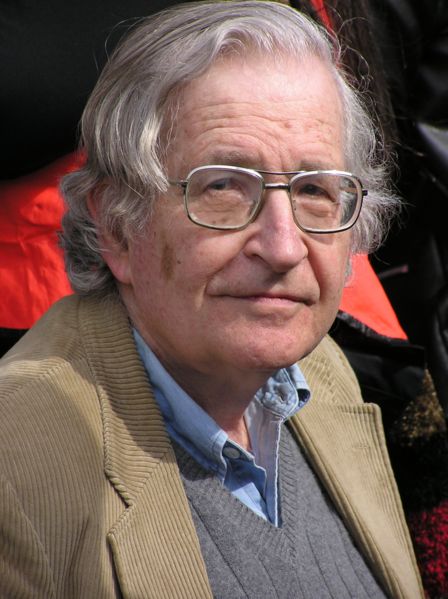
NOAM CHOMSKY: The first question here is from cocoon56: Do you currently see an elephant room of cognitive science, just like you named one 50 years ago—I guess that's a reference to my critique of radical behaviorism—something that needs addressing that gets too little attention?

Well, one thing that I think gets too little attention in the room of cognitive science is cognitive science. Most of the work that's done just doesn't seem to me to bear on cognitive science. I could pick up a couple of journals here and give examples.

Cognitive science ought to be concerned—should be just a part of biology. It's concerned with the nature, the growth, the development, maybe ultimately the evolution, of a particular subsystem of the organism, namely the cognitive system, which should be treated like the immune system or the digestive system, the visual system, and so on. When we study those systems, there are a number of questions we ask.

One question is of course, you know, what they are: can we characterize them? But that's almost totally missing in cognitive science. I mean, take my own particular area of interest, language. A ton of work in what's called “cognitive science” on what they call “language”, but it's very rare to see some effort to characterize what it is. Well, if you can't do that, it doesn't make much difference what else you do.

The second kind of question you have to ask about any organ, if you like (some use the term loosely), subsystem of the body, is how it gets the way it is. So how does it go from some initial state, which is genetically determined, to whatever state it assumes? And in investigating that topic, there are a number of different factors that you can take apart for analytic purposes. And one is the specific genetic constitution that's related specifically to this system. It doesn't mean that every piece of it is used only for this system, but just whatever combination of genetically determined properties happens to determine that you have a mammalian rather than an insect visual system, for example, or a gut-brain, or whatever it may be. That's one. The second is whatever data are outside that modify the initial state to yield some attained state. And the third is: how do laws of nature enter into the growth and development of the system? Which of course they do, overwhelmingly. I mean, nobody, for example, assumes that you have a particular genetic program to determine that cells split into spheres, not cubes, let's say—that's due to, you know, minimization of energy, other laws of nature. And the same holds throughout the course of development. Of course, the same is true for evolution. Evolution takes place with a specific physical, chemical channel of options and possibilities, and physical laws enter all the time into determining what goes on.

A Teacup Half-Full

Nate Silver on the Tea Party movement in 538:

Both the Winston and Gallup polls also asked people about their affinity for the tea-party by ideological group:

Although the Tea Party gets pretty decent numbers among independents, support is smaller among self-proclaimed moderates; only about 15 percent of moderates support the tea-party (Gallup) and about 10 percent consider themselves a part of it (Wilson). Liberals, who support the tea-party in the high single digits, are actually pretty close to the moderates.

OK, so what did we learn here? I think the tea-party basically has three broad defining characteristics — to the extent we can define it at all:

1. It is conservative.
2. It is anti-establishment.
3. It has a somewhat amorphous and nonspecific goals.

The first factor explains why the tea-party potentially does well among both Republicans (almost all of whom are conservative these days) as well as conservative independents. But, the second factor introduces some tension. While, on the one hand, Republicans tend to be more conservative than independents, on the other hand they tend to support the two-party establishment while independents — in broad strokes — are fed up with it. I would guess that if you looked at voters who were both independent and conservative, their support for the tea-party would be at least as high as among Republican conservatives.

Although we can infer that support for the tea party is not very high among non-conservative independents or among Democrats and liberals, the movement does get some support (especially among liberal independents as opposed to liberal Democrats). Why? Because the tea-party has many different faces.

Can Mobile Phones Make a Miracle in Africa?

Aker_mbiti_35.2_cellphoneJenny C. Aker and Isaac M. Mbiti in the Boston Review:

There are some good reasons to believe that mobile phones could be the gateway to better lives and livelihoods for poor people. While some of the most fundamental ideas in economics about the virtues of markets assume that information is costless and equally available to all, low-income countries in sub-Saharan Africa are very far from that idealization. Prior to the introduction of mobile phones, farmers, traders, and consumers had to travel long distances to markets, often over very poor roads, simply to obtain price (and other) information. Such travel imposed significant costs in time and money.

Mobile phones, by contrast, reduce the cost of information. When mobile phones were introduced in Niger, search costs fell by half. Farmers, consumers, and firms can now obtain more and in many cases “better” information—in other words, information that meets their needs. People can then use this information to take advantage of arbitrage opportunities by selling in different markets at different times of year, migrating to new areas, or offering new products. This should, in theory, lead to more efficient markets and improve welfare.

An emerging body of research suggests that perhaps theory is meeting reality. In many cases, these economic gains from information have occurred without donor investments or interventions from non-governmental organizations. Rather, they are the result of a positive externality from the information technology (IT) sector.

In Niger, millet, a household staple, is sold via traditional markets scattered throughout the country. Some markets are more than a thousand kilometers away from others with which they trade. The rollout of mobile phone coverage reduced grain price differences across markets by 15 percent between 2001 and 2007, with a greater impact on markets isolated by distance and poor-quality roads. Mobile phones allowed traders to better respond to surpluses and shortages, thereby allocating grains more efficiently across markets and dampening price differences. Mobile phone coverage also increased traders’ profits and decreased the volatility of prices over the course of the year.

The benefits of mobile phones are not limited to grain markets or to Africa.

What Can Darwin Teach Us About Morality?

RussellRussell Blackford offers an answer in The Guardian:

At least to some extent, we are a species with an evolved psychology. Like other animals, we have inherited behavioural tendencies from our ancestors, since these were adaptive for them in the sense that they tended to lead to reproductive success in past environments.

But what follows from this? It does not follow that we should now do whatever maximises our ability to reproduce and pass down our genes. For example, evolution may have honed us to desire and enjoy sex, through a process in which creatures that did so reproduced more often than their evolutionary competitors. But evolution has not equipped us with an abstract desire to pass down our genes. Knowing all this, what should we do? Well, we are not evolution’s slaves. All other things being equal, we should act in accordance with the desires that we actually have, in this case the desire for sex. We may also desire to have children, but perhaps only one or two: in that case, we should act in such a way as to have as much sex as possible while also producing children in this small number.

By all means, then, let’s use contraceptive technologies for family planning. This may be “unnatural”, in a sense, but so what?

Generally speaking, it is rational for us to act in ways that accord with our reflectively-endorsed desires or values, rather than in ways that maximise our reproductive chances or in whatever ways we tend to respond without thinking. If we value the benefits of social living, this may require that we support and conform to socially-developed norms of conduct that constrain individuals from acting in ruthless pursuit of self-interest. Admittedly, our evolved nature may affect this, in the sense that any workable system of moral norms must be practical for the needs of beings like us, who are, it seems, naturally inclined to be neither angelically selfless nor utterly uncaring about others. Thus, our evolved psychology may impose limits on what real-world moral systems can realistically demand of human beings, perhaps defeating some of the more extreme ambitions of both conservatives and liberals.

evil

20100331_2010+14child_w

Fifteen years ago, two ten-year-old boys tortured and killed a toddler, James Bulger, in the north of England. There was an outcry of public horror, though why the public found this particular murder especially shocking is not entirely clear. Children, after all, are only semi-socialised creatures who can be expected to behave pretty savagely from time to time. If Freud is to be credited, they have a weaker superego or moral sense than their elders. In this sense, it is surprising that such grisly events do not occur more often. Perhaps children murder each other all the time and are simply keeping quiet about it. William Golding seems to believe, in his novel Lord of the Flies, that a bunch of unsupervised schoolboys on a desert island would slaughter each other before the week was out. Perhaps this is because we are ready to believe all kinds of sinister things about children, since they seem like a half-alien race in our midst. Since they do not work, it is not clear what they are for. They do not have sex, though perhaps they are keeping quiet about this, too. They have the uncanniness of things which resemble us in some ways but not in others. It is not hard to fantasise that they are collectively conspiring against us, in the manner of John Wyndham’s fable The Midwich Cuckoos. Because children are not fully part of the social game, they can be seen as innocent; but for just the same reason, they can be regarded as the spawn of Satan. The Victorians swung constantly between angelic and demonic views of their offspring.

more from Terry Eagelton at The New Statesman here.

I believe you’ve killed the church, Holy Father

Pope385_704461a

We know two things about Pope Benedict XVI this Easter that we didn’t know last Easter. We know that he was implicated in covering up two cases of multiple child rapes and molestations, one in Germany and one in the United States. His record on this makes it hard to distinguish his career from that of many other bishops and cardinals who were indirectly but clearly guilty of ignoring or covering up their underlings’ violation of the bodies and souls of the young and the vulnerable. The Vatican has spent Holy Week fighting back against those facts, but it cannot abolish or undo them. The German case is the most clear-cut — because it was so glaring and so directly connected to Cardinal Joseph Ratzinger, as the Pope was then known. The facts are these: a priest, Peter Hullermann, was found guilty of raping children in at least three families under Ratzinger’s authority in the late 1970s. The local priest indicated that the families would “not file charges under the current circumstances”, and the case went to Ratzinger, who decided not to report the priest to the criminal authorities, nor to strip him of his office, but to send him for therapy and retain him as an active priest, capable of molesting again. The priest subsequently raped many more children; he was found guilty in 1986 and was given a suspended sentence.

more from Andrew Sullivan at The Times here.