The Empire of Conversation

Image Posted over at n+1, Dushko Petrovich's piece in the upcoming issue of the innovative contemporary arts journal Paper Monument:

The British Empire is now the Empire of Conversation. The distant lands are lost, but the language has increased, and its experts, still there on the island, are practicing nightly, drinking their way through the rain, refining their understatements somewhere inside the gray labyrinth of human feeling. No one suffers their expertise quite like the American, who will also be down at the pub, also losing an empire, often getting more loudly (but never more charmingly) drunk than his hosts. His empire consists of something else entirely. He tries to think what. Something gangly and violent, is all he can think.

This was some years ago. London kept attracting money and people, but New Labour’s magnet had worn off. Tony Blair’s dependable grin was now purely automatic. He ended up a warmonger, the little shit. Still, after just twenty seconds of Prime Minister’s Questions, our visitor was burning with envy. His own legislature couldn’t be called a parliament, he thought—its members don’t even know how to speak. Not to mention the president, who was so inarticulate he’d reduced himself to an initial and reduced several nations to war. Or that’s how it seemed to our visitor, staring at the TV, mesmerized by the overhead view of Westminster’s green leather.

But our visitor had come for culture. He had been invited, he reminded himself, for culture. That same evening, he had to attend a panel comparing the art worlds in America and Britain. He found a seat at the back, and settled in. From behind an intricate podium, in an accent that hovered somewhere over the Atlantic, the event’s organizer introduced a curator, an artist, and a journalist—all British. The tall man who had recently taken a job in Cincinnati expertly presented the American experience: everything was big and new and basically friendlier.

In the library, over a glass of claret, our visitor couldn’t but confirm this testimony for his inquiring friends. American art schools did tend to have newer facilities; people sometimes smiled at one another; and yes, the curricula often blurred into a kind of career development seminar. America was always entrepreneurial, and these were the boom years. At openings, yes, but also at drunken parties and staff meetings, or even at a hungover brunch, cheerful self-promotion spread like a vine in the protective shadow of the market. Everybody was shaking hands and kissing. Our visitor never thought he’d miss it.


hitch’s threesome

Hitch-22

My friendship with the Hitch has always been perfectly cloudless. It is a love whose month is ever May. —Martin Amis, The Independent, January 15, 2007. Events elicited the above tribute from Martin only after the mid-September of our real lives, when the press had been making the very most of a disagreement we had been having in print in the summer of 2002 about Stalin and Trotsky. Looking back, though, I am inclined to date the burgeoning refulgence of our love to something more like the calendar equivalent of April. Still, it was actually in the gloomy autumn of 1973, around the time of the Yom Kippur/Ramadan War, between Israel and Egypt, that we properly met. To anchor the moment in time: Salvador Allende had just been murdered by Pinochet in Chile, W. H. Auden had died, James Fenton (the author of the most beautiful poems to come out of the Second Indochina War) had won an Eric Gregory Award for poetry and used the money to go off and live in Vietnam and Cambodia, and at the age of 24 I had been hired to fill at least some of the void that he left behind at the New Statesman. Peter Ackroyd, literary editor of the rival and raffishly Tory Spectator, was giving me a drink one evening after returning from a trip of his own to the Middle East, and he said in that inimitable quacking and croaking and mirthful voice of his, “I’ve got someone I think you should meet.” When he told me the name, I rather offhandedly said that I believed we’d once met already, with Fenton at Oxford. Anyway, it was agreed that we would make up a threesome on the following evening, at the same sawdust-infested wine bar, called the Bung Hole, where my New Statesman career had begun.

more from Christopher Hitchens at Vanity Fair here.

germaine greer glances back 40 years or so

Germaine_greer

Feminism was no sooner recognised as a social force than the commercial media were bound to declare that it was over. The odd woman had barely got her bottom on a seat in the boardroom before we were told that high-flying female executives were ditching wealth and power and opting for stay-at-home motherhood. Contrariwise we were told that now that women could have it all, there was no need for feminist activism or even feminist attitudes. Under the twitter could be heard the rumble of massive change. Something terrible happened to marriage. Why do half of all marriages end in divorce and why are so many of those divorces initiated by the partner who has most to lose, the wife? Is this the end of monogamy and the patriarchal family? Are men and women struggling to arrive at rational systems of child-rearing that do not presuppose the subjection of one partner? Or is it just women? Patterns of cohabitation and parenting are disintegrating and reforming, as women walk away from relationships that are at worst demeaning or dangerous, or at best unfair and unrewarding. At the same time, lovers of the same sex are demanding and winning the right to marry. This may look very like chaos, but chaos is the matrix out of which viable structures form.

more from Germaine Greer at the ALR here.

my father was a communist

Rajk_sr_138x219Question from the audience: You said there is no place for morality when it comes to dealing with the past – it's not about saying “I was young and stupid”. So it seems that in your opinion it's about the facts rather than reconciliation. But what would that achieve? Is there a purpose in that? Or is it just about the truth – full stop?

MS: No, otherwise I wouldn't care so much. I think that the younger generation – my son for instance, who is 25 – has no chance of understanding history. The 1950s were exceptional, communism and Nazism were exceptional regimes. It's still important to talk about the past, about personal experience, about how it was in detail, and not only to rely on archives. I think that it's the responsibility of those writers and intellectuals who are still alive to talk about the past openly, as Ivan Klíma has done. Through their experience you can understand what it means to lose your freedom. That danger still exists. You can lose your freedom every day. I believe that the younger generation is not aware of the dangers. It is not systematic, it is perhaps not about life and death, but it can be. So what I am calling for is to give the younger generation at least the chance to understand the past and to prevent them from making the same mistakes.

Martin M. Simecka and László Rajk deal with the past at Eurozine here.

Tuesday Poem

I Never Knew When I Arrived In This Country

That my pillow might hold your scent
as I tried to sleep, beginning to know
you were with your first wife and son

That my dowry bought
you and your parents
a larger house in Richmond.

That if I believed you each time you warned
you'd hurt me and our baby if I left,
I would only feed the rakshas inside you.

That our elders' protests, our daughter's
brimming eyes, and my shame
might mean nothing to you

That I did not have to live
with a man shouting,
“I didn't choose to marry you!”

That the library and the internet
are such private places
to find shelters and friends

That if I threatened to show your boss
my bruises, it could stop you, mid-strike
and I'd smell your thwarted breath

That I wouldn't be raped
by a policeman or prostituted
in a shelter if I called for help.

That other women have seen
the noose of Yama move behind
their husband's eyes, and survived

That I wouldn't have to take
my three-year-old girl and leave
our home — instead, you would.

That if I did decide to leave and divorce,
someone in this country
would pay fairly for my work

That I could find one room with a stove
and a fridge, and live with
my daughter, on my own.

But I know now.

by Shauna Singh Baldwin
from The Fieldstone Review,
Issue 3, May 2008

Mathematical model explains marital breakups

From PhysOrg:

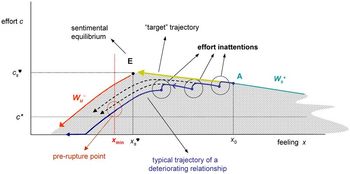
Journal_pone_0009881_g004 Most couples marry only after careful consideration and most are determined to make their marriage last, and a happy marriage is widely considered in Western societies to be important for overall happiness. Yet soaring divorce rates and break ups of de facto relationships across Europe and the U.S. show these plans and ideals are failing. Many scholars attribute the increasing rates of breakdown to economic forces and changes in sexual divisions of labor, but this does not fully explain the continuing rise in those rates. The research was carried out by José-Manuel Rey of the Department of Economic Analysis, at the Universidad Complutense in Madrid, and aimed to provide a mathematical model to explain rising rates of marital breakdown. Using the optimal control theory model, Rey developed an equation based on the “second thermodynamic law for sentimental interaction,” which states a relationship will disintegrate unless “energy” (effort) is fed into it.

The results of the mathematical analysis showed when both members of union are similar emotionally they have an “optimal effort policy,” which results in a happy, long-lasting relationship. The policy can break down if there is a tendency to reduce the effort because maintaining it causes discomfort, or because a lower degree of effort results in instability. Paradoxically, according to the second law model, a union everyone hopes will last forever is likely break up, a feature Rey calls the “failure paradox”.

More here.

Can an Enemy Be a Child’s Friend?

From The New York Times:

Child In sixth grade they were unlikely friends, the good kid and the bad one, the girl who studied and the one who smoked in the alley. They hung out; they met for lunch. They even walked home from school together, one watching, awestruck, while the other ducked into drugstores to shoplift lip gloss, cigarettes, candy. It couldn’t last. One morning in seventh grade, a nasty note appeared on the tough girl’s locker — and someone told her the writer was her cautious friend. “I would never, ever have done that,” said the friend, Bonnie Shapiro, 45, now a mother of two in Evanston, Ill., who works as a recruiter for a design agency. “But it didn’t matter.” Brushing aside Bonnie’s denials, the tough girl told her she was in for it. Sure enough, after school “she and her friends were outside waiting for me, and I had no one, no gang, no one there to support me,” Ms. Shapiro recalled. “I remember it all clearly — I remember what I was wearing: a yellow slicker, with a pink lining.” Admiration turned quickly to fear. “She became that person for me,” Ms. Shapiro said, “and you just don’t forget.”

Almost everyone picks up a tormentor or two while growing up, and until lately psychological researchers have ignored such relationships — assuming them to be little more than the opposite of friendship. Yet new research suggests that as threatening as they may feel, antagonistic relationships can often enhance social and emotional development more than they impede it.

More here.

Monday, May 17, 2010

Sunday, May 16, 2010

On Reading One Hundred Years of Solitude

We believe in the ascension.
Remember Remedios the Beauty
Who rose before us
And flew on to heaven?
Everyone stood gaping.

We believe in second comings,
And the raising of the dead.
Remember Melquiades
Who passed on so long ago?
All our sons have spoken with him.

Miracles, mere miracles.

Nature has always embraced
our deepest desires.
Remember Mauricio Babilonia
And her yellow butterflies?
They were all over the house.

And remember when it rained tiny
flowers
So that the whole town had to shovel
them away?
More miracles made to spare us
The prosaic and mundane.

So hush!

Speak not of banana companies,
Nor of electrified chicken yards,
And soldiers armed with machine guns
Enforcing Martial Law.
Those things do not happen here.

Hush!

Heed not Arcadio Segundo
And his dangerous babbling
About massacres,
And babies corpses being loaded onto
trains,
And two hundred freight cars
Carrying three thousand dead.

Ours has always been a peaceful and
happy village.

by Rick Lybeck
from Sheepshead Review; Fall 2003

Terrorism Studies: Social scientists do counterinsurgency

Nicholas Lemann in The New Yorker:

ScreenHunter_04 May. 16 11.51 Today, few consider the global war on terror to have been a success, either as a conceptual framing device or as an operation. President Obama has pointedly avoided stringing those fateful words together in public. His foreign-policy speech in Cairo, last June, makes an apt bookend with Bush’s war-on-terror speech in Washington, on September 20, 2001. Obama not only didn’t talk about a war; he carefully avoided using the word “terrorism,” preferring “violent extremism.”

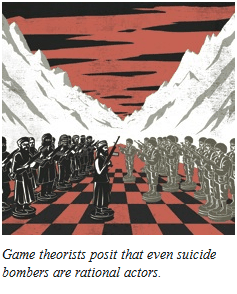
But if “global war” isn’t the right approach to terror what is? Experts on terrorism have produced shelves’ worth of new works on this question. For outsiders, reading this material can be a jarring experience. In the world of terrorism studies, the rhetoric of righteousness gives way to equilibrium equations. Nobody is good and nobody is evil. Terrorists, even suicide bombers, are not psychotics or fanatics; they’re rational actors—that is, what they do is explicable in terms of their beliefs and desires—who respond to the set of incentives that they find before them. The tools of analysis are realism, rational choice, game theory, decision theory: clinical and bloodless modes of thinking.

That approach, along with these scholars’ long immersion in the subject, can produce some surprising observations. In “A Question of Command: Counterinsurgency from the Civil War to Iraq” (Yale; $30), Mark Moyar, who holds the Kim T. Adamson Chair of Insurgency and Terrorism at the Marine Corps University, tells us that, in Afghanistan, the Taliban’s pay scale (financed by the protection payments demanded from opium farmers) is calibrated to be a generous multiple of the pay received by military and police personnel (financed by U.S. aid); no wonder official Afghan forces are no match for the insurgents.

More here.

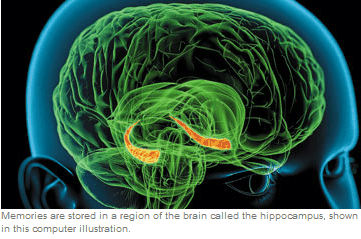
Surprising new research about the act of remembering

Greg Miller in Smithsonian Magazine:

ScreenHunter_03 May. 16 11.44 Like millions of people, Nader has vivid and emotional memories of the September 11, 2001, attacks and their aftermath. But as an expert on memory, and, in particular, on the malleability of memory, he knows better than to fully trust his recollections.

Most people have so-called flashbulb memories of where they were and what they were doing when something momentous happened: the assassination of President John F. Kennedy, say, or the explosion of the space shuttle Challenger. (Unfortunately, staggeringly terrible news seems to come out of the blue more often than staggeringly good news.) But as clear and detailed as these memories feel, psychologists find they are surprisingly inaccurate.

Nader, now a neuroscientist at McGill University in Montreal, says his memory of the World Trade Center attack has played a few tricks on him. He recalled seeing television footage on September 11 of the first plane hitting the north tower of the World Trade Center. But he was surprised to learn that such footage aired for the first time the following day. Apparently he wasn’t alone: a 2003 study of 569 college students found that 73 percent shared this misperception.

Nader believes he may have an explanation for such quirks of memory.

More here.

Why Dubai’s Islamic austerity is a sham – sex is for sale in every bar

Couples who publicly kiss are jailed, yet the state turns a blind eye to 30,000 imported prostitutes.

William Butler in The Observer:

ScreenHunter_02 May. 16 11.03 This was not Amsterdam's red-light district or the Reeperbahn in Hamburg or a bar on Shanghai's Bund. This was in the city centre of Dubai, the Gulf emirate where western women get a month in prison for a peck on the cheek; the Islamic city on Muhammad's peninsula where the muezzin's call rings out five times a day drawing believers to prayer; where public consumption of alcohol prompts immediate arrest; where adultery is an imprisonable offence; and where mall shoppers are advised against “overt displays of affection”, such as kissing.

Ayman Najafi and Charlotte Adams, the couple recently banged up in Al Awir desert prison for a brief public snog, must have been very unlucky indeed, because in reality Dubai is a heaving maelstrom of sexual activity that would make the hair stand up on even the most worldly westerner's head. It is known by some residents as “Sodom-sur-Mer”.

Beach life, cafe society, glamorous lifestyles, fast cars and deep tans are all things associated with “romance” in the fog-chilled minds of Europeans and North Americans. And there is a fair amount of legitimate “romance” in Dubai. Western girls fall for handsome, flash Lebanese men; male visitors go for the dusky charms of women from virtually anywhere. Office and beach affairs are common.

But most of the “romance” in Dubai is paid-for sex, accepted by expatriates as the norm, and to which a blind eye is turned – at the very least – by the authorities.

More here.

Middle East Plan B

Sasha Polakow-Suransky in The Boston Globe:

Israel__1273862716_1030 “I think this is a very big deal,” President Clinton declared to a group of American Jews and Arabs after the legions of photographers left the White House grounds on Sept. 13, 1993. However, Clinton warned, it would take commitment and hard work to guarantee that the historic Israeli-Palestinian Accord signed that day would “truly be a turning point.” It has been almost 17 years since Yasir Arafat and Yitzhak Rabin shook hands in the White House Rose Garden, setting in motion a process that was supposed to end the conflict for good. The agreement Clinton envisioned was relatively simple: Two states for two peoples. Israel would largely withdraw from the territories it has occupied since 1967, while retaining a few large settlement blocs within the West Bank and compensating the Palestinians with a similar amount of land from Israel proper. This two-state solution respects the fundamental tenets of Zionism — by allowing Israel to remain a Jewish-majority state — and satisfies moderate Palestinians’ nationalist ambitions by creating a national home for 4 million stateless Palestinians. It has guided western policy ever since.

But the two-state solution has not worked, and there is a growing fear that it never will, despite the resumption last week of indirect talks. Israel withdrew from the Gaza Strip in 2005 only to see the Islamic fundamentalist party Hamas take control of it, sending rockets into Israeli cities across the border. Meanwhile, Israel has continued to expand settlements in the West Bank, making the possibility of a territorially contiguous Palestine seem more remote than ever. With over 300,000 settlers in the West Bank today — compared to just over 100,000 in 1993 — many analysts on both sides believe that the settlements have become too entrenched and inextricably tied to Israel proper for the government to realistically evacuate all or most of its citizens, even if Israeli forces withdraw. Still, because negotiators on both sides and officials in Washington are so well-versed in two-state diplomacy and have been working for years to bring such a solution about, it remains the default option even as logistics conspire to make it impossible.

More here.

Metric Mania

John Allen Paulos in The New York Times:

Paulos In the realm of public policy, we live in an age of numbers. To hold teachers accountable, we examine their students’ test scores. To improve medical care, we quantify the effectiveness of different treatments. There is much to be said for such efforts, which are often backed by cutting-edge reformers. But do wehold an outsize belief in our ability to gauge complex phenomena, measure outcomes and come up with compelling numerical evidence? A well-known quotation usually attributed to Einstein is “Not everything that can be counted counts, and not everything that counts can be counted.” I’d amend it to a less eloquent, more prosaic statement: Unless we know how things are counted, we don’t know if it’s wise to count on the numbers.

The problem isn’t with statistical tests themselves but with what we do before and after we run them. First, we count if we can, but counting depends a great deal on previous assumptions about categorization. Consider, for example, the number of homeless people in Philadelphia, or the number of battered women in Atlanta, or the number of suicides in Denver. Is someone homeless if he’s unemployed and living with his brother’s family temporarily? Do we require that a women self-identify as battered to count her as such? If a person starts drinking day in and day out after a cancer diagnosis and dies from acute cirrhosis, did he kill himself? The answers to such questions significantly affect the count.

More here.

Saturday, May 15, 2010

Not So Natural Selection

Lewontin_1-052710_jpg_230x466_q85 Richard C. Lewontin reviews Jerry Fodor and Massimo Piattelli-Palmarini's What Darwin Got Wrong, in the NYRB:

e appearance of Fodor and Piattelli-Palmarini’s book at this time and the rhetoric and structure of its argument are guaranteed to provoke as strong a negative reaction in the community of evolutionary biologists as they have among philosophers of biology. To a degree never before experienced by the current generation of students of evolution, evolutionary theory is under attack by powerful forces of religious fundamentalism using the ambiguity of the word “theory” to suggest that evolution as a natural process is “only a theory.” While What Darwin Got Wrong may have been designed pour épater les bourgeois and to forcibly get the attention of evolutionists, when two accomplished intellectuals make the statement “Darwin’s theory of selection is empty,” they generate an anger that makes it almost impossible for biologists to give serious consideration to their argument.

Conscious that Fodor and Piattelli-Palmarini may have overdone it, they have circulated an essay that assures evolutionary biologists that they are not challenging the basic mechanism of evolution as a natural process described by the four principles of variation, heredity, differential reproduction, and mutation. In particular, they reject any notion that natural selection is some sort of “force” with laws like gravitation. For them, natural selection is simply a name for the differential reproduction of different kinds in a population. Not to be misunderstood, perhaps biologists should stop referring to “natural selection,” and instead talk about differential rates of survival and reproduction.

The other source of anxiety and anger is that the argument made by Fodor and Piattelli-Palmarini strikes at the way in which evolutionary biologists provide adaptive natural historical explanations for a vast array of phenomena, as well as the use by a wider scholarly community of the metaphor of natural selection to provide theories of history, social structure, human psychological phenomena, and culture. If you make a living by inventing scenarios of how natural selection produced, say, xenophobia and racism or the love of music, you will not take kindly to the book.

Even biologists who have made fundamental contributions to our understanding of what the actual genetic changes are in the evolution of species cannot resist the temptation to defend evolution against its know-nothing enemies by appealing to the fact that biologists are always able to provide plausible scenarios for evolution by natural selection. But plausibility is not science. True and sufficient explanations of particular examples of evolution are extremely hard to arrive at because we do not have world enough and time.