A Shakespeare Scholar Takes on a ‘Taboo’ Subject

Photo_4391_landscape_large Jennifer Howard in The Chronicle of Higher Education:

The most startling thing about Contested Will, James Shapiro's new book about the Shakespeare authorship debate, is not what it concludes about who really wrote Hamlet and King Lear. Shapiro, a professor of English at Columbia University, is an unrepentant Stratfordian, a firm believer that William Shakespeare of Stratford-upon-Avon created the plays and poems associated with his name.

What will surprise fellow Stratfordians—as well as doubters who want to dethrone Shakespeare and install Christopher Marlowe, Edward de Vere (the Earl of Oxford), Francis Bacon, or another contender in his place—is Shapiro's argument that the different camps have more in common than they admit. As Shapiro sees it, Stratfordians, Marlovians, Oxfordians, Baconians, and the rest share an anachronistic insistence on what he calls “reading the life out of the works.” In other words, they try to find autobiographical details in the plays and poetry that will confirm the true identity of the author.

Among mainstream Shakespeare scholars, Contested Will may be disconcerting for another reason. The book, just out from Simon & Schuster, argues that the authorship question is the one subject that they have deliberately neglected.

“More than one fellow Shakespearean was disheartened to learn that I was committing my energies to it,” Shapiro writes in the prologue, “as if somehow I was wasting my time and talent, or worse, at risk of going over to the dark side. I became increasingly interested in why this subject remains virtually taboo in academic circles, as well as in the consequences of this collective silence.”

Shapiro has not, in fact, gone over to the “dark side.” Contested Will includes a chapter on why he continues to believe that the Stratford candidate is the genuine article. But rehashing the authorship debate is not the purpose of the book. It does not attempt an exhaustive review of the merits of the competing claims. As Shapiro explicitly says, what interests him is not what people think about the authorship question but why they think it and how their personal and historical circumstances help shape that.


Understanding the Split Personality of Iceland’s Volcanoes

Volcano_IcelandJohn Timmer in Ars Technica:

The initial images of the Eyjafjallajökull eruption showed the sort of dramatic spires of molten rock that we associate with Hawaiian volcanoes. The next time it made the news, it was because air travel throughout Northern Europe had been shut down as a huge cloud of ash spread slowly across the UK and Scandinavia—very un-Hawaiian. To get a better sense of why this Icelandic volcano was showing such a split personality, we got in touch with the American Geophysical Union, which handed us on to Dr. Jeff Karson, who's chair of the Earth Sciences department at Syracuse University. Dr. Karson patiently explained what makes volcanism in Iceland distinct.

If you're like me, and know just enough Geology to be dangerous, you'd probably divide volcanoes into two categories: hotspots like Hawaii, where molten rock pours out as gently as anything that's 1,200°C possibly can, and volcanism associated with subduction zones, which tends to produce massive, explosive eruptions, such as the ones at St. Helens and Pinatubo. There is, of course, a third kind, the eruptions associated with the spreading of mid-ocean ridges. But these generally take place deep underwater, and are rarely captured on film.

Iceland is distinct because it's the product of a huge hot spot located directly under the Mid-Atlantic ridge. It's not unique in that regard; Karson said that the Azores and Galapagos Islands are the product of similar situations. But Iceland is much hotter and more active than the others.

If it's not on a subduction zone, however, you might not expect it to produce the sorts of explosive eruptions that send clouds of ash across large areas of the North Atlantic. Karson said there are two factors that can make Icelandic volcanoes pack a punch. The first is that, in addition to the basaltic magma associated with mid-ocean ridges, Iceland's volcanoes produce significant amounts of rhyolite, which is silica-rich and, more significantly, contains a lot more volatile substances. As the rhyolitic magma reaches the surface and pressure is released, the result can be an explosive eruption. As Karson put it, the cause is different from the explosive volcanic eruptions that occur at subduction zones, but the result can look very similar.

Individual magma chambers beneath Iceland can have varying mixes of basaltic and rhyolitic materials, which means that individual volcanoes on the island may have a complicated eruption history.

The other factor that adds to the explosiveness of Iceland's volcanoes is the ice itself.

Graveyard of Empires: Nine Months on the Ground in Obama’s Afghanistan

Genoways-thumbnail The new issue of the Virginia Quarterly Review has a number of interesting pieces on the war in Afghanistan. VQR editor Ted Genoways on the issue:

Everything seemed to be going exactly to plan. For the first week after Operation Moshtarak was launched under cover of darkness on February 13, NATO and Afghan troops lived up to the offensive’s lofty name—a Dari word meaning “together,” selected to reinforce the operation’s joint effort. The Afghan National Army made up some 60 percent of the thousands of troops advancing on the dusty redoubt of Marja, an agricultural town latticed with canals and ditches irrigating the poppy fields that made it a crossroads for heroin traffickers and pro-Taliban forces in the Helmand Province. Locals, as asked, voluntarily stayed in their homes to avoid IEDs emplaced by insurgents and shared intelligence with international commanders. Even Pakistan’s Directorate for Inter-Services Intelligence (ISI) got in the act, arresting two “shadow governors” of Afghanistan’s northern provinces and raiding a house in Karachi where Mullah Abdul Ghani Baradar, the Taliban’s military commander, was captured.

Coming nearly nine months after General Stanley McChrystal was appointed by President Barack Obama to be commander of forces in Afghanistan, the coordinated action in the southern provinces and across the border in Pakistan appeared to be an astounding exoneration of the general’s new counterinsurgency plan. And not a moment too soon. After eight long years of military stalemate and political neglect, US troops were scoring measurable victories, and the fresh focus on winning the confidence of ordinary Afghans appeared to be paying major dividends. For the first time since the shedding of burqas and shaving of beards in the exultant early days of the invasion, the Afghan people seemed to be rallying around NATO forces.

Then, on February 21, troops sweeping for insurgents on the run from Marja intercepted Taliban radio chatter near the main road in Oruzgan Province. Little Bird helicopters, flown by elite US Special Forces, were called in. Pilots discovered a tight-knit convoy of two Land Cruisers and a pickup, all overloaded and riding low, lurching up the Khotal Chowzar mountain pass toward Daykondi Province. They concluded that the vehicles were heavy-laden with arms and insurgents. They opened fire, destroying the convoy. But when ground troops moved in to collect Taliban casualties, they instead found twenty-seven dead civilians—including at least four women and a child—and fourteen more wounded. These were ordinary Afghans, it turned out, fleeing the renewed violence. President Hamid Karzai swiftly denounced the attack as “unjustifiable” and called it “a major obstacle for an effective counterterrorism effort.”

Fatima Bhutto: ‘We didn’t know what would happen tomorrow’

From The Guardian:

Fatima-bhutto-in-london-001 In December 2007, at the moment Benazir Bhutto was murdered in the chaotic run-up to the Pakistani elections – in which she hoped to win a third term as prime minister – her niece Fatima was out campaigning. Fatima's first thought, when the news came through, was disbelief: they couldn't kill another Bhutto, they wouldn't dare. Then shock set in as she made the emotional connection with the murder of her father, Murtaza, a decade before. “I cried for the next five days,” she writes in her new book, Songs of Blood and Sword. “By the time I had drained myself of tears, I had cried for everyone.” The tears were unexpected. Fatima was out campaigning for a rival party. She has for years been a ferocious critic of Benazir and her widower, Asif Ali Zardari, now president of Pakistan, and what she calls the “Bhutto cult”, whereby party leadership is handed down through the family. But she has good memories of Benazir as well. As a child she was often told she was just like her aunt. “We liked all the same revolting sweets,” she says.

The Bhuttos have dominated Pakistani politics for decades. But dynastic politics brought murderous rivalries. Benazir fell out with her brothers, one of whom was Fatima's father, after their father, Zulfikar Ali Bhutto, founder of the Pakistan People's Party and the country's fourth president, was executed by General Zia's dictatorship in 1979. While her brothers plotted to overthrow Zia from Kabul, and were accused of orchestrating a plane hijacking in 1981, Benazir pressed for political advantage and was twice elected prime minister – and twice removed on charges of corruption. The siblings became enemies, and when Murtaza was shot dead outside the family home in Karachi in 1996, Fatima, then 14, suspected her aunt of being involved.

More here.

Indecision-Making

From The New York Times:

Sheena Sheena Iyengar is the psychologist responsible for the famous jam experiment. You may have heard about it: At a luxury food store in Menlo Park, researchers set up a table offering samples of jam. Sometimes, there were six different flavors to choose from. At other times, there were 24. (In both cases, popular flavors like strawberry were left out.) Shoppers were more likely to stop by the table with more flavors. But after the taste test, those who chose from the smaller number were 10 times more likely to actually buy jam: 30 percent versus 3 percent. Having too many options, it seems, made it harder to settle on a single selection.

Wherever she goes, people tell Iyengar about her own experiment. The head of Fidelity Research explained it to her, as did a McKinsey & Company executive and a random woman sitting next to her on a plane. A colleague told her he had heard Rush Limbaugh denounce it on the radio. That rant was probably a reaction to Barry Schwartz, the author of “The Paradox of Choice” (2004), who often cites the jam study in antimarket polemics lamenting the abundance of consumer choice. In Schwartz’s ideal world, stores wouldn’t offer such ridiculous, brain-­taxing plenitude. Who needs two dozen types of jam?

More here.

Saturday Poem

Third Person Neuter

Is God mad? Was Christ
crazy? Is truth
the legal truth? (Three PhDs who swear

the human being who believes
a human being God
is what, in fairness, speaking

clinically, we call
a nut.) No jury,
given sacred laws

of science and democracy, would now
forgive so big a claim as Christ's—a claim
for good. (The wounded get

their settlements in millions, not
worlds-without-end.) We think of bliss
as ignorance, and heaven as naiveté: the doctor's

a philosopher, the priest a practicing
apologist. Not one of them
will let me see

with my own eyes my friend again.
When experts gave him time, it made
his luck and language die. What good

was love? It was the ultimate
authority to quit.
He had no use

for flesh at last
and, Christ,
I'm made of it.

by Heather McHugh
from Shades;
Wesleyan University Press, 1988

Byrne, Baby, Byrne

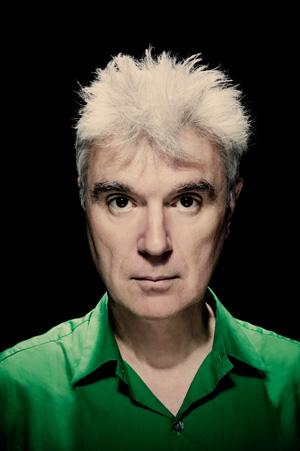
Michael Archer interviews David Byrne in Guernica:

Byrne300Clayton%20Cubitt Setting Imelda Marcos’s life to music—dance beats, no less—seems a perfectly mainstream concept coming from David Byrne. After all, this is a man who placed an old pump organ inside the Great Hall of the Battery Maritime Building in New York City and used hoses to connect it to pumps and motors set throughout the century-old former ferry terminal, so that when visitors pushed the organ’s keys they were “Playing the Building,” the project’s name. Still, a musical version of the former Phillippine First Lady’s life will likely raise some eyebrows. But beyond that, it’s also a potential new business model for the record industry. How so? By creating a musical biography of Marcos, one with a specific narrative thread, Byrne hopes to drum up demand not just for the catchiest of the songs, but the entire arc of the CD collection.

Here Lies Love, in which Byrne, 57, collaborates with Fatboy Slim (Norman Cook) to chronicle the rise and fall of Marcos and her relationship with former servant Estrella Cumpas, seems a perfectly logical progression for the frontman and principle song writer for the legendary Talking Heads, the influential band that placed four albums on Rolling Stone’s list of the 500 greatest and was inducted into the Rock and Roll Hall of Fame in 2002. Throughout his career, Byrne has collaborated with musicians as varied as Selena, members of Devo, and Luaka Bop. His world music label has released work from Os Mutantes, the Brazilian psychedelic rock band, and the Belgian group Zap Mama.

More here. [I wrote about Here Lies Love here.]

Friday, April 16, 2010

The Blacks of Mexico

Afro-mexicans2Alexis Okeowo in More Intelligent Life:

The first time I felt deeply uncomfortable being black was when I was a kid. My family had just moved to Alabama, and I was in a car with my father and my brother. A white woman with a harshly lined face and brown frizzy hair yelled out a racial slur as we drove by. Dad immediately put the car in reverse and drove over to her as she pumped gas at a filling station. “What did you say?” he demanded. She glared at him and refused to respond. Shocked into silence, my brother and I didn't say anything for the rest of the drive home.

The second time was in a quaint town in Mexico. I am a journalist living in Mexico City and I had decided to take a trip to Veracruz, where hundreds of thousands of African slaves had been brought by Spanish colonialists five centuries prior. I wanted to visit Yanga, a place that called itself “the first free slave town in the Americas”. The town was named for Gaspar Yanga, a slave who had led a successful rebellion against the Spanish in the 16th century.

I had only just learned about Afro-Mexicans, the isolated descendants of Mexico's original slaves, who reside on the country's rural Pacific and Gulf Coasts. After months of research and a visit to the remote Afro-Mexican community on the Pacific Coast, where most of them live, I felt compelled to visit the Afro-Mexicans in Veracruz on the Gulf Coast. I ended up spending most of my time trying to figure out Yanga.

As I arrived in town, I peered out of my taxi window at the pastel-painted storefronts and the brown-skinned residents walking along the wide streets. “Where are the black Mexicans?” I wondered. A central sign proclaimed Yanga's role as the first Mexican town to be free from slavery, yet the descendants of these former slaves were nowhere to be found. I would later learn that most live in dilapidated settlements outside of town.

Neuroeconomic Theory

Photo_IBrocasIsabelle Brocas and Juan D. Carrillo over at Vox EU:

Economics has always relied on a careful modelling of decision-makers. They are described by utility functions that represent their goals, and they interact at (Nash) equilibrium. Nevertheless, the discrepancies between theoretical predictions and observed behaviour have haunted the field for many decades.

To cope with this mismatch, behavioural economists have developed new theories of decision-making that are a better fit for the behavioural data than traditional models. The methodology consists in building models to demonstrate the relationship between a cause (such as a preference for a particular object) and a behavioural anomaly. This line of research formulates possible explanations for behavioural data, but it is nevertheless subject to shortcomings. Often the cause is not observable, and there is no evidence of the relationship provided by the model. Most notably, the freedom provided by the introspection method leads to a model selection problem. Also, the cause of the behavioural anomaly may simply lie elsewhere.

Photo_JCarrillo

Neuroeconomics offers a solution through an additional set of data obtained via a series of measurements of brain activity at the time of decisions. Experimental neuroeconomics can be seen as a subfield of experimental economics, where behavioural data is enriched with brain data. Neuroeconomic theory proposes to build brain-based models capable of predicting observed behaviour.

Experimental neuroeconomics is controversial. While some consider it to be an irrelevant body of research, there are those who claim it is essential (see Camerer, et al. 2005, Gul and Pesenderfor 2008). In fairness, the field is probably too young to tell. Surprisingly, the discussion has been centred on empirical issues regarding the collection method, amount, cost, and quality of brain data – the broad implications have not received as much attention. Indeed, the new set of data provided by experimental neuroeconomics will shed light on the causes of behaviour (and therefore of the behavioural anomalies) and help build new theories capable of explaining and predicting decisions, a long-term goal of economics. Neuroeconomic theory offers to do precisely this. So far, research in that direction has been very limited and its impact has been largely ignored.

On Obama’s Plan for the Future of Human Space Flight

WIR_4_16_10_SQRLee Billings in Seed:

Consider NASA: Today’s extremely expensive and somewhat unsatisfying staples of US human spaceflight, the space shuttle and a space station, can be traced back forty years or so to the aftermath of the Apollo program, when President Nixon chose them as its replacements. The legacy of these choices is that no one has ventured beyond low-Earth orbit ever since.

This has far graver implications than failing to fulfill a generation’s dreams of Pan-Am moon flights and Lunar Hiltons. In the fullness of time, lack of progress in expanding humanity’s sustainable presence off-planet represents an existential threat to our species. Even staunch critics of human spaceflight must acknowledge this. It doesn’t take a rocket scientist to realize that keeping all one’s eggs in a single, vulnerable planet-sized basket is an unsound long-term investment strategy. To do so is to court extinction.

NASA administrator Charles Bolden may have had such thoughts in mind on Tuesday when he addressed the audience at the National Space Symposium. “This is a big week for the entire nation,” Bolden said, “and it’s a week where probably more people than ever before will be thinking about space. It’s an important week for all of us in the space industry and it’s a particularly important week for NASA.”

Bolden was referring to the Obama administration’s new plans for America’s space agency, which the president himself presented and defended yesterday in a speech at Kennedy Space Center in Cape Canaveral, Florida. President Obama’s 2011 budget request eliminated funding for the earlier Bush administration’s Constellation program, which aimed to build a fleet of government-run rockets for returning astronauts to the Moon in the 2020s to build a lunar base. Instead, Obama’s plan deemphasizes the Moon and pumps more money into the commercial space sector for creating rockets to replace the aging space shuttle fleet. It also seeks to spark innovation, boosting NASA funds for development of breakthrough technologies in space-based propulsion, life-support, and power generation.

ramble on, outworn college creed

Fredric+Jameson

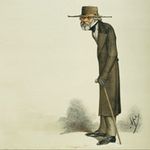
Fredric Jameson’s pre-eminence, over the last generation, among critics writing in English would be hard to dispute. Part of the tribute has been exacted by his majestic style, one distinctive feature of which is the way that the convoy of long sentences freighted and balanced with subordinate clauses will dock here and there to unload a pithy slogan. ‘Always historicise!’ is one of these, and Jameson has also insisted, under the banner of ‘One cannot not periodise,’ on the related necessity (as well as the semi-arbitrariness) of dividing history into periods. With that in mind, it’s tempting to propose a period, coincident with Jameson’s career as the main theorist of postmodernism, stretching from about 1983 (when Thatcher, having won a war, and Reagan, having survived a recession, consolidated their popularity) to 2008 (when the neoliberal programme launched by Reagan and Thatcher was set back by the worst economic crisis since the Depression). During this period of neoliberal ascendancy – an era of deregulation, financialisation, industrial decline, demoralisation of the working class, the collapse of Communism and so on – it often seemed easier to spot the contradictions of Marxism than the more famous contradictions of capitalism, and no figure seemed to embody more than Fredric Jameson the peculiar condition of an economic theory that had turned out to flourish above all as a mode of cultural analysis, a mass movement that had become the province of an academic ‘elite’, and an intellectual tradition that had arrived at some sort of culmination right at the point of apparent extinction.

more from Benjamin Kunkel at the LRB here.

when will they come for our women?

201016std001

IN THE Cascade mountains of California, north of Lassen Peak, astronomers are looking for aliens. The Allen Telescope Array (mostly paid for by Paul Allen, co-founder of Microsoft) consists of 42 dish antennas, each six metres across, scattered across the countryside. When the array is complete, it will have 350 dishes that, by acting in concert, will have the power of a single instrument 700 metres across. The Allen telescope is looking for aliens the traditional way: by searching for radio signals that have either been sent out deliberately, or leaked into space accidentally, as human radio signals are. The search for extraterrestrial intelligence, or SETI, is a 50-year-old idea. Much progress has been made in locating Earthlike planets (see article) but about 1,000 star systems have also been subject to serious radio scrutiny. The Allen array will increase the number to 1m within a decade.

more from The Economist here.

ice station neutrino!!!!!

IceCube_LRG

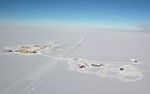
For decades physicists have suspected that neutrinos hold some of the universe’s darkest secrets. Determining their behavior and where they came from could tell rich stories of the early universe and potentially illuminate the curious nature of dark matter. Untold trillions of these tiny subatomic particles—some born soon after the birth of the universe, others born in the hearts of stars—have traveled unimaginable distances to pass through your body every second. So what does this mean for you? Not much, really. The nearly massless particles pass through almost all matter unabated, without leaving a trace. It’s this elusive nature that also makes them so difficult to detect and therefore study. Very occasionally, however, a neutrino collides into an atom, producing from the wreckage another particle—known as a muon—that can be detected (using special light sensors). At the IceCube Neutrino Observatory, a team of pioneering researchers has buried thousands of these sensors miles deep into the ice at the bottom of the Earth, all in an attempt to catch the rare neutrino that crashes into an atom of ice.

more from Greg Boustead at Seed here.

An Awareness of What is Missing

Stanley-fish

The German philosopher Jürgen Habermas has long been recognized as the most persistent and influential defender of an Enlightenment rationality that has been attacked both by postmodernism, which derides formal reason’s claims of internal coherence and neutrality, and by various fundamentalisms, which subordinate reason to religious imperatives that sweep everything before them, often not stopping at violence. In his earlier work, Habermas believed, as many did, that the ambition of religion to provide a foundation of social cohesion and normative guidance could now, in the Modern Age, be fulfilled by the full development of human rational capacities harnessed to a “discourse ethics” that admitted into the conversation only propositions vying for the status of “better reasons,” with “better” being determined by a free and open process rather than by presupposed ideological or religious commitments: “…the authority of the holy,” he once declared, “is gradually replaced by the authority of an achieved consensus.”

more from Stanley Fish at The Opinionater here.

an Angel of Death, hangs over France, noyading, fusillading, fighting, gun-boring, tanning human skins

TLS_Scurr_707688a

“It is a wild savage Book, itself a kind of French Revolution; – which perhaps, if Providence have so ordered it, the world had better not accept when offered it? With all my heart! What I do know of it is that it has come hot out of my own soul; born in blackness whirlwind and sorrow; that no man, for a long while, has stood speaking so completely alone under the Eternal Azure, in the character of man only; or is likely for a long while so to stand:– finally that it has gone as near to choking the life out of me as any task I should like to undertake for some years to come; which also is an immense comfort, indeed the greatest of all.” The term exhaustion scarcely covered the state he was in: he wanted to weep and pray when he put down his pen, but did not do either “at least not visibly or audibly”. He was poor, he had a sick wife to support and his own health was fragile. He was forty-two and had long hoped to live by writing, but his only substantial work so far, Sartor Resartus, (an experimental narrative serialized in Fraser’s Magazine between 1833 and 1834) had met with general bafflement. For his book on the French Revolution, Carlyle had a “half- profits” contract with his publisher James Fraser, which would give him no income from the finished text until the production and printing costs had been recouped. Only then would he be entitled to half of any money it might make.

more from Ruth Scurr at the TLS here.

Friday Poem

The Heart of Herakles

Lying under the stars,
In the winter night,
Late, while the autumn
Constellations climb the sky,
As the cluster of Hercules
Falls down the west
I put the telesccope by
And watch Deneb
Move towards the zenith.
My body is asleep. Only
My eyes and brain are awake.
The stars stand around me
Like gold eyes. I can no longer
Tell where I begin and leave off.
The faint breeze in the dark pines,
And the invisible grass,
The tipping earth, the swarming stars
Have an eye that sees itself.

by Kenneth Rexroth

Why are volcanic plumes so dangerous?

From MSNBC:

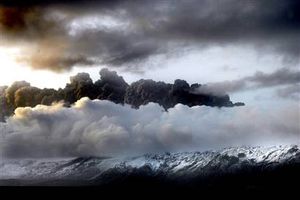
Fumes The mushrooming cloud of ash from the eruption of the Eyjafjallajoekull volcano in Iceland has resulted in the closure of major airports throughout the U.K. and Scandinavia. The grounded flights make sense, as these super-heated plumes can do more than reduce visibility. They're downright hazards for airplanes. “Basically, planes and volcanic ash don't mix,” Elizabeth Cory, a spokesperson for the Federal Aviation Administration, said today. “When ash is ingested into the engine, it creates problems for the plane, including electrical failure.” The thing that makes volcanic plumes so dangerous is that they look extremely similar to regular clouds, visibly and on radar screens. Even when ash isn't visible to the human eye, it can still pose a threat to aircrafts because of the chemicals floating within volcanic plumes.

Airborne ash makes air travel extremely dangerous and difficult for several reasons, the number one being that when the air that gets sucked through an aircraft's jet engine is mixed with ash, it can cause engine failure. The ash particles that make up volcanic clouds contain powder-size to sand-size particles of igneous rock material that have been blown into the air by an erupting volcano. The tiny particles instantly melt when faced with the internal temperature of an in-flight jet engine, which exceeds 1,832 degrees Fahrenheit (1,000 degrees Celsius).

More here.

Thursday, April 15, 2010

the least interesting thing to do with a puzzle is solve it

22378_299520147847_538727847_4552072_6181312_s

Why would anyone want to play with a toy that is so damn hard? The Rubik’s Cube entered our collective cultural experience 30 years ago, next month, and there is still no satisfying answer. At first, in the early ’80s, we all had fun just spinning it around in our hands. The original Cube was an elegant object — a perfect 3x3x3, solid but also flexible and smooth. It was covered in bright colored stickers and felt good to hold. But it didn’t make hilarious noises or crazy smells. It didn’t talk or pee or dance. You couldn’t dress it up and (a minor thing here) it was impossible. Even so, we all had to have it. Its impossibility was funny, and this satisfied us. Then, quietly, slowly, we started to hear the stories. People, children like us, were starting to solve it. The Cube transformed these boys (because they were mostly boys) from goofy weird dudes without social skills into superhuman weird dudes that were intimidating. The boys who solved Rubik’s Cube were like wizards, distant and terrifying demigods with magical qualities. This is because a single, unspeakable question lingered around them: How much committed alone time had they spent with the Cube? We didn’t want to know the answer. Hours? Days? Weeks?

more from Stefany Anne Golberg at The Smart Set here.

He Conquered the Conjecture

Paulos_1-042910_jpg_230x704_q85John Allen Paulos reviews Masha Gessen's biograpghy of Grigory Perlman, Perfect Rigor: A Genius and the Mathematical Breakthrough of the Century, in the NYRB:

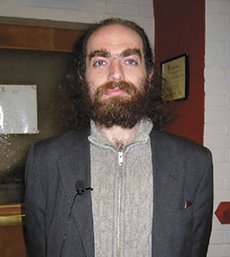
Masha Gessen’s Perfect Rigor is a fascinating biography of Grigory (Grisha) Perelman, the fearsomely brilliant and notoriously antisocial Russian mathematician. Perelman proved the Poincaré Conjecture, one of mathematics’ most important and intractable problems, in 2002—almost a century after it was first posed, and just two years after the Clay Mathematics Institute offered a one-million-dollar prize for its solution.

Gessen herself grew up in the former Soviet Union, is roughly Perelman’s age, and has a mathematical background, which facilitated her interviews with many of his classmates, mentors, teachers, and colleagues. Not surprisingly, she did not interview the reclusive mathematician or his mother, with whom he currently lives. But the others give a convincing picture not only of him but also of the strange world of Soviet mathematics, which was divided between the official, rigid mathematical establishment and the informal mathematical counterculture. The former, because of its historical importance to engineering and military projects, was supported by the Party and the government; the latter consisted of scholars who loved mathematics for its own sake and used it as a way to escape the stultifying influence of officious apparatchiks.

Born in 1966 to Jewish parents, Perelman came of age when this distinction was breaking down during the era of glasnost and perestroika. By the time he was ten he began to show a talent for mathematics, and his mother, who had abandoned her own graduate work in the field in order to raise him, enrolled him in an after-school math club coached by Sergei Rukshin, a mathematics undergraduate at Leningrad University. Rukshin was a troubled youth who became obsessed with mathematics and gradually developed a rigorous, distinctive, and very effective method of teaching problem-solving. Over the last twenty years, approximately half of all Russian entrants to the International Mathematical Olympiad have studied with him.

Only nineteen himself when he met Perelman, Rukshin stayed in contact with him from his first after-school math club until, it seems, a relatively recent break. He found that the not yet adolescent Perelman, described by Gessen as “an ugly duckling among ugly ducklings…pudgy and awkward,” was already unusually deliberate and precise in his thinking. Alexander Golovanov, who studied math alongside Perelman, said that Rukshin’s growing commitment to and love for Perelman came to give meaning to his own life. Like many a competitive sports coach, Rukshin hated it when his charges engaged in anything other than his sport. This was an unnecessary restriction in Perelman’s case since from the beginning he seemed uninterested in girls or anything other than mathematics.