I’m just here to measure your penises

Jesse Adelman in McSweeny's:
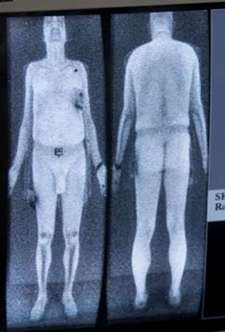
Rapi_scan_lg There's been quite a bit of scuttlebutt in the press and amongst the civil liberties crowd about what we—myself and my fellow full-body scanners—are coming to your airports to do. What is our real purpose? How invasive, truly, are these full-body scans? Will air travel, over time, become somehow less dignified, less “private”?

I'd like to take the opportunity of this writing to allay these and other misgivings. Please know: I'm just here to measure your penises. And I'm very, very good at it.

Can I see electronic components or liquid metals? Exotic bomb-making compounds? Timers or wires poking out of foreign orifices that mean us harm? No, no, and no, I cannot. And ladies, I have no interest in whatever arrangements you might have going on down there—no thanks! Fundamentally, I'm a specialist. I was built to measure penises for national security.

Many folks seem to have the impression that their penis scans will simply be appraised by a crew of chuckling, fantastically overweight elementary school dropouts in some musty back room near the baggage drop. While that may well be the case, you can rest assured that your penis will be regarded with the utmost professional care and clinical detachment until the very moment that a fine-grained digital image of your business leaves my fiber-optic cable en route to our vast federal crotch database.

More here.
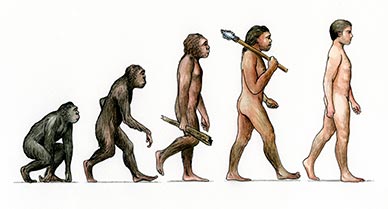
The Top Ten Daily Consequences of Having Evolved

Rob Dunn in Smithsonian Magazine:

Consequences-of-evolution-388 1. Our cells are weird chimeras
Perhaps a billion years ago, a single-celled organism arose that would ultimately give rise to all of the plants and animals on Earth, including us. This ancestor was the result of a merging: one cell swallowed, imperfectly, another cell. The predator provided the outsides, the nucleus and most of the rest of the chimera. The prey became the mitochondrion, the cellular organ that produces energy. Most of the time, this ancient symbiosis proceeds amicably. But every so often, our mitochondria and their surrounding cells fight. The result is diseases, such as mitochondrial myopathies (a range of muscle diseases) or Leigh’s disease (which affects the central nervous system).

2. Hiccups
The first air-breathing fish and amphibians extracted oxygen using gills when in the water and primitive lungs when on land—and to do so, they had to be able to close the glottis, or entryway to the lungs, when underwater. Importantly, the entryway (or glottis) to the lungs could be closed. When underwater, the animals pushed water past their gills while simultaneously pushing the glottis down. We descendants of these animals were left with vestiges of their history, including the hiccup. In hiccupping, we use ancient muscles to quickly close the glottis while sucking in (albeit air, not water). Hiccups no longer serve a function, but they persist without causing us harm—aside from frustration and occasional embarrassment. One of the reasons it is so difficult to stop hiccupping is that the entire process is controlled by a part of our brain that evolved long before consciousness, and so try as you might, you cannot think hiccups away.

More here.

Margaret Atwood interview

From The Guardian:

Margaret-atwood-in-london-007 Atwood's pressing interest, as the daughter of an eminent Canadian entomologist, is our planet and its future. Nothing seems more important to her, and since this concern animates almost everything she does, her conversation segues as easily into global warming as Canadian literature: “The threat to the planet is us. It's actually not a threat to the planet – it's a threat to us.” She goes on: “The planet will be OK in its own way. No matter what we do to it, we won't eliminate every last life form from it.” As evidence of this, there's the Canadian city of Sudbury, a favourite of Atwood's. When she was growing up in the 1940s, the place was as “barren as the moon” through overlogging, forest fires and relentless mining. “All the rain was acid,” she says. It was so bad that “a Sudbury” became a unit of pollution. But then a volunteer programme of regeneration was launched. Earth and seeds were painstakingly stuffed into the cracks between the rocks. Now, “Sudbury has forests again, birds in the trees and fish in the streams.” For her, Sudbury, “a symbol of hope”, offers a paradigm for the planet. And so, Atwood continues, with rather bracing realism, “some form of life will remain after us. We shouldn't be saying 'Save the planet'; we should be saying: 'Save viable conditions in which people can live.' That's what we're dealing with here.”

Atwood likes to tell the Amoeba's Tale as an illustration of the “magic moment” at which planet earth now finds itself. There's this test tube, and it's full of amoeba food. You put one amoeba in at 12 noon. The amoeba divides in two every minute. At 12 midnight the test tube is full of amoebas – and there's no food left. Question: at what moment in time is the tube half full? Answer: one minute to midnight. That's where we are apparently. That's when all the amoebas are saying: “We are fine. There's half a tube of food left.”

More here.

The Voyager

From The New York Times:

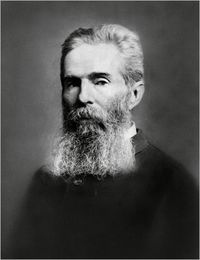
Marshall-popup Writing in The Atlantic last year, presumably while finishing work on “The Passages of H. M.,” a novel based on the life of Herman Melville, Jay Parini declared that the historical novel “has become our primary form of fiction.” The present, he speculated, “can seem too bright, too close,” requiring “the filter of memory” to sort out and deliver the profound insights readers hope to find in novels. Going a step farther, he argued that it is in fiction like Gore Vidal’s “Lincoln” or Russell Banks’s “Cloudsplitter” that “one gets ‘real’ history.”

Parini, a poet, biographer and literary critic as well as a novelist, can write with admirable lyric intensity: “In these islands, the sun shone as if from within, the moon burned in his brain. Water became sky, and night exchanged its sultry qualities with day.” But even these passages make us hunger for Melville’s own words: “Hither, and thither, on high, glided the snow-white wings of small, unspeckled birds; these were the gentle thoughts of the feminine air; but to and fro in the deeps, far down in the bottomless blue, rushed mighty Leviathans, sword-fish, and sharks; and these were the strong, troubled, murderous thinkings of the masculine sea.”

More here. (Note: I am posting this review mainly for the Melville quote in the last paragraph. To this day, Moby Dick remains my favorite American novel, one that finally made me appreciate the storms in the souls of men that make them go whaling. Read it again if it has been more than 5 years since you read it last.)

Sunday Poem

At a Jazz in Denver with my Son and His Friends
I Learn Something New

I sit and listen in the midst
of my son’s crowd, speak
a bouncy banter.
We kill time
with the Simpsons before
David plays jazz.
In jeans and casual jackets,
we drink Coors,
check the wind-tossed sky,
the flash of lightning, hoping
in spite of the weather, a crowd
will pour through the door.
After a while, I hear a shift
of tone, a carefulness
I hadn’t noticed before.
In a conversation of augmented fifths
and ninths, the friends address me
in safe thirds. I listen more carefully.
Where is the cutting edge,
the forward motion? We converse
in C major, squarely metered.
I sit back stunned. The lack
of dissonance strikes a new chord.
When did Youth leave me and move on?
I adjust my position on the barstool,
lean into her absence, wonder
how I never saw her go.

by Mary Jo Balistreri
from Joy in the Morning
Bellowing Ark Press, © 2008

Saturday, November 27, 2010

a truth beyond accuracy

The-box-gunter-grass

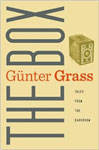
“The children must never find out about what their father has suppressed,” writes Günter Grass in The Box: Tales From the Darkroom, his new memoir in the form of a novel. “Not a word about guilt and other unwelcome deliveries.” The last time Grass wrote about his life, in the more straightforward 2007 memoir Peeling the Onion, suppression and guilt were all that readers wanted to talk about: in particular, the revelation that the teenage Grass, during the last days of the Second World War, had served in the Waffen SS, and concealed this fact for the next six decades. The story made headlines, and not just in book-review sections, because Grass has long been more than just another novelist. Ever since the publication of The Tin Drum, in 1959, he has been something like the conscience of postwar Germany—a position solidified when he won the Nobel Prize in 1999. In his new book, the 83-year-old writer is still reckoning with the past. But this time he turns his attention to a different, and even more complicated, kind of accounting: the one that every parent owes to his children. This means exploring types of guilt and penance that are just as painful, if less sensational, than anything in Peeling the Onion: “Now the inadequate father hopes the children will feel some compassion. For they cannot sweep aside his life, nor he theirs, pretending that none of it ever happened.”

more from Adam Kirsch at Slate here.

cranach

1b7c015e-f95b-11df-a4a5-00144feab49a

Our taste in Old Masters often tells us more about ourselves than fashions in contemporary art. El Greco was ignored until his exaggerations suddenly chimed with modernism in the 1900s. Caravaggio emerged from obscurity only when his streetwise dramas and androgynous sensibility echoed democratic, sexualised postwar culture. And now Lucas Cranach, little known beyond Germany even a few years ago, is becoming the Old Master for the early 21st century. Why? Cranach’s first UK shows took place in 2007 at the Courtauld Institute, and in 2008 at the Royal Academy – its posters advertising his slinky nudes were nearly banned from London Underground. This autumn brings further major exhibitions: Lucas Cranach, the Other Renaissance at Rome’s Galleria Borghese is the first ever display of the artist in Italy; The World of Lucas Cranach, at Brussels’ BOZAR, then travelling to Paris, is his first retrospective in France or any Benelux country.

more from Jackie Wullschlager at the FT here.

huck

57561265-11114857

“Huckleberry Finn” turns 125 this year, which is also the 175th anniversary of Twain’s birth and the 100th of his death. It’s a perfect time to reconsider his importance, not because of these anniversaries but in spite of them. Such occasions, after all, often obscure our ability to engage with a writer; they become mausoleums built around the life and work. What does it mean to call “Huckleberry Finn” a great book, and Twain a quintessential American voice? Such praise means nothing if we can’t feel it, if we can’t get inside the language, the world view, if we can’t experience it as living literature, something that transcends its time. For this reason, Norman Mailer chose, on the occasion of “Huckleberry Finn’s” centennial, to celebrate it as if it were a new book, transformative and fresh. “The book was so up-to-date!” he wrote in the New York Times Book Review. “I was not reading a classic author so much as looking at a new work sent to me in galleys by a publisher. It was as if it had arrived with one of those rare letters which says, ‘We won’t make this claim often but do think we have an extraordinary first novel to send out.’ So it was like reading ‘From Here to Eternity’ in galleys, back in 1950, or ‘Lie Down in Darkness,’ ‘Catch-22,’ or ‘The World According to Garp.'”

more from David L. Ulin at the LA Times here.

Saturday Poem

Enough Space

give me the Blues
give me
the Blues
all the space I need
is three chords
to tell a howling
'ya beautiful honey'
knuckles cracking at sun-up story
give me the
Blues
with deep pockets of bass rhythm that pumps
like the heart of black earth and
dreams deferred.
The Blues is
enough room to breathe is
three chords
and a bit of sunlight
through dirt- and smoke-fogged
windows, the Blues
is an attic garret in
Paris or Prague or New York
or Chicago or
a sharecropper's shack in
Bogaloosa Lousiana –
where art
without any name at all
first cries its be-wah-wah-be-wah-dah.

give me enough space
give me the Ba-looos

by Albert DeGenoa
Poetry From Blue Fred's Kitchen

When new narratives meet old brains

From NewScientist:

Storywriter “We are our narratives” has become a popular slogan. “We” refers to our selves, in the full-blooded person-constituting sense. “Narratives” refers to the stories we tell about our selves and our exploits in settings as trivial as cocktail parties and as serious as intimate discussions with loved ones. We express some in speech. Others we tell silently to ourselves, in that constant little inner voice. The full collection of one's internal and external narratives generates the self we are intimately acquainted with. Our narrative selves continually unfold. State-of-the-art neuro-imaging and cognitive neuropsychology both uphold the idea that we create our “selves” through narrative. Based on a half-century's research on “split-brain” patients, neuroscientist Michael Gazzaniga argues that the human brain's left hemisphere is specialised for intelligent behaviour and hypothesis formation. It also possesses the unique capacity to interpret – that is, narrate – behaviours and emotional states initiated by either hemisphere. Not surprisingly, the left hemisphere is also the language hemisphere, with specialised cortical regions for producing, interpreting and understanding speech. It is also the hemisphere that produces narratives.

More here.

Self Comes to Mind

Ned Block in the New York Times Book Review:

ScreenHunter_04 Nov. 27 12.17 In “Self Comes to Mind,” the eminent neurologist and neuroscientist Antonio Damasio gives an account of consciousness that might come naturally to a highly caffeinated professor in his study. He emphasizes wakefulness, self-awareness, reflection, rationality, “knowledge of one’s own existence and of the existence of surroundings.”

That is certainly one kind of consciousness, what one might call self-consciousness. But there is also a different kind, as anyone who knows what it is like to have a headache, taste chocolate or see red can attest. Self-consciousness is a sophisticated and perhaps uniquely human cognitive achievement. Phenomenal consciousness by contrast — what it is like to experience — is something we share with many animals. A person who is drunk or delirious or dreaming can be excruciatingly conscious without being wakeful, self-aware or aware of his surroundings.

The term “conscious” was first introduced into academic discourse by the Cambridge philosopher Ralph Cudworth in 1678, and by 1727, John Maxwell had distinguished five senses of the term. The ambiguity has not abated. Damasio’s distinctive contributions in “Self Comes to Mind” are an account of phenomenal consciousness, a conception of self­consciousness and, most controversially, a claim that phenomenal consciousness is dependent on self-consciousness.

More here.

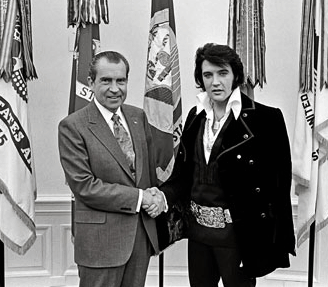
When Elvis Met Nixon

Peter Carlson in Smithsonian Magazine:

ScreenHunter_03 Nov. 27 12.01 Elvis was traveling with some guns and his collection of police badges, and he decided that what he really wanted was a badge from the federal Bureau of Narcotics and Dangerous Drugs back in Washington. “The narc badge represented some kind of ultimate power to him,” Priscilla Presley would write in her memoir, Elvis and Me. “With the federal narcotics badge, he [believed he] could legally enter any country both wearing guns and carrying any drugs he wished.”

After just one day in Los Angeles, Elvis asked Schilling to fly with him back to the capital. “He didn't say why,” Schilling recalls, “but I thought the badge might be part of the reason.”

On the red-eye to Washington, Elvis scribbled a letter to President Nixon. “Sir, I can and will be of any service that I can to help the country out,” he wrote. All he wanted in return was a federal agent's badge. “I would love to meet you,” he added, informing Nixon that he'd be staying at the Washington Hotel under the alias Jon Burrows. “I will be here for as long as it takes to get the credentials of a federal agent.”

After they landed, Elvis and Schilling took a limo to the White House, and Elvis dropped off his letter at an entrance gate at about 6:30 a.m. Once they checked in at their hotel, Elvis left for the offices of the Bureau of Narcotics and Dangerous Drugs. He got a meeting with a deputy director, but not approval for a bureau badge.

More here.

Christopher Hitchens 1-0 Tony Blair

Paul Harris in The Guardian:

ScreenHunter_02 Nov. 27 11.46 In theory it was not an event that should have created a stir: a philosophical debate on the moral merits of religion. In an age of reality TV drama and Hollywood blockbusters loaded with special effects it would seem hard to get the masses to flock to witness such an old-fashioned, high brow spectacle.

But when the two debaters are the world's most famous recent Roman Catholic convert in the shape of Tony Blair and the charismatic yet cancer-stricken sceptic Christopher Hitchens suddenly it becomes easier to sell tickets.

Two thousand seven hundred tickets to be precise. For that was the size of the crowd that packed the space age-looking Roy Thomson Hall in Toronto late last night to watch the two ideological foes – when it comes to religion – spar and trade verbal blows.

The occasion was part of the Munk Debate series, organised by the Aurea Foundation group, and the motion was simply: “Be it resolved, religion is a force for good in the world”.

Both men were unabashedly stalwart in their positions. Hitchens, one of the leading “new atheists” and author of the hit book God Is Not Great, slammed religion as nothing more than supernatural gobbledegook that caused untold misery throughout human history. “Once you assume a creator and a plan it make us subjects in a cruel experiment,” Hitchens said before causing widespread laughter by comparing God to “a kind of divine North Korea”.

More here.

Building Museums, and a Fresh Arab Identity

From The New York Times:

Abu ABU DHABI, United Arab Emirates — It is an audacious experiment: two small, oil-rich countries in the Middle East are using architecture and art to reshape their national identities virtually overnight, and in the process to redeem the tarnished image of Arabs abroad while showing the way toward a modern society within the boundaries of Islam. Here, on a barren island on the outskirts of Abu Dhabi, workers have dug the foundations for three colossal museums: an $800 million Frank Gehry-designed branch of the Guggenheim 12 times the size of its New York flagship; a half-billion-dollar outpost of the Louvre by Jean Nouvel; and a showcase for national history by Foster & Partners, the design for which was unveiled on Thursday. And plans are moving ahead for yet another museum, about maritime history, to be designed by Tadao Ando.

Museum-1-popup Nearly 200 miles across the Persian Gulf, Doha, the capital of Qatar, has been mapping out its own extravagant cultural vision. A Museum of Islamic Art, a bone-white I. M. Pei-designed temple, opened in 2008 and dazzled the international museum establishment. In December the government will open a museum of modern Arab art with a collection that spans the mid-19th-century to the present. Construction has just begun on a museum of Qatari history, also by Mr. Nouvel, and the design for a museum of Orientalist art by the Swiss firm Herzog & de Meuron is to be made public next year. To a critic traveling through the region, the speed at which museums are being built in Abu Dhabi — and the international brand names attached to some of them — conjured culture-flavored versions of the overwrought real-estate spectacles that famously shaped its fellow emirate, Dubai. By contrast, Doha’s vision seemed a more calculated attempt to find a balance between modernization and Islam.

More here.

Friday, November 26, 2010

The International Necronautical Society

Article_ins

5. The INS rejects the Enlightenment’s version of time: of time as progress, a line growing stronger and clearer as it runs from past to future. This version is tied into a narrative of transcendence: in the Hegelian system, of Aufhebung, in which thought and matter ascend to the realm of spirit as the projects of philosophy and art perfect themselves. Against this totalizing (we would say, totalitarian) idealist vision, we pit counter-Hegelians like Georges Bataille, who inverts this upward movement, miring spirit in the trough of base materialism. Or Joyce’s Stephen Dedalus, who, hearing the moronic poet Russel claim that “art has to reveal to us ideas, formless spiritual essences,” pictures Platonists crawling through Blake’s buttocks to eternity, and silently retorts: “Hold to the now, the here, through which all future plunges to the past.” 6. To phrase it in more directly political terms: the INS rejects the idea of the future, which is always the ultimate trump card of dominant socioeconomic narratives of progress. As our Chief Philosopher Simon Critchley has recently argued, the neoliberal versions of capitalism and democracy present themselves as an inevitability, a destiny to whom the future belongs. We resist this ideology of the future, in the name of the sheer radical potentiality of the past, and of the way the past can shape the creative impulses and imaginative landscape of the present. The future of thinking is its past, a thinking which turns its back on the future.

more from the INS at The Believer here.