
Category: Recommended Reading
Now For An Arab Economic Revolution
Saifedean Ammous in Project Syndicate:

But any examination of the protesters’ slogans and demands clearly indicates otherwise. The protests are much more about political and economic freedom than about material needs, reflecting a keen awareness that such needs are merely a symptom and consequence of the absence of political and economic freedom.
The dominant “handout approach” is not sustainable, and, if continued, would likely exacerbate the Arab world’s current economic malaise. Economic wealth cannot be created by government decree; it comes from productive jobs that create goods and services that people value.
Governments that hand out benefits are not making their citizens richer by generating new wealth; they are simply redistributing existing wealth. This also applies to government-created and guaranteed jobs: if a job is indeed productive, its output would be rewarded by other members of society who benefit from it, without the need for government subsidies and guarantees. The fact that government guarantees a job implies that its output is not wanted. Such jobs are a liability for society, not an asset.
As citizens start relying on redistribution, productive work is discouraged, and real wealth creation suffers. Economic rot sets in as the ranks of dependent citizens grow, productive citizens dwindle in number, and society eventually runs out of other people’s money.
More here.
remembering memory
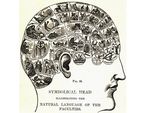
In his new book Moonwalking With Einstein (Penguin), Joshua Foer teaches us tricks to remember phone numbers, and even their owners’ names—at least until we have a chance to write them down on a matchbook. His book, misleadingly subtitled The Art and Science of Remembering Everything, deals mostly with a handful of well-established methods for remembering numbers and sequences of playing cards. It is nonetheless delightful. Foer meanders through a history of memory, from the oral traditions of the Greek bards to the thankfully-not-yet-realised merging of neurons and nanochips by way of the intermediate technologies: stone tablets, scrolls, manuscripts, printed books, indexed volumes, searchable electronic files, the Googlenet. With each new technology, our ability to outsource the functions of memory has grown. For information to be useful over the long term, it has to be both stored and retrievable. Marble slabs are pretty good for long-term storage—much less likely to be ruined by a wayward coffee cup than a CD-Rom—but not terribly searchable. The papyrus scrolls of the Greeks were at least more portable but they were WRITTENALLASSINGLEWORDINCAPSWITHOUTSPACESORPUNCTUATIONANDWITH RANDOMLINEBREAKSANDREALLYHARDTOREADLETALONESEARCH. Indexing allowed us to find information in a book without having read the whole thing, but we still had to keep enough data in our heads to tell us which books to look in. Now, most of us have freed up the space in our brains that was given over to phone numbers, appointments and train timetables by leaving the information on some electronic device or other and accessing it only when we need to. Soon, poetry, literature and even the historical performance of sports teams will go the same way.
more from Elizabeth Pisani at Prospect Magazine here.
A country on the edge of time

Belgrade’s motorists hit the accelerator hard but they’re not so heavy on their horns. They speed through the city, but they don’t hound the pedestrians. Then again, these two species barely come face to face in the city centre. The city fathers, as if possessed by the spirit of Corbusier, have rigidly separated the bipeds from the quadrupeds. On Brankova Street a line of cars snakes its way into a tunnel that passes under a tower-block to emerge in the maze of streets that comprises the city centre. At every other step there are passages for pedestrians to make their way between the concrete tower-blocks or tunnels under the roads. Everywhere in these ground-level and underground thoroughfares, small trade sprouts its luscious blooms; each pore of this unexpectedly gained public space is exploited. It takes a while for pedestrians to find their bearings after emerging from these artificial merchandise paradises. The streets of Belgrade are tortuous and winding. And not just the streets. “I publish a series with alternative Serbian authors,” says author Igor Marojevic, born in 1968. His punky hairstyle and T-shirt imprinted with “Boss” in skewered writing on the front somehow just refuse to fit in with the tastefully decorated rooms of the Serbian PEN centre in Terazije Street this morning. Which authors? “Sreten Ugricic for example,” says Marojevic, whose novel “Cut” investigates the Nazi past of Hugo Boss. “Sreten Ugricic, the director of the National Library, is an alternative author?” “Oh yes!” Vigorous nodding. Apparently quite a few things are different here in Serbia.
more from Jörg Plath at Sign and Sight here.
the arab street

With the recent wave of popular uprisings in the Middle East, Western observers have had the chance to face up to an important realization: that the oldest of clichés about Middle Eastern politics, “the Arab street,” is both a pernicious myth and a dynamic reality. For decades, Orientalist stereotypes about Arab culture and attitudes imbued this so-called street—a crude and monolithic metaphor for Arab public opinion and popular political sentiment—with almost uniformly negative connotations, which would then segue into dire warnings about the consequences of its eruption. Now the uprisings in Tunisia and Egypt and antigovernment protests in many other Arab states have demonstrated that the Arab street most certainly does exist—but it bears no resemblance to the bogeyman so long cultivated in the Western imagination. Western commentators supplemented their hand-wringing about the Arab street with anxiety about “our Arab allies,” generally autocrats whose rule was considered vital to American interests in the region: the maximization of US power and influence, the control and pricing of energy, Israeli security, and regional stability. It’s true, of course, that the future complexion of the Arab political landscape remains uncertain, but the character of the rebellions has already been the strongest possible refutation of this traditional calculus and the mythology that misinformed it.
more from Hussein Ibish at Bookforum here.
Tuesday Poem
Disappearing Act
No, soul doesn't leave the body.
My body is leaving my soul.
Tired of turning fried chicken and
coffee to muscle and excrement,
tried of secreting tears, wiping them,
tired of opening eyes on another day,
tired especially of that fleshy heart,
pumping, pumping. More,
that brain spinning nightmares.
Body prepares:
disconnect, unplug, erase.
But here, I think, a smallish altercation
arises.
Soul seems to shake its fist.
Wants brain? Claims dreams and nightmares?
Maintains a codicil bequeathes it shares?
There'll be a fight. A deadly struggle.
We know, of course, who'll win. . . .
But who's this, watching?
by Eleanor Ross Taylor
from Blackbird, Spring 2002
from Blackbird, Spring 2002
How quickly are you aging?
From Scientific American:

Two groups of prominent researchers have started companies to provide just such a test, which would measure the length of one’s telomeres. Telomeres are caps on the ends of chromosomes, protecting them much as plastic tips on the ends of shoelaces keep the laces from fraying. Whenever chromosomes—the storehouses of our genes—are replicated in preparation for cell division, their telomeres shorten. That shrinking has led many scientists to view telomere length as a marker of biological aging, a “molecular” clock ticking off the cell’s life span, as well as an indicator of overall health. Studies comparing the telomere length of white blood cells among groups of volunteers show distinct correlations between telomere length and lifestyle. Those who exercise regularly have longer telomeres than those who do not. Folks who perceive themselves as the most stressed have shorter telomeres than those who see themselves as the least. Certain diseases, too, correlate with shorter telomeres, including cardiovascular, obesity and Alzheimer’s.
More here.
Multitude of Species Face Climate Threat
Carl Zimmer in The New York Times:

The Berkeley scientists warn that their new study may actually grossly underestimate how many species could disappear. So far, humans have pushed species toward extinctions through means like hunting, overfishing and deforestation. Global warming, on the other hand, is only starting to make itself felt in the natural world. Many scientists expect that as the planet’s temperature rises, global warming could add even more devastation. “The current rate and magnitude of climate change are faster and more severe than many species have experienced in their evolutionary history,” said Anthony Barnosky, the lead author of the Nature study.
More here.
Monday, April 4, 2011
perceptions

Sunday, April 3, 2011
Five Ways of Looking at the Legend of Derek Jeter

1. The Book of Jeter
The time has come, once again, for everyone to think about Derek Jeter. Don’t try to fight it: it is time. Here in the spring of Jeter’s 17th season, as he begins to play out what should be the last of his giant contracts, as he prepares to become the first career-long Yankee to amass 3,000 hits, as he melts the snow across the Northeast with the warmth of his intangible clutchness and coaxes the fresh blades of grass (which he spent his entire off-season individually planting across America) out of the dark and loamy soil — it is only right that our thoughts should turn back to the Captain.
But how do we even begin to think about someone who has been so thoroughly thought about? Jeter has been, since the middle of the Clinton administration, the signature player on the signature franchise in America’s signature sport — a sport that doubles as national mythology. He is the meta-Yankee: his legendary glories help us to experience, firsthand, the legendary glories of previous generations of Yankees. He’s like a wormhole to the world of our grandparents. His entire career might as well have been broadcast in sepia.
Jeter’s mythology is, at this point, basically impenetrable. His public image is almost scandalously banal — as Buster Olney once put it, he is “Jimmy Stewart in pinstripes.” He’s like an after-school special about the Protestant work ethic. His every motion expresses the quiet dignity of champion champion dignity champion dignity champion. (Sorry: my word-processing software figured out that I was writing about Derek Jeter and started automatically filling in the text.)
Imperialism Reclaimed

Ferguson snazzily summarizes the reasons for this reversal in six “killer apps”: competition, science, property rights, medicine, the consumer society, and the work ethic. Against such tools – unique products of Western civilization – the rest had no chance. From such a perspective, imperialism, old and new, has been a beneficent influence, because it has been the means of spreading these “apps” to the rest of the world, thereby enabling them to enjoy the fruits of progress hitherto confined to a few Western countries.
Understandably, this thesis has not met with universal approbation. The historian Alex von Tunzelmann accused Ferguson of leaving out all of imperialism’s nasty bits: the Black War in Australia, the German genocide in Namibia, the Belgian exterminations in the Congo, the Amritsar Massacre, the Bengal Famine, the Irish potato famine, and much else.
But that is the weakest line of attack. Edward Gibbon once described history as being little better than a record of the “crimes, follies, and misfortunes of mankind.” Imperialism certainly added its quota to these. But the question is whether it also provided, through Hegel’s “cunning of reason,” the means to escape from them. Even Marx justified British rule in India on these grounds. Ferguson, too, can make a sound argument for such a proposition.
Foreign Aid for a Frugal Age

[Dean Karlan and Jacob Appel's] More Than Good Intentions builds off the behavioral economics ideas widely publicized in Nudge, the Richard Thaler/Cass Sunstein book that explains how people can be encouraged to make better decisions by a society that makes good decisions easier to reach than bad ones. (Prototypical example: Students eat more fresh fruit and vegetable sticks when they are put in an appealing display next to the cafeteria cash register.) But Karlan’s book combines a keen sense of the quirks of behavioral economics with an insistence on the rigorous scientific testing of international development programs, using random, controlled trials to see whether the programs improve people’s lives.
The first sections of the book are fascinating, if less cheerful than the rest, as they take the shine off a category of aid that has been a darling of the development sector: micro-credit. In 2006, the Nobel Peace Prize went to Bangladeshi economist Muhammad Yunus and the Grameen Bank, which Yunus created, for their work over three decades to, as the Norwegian Nobel Committee put it, “create economic and social development from below.”
“Lasting peace cannot be achieved,” the committee opined, “unless large population groups find ways in which to break out of poverty. Micro-credit is one such means.”
Micro-credit programs — which offer small-scale loans to people (often women) in developing countries who then start or expand small-scale businesses — have spread to reach some 155 million people. More Than Good Intentions does not conclude that the micro-credit movement is a failure, but through a series of studies Karlan does show that, as he put it in a recent phone conversation with me, micro-credit “is the poster child for programs that are oversold.” In random, controlled trials aimed at testing the efficacy of several micro-lending programs, he finds that there are, indeed, amazing success stories, people who have taken small loans and, through entrepreneurial skill and hard work, lifted themselves out of poverty. But the studies show that this result isn’t the most common, that — as anyone with much experience in the for-profit world might guess — a poor population in a developing nation with a rudimentary educational system is unlikely to contain a far higher percentage of brilliant entrepreneurs than the general population of a richer, better-educated country.
But More Than Good Intentions doesn’t debunk international development mythology just for the sake of debunking. It tries, instead, to find a middle way between continuing to invest billions of dollars in aid programs with long, sad histories of accomplishing little and giving up on development aid as inherently ineffective.
kinski is jesus
kinski butterfly
herzog reads waldo
Sunday Poem
Sean Pen Anti-ode
Must Sean Penn always look like he’s squeezing
the last drops out of a sponge and the sponge
is his face? Even the back of his head grimaces.
Just the pressure in his little finger alone
could kill a gorilla. Remember that kid
whose whole trick was forcing blood into his head
until he looked like the universe’s own cherry bomb
so he’d get the first whack at the piñata?
He’s grown up to straighten us all out
about weapons of mass destruction
but whatever you do, don’t ding his car door with yours.
Don’t ask about his girlfriend’s cat.
Somewhere a garbage truck beeps backing up
and in these circumstances counts as a triumph of sanity.
Sleet in the face, no toilet paper,
regrets over an argument, not investing wisely,
internment of the crazy mother, mistreatment
of laboratory animals.
Life, my friends, is ordinary crap.
Pineapple slices on tutu-wearing toothpicks.
Those puke bags in the seatback you might need.
The second DVD only the witlessly bored watch.
Some architectural details about Batman’s cape.
Music videos about hairdos, tattoos, implants and bling.
The crew cracking up over some actor’s flub.
by Dean Young
from Poetry, Vol. 188, No. 4, July/August
Publisher: Poetry, Chicago, © 2006
from Poetry, Vol. 188, No. 4, July/August
Publisher: Poetry, Chicago, © 2006
Natural history of the soul
From New Humanist:
![Nick[1]](/wp-content/legacy/6a00d8341c562c53ef014e6059325c970c-200wi "Nick[1]")
His solution to both these problems is the same, because for him the strange properties of consciousness, the fact that for those of us that have it the world of dull matter is suffused with meaning, beauty, relevance and awe – means that it makes sense to think that we are permanent inhabitants of a “soul-niche” or “soul-world”. As the jacket blurb of his book has it, “consciousness paves the way for spirituality”, by creating a “self-made show” that “lights up the world for us, making us feel special and transcendent.” Consciousness and the soul are one and the same.
More here.
I’ve Seen Every Woody Allen Movie: Here’s what I’ve learned
From Slate:

This nameless woman seems to articulate Allen's world view exactly. (After the 2009 release of Whatever Works, he told NPR that filmmaking “distracts me from the uncertainty of life, the inevitability of aging and death and death of loved ones; mass killings and starvation, from holocausts—not just man-made carnage, but the existential position you're in.” Inspiring!) But in Play It Again, Sam, we're clearly meant to find her approach ridiculous. The depressive despairs: Because there is “nothing,” she longs to return to that state. Felix, by contrast, moves forward blithely: If existence is lonely and hideous, why not go out on Saturday? Or Friday, whatever, he's not busy. By letting Felix win the volley, Allen also endorses his protagonist's resigned epicurean sensibility.
More here.
Dhoni leads India to World Cup glory
From CNN:

Dhoni, the world's highest-paid player, produced his best performance of the six-week-long event when it mattered most as India passed Sri Lanka's total of 274-6 with 10 balls of the allotted 50 overs to spare.
The 29-year-old smashed the winning runs with a huge six over the boundary ropes to finish the innings unbeaten on 91 off only 79 balls faced.
He set up victory with his fourth-wicket partnership of 109 with Gautam Gambhir, who top-scored with an invaluable 97, after coming to the batting crease at 114-3 in the 22nd over.
Sri Lanka, winners of the tournament in 1996 and runners-up in the last staging four years ago, set a potentially testing target for India thanks to an unbeaten 103 from captain Mahela Jayawardene.
With the victory, India — the top-ranked team in cricket's five-day Test format — assumed the No. 1 position in the limited-overs game ahead of previous champions Australia.
More here. [Photo shows Sachin Tendulkar.]
Reconsidering the Goldstone Report on Israel and war crimes
Richard Goldstone in the Washington Post:
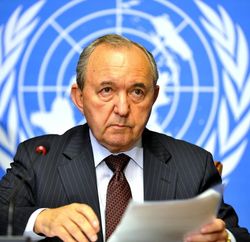
The final report by the U.N. committee of independent experts — chaired by former New York judge Mary McGowan Davis — that followed up on the recommendations of the Goldstone Report has found that “Israel has dedicated significant resources to investigate over 400 allegations of operational misconduct in Gaza” while “the de facto authorities (i.e., Hamas) have not conducted any investigations into the launching of rocket and mortar attacks against Israel.”
Our report found evidence of potential war crimes and “possibly crimes against humanity” by both Israel and Hamas. That the crimes allegedly committed by Hamas were intentional goes without saying — its rockets were purposefully and indiscriminately aimed at civilian targets.
More here.