Jacqueline de Romilly (1913-2010)

ROMILLY-obit-articleInline

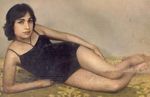
Jacqueline de Romilly, one of France’s leading scholars of Greek civilization and language and only the second woman to be elected to the Académie Française, died on Saturday in the Paris suburb Boulogne-Billancourt. She was 97. Her death was confirmed by Dr. Philippe Rodet, a friend. Ms. de Romilly, who in 1973 became the first woman named a professor at the Collège de France, embraced the culture of ancient Athens with an almost romantic fervor and spent much of her life championing the humanities, in particular Greek and Latin, whose waning role in the French education system distressed her greatly. Although known as a specialist on the historian Thucydides and the Peloponnesian War, she wrote dozens of books on philosophy and political thought in ancient Greece, on the tragedians Aeschylus and Sophocles, and on Homer.

more from William Grimes at the NYT here.

Why Edward Hopper puzzles

Our own Morgan Meis in The Smart Set:

A woman sits on the bed with her back to us. She is heavily involved in the process of what looks to be the sewing of a dress. Her hair is parted in the middle and falling down forward as she concentrates. She has become one with the simple task she is performing. That kind of thing happens to all of us every day. And there it is on the canvas.

ID_IC_MEIS_HOPPE_AP_001

In “Soir Bleu,” Hopper goes too far, he shows too much. He is hitting us over the head with the idea that the clown, with his outwardly clowny appearance, is actually hiding a lonesome and troubled man. It is just plain dumb. But “New York Interior” gives us a woman wrapped up in the process of acting and doing and thinking and dreaming all at once. We don't even have the faintest glimpse of what could be going on in her head, where her thoughts have wandered as she sews her dress. But we know that she is going somewhere, mentally, that her thoughts are wandering. It is in her gesture, in the absent-minded way she pulls the thread. We know that there is an entire universe of interiority unfolding within that person as she does what she does. We can see it because Hopper has so perfectly captured her in that moment of hiddenness without bursting the shell, without rupturing that thin but impenetrable membrane between the inner and outer. “New York Interior” is dangerously close to being a sappy and sentimental study of a lonely young woman. It is a great painting because it hovers so very close to being a cliché without ever crossing that line.

More here.

Thursday Poem

Aristotle

This is the beginning.

Almost anything can happen.
This is where you find
the creation of light, a fish wriggling onto land,
the first word of Paradise Lost on an empty page.
Think of an egg, the letter A,
a woman ironing on a bare stage as the heavy curtain rises.
This is the very beginning.
The first-person narrator introduces himself,
tells us about his lineage.
The mezzo-soprano stands in the wings.
Here the climbers are studying a map
or pulling on their long woolen socks.
This is early on, years before the Ark, dawn.
The profile of an animal is being smeared
on the wall of a cave,
and you have not yet learned to crawl.
This is the opening, the gambit,
a pawn moving forward an inch.
This is your first night with her, your first night without her.
This is the first part
where the wheels begin to turn,
where the elevator begins its ascent,
before the doors lurch apart.

Read more »

Nikesh Shukla’s top 10 Anglo-Asian books

From The Guardian:

The-Black-Album-007 1. Hanif Kureishi – The Black Album

While The Buddha of Suburbia is a masterfully comic tale of rise and fall that loves its characters, there's something a lot more sinister about The Black Album, making it the oddball in his output. It seems to foreshadow works like Four Lions, City of Tiny Lights and even the forthcoming Ours Are the Streets by decades, and is written with the energy and exuberance of Kureishi's early work, embodied by the raw funk of Prince's eponymous album, and the dizzying chemical overload of the ectasy that fills the rave scenes. It charts clean-cut Shahid's trip into hedonism and flirtations with fundamentalism with eerie prescience, and its take on the classic Anglo-Asian identity crisis tale throws a cleancut, sheltered lad in at the deep end of a naked rave party.

More here.

Dead or Alive? The Eyes Hold the Answer

From Science:

Faces With its technologically advanced animated characters, the 2004 film The Polar Express was supposed to change moviemaking. Instead, it gave audiences the creeps. Reviewers dissed it as “the night of the living dead.” Why didn't the audience perceive the characters as alive? Something, they said, was wrong with the eyes.

Now, a new study shows just how important the eyes really are when we judge whether a face is that of a living person or an inanimate object. And that ability, the researchers say, is key to our survival, enabling us to quickly determine whether the eyes we're looking at have a mind behind them. “People want to see faces, and we're very adept at seeing faces everywhere: in clouds, a burnt piece of toast, even two dots and a line,” says Christine Looser, a Ph.D. candidate in psychology at Dartmouth College and the study's lead author. “And it makes sense to be aware of faces,” because they might be those of living, dangerous creatures, such as a grizzly bear. “But we also don't want to waste time on faces that aren't alive, that aren't attached to minds.”

More here.

Wednesday, December 22, 2010

Edible Advice

468S10a-f2.2 Farooq Ahmed in Nature:

Too much tea can treble cancer risk in women'. 'Tea could cut risk of ovarian cancer'. Just two examples of the frequent contradictory newspaper headlines that confuse the public about the health benefits — or risks — of food and confound genuine nutrition-related research.

For some diseases such as diabetes the link with food is subtle. “Although we know that dietary factors are related to the risk of diabetes, there are a lot of inconsistencies between studies in terms of what precise micronutrients or macronutrients associate with the disease. We're quite limited in terms of the data,” explains Nick Wareham, head of the epidemiology unit at the UK's Medical Research Council.

Using new tools and methodologies, ambitious projects are underway to make up this shortfall. One such effort, which Wareham coordinates, is InterAct — a multinational study to define how diet and lifestyle influence risk of type 2 diabetes. This disorder of blood glucose regulation is a growing problem in Europe, afflicting nearly 40% of the population at some point in their lifetime. InterAct estimates that the diabetes accounts for as much as 10% of health care costs in Europe.

Through endeavours such as InterAct, researchers are starting to expose the complex interplay of genetics, diet and disease, and bring order to the confusing array of nutritional information.

InterAct began in 2006 as part of the European Community's sixth Framework Programme. It has a budget of euro10 million and involves more than 12,000 patients recently diagnosed with diabetes across 10 countries — nine in Europe plus India. Such a broad cohort is important. “Sometimes variation within a country is not so great,” says Wareham. “International efforts give you heterogeneity in the lifestyles of patients, especially in the diet, and that's a major advantage.” This diversity provides scientists with more variables to study as they attempt to untangle what factors are responsible for causing disease.

Newsprint and Transcendence: Alberto Giacometti vs. the Horrors of the Media Circus.

KeelerVanGogh_0 Jed Perl in The New Republic:

There were wonders to be discovered in New York on a recent cold, clear, brilliant December day. Eykyn Maclean, an elegant new gallery with space on two floors of a narrow building on East 67th Street, had mounted an exhibition of work by Alberto Giacometti. While there was a great deal of sculpture and much else to see, what I found myself thinking about was Giacometti’s curious habit of drawing on the pages of books or on newspapers and magazines, effacing an author’s words or journalism’s daily dose of reality with his masterful renderings of figures and faces. Something in the tidal wave of unmediated information in which we live today—the sense of words and images as detached from reasoned meanings in our crazily wired and Wikileaked moment—has set me to wondering about Giacometti’s willful obscuring or at least partial obscuring of words and images in some of his drawings. There can be something strangely illiberal—something almost demagogic—in the surfeit of information and pseudo-information we are grappling with now. Liberalism must be grounded in distinctions and discriminations, and the other day I found myself wondering if Giacometti’s habit of drawing over and around texts and images was in fact animated by a desire to make certain kinds of judgments, to explore the relative value of various kinds of experience.

Surely Giacometti—friend of Beckett, Genet, Sartre, Leiris, Crevel, and many other writers—was sensitive to the weight of words. So what do we make of the counterpoint he creates as he works his virtuosic lines against blocks of prose? Is he defacing the text or somehow celebrating it? Or are both impulses involved? When Giacometti copies a self-portrait by van Gogh in blue ink on the text page facing the reproduction in John Rewald’s history of Postimpressionism, my first impulse is to see this as nothing more than Giacometti’s spontaneous response to van Gogh. He’s drawing on the paper that is most immediately available, which means that he’s drawing over Rewald’s text. Now I am beginning to wonder if there is not something more going on. I would not be surprised if Giacometti admired Rewald’s writing, so perhaps when he draws over Rewald’s text he’s suggesting a competition between the interpretive arts, writing and drawing as parallel means of responding to the Dutch artist’s achievement. Through the lacework of Giacometti’s drawing, Rewald’s text can still be read. Word and image become two competing forms of knowledge, a modern-day version of the contests between the arts so beloved of the masters of the Renaissance and the Baroque.

Another case of early human interbreeding confirmed in Siberia

John Timmer in ars technica:

ScreenHunter_02 Dec. 22 21.03 It's been a busy year in research on recent human ancestry. Back in the spring, scientists completed a draft of the Neanderthal genome, which provided clear evidence that these now-extinct humans left some of their genes behind by interbreeding with some human ancestors. A bit earlier in the year, DNA sequencing revealed an even larger surprise: there seems to have been another population of premodern humans present in Asia that were genetically distinct from modern humans and Neanderthals. Now, the team behind both of these discoveries is back with a draft genome of this population that suggests it was genetically distinct from both humans and Neanderthals, and a single tooth that suggests it was physically distinct. And that it also interbred with the ancestors of a modern human population.

The new population was identified based on sequence from a single bone found in a cave called Denisova. Sequencing the genome of its mitochondria indicated it had branched off from the ancestor of both humans and Neanderthals roughly a million years ago, making it a relatively archaic lineage. But mitochondrial DNA is prone to rapid sequence changes as well as founder and bottleneck effects, which could exaggerate the divergence. The bone it came from didn't differ significantly from either of these human populations, meaning there was no physical indication that the Denisova remains represented a new population.

In the new paper, which will be published in Nature, the researchers have gone back and corrected both of these issues.

More here. [Thanks to Omar Ali.]

Why Religious People Are Scared of Atheists

Greta Christina in AlterNet:

ScreenHunter_01 Dec. 22 20.52 If you follow the atheism debates in op-ed pieces and whatnot, you'll see that critiques of the so-called New Atheist movement are often aimed at our tone. Among the pundits and opinion-makers, atheist writers and activists are typically called out for being offensive, intolerant, disrespectful, extremist, hostile, confrontational, and just generally asshats. The question of whether atheists are, you know, right, typically gets sidestepped in favor of what is apparently the much more compelling question of whether atheists are jerks. And if these op-ed pieces and whatnot were all you knew about the atheist movement and the critiques of it, you might think that atheists were simply being asked to be reasonable, civil, and polite.

But if you follow atheism in the news, you begin to see a very different story.

You begin to see that atheists are regularly criticized — vilified, even — simply for existing.

Or, to be more accurate, for existing in the open. For declining to hide our atheism. For coming out.

Case in point: In Bryan/ College Station, Texas, the Brazos Valley Vuvuzela Atheist Marching Band recently marched in the annual Christmas parade. Now, let's be very clear about this: The 18-person marching band didn't march with signs saying “Fuck Your Religion,” or “You Know It's A Myth,” or even “There's Probably No God — Now Stop Worrying and Enjoy Your Life.” They wished people a merry Christmas, and a happy Hanukkah, and a merry Kwanzaa. They played “Jingle Bells” on vuvuzelas. And they carried a banner saying they were atheists.

Which was enough, apparently, to send many Christians into fits.

More here.

The bedbug: To accept him is to be free

ID_PI_GOLBE_BEDBU_AP_001

Insects are so often featured characters in children’s stories because they, like children, appear to adults as simultaneously fragile and invincible. Though most of us prefer the children to the insects, we recognize in both a tendency toward chaos. We want to control that chaos, but are often overcome by it in the process. We sometimes say about the insects that if they would only let us be, their existence would not vex us. That is, if they didn’t insist on reminding us of their existence, we wouldn’t insist on destroying them. This is the logic of xenophobia. In the classic essay “Men versus Insects,” Bertrand Russell wrote that if humans beings, in their rage against each other, invoke the aid of the insects and microorganisms, it is likely the insects will be the “sole ultimate victors”. He was writing in 1933 about the somewhat new idea of using bugs as weapons of mass destruction. Yet we don’t really need a war zone to see how humans use bugs against each other to satisfy their daily fears. Just go to any public place in New York City today and yell, “Bedbug.” Indeed, the ones who will be damaged the least, the sole ultimate victors, are the bedbugs themselves. “Perhaps,” writes Russell, “from a cosmic point of view, this is not to be regretted, but as a human being, I cannot help heaving a sigh for my own species.”

more from Stefany Anne Golberg at The Smart Set here.

sneaky unpretentiousness

Frost

About Robert Frost, it should be borne in mind that he was fashioning his distinctive style and voice long after Walt Whitman’s “barbaric yawp” had sounded to raze the old structures of meter and rhyme, when poets like Robinson Jeffers, say, were building up from that rubble. Perhaps partly for this reason, the several neat rows of poems Frost left behind look now, in posterity, to be weathering well, some maybe tilting in the turf these days, but deeply inscribed with a traditional, formal simplicity to keep them legible through many more ages’ storms of fashion. Frost always did say it was his goal “just to lodge a few poems where they’ll be hard to get rid of,” and in that effort he apparently sacrificed innovation. (If he was tempted at all by innovation.) Right up until his death in 1962, he went on offering out the same four trusty iambs, mostly—or sometimes three iambs, sometimes five—while the world’s podiums were occupied by such free-verse innovators as T. S. Eliot and Wallace Stevens and even the first raiding parties of so-called “Beats.” All these phenomena Frost ignored or openly deplored. Wallace Stevens he called “the bric-a-brac poet.” Eliot he snubbed most churlishly on a number of awkward public occasions, always in the face of Eliot’s more debonair grace and forgiveness. He met with Pound in London before he’d ever published a book, and the great mentor did try to educate him in the new manner, though it didn’t stick.

more from Louis B. Jones at the Threepenny Review here.

an autobiographical game creator

101220_r20334_p465

When Shigeru Miyamoto was a child, he didn’t really have any toys, so he made his own, out of wood and string. He put on performances with homemade puppets and made cartoon flip-books. He pretended that there were magical realms hidden behind the sliding shoji screens in his family’s little house. There was no television. His parents were of modest means but hardly poor. This was in the late nineteen-fifties and early nineteen-sixties, in the rural village of Sonobe, about thirty miles northwest of Kyoto, in a river valley surrounded by wooded mountains. As he got older, he wandered farther afield, on foot or by bike. He explored a bamboo forest behind the town’s ancient Shinto shrine and bushwhacked through the cedars and pines on a small mountain near the junior high school. One day, when he was seven or eight, he came across a hole in the ground. He peered inside and saw nothing but darkness. He came back the next day with a lantern and shimmied through the hole and found himself in a small cavern. He could see that passageways led to other chambers. Over the summer, he kept returning to the cave to marvel at the dance of the shadows on the walls. Miyamoto has told variations on the cave story a few times over the years, in order to emphasize the extent to which he was surrounded by nature, as a child, and also to claim his youthful explorations as a source of his aptitude and enthusiasm for inventing and designing video games. The cave has become a misty but indispensable part of his legend, to Miyamoto what the cherry tree was to George Washington, or what LSD is to Steve Jobs. It is also a prototype, an analogue, and an apology—an illuminating and propitious way to consider his games, or, for that matter, anyone else’s.

more from Nick Paumgarten at The New Yorker here.

Wednesday Poem

House

Up the white road through the olive groves,
past the stretched red string, plumb line for the mason.

At the last bend below the high-tension wires
a three-coned trullo someone has let go.

No lights inside―shuttered windows turn back the stars.
Just as in her last year my mother’s eyes flattened.

Her starlessness caught in the camera at the registry of motor vehicles.
Record of her letting go.

Our guide tells us, “In Puglia, olive trees and stone.”
(And so, white faces peek from shadows.)

In my mind I have made this house my mother.
I have opened her gate; righted her tumbled walls;

painted the petroglyph for Joy on every cone.
What we do not see we cannot change.

by Miriam On'Neal
from Blackbird, Spring 2010

The Bed of Procrustes by Nassim Nicholas Taleb

From The Guardian:

Digested-read-The-Bed-of--007 Procrustes, in Greek myth, was the cruel owner of an estate in Attica who abducted travellers and cut off their heads to ensure they fitted his bed perfectly. Every aphorism here is about a Procrustean bed of sorts: faced with the imperfection of the unknown and the unobserved, we humans tend to backfit the world into reductive categories such that only someone of my immense intellect is able to point out the inherent futility of modern life. Since aphorisms lose their charm whenever explained – especially when they are as banal as the ones that follow – I pompously relegate further discussion to the postface, though they all revolve around matters more deeply dealt with in my extremely significant and influential book, The Black Swan.

▶ If your anger decreases with time, you did injustice: If it increases, you suffered injustice.

▶ The opposite of manliness isn't cowardice; it's technology.

▶ Most of what they call humility is successfully disguised arrogance.

▶ The more a writer thinks himself to be serious, the less serious his writing becomes.

▶ A man who is labelled a guru for his last book, will think himself a philosopher in the next.

▶ You can be once, twice, three times a lady; but only once a man.

▶ People used to wear ordinary clothes weekdays and formal attire on Sunday. Today it is the exact reverse.

More here.

Group IQ

From The Boston Globe:

GroupIQ1__1292697415_5596 For a century, people have been devising tests that aim to capture a person’s mental abilities in a score, whether it is an IQ test or the SAT. In just an hour or an afternoon, a slate of multiple choice questions or visual puzzles helps sift out the superstars — people whose critical thinking skills suggest they have potent intellectual abilities that could one day help solve real-world problems. But separating the spectacularly bright from the merely average may not be quite as important as everyone believes. A striking study led by an MIT Sloan School of Management professor shows that teams of people display a collective intelligence that has surprisingly little to do with the intelligence of the team’s individual members. Group intelligence, the researchers discovered, is not strongly tied to either the average intelligence of the members or the team’s smartest member. And this collective intelligence was more than just an arbitrary score: When the group grappled with a complex task, the researchers found it was an excellent predictor of how well the team performed.

More here.

Tuesday, December 21, 2010

The Winners of the 3 Quarks Daily 2010 Politics Prize

Top_2010_politics_Lapham_19th Politics_160_winner1 Politics-winner-2010

Lewis H. Lapham has picked the three winners:

  1. Top Quark, $1000: Stephen Walt, Why America is going to regret the Cordoba House controversy
  2. Strange Quark, $300: Huffington Post, The Two Most Essential, Abhorrent, Intolerable Lies Of George W. Bush's Memoir
  3. Charm Quark, $200: The Philosopher's Beard, Politics: Can't Someone Else Do It?

Here is what Mr. Lapham had to say about them:

As an editor, I take seriously the craft of writing. The political blog at its best accounts for the editorial process—for the checking of facts as well as the redrafting of manuscripts; the political blog at its worst disregards even the semblance of considered judgment, leaving the internet user to portion out the wheat of informed opinion from the chaff of paranoid rant. The readers and editors of 3QD nominated more than forty pieces of internet writing, then narrowed the field by a public vote to nine finalists. I cannot say these are the best pieces of political blog writing on the internet, but they are representative of the impassioned rhetoric that has engulfed the public political discourse.

In accordance with the rules of the 3QD political prize, I have chosen three entries that exemplify the spirit of the times.

1st Place: “Why America is Going to Regret the Cordoba House Controversy” by Stephen M. Walt

A measured, thoughtful response to the religious intolerance that surrounded the “mosque” at ground zero.

2nd Place: “The Two Most Essential, Abhorrent, Intolerable Lies of George W. Bush's Memoir” by Dan Froomkin

This post uses the publication of George Bush's memoir Decision Points as the occasion to reexamine the Bush years and remind us of the facts embedded in the history of his presidency.

3rd Place: “Politics: Can't Someone Else Do It?” by Thomas Rodham

A philosophical look at the constraints imposed upon liberal politicians during their terms in office. They expect too much from their time in government and their constituents expect too much from them.

Congratulations also from 3QD to the winners (I will send the prize money later today–and remember, you must claim the money within one month from today–just send me an email). And feel free to leave your acceptance speech as a comment here! And thanks to everyone who participated. Thanks also, of course, to Lewis Lapham for doing the final judging.

The three prize logos at the top of this post were designed, respectively, by Sughra Raza, Carla Goller, and me. I hope the winners will display them with pride on their own blogs!

Details about the prize here.

Endgame Capitalism

9780415246552Nathan Schneider interviews Simon During over at The Immanent Frame:

NS: Why is capitalism the focal point of your recent book? And what about capitalism is “postsecular”?

SD: Can I begin with the “postsecular”? It’s a rather confusing term. Mainly it points to a ceasefire—or, anyway, a slowdown—in the long battle between secular reason and religion. That’s ultimately what it implies in the recent work of Habermas, for instance. And that’s also what it means in the kind of intellectual history that uncovers the religious prehistory of secular concepts. But I suspect such work can usually be understood as secularism proceeding under the flag of its own decease. I am more interested in two other possibilities that occur when we think about a zone that is neither secular nor non-secular. The first appears when the limits of the (secular) world become apparent in everyday or mundane life, outside of religion. The second appears when we are compelled to radical leaps of faith—again, outside religion.

Both of these have a direct relation to democratic state capitalism. That’s because democracy and capitalism have each become compulsory and fundamental. They ground everything we do, including religious practice—so we can only get outside them through the kind of postsecular leap of faith that I am talking about. That realization is one of the things that is important about Alain Badiou’s thought. Such leaps may also be relevant to situations in which we encounter secularism’s limits—when secularism can’t contain the ethical and epistemological demands we make of it.

NS: Why can’t secularism itself contain leaps of faith? Why do we need to move past it, to the postsecular?

SD: Of course, there are all kinds of secular leaps of faith. But the will to get outside democratic state capitalism requires something else. It’s true that secular reason is useful in adjudicating upon the current system. You can at least attempt to measure its benefits—the joys, capacities, wealth, and opportunities that it does indeed provide us, and the way that it makes so much seem “interesting,” for instance—against the insecurities, inequalities, restrictions, and controls that it also imposes.

Waking

Kalidasa_sm Kalidasa in the 4th or 5th century C.E. (translated by W. S. Merwin & J. Moussaieff Masson):

Even the man who is happy
glimpses something
or a hair of sound touches him

and his heart overflows with a longing
he does not recognize

then it must be that he is remembering
in a place out of reach
shapes he has loved

in a life before this

the print of them still there in him waiting

Of Course the Civil War Was About Slavery

Mmw_succession Emily Badger in Miller-McCune:

The Sons of Confederate Veterans are holding a gala this week in Charleston, S.C., a hundred-dollar-a-ticket affair celebrating the state’s secession from the Union 150 years ago. It’s the first of countless commemorations planned for the coming four years — lectures, conferences, parades, re-enactments, museum exhibitions and government proclamations — to mark the sesquicentennial of the Civil War.

The Charleston “Secession Ball” — advertised as “an event of a lifetime” — includes a theatrical re-enactment of the signing of the Ordinance of Secession (the original version of which will be on display), as well as dinner and a dance.

“We’re celebrating that those 170 people risked their lives and fortunes to stand for what they believed in, which is self-government,” one of the event’s organizers told The New York Times. “Many people in the South still believe that is a just and honorable cause.”

“Of course, when South Carolina did secede, there was enormous celebration, dancing in the streets and so on,” said James McPherson, a Princeton Civil War historian and author of the Pulitzer Prize-winning history Battle Cry of Freedom.

But something about the Charleston event of 2010 strikes an odd tone.

“They didn’t know what was going to happen to them,” McPherson said of the original revelers. “Now we do know what happened to them, and maybe a celebratory note is not very appropriate.”

Scholars today are mostly of one mind about why South Carolina seceded and what caused the war. But Americans, even a century and a half later, still deeply disagree with each other and historians, many of them embracing a Civil War story about self-government and “states’ rights” that reveals more about America in 2010 than what actually occurred in the 1860s.