81 Minutes With Mike Tyson

Geoffrey Gray in New York Magazine:
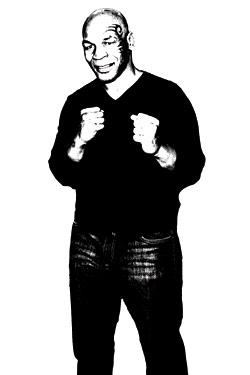
Encounter110314_250 Mike Tyson walks into the Ringside Lounge in Jersey City. It’s late afternoon on a Wednesday but feels after-hours inside the bar. A pink neon light faintly streaks the walls, which are covered with Tyson photos, and the ceiling, which drips with Mylar streamers. The music is loud. A birthday posse, four women, already drunk, shimmy around their stools as if they were stripper poles.

“What’s the food situation?” Tyson asks the proprietor. “I’m famished.”

The house specialty is pork chops.

“You have rice?” Tyson asks. “Yellow rice? And carrots?”

“So mixed vegetables. Sautéed onions, Mike?

“No onions.”

“And what to drink, Mike? Tea?”

“Chamomile.”

It’s an unexpected order from the former most feared man on the planet, but it’s what his new diet dictates. After retiring from boxing, Tyson struggled with drug addiction. He wasn’t exercising, and he got so fat he thought his heart might explode. For more than a year now, he’s been vegan. He claims to have lost over a hundred pounds.

More here.
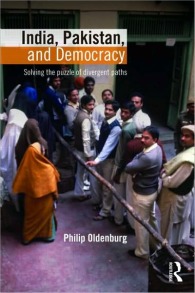
Why India Is Democratic and Pakistan Is Not

Christophe Jaffrelot in Foreign Affairs:

Indiapakistananddemocracy195 Since 1995, when the historian Ayesha Jalal's pathbreaking and controversial book Democracy and Authoritarianism in South Asia was published, there has been no serious study comparing the political trajectories of India and Pakistan. Those who have tried to fill this gap have succumbed to the temptation of attributing India's democracy to Hinduism and Pakistan's autocracy to Islam — a reductionist and not particularly productive approach, since religion is usually only secondary in explaining political trajectories, whether it is Indonesia's democratization or Sri Lanka's march to dictatorship. In the remarkable India, Pakistan, and Democracy, Philip Oldenburg, a research scholar at Columbia University, is wise enough not to resort to such sociocultural explanations. Instead, he examines historical, political, sociological, cultural, and external factors to explain the reasons why India and Pakistan diverged.

Oldenburg is quick to dispel some common misunderstandings about India and Pakistan, the first being that they had similar experiences during the colonial era. In the late nineteenth and early twentieth centuries, the British began gradually devolving power to local authorities in several provinces across India. They did not pursue such reform very far in the North-West Frontier Province and Punjab, two provinces that would make up the bulk of Pakistan after the 1947 partition. Both territories were important military recruitment grounds for the Raj and were located along its restive western frontier, where devolution was considered a security threat. Whereas several of the provinces India inherited from the Raj had experience with some democracy, Pakistan inherited two highly militarized provinces with no such background, laying the groundwork for the country's military-bureaucratic ethos. Even more, India was born with an intact bureaucratic apparatus in Delhi, whereas Pakistan had to build an entire government in 1947 under a state of emergency.

More here.

what hitch doesn’t see at the revolution

Hitchens

When anatomizing revolutions, it always pays to consult the whiskered old veterans. Those trying to master a new language, wrote Karl Marx about the turmoil in France in the 19th century, invariably begin haltingly, by translating it back into the familiar tongue they already know. And with his colleague Friedrich Engels he defined a revolution as the midwife by whom the new society is born from the body of the old. Surveying the seismic-looking events in Tunis and Cairo in January and February of this year, various observers immediately began by comparing them to discrepant precedents. Was this the fall of the Arab world’s Berlin Wall? Or was it, perhaps, more like the “people power” movements in Asia in the mid-1980s? The example of Latin America, with its overdue but rapid escape from military rule in the past decades, was also mentioned. Those with longer memories had fond recollections of the bloodless “red carnation” revolution in Portugal, in 1974: a beautiful fiesta of democracy which also helped to inaugurate Spain’s emancipation from four decades in the shadow of General Franco. I was a small-time eyewitness to those “bliss was it in that dawn” episodes, having been in Lisbon in 1974, South Korea in 1985, Czechoslovakia in 1988, Hungary and Romania in 1989, and Chile and Poland and Spain at various points along the transition. I also watched some of the early stages of the historic eruption in South Africa. And in Egypt, alas—except for the common factor of human spontaneity and irrepressible dignity, what Saul Bellow called the “universal eligibility to be noble”—I can’t find any parallels, models, or precedents at all.

more from Christopher Hitchens at Vanity Fair here.

not Poet of the mundane

William-eggleston-superstar.5808226.40

“Poet of the mundane.” That’s what the LACMA press material calls photographer William Eggleston, and that’s how “the Eggleston legend” usually goes: Reclusive Southern gentleman, a soft-spoken, polite savant out of the pages of Eudora Welty or William Faulkner, turns his camera on the neglected vistas of Memphis and environs and in the process makes color photography safe for museums. It’s a neat legend, one that is readily available to anyone trying to describe the genius of Eggleston’s photographs, and one that has helped Eggleston craft his public persona to this day. But the Eggleston legend, that shorthand way of describing his considerable achievement, papers over all the delicious contradictions that define the photographer’s unique journey. That journey has been on display at LACMA for a couple of months as “William Eggleston: Democratic Camera, Photographs and Video, 1961-2008.” You have only two weeks left to experience it, and you most certainly should. But this “poet of the mundane” business can be reductive and, in a sense, limits a complex appreciation of the photographer’s craft.

more from Gustavo Turner at the LA Weekly here.

OUR KILLER APPLICATIONS

Dikotter_03_11

On 4 October 1957 a shiny steel sphere the size of a beach ball hurtled through the sky, emitting signals picked up by radio operators around the world. Taking the United States completely by surprise, the Soviet Union had successfully launched the world’s first earth satellite, opening a new chapter in the space race that was met with both awe and fear. A month later Nikita Khrushchev promised that, by freeing the economy from the dead hand of Stalinism, he would create such abundance that even the United States would be left in the dust. The claims now seem extravagant, but at the time the spectre of a rising Soviet Union seemed real enough. In the mid-1970s American visitors walking through the major cities of Siberia were taken aback by downtowns that were made to appear every bit as modern as their counterparts back home. Yet by the time the Soviet Union came crashing down a decade or so later, the perceived threat to the West had already been transposed to the East. Glittering Japan was the future. Bankers predicted that a rising empire of the sun would soon supplant the United States as the world’s leading economy. Distinguished academics such as the French sociologist Jean Baudrillard wondered whether Japan had a different model from the West, its citizens cells of an organic whole that stifled open dissent. On a more popular level, Michael Crichton’s Rising Sun imagined a ruthless corporate world headquartered in Tokyo taking over American industries. By the time the book was published in 1992, Japan had already fallen into a decade of slump. Niall Ferguson is not quite sure when and where he was hit by the realisation that we are living through the end of 500 years of Western ascendancy, but he believes it may have been during his first walk along the Bund in Shanghai in 2005, dazzled by modern skyscrapers far taller than the erstwhile symbols of Western hegemony.

more from Frank Dikötter at Literary Review here.

Elephants Can Lend a Helping Trunk

From Science:

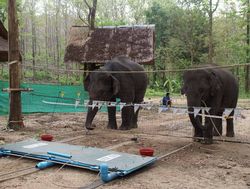
Elephants Elephants know when they need a helping hand—or rather, trunk. That's the conclusion of a new study that tested the cooperative skills of Asian elephants (Elephas maximus) in Thailand and showed that the pachyderms understand that they will fail at a task without a partner's assistance. The ability to recognize that you sometimes need a little help from your friends is a sign of higher social cognition, psychologists say, and is rarely found in other species. Elephants now join an elite club of social cooperators: chimpanzees, hyenas, rooks, and humans.

To test the elephants' cooperation skills, a team of scientists modified a classic experiment first administered to chimpanzees in the 1930s, which requires two animals work together to earn a treat. If they don't cooperate, neither gets the reward. For the elephants, the researchers used a sliding table with a single rope threaded around it. Two bowls of corn were attached to the table, but the elephants could reach them only by pulling two ends of the rope simultaneously. Working with mahout—Asian elephant trainers—trained elephants at the Thai Elephant Conservation Center in Lampang, the researchers first taught individual animals to pull the rope with their trunks. The 12 elephants were then divided into six pairs, and each pair was released to walk to their waiting ropes. If one animal pulled the rope before the other, the rope would slip out, leaving the table—and treats—in place. “That taught them to pull together,” says Joshua Plotnik, a postdoc in experimental psychology at the University of Cambridge in the United Kingdom and the lead author of the study, which appears online this week in the Proceedings of the National Academy of Sciences.

More here.

Tuesday Poem

When You Are Old

When you are old and grey and full of sleep,
And nodding by the fire, take down this book,
And slowly read, and dream of the soft look
Your eyes once had, and of their shadows deep;

How many loved your moments of glad grace,
And loved your beauty with love false or true,
But one man loved the pilgrim soul in you,
And loved the sorrows of your changing face;

And bending down beside the glowing bars,
Murmur, a little sadly, how Love fled
And paced upon the mountains overhead
And hid his face among a crowd of stars.

W.B. Yeats

From ‘End of History’ Author, a Look at the Beginning and Middle

Nicholas Wade in The New York Times:

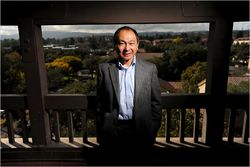
Fuku Human social behavior has an evolutionary basis. This was the thesis in Edward O. Wilson’s book “Sociobiology” that caused such a stir, even though most evolutionary biologists accept that at least some social behaviors, like altruism, could be favored by natural selection. In a book to be published in April, “The Origins of Political Order,” Francis Fukuyama of Stanford University presents a sweeping new overview of human social structures throughout history, taking over from where Dr. Wilson’s ambitious synthesis left off.

Dr. Fukuyama, a political scientist, is concerned mostly with the cultural, not biological, aspects of human society. But he explicitly assumes that human social nature is universal and is built around certain evolved behaviors like favoring relatives, reciprocal altruism, creating and following rules, and a propensity for warfare. Because of this shared human nature, with its biological foundation, “human politics is subject to certain recurring patterns of behavior across time and across cultures,” he writes. It is these worldwide patterns he seeks to describe in an analysis that stretches from prehistoric times to the French Revolution.

More here.

Monday, March 7, 2011

Monday Poem

I’m nobody! Who are you?
Are you nobody too?
……………… -Emily Dickenson

The Book of Nobody

The book nobody can read
of words nobody can understand
is set in lines nobody can see
on leaves no one can turn by hand

It tells tales nobody can believe
of worlds nobody ever knew
of things nobody can conceive
of which nobody has a clue

The song nobody can sing
for nobody who will hear
is like the bell nobody rings
for nobody who is here

The nothing everybody fears
the nothing everybody knows
the sum of everybody’s tears
is of nowhere everybody goes

by Jim Culleny
Feb 15, 2011

Sunday, March 6, 2011

The Book Surgeon

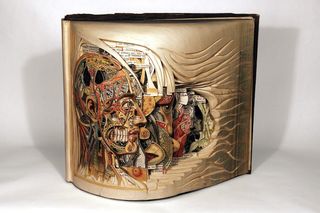
BrianDettmer1 Via Andrew Sullivan, Eugene over at My Modern Met (see some of Dettmer's other work there):

Using knives, tweezers and surgical tools, Brian Dettmer carves one page at a time. Nothing inside the out-of-date encyclopedias, medical journals, illustration books, or dictionaries is relocated or implanted, only removed.

Dettmer manipulates the pages and spines to form the shape of his sculptures. He also folds, bends, rolls, and stacks multiple books to create completely original sculptural forms.

“My work is a collaboration with the existing material and its past creators and the completed pieces expose new relationships of the book’s internal elements exactly where they have been since their original conception,” he says.

“The richness and depth of the book is universally respected yet often undiscovered as the monopoly of the form and relevance of the information fades over time. The book’s intended function has decreased and the form remains linear in a non-linear world. By altering physical forms of information and shifting preconceived functions, new and unexpected roles emerge.”

Here is an interview with Dettmer and more images.

The Revolutionary Rosa Luxemburg

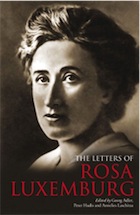
The-Letters-of-Rosa-Luxembur Sheila Rowbotham in The Guardian:

George Shriver's new translation of The Letters of Rosa Luxemburg is the most comprehensive collection of her correspondence yet to appear in English. It transports us directly into the private world of a woman who has never lost her inspirational power as an original thinker and courageous activist in first the Marxist Social Democratic party, and then the German revolutionary group, the Spartacist League. She suffered for her convictions; jail sentences in 1904 and 1906 were followed by three and a half years in prison for opposing the first world war. Her brutal death at the hands of the militaristic Volunteer Corps during the 1919 workers uprising in Berlin has contributed to her mystique: she is revered as the revolutionary who never compromised. This collection of her letters reveals that the woman behind the mythic figure was also a compassionate, teasing, witty human being.

Annelies Laschitza, one of the volume's editors, observes in her introduction that the revelation in 1956 of Stalin's purges, along with new waves of activism during the 60s and 70s, reawakened interest in Luxemburg. My generation of left-libertarians did indeed hail Luxemburg's defiance of Lenin's “night-watchman spirit”. Against his emphasis on the centralised party, many of us were drawn to Luxemburg's conviction that workers' action brought new social and political understandings.

Luxemburg's criticism of Marxism as dogma and her stress on consciousness exerted an influence on the women's liberation movement which emerged in the late 60s and early 70s. When I was writing Woman's Consciousness, Man's World during 1971, I drew on her analysis in The Accumulation of Capital (1913) of capital's greedy quest for non-capitalist markets, adapting it as a metaphor for the commodification of sexual relations and the body.

The awkward truth, however, was that Luxemburg herself had never identified with the feminist movement of her day. Moreover, she maintained a semi-detached relationship with the socialist women whom her friend Clara Zetkin organised in the Marxist Social Democratic party in Germany. Though she would be profoundly moved when they came to meet her from prison in 1916, and when they filled her flat with precious luxuries such as tea bags, cocoa, flowers and fruitcake, Luxemburg always carefully avoided being categorised as a “woman”. Her resistance was partly strategic; she was determined not to be sidelined within the party. But it was also bound up with her theoretical conviction that class struggle was the key to change, along with a strong aversion to being regarded as a victim.

A Blazing Defense of Individualism

022511_michelstaedter Benjamin Ivry in The Forward:

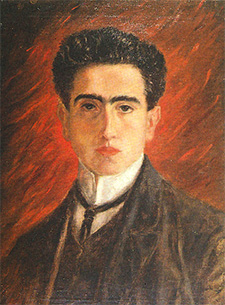
When the brilliant young Italian-Jewish philosopher, poet and artist Carlo Michelstaedter killed himself in 1910 at age 23, he must not have suspected that a century on, he and his works would be internationally celebrated. After initial neglect, a major exhibit, “Carlo Michelstaedter. Far Di Se Stesso Fiamma” (“Carlo Michelstaedter: Transform Yourself Into a Flame”), opened in October and is on view until February 27 at the National Savings Bank Foundation (Fondazione Cassa di Risparmio) of his native city of Gorizia in northeastern Italy, close to the Slovenian border.

“Carlo Michelstaedter. Far Di Se Stesso Fiamma,” features more than 250 manuscripts, books, photos and artworks. Of the last-mentioned, the most impressive are several poignantly painted self-portraits that would express melancholy even if the author’s tragic fate were not known. Accompanied by an elegant, profusely illustrated catalog from Marsilio Editori, the exhibit gives a strong sense of the complex identity issues confronted by sensitive, intellectually creative Italian Jews at the turn of the century. As Thomas J. Harrison’s insightful “1910: The Emancipation of Dissonance” (University of California Press, 1996) observes, the Michelstaedter family was “firmly Italian, even if educated, like most citizens of the [Austro-Hungarian] empire, primarily in German. Italian for themselves and Austrian for the state, they were primarily Jews for others. On such disinherited fringes of states, questions of identity are not a choice but a painful fatality.”

Michelstaedter was not alone; fellow northern Italians such as the tormented novelist Italo Svevo (born Aron Ettore Schmitz) and poet Umberto Saba (born Poli) were other neurotic overachievers. Yet their achievement came at an obvious cost.

Joseph Brodsky: A Literary Life

4687513_569341t Carol Rumens reviews Lev Loseff's new biography, in The Independent:

Joseph Brodsky's observation that what he liked about life in the US was “being left alone to do what I can do” is faintly reminiscent of Philip Larkin's commendation of Hull as “a town that lets you write.” In fact, the free-range Russian exile and the travel-shy Englishman share several affinities, including jazz. Lev Loseff records Brodsky's early poetic attempts at creating an effect of improvisation: “I'm a son of the outskirts, the outskirts, the outskirts,/ in a wire cradle, dank hallways, are my door and my address,/ streetcars clanking, rattle bang ring, stone sidewalks, soles,/ girls lined against painted wood fences,/ grassy banks, oil spot/ factory lights” (“Russian Gothic”).

Brodsky (unlike Larkin) was cavalier about “the toad, work”. He dropped out of school at 15, and hopped from menial job to job before being charged with “parasitism” and despatched to a labour camp near Archangelsk. His real crime, Loseff notes, was that he had broken the rigid rules of initiation into Soviet society. His sentence was commuted after international pressure, and an exit-visa to Israel provided (he changed course at Vienna).

His attachment to a vast range of European literature and his deep individualism seem inevitably to have pointed him west. His youthful poems were published not only in samizdat, but in tamizdat (“over there”). But what mattered to Brodsky far more than ethnicity or country was the Russian language: his only nation-state.

Ten Years On: Why a Complete Human Genome Mattered

Feat-human-genome-list-thumb-640xauto-19652John Timmer in Ars Technica:

Open a recent edition of Science or Nature, and you're likely to be bombarded with articles about a significant anniversary: ten years have passed since the announced completion of the human genome.

These articles tend to focus on how the genome is (or isn't) transforming medicine, science, or society. Sure, it sounds like a terrific milestone, but did it change anything about life in the lab?

I started graduate school back when the debate about whether to sequence the human genome began, and my research career ultimately benefitted from the technology that came out of the program. Most of what you'll read about the anniversary will involve grand perspectives and talk of “breakthroughs,” and those are important, but I'd like to offer a grunt-level view of just how much the human genome project changed biology. This is a personal perspective, and any mis-rememberances or erroneous interpretations are my own.

One of my clearest memories, however, is that back when the project was first proposed, there were real questions about whether it would ever get off the ground…

My graduate career began at the same time that biologists and policymakers had kicked off a public debate about whether to sequence the entire human genome. The project would be an enormous undertaking in terms of funding, resources, and personnel, one that might pull federal funding from individual labs.

It was also a bit of a departure for biology, which hadn't known the big-budget science projects that were common in fields like astronomy and physics. Needless to say, allocating this much money to one idea made many researchers uneasy.

And it wasn't clear that such a project was even necessary.

The Collaborator

Kamila Shamsie in The Guardian:

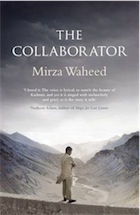
The-Collaborator The unnamed protagonist of Mirza Waheed's devastating debut novel grows up in “the forgotten last village before the border”. The border is not really a border but – in official parlance – the Line of Control, which divides the former princely state of Kashmir between India and Pakistan; the time period is the early 1990s, when the confrontation between the Indian state and Kashmiris demanding azaadi (freedom) turned particularly violent. Such a place, in such a time, cannot remain forgotten very long.

The novel starts when the eponymous narrator is 19, and the forgotten days of the village are long past. He is employed by a captain in the Indian army to go down into a valley near the village and collect the ID cards and weapons of the corpses – thousands of them – which are strewn about the valley floor. The corpses are those of Kashmiri “militants” or “freedom fighters”, depending on which side of history you're on, who crossed the Line of Control into Pakistan for training and were gunned down by the Indian army while crossing back. Their ID cards can be used for PR purposes when the Indian army issues press releases about the militants it has killed; the corpses themselves are just “dead meat”, left to rot.

More here.

The Billionaire Who Is Planning His 125th Birthday

From The New York Times:

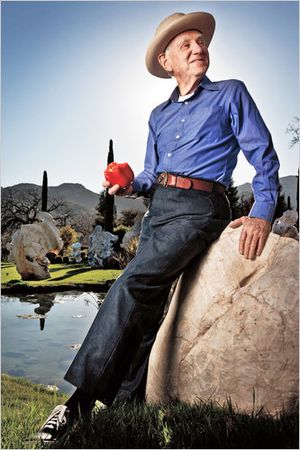
Murdock-t_CA1-popup-v2 One morning in early January, David Murdock awoke to an unsettling sensation. At first he didn’t recognize it and then he couldn’t believe it, because for years — decades, really — he maintained what was, in his immodest estimation, perfect health. But now there was this undeniable imperfection, a scratchiness and swollenness familiar only from the distant past. Incredibly, infuriatingly, he had a sore throat. “I never have anything go wrong,” he said later. “Never have a backache. Never have a headache. Never have anything else.” This would make him a lucky man no matter his age. Because he is 87, it makes him an unusually robust specimen, which is what he must be if he is to defy the odds (and maybe even the gods) and live as long as he intends to. He wants to reach 125, and sees no reason he can’t, provided that he continues eating the way he has for the last quarter century: with a methodical, messianic correctness that he believes can, and will, ward off major disease and minor ailment alike.

So that sore throat wasn’t just an irritant. It was a challenge to the whole gut-centered worldview on which his bid for extreme longevity rests. “I went back in my mind: what am I not eating enough of?” he told me. Definitely not fruits and vegetables: he crams as many as 20 of them, including pulverized banana peels and the ground-up rinds of oranges, into the smoothies he drinks two to three times a day, to keep his body brimming with fiber and vitamins. Probably not protein: he eats plenty of seafood, egg whites, beans and nuts to compensate for his avoidance of dairy, red meat and poultry, which are consigned to a list of forbidden foods that also includes alcohol, sugar and salt.

More here. (Note: Thanks to Alia Raza.)