How To Respect Sex Workers

Speradeconomyissuecover300x200$pread Magazine is closing. $pread:

a quarterly magazine by and for sex workers and those who support their rights. We are current and former strippers, escorts, pro-dommes, phone sex and fetish workers, and porn stars of all genders. The magazine has a focus on personal experiences and political insights, and contains practical information like news, features, health columns, and resources related to the sex industry. $pread builds community in the sex trade by featuring the honest and diverse perspectives of those who know it best: the women and men, including transgender persons, who work within this sensationalized, highly stereotyped industry.

Over at Ms. Magazine's blog, Monica Shores from $pread:

Most women have strong feelings about the sex industry, be they for or against. (And many, of course, remain undecided.) When dealing with such an emotionally volatile topic, it’s easy to inadvertently silence or even insult sex workers themselves. (As a participant in sex worker activism for the past four years, I’ve seen that in action and on the page.) There’s a way to debate commercial sex while respecting the industry’s laborers. Here are some suggestions:

1) Don’t diminish or mock sex workers’ agency. When discussing a person coerced or forced into sex work, a sensitive recognition of the violation they’ve suffered is definitely in order. However, it’s important to let individuals themselves make this distinction, rather than automatically assigning them a label that indicates lack of agency. For instance, referring to all sex workers as “prostituted” or “used” can be violating in and of itself if the person identifies their work as a free choice.

Similarly, language implying that sex workers are defiled or disgusting will quickly alienate them—for instance, calling porn an “institution that systematically uses the bodies of subordinate groups as sheer sexual objects at best, and open toilets at worst,” as this Ms. blog comment does. Even abused workers don’t want the public analogizing them to waste receptacles.

There’s a way to recognize the indignities wrought upon another human being without furthering those indignities.

Photography in Turn-of-the-Century River Baptisms

ID_PI_GOLBE_BAPTI_AP_003Stefany Anne Golberg in The Smart Set:

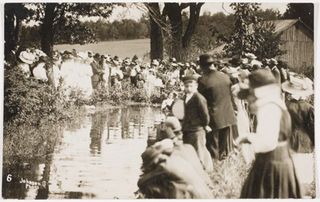
The public nature of the river baptism is what sets it apart from so many other religious rituals (especially in America, a country of believers with, paradoxically, few shared rituals). A river baptism doesn’t have to be in a river; it can be in a creek, the sea, an old bathtub in the yard. One “Take Me to the Water” photograph shows a 1920 baptism being performed in a square, above-ground, wooden swimming pool that is part stage and stands in the middle of a barren Kansas prairie.

The river baptism doesn’t need a river but it does need an audience. Baptism itself doesn’t make you a believer, nor does it make you holy. It is a public testimony of faith, a covenantal act. The ritual of immersion baptism mirrors the death, burial, and resurrection of Christ by giving the initiate a spiritual death, burial/resurrection, and renewal. These three stages follow what anthropologist Arnold Van Gennep, in The Rites of Passage, classified as “separation,” “transition,” and “incorporation.” In the first stage, separation, the initiate is singled out from the community and led into the river. In the second stage, transition, the initiate is “buried” in the river along with her old life, and then “resurrected” as she is pulled from the watery grave. Finally, the initiate is brought officially into the community of worshippers, incorporated into her new life. Even though the baptism is performed individually, the ritual is one of communal bonding. With each baptism, the group of faithful also is reborn, refreshed.

The river baptism’s audience isn’t just made up of believers. Because they are meant to take place in ordinary, open settings, the rituals would often be joined by the curious, passersby, or, as we now know, a photographer. As the photos at ICP show, the witnesses to the baptisms are as much a part of the story as those being baptized.

Best Wishes, Donald

Mark Singer in The New Yorker:

Donald A deputy mayor of New York City once sagely observed, “I wouldn’t believe Donald Trump if his tongue were notarized.” A simple enough rule to live by, which raises the question of whether Trump “believes” his own non-stop prevarications. Leaving aside the tempting armchair theories about where Trump belongs on the spectrum of acute narcissistic personality disorder, I’m convinced that he’s convinced that everything he says and does is ultimately good for business. A large proportion of the tenants in Trump properties are foreigners who regard them as worthy flight-capital investments. A reassuring segment of the American electorate recognizes Trump’s execrable birtherism, aspersions upon President Obama’s academic credentials, and the slur that he needs to get “off his basketball court” for exactly what they are. Abroad, however, I doubt that a large audience is playing close enough attention.

Probably the funniest thing I ever heard Trump say was when, one day in his office, he handed me an unaudited financial statement (the provisional numbers added up to a net worth of a few billion) and declared, “I’ve never shown this to a reporter before.” If, at some point in the near future, Trump makes public an up-to-date “audited” financial statement, my guess is that a very large percentage will be assigned to the value of his name alone and a far less impressive amount to his tangible holdings. Until a couple of days ago, I was in accord with those who maintained that Trump would never formally announce his Presidential candidacy because he couldn’t walk away from whatever his fellow cynics at NBC Universal would pay him for another season of “Celebrity Apprentice.” Now I’m not so sure. Clearly, he needs the money—he always needs the money. One potential pitfall for Trump is that his compulsive ugliness is self-propagating. As Hertzberg and David Remnick observe, whatever laughter Trump evokes is rooted in dread and disgust, which the demeaning spectacle of President Obama releasing the long form of his birth certificate deepened into revulsion. Can he and will he get even uglier? Count on it. As of yet, there are no indications that the suits at NBC will muster the scruples to deprive him of his lucrative franchise. Unless, that is, Trump winds up doing a Full Frontal Charlie Sheen. Not an outcome we should necessarily hope for, but at the rate he’s going he just might.

More here.

My big fat humanist wedding

From New Humanist:

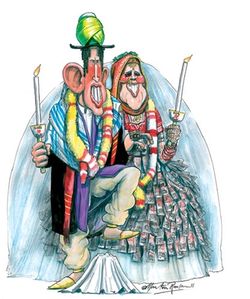
NewHumanistWillnKate If you’re anything like me, you’re not particularly interested in the royal wedding. Perhaps you have republican leanings, or you can’t bear the mawkishness of it all, or you disapprove of the terrible waste of money. Nevertheless, it cannot be denied that this cloud has a silver lining – it has presented the nation with a golden opportunity to have some fun. Let’s face it, an opportunity to have a prank in the glare of the world’s media doesn’t come along very often. And the nation’s satirists and lampooners have been rising to the occasion with gusto. But no spoof piqued global interest quite as much as the Jewish Chronicle’s deadpan story which ran on the festival of Purim (where Jews get drunk to commemorate the execution of a malevolent Persian minister, four hundred years before Christ). Kate and Wills, the Chronicle reported, are planning to acknowledge “the multi-cultural nature of modern British society” in their nuptials. While the ceremony will be “completely Anglican in nature,” the happy couple will smear “mehendi” paste on each other in accordance with Muslim tradition, then, following Hindu custom, offer each other a “morsel of food”. Finally, the Chronicle quipped, the prince will “smash a glass with his foot” in a nod to the Jewish tradition.

The response to this nugget of foolishness was extraordinary. News outlets all around the world took it seriously, including Israel’s leading broadsheet, Ha’aretz (who, red-faced, have since removed the report from their website). Meanwhile, the Twitterverse took the ball and ran with it. Wiccans demanded a human sacrifice in Trafalgar Square; Jedis suggested that Charles lop off Wills’ hand with a light sabre; and Pastafarians – devotees of Dawkins’s Flying Spaghetti Monster – began lobbying for a “traditional” pasta-based feast.

More here.

Sunday Poem

Scarecrow
'
The rice field birds are too clever for scarecrows,
They know what they love, milk in the grain.
When it happens, there will be no time to look for anyone.
Husband, children, nine brothers and sisters.
You will drop your sugarcane-stick-beating of plastic bucket,
Stop shouting at birds and run.
They will load you in trucks and herd you for a hundred miles.
Old men will teach you trade with soldiers at checkpoints.
You will give them your spoon, blanket and beans,
They’ll let you keep your life. And if you jump off the truck,
The army jeep trailing it will run you over.
Later, they will accuse you of giving up your land.
Later, you will stand in distribution lines and won’t receive enough to eat.
Your mother will weave you new underwear from flour sacks.
And they’ll give you plastic tents, cooking pots,
Vaccine cards, white pills, and wool blankets.
And you will keep your cool.
Standing with eyes shut tight like you’ve got soap in them.
Arms stretched wide like you’re catching rain.
;
;
by Fady Joudah
from The Earth in the Attic
Copyright © 2008, Yale University Press.

Behind the scenes at the start of Microsoft

From The Economist:

20110430_bkp002 Asked to pen an endorsement for Paul Allen’s new autobiography, Bono, a well-known musician, declares that the co-founder of Microsoft’s “…intellect and generosity of spirit are there on every page”. He is only half right. “Idea Man” does provide plenty of insights into the ways in which Mr Allen has helped revolutionise everything from software to space travel. But its pages are also permeated by a bitterness towards Bill Gates, the man with whom he created a company that transformed the world of technology. Indeed, there are enough sour grapes in these pages to fill an entire vineyard.

The irony is that the primary focus of Mr Allen’s resentment—his co-founder’s intense competitiveness—is also one of the things that propelled Microsoft to greatness. That trait, and the tension that it provoked between the two men, is evident from the time they meet at school. Mr Allen describes how Mr Gates became apoplectic when a practical joke he played on Mr Allen backfired. In another vignette, he portrays his pal sweeping the pieces off a chessboard in fury when he lost yet another game to Mr Allen.

More here.

Once upon a life: Mohsin Hamid

Mohsin Hamid in The Observer:

ScreenHunter_11 May. 01 10.28 In December 1980, at the age of nine, I moved back to Pakistan for the first time.

We touched down at Lahore, in those less security-conscious days when it was still a place where families strolled to the tarmac to greet deplaning passengers. Ronald Reagan had just beaten Jimmy Carter in the election for president of the United States, the Soviet Union was about to mark the first anniversary of its invasion of Afghanistan, racoon-eyed General Zia-ul-Haq was ensconced in Islamabad as Pakistan's dictator, and I'd lost my Urdu.

It's a funny thing to lose your first language. I was an early talker, chirping along in full sentences and paragraphs well before I turned two, and I have a scar to prove it. In the summer of 1973, ZA Bhutto was campaigning to become prime minister of Pakistan, and I picked up the habit of climbing on to the dining table and holding forth in the manner of the speeches I'd heard him make on PTV: “When I become prime minister…”

One day someone tried to get hold of me and lower me to the ground. I made a run for it, dashed into thin air, fell, split open my head and wound up with blood in my eye and stitches across my brow. (ZA Bhutto's fate would, sadly, be similar.)

More here.

Saturday, April 30, 2011

Trolley Problems

Terrence Tomkow in his own blog:

A runaway trolley is coming down the track. It is headed towards five people who cannot get out of its way. A Passerby realizes that he can save the five by throwing a switch and diverting the trolley down a siding, but he also realizes that if he does so, the trolley will kill a Lone Man standing on the siding.

ScreenHunter_09 May. 01 10.06

Should you divert the trolley? Lots of folks say, “Yes!” Whether or not they are right is an interesting problem but it is not what philosophers call “The Trolley Problem“. That problem involves a different case:

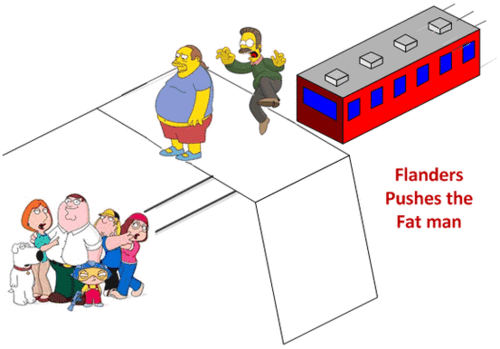
A runaway trolley is coming down the track. It is headed towards five people who cannot get out of its way. A passerby realizes that if he pushes a nearby fat man onto the tracks his bulk will stop the trolley before it hits the five, though the fat man himself will be killed.

ScreenHunter_10 May. 01 10.08

Most people, including those who think it is okay to turn in TROLLEY, think that it is not okay to push the FAT MAN. “The Trolley Problem” is how to reconcile these two answers. In both cases it seems you can do something that will save five people but only by killing one. How can anyone think it okay to turn in TROLLEY but wrong to push the FAT MAN? What difference is there between the two stories that can possibly make a moral difference?

In the almost forty years since Judith Jarvis Thomson first posed the problem in this form there have many attempts to solve it but none is generally accepted as successful. Indeed a general consensus seems to have developed that the “folk intuitions” (as philosophers call them) about the difference between these cases are simply irrational.

More here.

union

Foner-articleInline

Among the enduring mysteries of the American Civil War is why millions of Northerners were willing to fight to preserve the nation’s unity. It is not difficult to understand why the Southern states seceded in 1860 and 1861. As the Confederacy’s founders explained ad infinitum, they feared that Abraham Lincoln’s election as president placed the future of slavery in jeopardy. But why did so few Northerners echo the refrain of Horace Greeley, the editor of The New York Tribune: “Erring sisters, go in peace”? The latest effort to explain this deep commitment to the nation’s survival comes from Gary W. Gallagher, the author of several highly regarded works on Civil War military history. In “The Union War,” Gallagher offers not so much a history of wartime patriotism as a series of meditations on the meaning of the Union to Northerners, the role of slavery in the conflict and how historians have interpreted (and in his view misinterpreted) these matters. The Civil War, Gallagher announces at the outset, was “a war for Union that also killed slavery.” Emancipation was an outcome (an “astounding” outcome, Lincoln remarked in his second Inaugural Address) but, Gallagher insists, it always “took a back seat” to the paramount goal of saving the Union. Most Northerners, he says, remained indifferent to the plight of the slaves. They embraced emancipation only when they concluded it had become necessary to win the war. They fought because they regarded the United States as a unique experiment in democracy that guaranteed political liberty and economic opportunity in a world overrun by tyranny. Saving the Union, in the words of Secretary of State William H. Seward, meant “the saving of popular government for the world.”

more from Eric Foner at the NYT here.

texas trillin

Calvintrillin

Calvin Trillin is a man of principle. He can’t stand, for instance, people who talk about themselves in the third person, which made things difficult back in the days of Dole and Dukakis. He once declared that people caught trying to sell macramé should be, themselves, “dyed a natural color.” And of writers, he once said: “There is no progress” — no corporate world to fall back on, no middle management. Writers are as good as the last thing they wrote, and sometimes not even that. Atop that bedrock of curious dogma, Trillin has built an itinerant and confounding career. He is viewed as a consummate New York writer, though he grew up in the sturdy Midwest. He was a big wheel in the Ivy League, though he relishes kicking the pedestals beneath those who were big wheels in the Ivy League. He became an early and influential guru of regional cuisine, though he professed to know next to nothing about the subject. During his prolific 50 years, in the New Yorker and other publications and in 27 books, Trillin has tackled a ridiculous array of subjects: politics and culture, Americana and adventure, lore and history, catfish and milkshakes, even — famously — parking. So in his latest book, “Trillin on Texas,” it is surprising and even mesmerizing to watch Trillin return — sort of — to his roots.

more from Scott Gold at the LA Times here.

cadences of pure poetry

396c98f2-714e-11e0-acf5-00144feabdc0

Not so long ago the Reverend Mary Garbutt, Anglican pastor of a village in Northamptonshire, performed a gruelling sponsored marathon. She read out loud the entire 823,156-word text of the 1611 King James Bible over three and a half days. She read for 14 hours at a stretch, with only occasional 10-minute breaks, while parishioners stood by with orange juice, cakes and throat lozenges. Croaking through the final pages, she burst into tears, she said, from a sense of “spiritual joy”. Rector Garbutt’s project was just one of many readings, conferences, broadcasts and exhibitions in recent months to celebrate the 400th anniversary of the publication of the King James Bible (KJB), which falls putatively on May 2. For centuries the dominance of the KJB was unchallenged among English-speaking Protestants, and still is among many American Christian faith communities. At his inauguration, President Barack Obama took the oath of office from Lincoln’s copy of the KJB. Reputedly the most read book in English, it now competes with scores of subsequent translations that have strived to reduce obsolete expressions; yet it still sells some 250,000 copies each year. Despite the stumbling block of its archaic language and spelling, the KJB retains for many an impression of peerless sublimity. All those “begats”, “knoweths” and “spakes”, and occasional sheer gobbledegook – “Moab is my wash-pot ouer Eom wil I cast out my shooe” (in the spelling of the 1611 edition) – interpenetrate with cadences of pure poetry.

more from John Cornwell at the FT here.

In Defense of Flogging

Peter Moskos in the Chronicle of Higher Education:

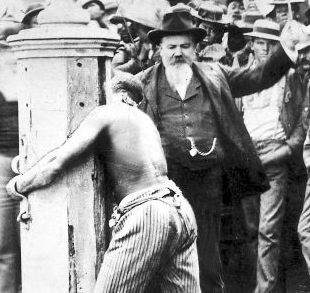
ScreenHunter_07 Apr. 30 15.04 When I started writing In Defense of Flogging, I wasn't yet persuaded as to the book's basic premise. I, too, was opposed to flogging. It is barbaric, retrograde, and ugly. But as I researched, wrote, and thought, I convinced myself of the moral justness of my defense. Still, I dared not utter the four words in professional company until after I earned tenure. Is not publishing a provocatively titled intellectual book what academic freedom is all about?

Certainly In Defense of Flogging is more about the horrors of our prison-industrial complex than an ode to flogging. But I do defend flogging as the best way to jump-start the prison debate and reach beyond the liberal choir. Generally those who wish to lessen the suffering of prisoners get too readily dismissed as bleeding hearts or soft on criminals. All the while, the public's legitimate demand for punishment has created, because we lack alternatives, the biggest prison boom in the history of the world. Prison reformers—the same movement, it should be noted, that brought us prisons in the first place—have preached with barely controlled anger and rational passion about the horrors of incarceration. And to what end? Something needs to change.

Certainly my defense of flogging is more thought experiment than policy proposal. I do not expect to see flogging reinstated any time soon. And deep down, I wouldn't want to see it. And yet, in the course of writing what is, at its core, a quaintly retro abolish-prison book, I've come to see the benefits of wrapping a liberal argument in a conservative facade. If the notion of tying people to a rack and caning them on their behinds à la Singapore disturbs you, if it takes contemplating whipping to wake you up and to see prison for what it is, so be it! The passive moral high ground has gotten us nowhere.

More here. [Thanks to Ejaz Haider.]

Israel: Prosperous but Unequal

Nathan Jeffay in Forward:

ScreenHunter_06 Apr. 30 14.59 When Israel was invited to join the Organization for Economic Cooperation and Development, Prime Minister Benjamin Netanyahu declared it an international “seal of approval.” But a year later, it’s clear that membership in the elite group has brought anything but approval of the country’s direction in one key area: inequality.

Israel’s ascension last May to the OECD — an organization of the world’s most prosperous economies — has shone a spotlight on the economic strengths and weaknesses of the state, as compared with other OECD countries.

Growing by 7.8% last year, the Israeli economy ranked fifth highest in growth among the group’s 34 members. Israel’s growth outstripped that of the United States, Britain, Japan, Germany and France.

At the same time, the group has reported that poverty is almost twice as widespread in Israel, 19.9% of the population, compared to the OECD average, 10.9%. The gap between the overall standard of living in Israel and that of the lowest tenth of the population was three times higher than the OECD average. In its latest release of data, made public April 12, the OECD reported that 39% of Israelis find it “difficult” or “very difficult” to live on their current incomes, well above the OECD average of 24%.

More here.

What Is Totalitarian Art? Cultural Kitsch From Stalin to Saddam

Kanan Makiya in Foreign Affairs:

ScreenHunter_05 Apr. 30 14.49 In his important and encyclopedic tome on the art produced under the twentieth century's four most brutal political systems — the Soviet Union, the Third Reich, Fascist Italy, and the People's Republic of China — Igor Golomstock makes it clear that he is writing not about “art under totalitarian regimes” but rather about “totalitarian art,” a particular cultural phenomenon with its own ideology, aesthetics, and style. This type of art did not arise because of common threads running through Soviet, German, Italian, and Chinese culture; the cultural traditions of the countries, Golomstock holds, are “simply too diverse” to explain the stylistic and thematic similarities among totalitarian works. He collects these similarities under the term “total realism,” a genre that has its roots in the socialist realist art of the Soviet Union after 1932, when Stalin decreed it the only type of art acceptable.

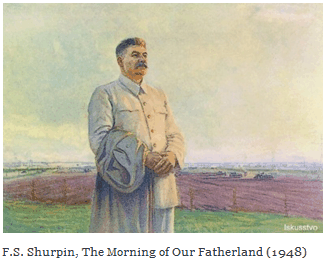
One cannot think of a more perfect example of the totalitarian artistic impulse than Saddam's insistence that a cast of his own forearms be used as the mold from which the Victory Arch was to be made. But in general, depictions of the leader, perhaps the most common subject of total realism, had to be mythologized. It would not do, for example, for a Soviet artist to depict Stalin as the short, pockmarked, bandy-legged man that he really was. His physical attributes, as in F. S. Shurpin's portrait The Morning of Our Fatherland, had to undergo the same transformation as Stalin's version of history, to be turned into what the writer Milan Kundera so eloquently referred to as “the beautifying lie.”

More here.

The Cloud Messenger by Aamer Hussein

From The Telegraph:

Cloud-messenge_1882494f The title of this taut new novel from Aamer Hussein comes from a legend, in which clouds carry messages of love from separated lovers across the world. Relationships, and their varying levels of permanence, are thus the main theme, as we follow the narrator, Mehran (who appears sometimes in the first person, sometimes in the third, adding to the novel’s dreamlike quality), in his tangled encounters. Mehran’s youth, as a scion of a grand family in India, prepares him for adulthood in that he learns never to put too much faith in friends: they come and go, for him, like clouds, as he switches from city to city, country to country. His cultured relatives feed him poetry and stories; he ends by studying Urdu and Persian in London.

Hussein’s evocation of Mehran’s early childhood is precise and therefore of almost photographic vividness. The extraordinary – Mehran’s mother has shot a crocodile, while his aunt has bagged a tiger – rubs against the everyday, as the children long for rain and Enid Blyton. This mixing of the magical and the mundane is also key to the book. In London, Mehran finds his first fixed friendships, with Riccarda, an older, married woman who loves dancing till dawn, yet who has a son not much younger than Mehran himself; and with Marco, a wild, good-looking Italian boy who gets all the girls, and yet with whom Mehran has the tiniest of erotic frissons.

More here.

Shakespeare and the Will to Deceive

From The New York Times:

Art Somewhere buried under the floorboards of this splendidly devious novel is a real-life event. In 1794, a young Englishman, William Henry Ireland, came across something astonishing that he hurried to show his father: an old mortgage deed, with its seal intact, signed by none other than William Shakespeare.

The young man’s father, Samuel, an antiquarian and a passionate Shakespeare enthusiast, was thrilled, and still more thrilled when from the same mysterious source — an old chest in the possession of a reclusive aristocrat who wished his identity to remain secret — his son came up with a series of further discoveries. These included contracts; theatrical receipts; correspondence between Shakespeare and his patron, the Earl of Southampton; a letter to Shakespeare from Queen Elizabeth herself; a “profession of faith” in Shakespeare’s own hand, proving once and for all that he was a good Protestant; and the playwright’s own manuscript of “King Lear.” Alerted to the news, people crowded into Ireland’s house. James Bos­well fell to his knees to kiss the great playwright’s relics. Against his son’s vehement objections, the proud Samuel hurried most of these stupendous finds into print. But he held in reserve the best of them all, until they could be returned in glory to the stage where they belonged: two full-length plays by Shakespeare, both hitherto unknown, “Vortigern and Rowena” and “Henry II.”

More here.

Friday, April 29, 2011

Quality of Life: India vs. China

Sen_1-051211_jpg_230x846_q85 Amartya Sen in the NYRB:

The steadily rising rate of economic growth in India has recently been around 8 percent per year (it is expected to be 9 percent this year), and there is much speculation about whether and when India may catch up with and surpass China’s over 10 percent growth rate. Despite the evident excitement that this subject seems to cause in India and abroad, it is surely rather silly to be obsessed about India’s overtaking China in the rate of growth of GNP, while not comparing India with China in other respects, like education, basic health, or life expectancy. Economic growth can, of course, be enormously helpful in advancing living standards and in battling poverty. But there is little cause for taking the growth of GNP to be an end in itself, rather than seeing it as an important means for achieving things we value.

It could, however, be asked why this distinction should make much difference, since economic growth does enhance our ability to improve living standards. The central point to appreciate here is that while economic growth is important for enhancing living conditions, its reach and impact depend greatly on what we do with the increased income. The relation between economic growth and the advancement of living standards depends on many factors, including economic and social inequality and, no less importantly, on what the government does with the public revenue that is generated by economic growth.

Some statistics about China and India, drawn mainly from the World Bank and the United Nations, are relevant here. Life expectancy at birth in China is 73.5 years; in India it is 64.4 years. The infant mortality rate is fifty per thousand in India, compared with just seventeen in China; the mortality rate for children under five is sixty-six per thousand for Indians and nineteen for the Chinese; and the maternal mortality rate is 230 per 100,000 live births in India and thirty-eight in China. The mean years of schooling in India were estimated to be 4.4 years, compared with 7.5 years in China. China’s adult literacy rate is 94 percent, compared with India’s 74 percent according to the preliminary tables of the 2011 census.

polygamous

Exclusionofall

Two decades ago, RCMP officers drove up a winding road through the Creston Valley of southeastern British Columbia, past fields of timothy hay and cottonwood stands, to an unmarked settlement known as Bountiful. It looked a typical rural town — homesteads bordered by well-kept yards full of children running and swinging and cycling — but, in fact, the officers had come to investigate a complaint that two local patriarchs, young gun Winston Blackmore and his fifty-seven-year old father-in-law Dalmon Oler, were polygamists — an offence under Section 293 of the Criminal Code. All 1,000 or so residents of Bountiful are members of the Fundamentalist Church of Jesus Christ of Latter-day Saints (FLDS), a Mormon sect that believes God’s chosen leaders should each marry several virgins and “multiply and replenish the Earth… that they may bear the souls of men.” Unashamed, Oler invited the officers into the fifteen-bedroom home he shared with his five wives and forty-eight children. Blackmore, who in addition to leading Canada’s FLDS operated a multimillion-dollar logging, trucking, and manufacturing business, was cagier about numbers, only admitting to having more than one wife. He was rumoured, however, to have at least twenty-five (many underage at the time he married them), and more than eighty children.

more from Elizabeth Abbott at The Walrus here.