David Meskhi. “23” from the series “When the Earth Seems to be Light”, 2008.
More on this young Georgian photographer here, here and here.

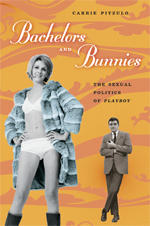
How Playboy brought carnal and acquisitive desires into alignment is the central concern of [Carrie] Pitzulo’s study. She focuses on the magazine’s first two decades, from its debut in 1953 through a mutually polemical encounter with radical feminism in the early 1970s. In the uncorrected page proofs sent out to reviewers, she refers to the book a couple of times by the title For the Articles — a nod to the old joke explaining why one read Playboy. Presumably this was the title it bore when the project started out as a dissertation. (Pitzulo is now assistant professor of history at the University of West Georgia.) This has been corrected in the final version — and in any case, Bachelors and Bunnies is both a better title and more fitting, since its argument is that Playboy's agenda was, at heart, emancipatory for men and women alike.
As the magazine came on the scene in the 1950s, pundits were in the midst of brow-furrowing over a “crisis in masculinity.” Expansion of the professional-managerial class meant that there were more guys working at desks than ever. Women had increasing power in the marketplace, and lots of them were having careers. Some of the rough-hewn male virtues of yesteryear, such as indifference to fashion and a distaste for luxury, were becoming inappropriate in an affluent society. However suitable in the day of the covered wagon, they now slowed the wheels of commerce. “This translated into a cultural angst over the ability of middle-class men to maintain their traditional authority in the home, workplace, and world,” Pitzulo writes.
A new, alternative code of masculinity could be found in the pages of Playboy. It was completely urban and tended towards a sophistication verging on dandyism. While displaying an aversion toward being domesticated by women, it was unambiguously (even strenuously) heterosexual. A man had to know how to consume, and women were there for the consuming. You used the best available hi-fi to play the coolest possible jazz album for that secretary you met in the elevator; soon she would be wearing only a smile, just like this month’s centerfold.

[T]hree or four years ago, something changed. For some reason I can’t recall (probably a longish lapse in productivity on my thesis) I set myself the task of reading a Great Big Important Novel. For another reason I can’t recall (probably the fact that it had been sitting on a shelf for years, its pages turning the sullen yellow of neglected great books), I settled on Gravity’s Rainbow. I can’t say that I enjoyed every minute of it, or even that I enjoyed all that much of it at all, but I can say that by the time I got to the end of it I was glad to have read it. Not just glad that I had finally finished it, but that I had started it and seen it through. I felt as though I had been through something major, as though I had not merely experienced something but done something, and that the doing and the experiencing were inseparable in the way that is peculiar to the act of reading. And I’ve had that same feeling, I realize, with almost every very long novel I’ve read before or since.
You finish the last page of a book like Gravity’s Rainbow and—even if you’ve spent much of it in a state of bewilderment or frustration or irritation—you think to yourself, “that was monumental.” But it strikes me that this sense of monumentality, this gratified speechlessness that we tend to feel at such moments of closure and valediction, has at least as much to do with our own sense of achievement in having read the thing as it does with a sense of the author’s achievement in having written it. When you read the kind of novel that promises to increase the strength of your upper-body as much as the height of your brow—a Ulysses or a Brothers Karamazov or a Gravity’s Rainbow—there’s an awe about the scale of the work which, rightly, informs your response to it but which, more problematically, is often difficult to separate from an awe at the fact of your own surmounting of it.
The upshot of this, I think, is that the greatness of a novel in the mind of its readers is often alloyed with those readers’ sense of their own greatness (as readers) for having conquered it. I don’t think William Gaddis’s The Recognitions, for instance, is nearly as fantastic a novel as people often claim it is. But it is one of the most memorable and monumental experiences of my reading life. And these are the reasons why: because the thing was just so long; because I had such a hard time with it; and because I eventually finished it.
A video over at Reset DOC.

I visited Vilayanur S. Ramachandran's lab at the University of California, San Diego recently, and interviewed him and several members of his lab about their work. Rama and I talked, among other things, about the controversial broken mirror hypothesis, which he and others independently proposed in the early 1990s as an explanation for autism. I've written a short article about it for the Simons Foundation Autism Research Initiative (SFARI), and the transcript of that part of the interview is below. I also wrote an article summarizing the latest findings about the molecular genetics of autism, which were presented in a symposium held at the Society for Neuroscience annual meeting last November.
MC: Autism is an umbrella term referring to numerous conditions. Can the broken mirror hypothesis account for all of them?
Ramachandran: Autism is characterized by a specific subset of symptoms. There may be three or four that are lumped together, but by and large it is one syndrome, as good a syndrome as any in neurology. It's not like dyslexia, where there are half a dozen or a dozen types. With autism, people are debating whether high functioning and low functioning autistics should be lumped together or not. There's a tendency to group them together rather than saying they're distinct.
We have suggested that the mirror neuron system is deficient in autism, and there's mixed evidence of that, but most groups support our view. [Marco] Iaconobi's group at UCLA did a brain imaging study showing that the mirror neuron system is deficient, but others claim that it's normal. That may partly be based on the heterogeneity of autism. The mirror neuron system itself could be normal but its projections, or the regions it's projecting to, could be abnormal. It's still up in the air.
A Soul, Geologically
The longer we stay here the harder
it is for me to see you.
Your outline, skin
that marks you off
melts in this light
and from behind your face
the unknown areas appear:
hills yellow-pelted, dried earth
bubbles, or thrust up
steeply as knees
the sky a flat blue desert,
these spaces you fill
with their own emptiness.
Your shape wavers, glares
like heath above the toad,
then you merge and extend:
you have gone,
in front of me there is a stone ridge.
Which of these forms
have you taken:
hill, tree clawed
to the rock, fallen rocks worn
and rounded by the wind
You are the wind,
you contain me
I walk in the white silences
of your mind, remembering
the way it is millions of years before
on the wide floor of the sea
while my eyes lift like continents
to the sun and erode slowly
by Margaret Atwood
from Margaret Atwood Selected Poems
Simon and Shuster, 1976
From Guernica:
The movie subverts expectations a viewer is likely to have for a story set in Kashmir. The region has long been a place of violence and has been a primary cause of conflict between India and Pakistan since the 1947 partition. An indigenous movement for independence exploded there in 1989, leading to India’s military occupation and a period of vicious guerrilla combat. Violent uprisings against the Indian army have occurred regularly since the end of the 1990s, and thousands—some say tens or hundreds of thousands—of Kashmiris have been killed or disappeared since the start of the insurgency. Fighting, poor infrastructure, poverty, and unregulated pollution have eroded the region’s stunning natural beauty.
More here.
From PhysOrg:

Shu and his students manipulated strands of DNA at the strand level and at the test tube level. They found that they could fuse strands together, as well as cut them, and perform other operations that would affect the ability of the DNA to compute. In this model, DNA molecules are used to store information that can be used for computational purposes. “We can join strands together, creating an addition operation, or we can divide by making the DNA smaller by denaturization,” Shu says. “We expect that more complex operations can be done as well.”
More here.
Marx and Lenin both liked a joke. So they would have appreciated the irony that, since the ongoing financial crisis began, their analyses of unstable, destructive capitalism has been spectacularly confirmed at the same time that the movement they ostensibly inspired (and for a time, involuntarily gave their names to) lies powerless and moribund. All of capitalism’s house journals have run some obligatory article since 2008 asking: “Was Marx right?” but the proletarian revolution has singularly failed to rise in response. There have been very exciting, even epochal outbreaks of revolt, but whether democratic pan-Arabism or internet-assisted student autonomism, they don’t threaten capitalism itself. These two short books don’t explore this irony, but, in the absence of the movement, they offer challenges to our received ideas about communism. Of the two, Why Marx Was Right, by prolific academic populariser and scourge of English letters Terry Eagleton, is the less controversial. As he acknowledges, our age of no-strings-attached state handouts to banks and punitive cuts to social services has embraced a form of capitalism so grotesque that it resembles the caricatures of the most leaden Soviet satirists. Eagleton presents his book as the fruit of “a single, striking thought: what if all the objections to Marx’s thought are mistaken?” In order to demonstrate this, each of the chapters of this erudite yet breezy (occasionally too breezy) tract begins with a series of assertions about Marx and Marxism, which Eagleton then proceeds to debunk, one by one.
more from Owen Hatherley at The Guardian here.
“There’s so many sides to Bob Dylan, he’s round,” recalls one of the singer-songwriter’s old Woodstock buddies, quoted in just about every book ever written on Dylan. Like a planet, then, with its own rarefied atmosphere and a gravitational pull that has brought more than one hopeful author crashing to the ground. How to write about Dylan? To engage with him as a fan is to risk high-temperature sycophancy and subsequent ridicule; but to approach him as a scholar is fraught with even greater dangers. Since his earliest days, Dylan has indulged in the art of playful deceit. He made up stories, lied to his loved ones and treated his casual interlocutors with even more contempt than his colleague-in-mischief, John Lennon. Here is a typical exchange, from Robert Shelton’s early account of a 1965 press conference, freshly re-edited in time for Dylan’s 70th birthday on Tuesday: “Q: Who are your favourite performers, I don’t mean folk, I mean general?” “A: Rasputin. Charles de Gaulle. The Staple Singers.” It is a reply that owes more to Dadaist disdain than the tinny tropes of showbusiness.
more from Peter Aspden at the FT here.
In the thousand years between the decline of Rome and the springtime of the Renaissance, science and other branches of learning took a holiday throughout Europe. It was a benighted time in the history most of us raced through in school, skipping lightly through Charlemagne and Richard the Lion-Hearted, the Norman Conquest and the Crusades, and arriving none too soon at the time of Leonardo and Michelangelo, Columbus and da Gama, Erasmus and Luther. Ignored for the most part in Eurocentric accounts is the parallel culture that rose in the Middle East with the swift spread of Islam after the death of the prophet Muhammad in 632. Lands from Spain to Persia and beyond fell to the Muslim sword, and in time some ambitious rulers made their palaces sanctuaries of learning, the think tanks of their day, where astronomers, mathematicians, physicians and philosophers were allowed to venture beyond the received word and to practice science as an empirical inquiry. Jim al-Khalili, an Iraqi-born physicist who has lived in Britain since 1979, has taken on the task of elevating this neglected period to its rightful place in history. His new book, “The House of Wisdom,” reflects a depth of research, an ability to tell a fascinating story well and fair-mindedness where minds too often are closed.
more from John Noble Wolford at the NYT here.

The Los Angeles Times reported on Thursday that a New Hampshire company is offering post-Rapture pet care for Christians who believe, according to the predictions of Christian radio personality Harold Camping, that Judgment Day is this Saturday. Those willing to pay the (recently increased) $135 fee for the service seem to be operating under the principle that their pets will not be saved. But what is the official word on Fido's chances of making it through the Second Coming?
Not very good. Like all matters of theology, the question of animal salvation is complicated and subject to much interpretation. Camping, who has not been affiliated with a church since 1988, believes that animals do not have souls, and therefore do not experience salvation or ascension to heaven. An animal, when he dies, simply ceases to exist. Many mainstream Christian theologians agree with him. Since the high Middle Ages, when the Catholic Church began framing its understanding of nature and the supernatural in Aristotelian terms, the standard Christian interpretation has been that human beings have an immortal soul, and cannot die, but other forms of life do not, and can.
From Guardian:

“The revolution was a great human achievement,” Aswany says in a booming voice that amplifies his evident emotion. “It means people are willing to die for freedom and justice. When you participate in a real revolution you become a much better person. You are ready to defend human values.” Now though, like other Egyptian democrats, he fears a counter-revolution led by old regime loyalists fomenting violence and sectarian attacks, precisely in line with the finger-wagging warning by Mubarak of the “chaos” that would follow if he were forced from the presidency. Uncertainties abound, Aswany admits, smoking furiously between appointments in his dental surgery in Cairo's Garden City district, its leafy streets a haven from one of the noisiest urban spaces on the planet, and whose fading charms and human vibrancy he captured in his best-selling novel The Yacoubian Building.
More here.
From The New York Times:

“For me, Shakespeare is God,” he declares at one point, and in other places he says much the same thing, in much the same words, a reminder that to read Bloom once is in a sense to reread him, so often does he repeat himself. Twice he asserts that Shakespeare’s greatest creations are Falstaff, Hamlet, Iago and Cleopatra; twice that “The Tempest” and “The Winter’s Tale” are tragicomedies and not romances; three times that “Titus Andronicus” parodies the tragedies of Shakespeare’s defeated rival Marlowe. Prospero, Bloom shrewdly observes, “is one of those teachers who is always convinced his auditors are not quite attentive.” So too Bloom, himself a “professional teacher” for 55 years now, has perhaps learned that the most efficient way to get your point across is to keep making it, the classroom sage’s version of staying on message.
More here.
For the first time since the end of World War II, no country or strong alliance of countries has the political will and economic leverage to place its goals on the global stage. This vacuum may encourage, as in previous historical periods, the ambitious and the aggressive to seek their own advantage. In such a world, the absence of a high-level agreement on creating a new collective security system—one focused on economics rather than the 20th-century dynamic of military power—is not merely irresponsible but dangerous. A G-Zero world without leadership and global cooperation is an unstable equilibrium that threatens both economic prosperity and security. The argument that we live in a G-Zero rather than a G-20 world should not be taken as a normative statement. It is rather just an analytical statement of the world we are in rather than the world of cooperation we should be in. Since most global issues are transnational, with global spillover effects, the need for dialogue, coordination and cooperation is more necessary than ever. And it is possible that the great powers will realize that most global issues—economic, trading, financial, security—are not a zero-sum game but rather a positive-sum game, where mutually beneficial agreements can and should be reached. But true dialogue may require less rigid and bureaucratic fora, where true dialogue and robust discussion may eventually lead to cooperation and agreement on a wide range of issues that includes not only governments but also non-governmental organizations and representatives of the private sector. That is why fora such as the 21st Century Council can be less formal and more substantial spaces, where there is the real dialogue and debates that are necessary precursors to eventual international cooperation and coordination can take place.
more from Nouriel Roubini at NPQ here.
From 1892 to 1946, India’s premier cricket tournament was fought on the pitch by a pantheon of adversaries: the British, the Hindoos, the Parsees of the Zoroastrian Cricket Club, the Muslims of the Mohammedan Gymkhana, and, as of 1937, a team called “The Rest,” made up of Buddhists, Jews, and Indian Christians. (The Rest never won a match.) The Bombay Pentangular, as it was finally known, was abolished in 1946, condemned for its forthright communalism. And yet, like most things in India, the Pentangular has undergone an unlikely reincarnation. This year, India’s regional film industries — the lissome fivesome of Bollywood, Mollywood, Tollywood, Kollywood, and Sandalwood — will slug it out in the inaugural season of the Celebrity Cricket League. In this latest phase of the ongoing metastasis of a stodgy sixteenth-century British gentlemen’s game into mega-Asian sportainment, the league hopes to cater to (and cash in on) the hundreds of millions of Indians for whom cricket and cinema are two faces of the same god. The Victorians thought that the edifice of civilization could be built on the values of cricket alone. The edifice of cricket, in turn, is built on the Test match. Thirty-three hours of play, stretched out over five days, Test cricket is an exercise in humility. Excellence at cricket requires self-denying stoicism, sportsmanship, and a continual refinement of one’s relationship to the Laws of Cricket — an actual document, safeguarded by the Marylebone Cricket Club at Lord’s Ground in London. A cross between baseball and a garden party, the luxurious pace of the cricket match makes the character of the player nearly as important as his athleticism, requiring precise psychological evaluations of opponents’ strengths and weaknesses on the field. Players are obliged to halt the match for lunch or even tea with enemy cricketers and the umpire, no matter how nail-bitingly tense the game.
more from Anna Della Subin at Bidoun here.
On June 13th, a fifty-four-year-old former government employee named Thomas Drake is scheduled to appear in a courtroom in Baltimore, where he will face some of the gravest charges that can be brought against an American citizen. A former senior executive at the National Security Agency, the government’s electronic-espionage service, he is accused, in essence, of being an enemy of the state. According to a ten-count indictment delivered against him in April, 2010, Drake violated the Espionage Act—the 1917 statute that was used to convict Aldrich Ames, the C.I.A. officer who, in the eighties and nineties, sold U.S. intelligence to the K.G.B., enabling the Kremlin to assassinate informants. In 2007, the indictment says, Drake willfully retained top-secret defense documents that he had sworn an oath to protect, sneaking them out of the intelligence agency’s headquarters, at Fort Meade, Maryland, and taking them home, for the purpose of “unauthorized disclosure.” The aim of this scheme, the indictment says, was to leak government secrets to an unnamed newspaper reporter, who is identifiable as Siobhan Gorman, of the Baltimore Sun. Gorman wrote a prize-winning series of articles for the Sun about financial waste, bureaucratic dysfunction, and dubious legal practices in N.S.A. counterterrorism programs. Drake is also charged with obstructing justice and lying to federal law-enforcement agents. If he is convicted on all counts, he could receive a prison term of thirty-five years. The government argues that Drake recklessly endangered the lives of American servicemen. “This is not an issue of benign documents,” William M. Welch II, the senior litigation counsel who is prosecuting the case, argued at a hearing in March, 2010. The N.S.A., he went on, collects “intelligence for the soldier in the field. So when individuals go out and they harm that ability, our intelligence goes dark and our soldier in the field gets harmed.”
more from Jane Mayer at The New Yorker here.