
Category: Recommended Reading
Pakistan’s Spies Tied to Slaying of a Journalist
Jane Perlez and Eric Schmitt in the New York Times:
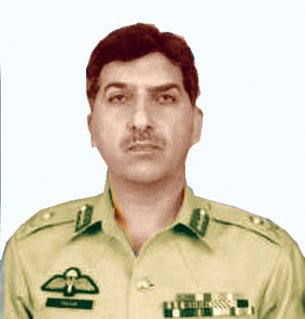
New classified intelligence obtained before the May 29 disappearance of the journalist, Saleem Shahzad, 40, from the capital, Islamabad, and after the discovery of his mortally wounded body, showed that senior officials of the spy agency, the Directorate for Inter-Services Intelligence, directed the attack on him in an effort to silence criticism, two senior administration officials said.
The intelligence, which several administration officials said they believed was reliable and conclusive, showed that the actions of the ISI, as it is known, were “barbaric and unacceptable,” one of the officials said. They would not disclose further details about the intelligence.
But the disclosure of the information in itself could further aggravate the badly fractured relationship between the United States and Pakistan, which worsened significantly with the American commando raid two months ago that killed Osama bin Laden in a Pakistan safehouse and deeply embarrassed the Pakistani government, military and intelligence hierarchy. Obama administration officials will deliberate in the coming days how to present the information about Mr. Shahzad to the Pakistani government, an administration official said.
More here. [Photo shows General Pasha, chief of the ISI.]
Pakistani Military Still Cultivates Militant Groups, a Former Fighter Says
Carlotta Gall in the New York Times:
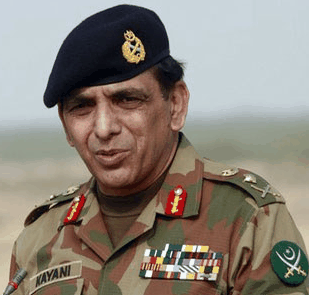
The former commander said that he was supported by the Pakistani military for 15 years as a fighter, leader and trainer of insurgents until he quit a few years ago. Well known in militant circles but accustomed to a covert existence, he gave an interview to The New York Times on the condition that his name, location and other personal details not be revealed.
Militant groups, like Lashkar-e-Taiba, Harakat-ul-Mujahedeen and Hizbul Mujahedeen, are run by religious leaders, with the Pakistani military providing training, strategic planning and protection. That system was still functioning, he said.
The former commander’s account belies years of assurances by Pakistan to American officials since the Sept. 11, 2001, attacks that it has ceased supporting militant groups in its territory.
More here. [Photo shows General Kayani, chief of the Pakistan Army.]
Monday, July 4, 2011
perceptions

Sunday, July 3, 2011
Feminism in the 21st century
Zoe Williams in The Guardian:

Caitlin Moran's How to be a Woman is firm, delightfully firm, on many things – heels (against), pubic waxing (against), abortion (for), the disadvantages of economising on sanitary products – and she is firm, she insists on, this simple definition of feminism. Feminism is just equality. Would a man be allowed to do it? Then so should you. Would a man feel bad about it? No? Then nor should you. Everything else – the pressure to be sisterly (“When did feminism become confused with Buddhism?”); the idea that we should be held to account, as feminists, for every possible ill that could befall the modern woman (“There's a whole generation of people who've confused 'feminism' with 'anything to do with women'”) – all of that is just hassle in disguise.
Moran is right, it is simple: and yet, for such a simple message, its cultural penetration has been patchy, fluctuating and disappointing. People who like to sound the death knell for the ideology – it's remarkable even that such people still exist – point to the fact that young women tend not to describe themselves as feminists.
More here.
In defense of the other woman
Jessa Crispin in The Smart Set:
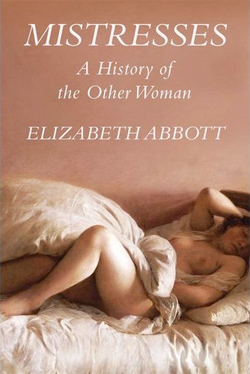
Because if we believe that monogamous marriages that produce children are the strongest units of our society — and we do — then the mistress becomes the termite gnawing at the foundations. And we don’t much care if pests have feelings; we simply want them dead. Americans love marriage. By which I mean of course that Americans hate marriage. Lisa Appignanesi reports in All About Love: Anatomy of an Unruly Emotion that Americans are the marrying-est of all the countries. “Americans have the highest divorce, romantic break-up and remarriage rates in the world: 10 percent of American women — a far greater proportion than their European sisters — will have lived with three or more husbands or domestic partners by the age of 35.” Even after the shine wears off and we’re disillusioned about that “til death” stuff, we fight to find new spouses. And yet, when we are married, all we can do is complain about it. How stifling it is. How boring, how dull, how sexless and dispassionate. It’s because of these opposing feelings that we defend the institution of marriage so vigorously. Underground ambivalence often presents itself as vicious certainty.
We mistakenly equate the mistress with the homewrecker because we hear from the homewrecker all of the time, from Jolie to Rielle Hunter to Monica Lewinsky.
More here.
On the Poverty of Indian Muslims
Anjum Altaf in The South Asian Idea:
How do we square that with the fact that up until 1857 Muslims had ruled parts of India for over 800 years? I mention this fact because, in the minds of some people, Muslims had expropriated all the wealth of India during this period and oppressed all the non-Muslims.
India has been independent for a little more than 60 years, so this transformation from being the owners of the land to being the poorest of the poor could not conceivably have occurred during this short period.
So, did the decline of the Muslims occur during the less than hundred years of British rule between 1857 and 1947? If so, how?
I don’t know. I am writing this post partly to find out and partly to discharge a long-owed debt to Dr. G.M. Mekhri, a remarkable man in my opinion, who I met just once in the mid-1980s and have never forgotten because he had a very unique perspective on this issue.
Dr. Mekhri had a hypothesis that intrigued me. I don’t really know if it would survive a rigorous test but that seems beside the point. What fascinated me was the audacity and innovativeness of his thinking and his ability to communicate the excitement of such thinking to a younger generation.
More here.
ganja man style
Odysseus to Telemachus
ouija board
smile
A candid view of Candide
Julian Barnes in Guardian:

More here.
Jackson Pollock, artist and physicist?
From PhysOrg:
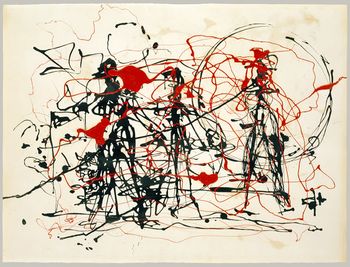
Instabilities in a free fluid jet can form in a few different ways: the jet can break into drops, it can splash upon impact with a surface, or it can fold and coil, as when a stream of honey lands on a slice of toast. The artist Robert Motherwell produced drips and splashes by flicking his brush; Pollock's technique, on the other hand, is defined by the way a relatively slow-moving stream of paint falls onto the canvas, producing trails and coils. In a sense, the authors note, Pollock was learning and using physics, experimenting with coiling fluids quite a bit before the first scientific papers on the subject would appear in the late 1950s and '60s.
More here.
Sunday Poem
In the City of Light
The last thing my father did for me
Was map a way: he died, & so
Made death possible. If he could do it, I
Will also, someday, be so honored. Once,
At night, I walked through the lit streets
Of New York, from the Gramercy Park Hotel
Up Lexington & at that hour, alone,
I stopped hearing traffic, voices, the racket
Of spring wind lifting a newspaper high
Above the lights. The streets wet,
And shining. No sounds. Once,
When I saw my son be born, I thought
How loud this world must be to him, how final.
That night, out of respect for someone missing,
I stopped listening to it.
Out of respect for someone missing,
I have to say
This isn’t the whole story.
The fact is, I was still in love.
My father died, & I was still in love. I know
It’s in bad taste to say it quite this way. Tell me,
How would you say it?
The story goes: wanting to be alone & wanting
The easy loneliness of travelers,
I said good-bye in an airport & flew west.
It happened otherwise.
And where I’d held her close to me,
My skin felt raw, & flayed.
Descending, I looked down at light lacquering fields
Of pale vines, & small towns, each
With a water tower; then the shadows of wings;
Then nothing.
My only advice is not to go away.
Or, go away. Most
Of my decisions have been wrong.
When I wake, I lift cold water
To my face. I close my eyes.
A body wishes to be held, & held, & what
Can you do about that?
Because there are faces I might never see again,
There are two things I want to remember
About light, & what it does to us.
Her bright, green eyes at an airport—how they widened
As if in disbelief;
And my father opening the gate: a lit, & silent
City.
by Larry Levis
from Blackbird, Fall 2006
Saturday, July 2, 2011
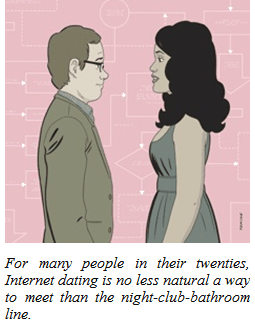
Sex, love, and loneliness on the Internet
Nick Paumgarten in The New Yorker:
More here.
Quasirandom Ramblings
Brian Hayes in American Scientist:
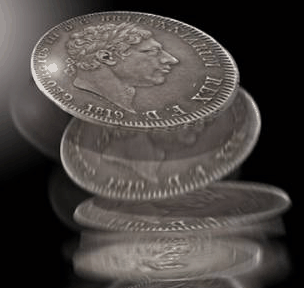
There was no hope of finding an exact solution. Paskov and his adviser, Joseph Traub, decided to try a somewhat obscure approximation technique called the quasi–Monte Carlo method. An ordinary Monte Carlo evaluation takes random samples from the set of all possible solutions. The quasi variant does a different kind of sampling—not quite random but not quite regular either. Paskov and Traub found that some of their quasi–Monte Carlo programs worked far better and faster than the traditional technique. Their discovery would allow a banker or investor to assess the value of a CMO with just a few minutes of computation, instead of several hours.
It would make a fine story if I could now report that the subsequent period of “irrational exuberance” in the financial markets—the frenzy of trading in complex derivatives, and the sad sequel of crisis, collapse, recession, unemployment—could all be traced back to a mathematical innovation in the evaluation of high-dimensional integrals. But it’s just not so; there were other causes of that folly.
On the other hand, the work of Paskov and Traub did have an effect: It brought a dramatic revival of interest in quasi–Monte Carlo.
More here.
Britain’s Crucial Role in the American Civil War
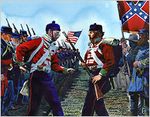
Was it a civil war twice over? Not only did the “war between the states” divide the American people, it sundered the larger English-speaking community stretching across the Atlantic. The conflict was followed with consuming interest by the British, it affected them directly, many of them fought in it — and it split them into two camps, just as it did the Americans. Now that Americans are taught that the war was a noble conflict waged by Lincoln and the forces of light against misguided and contumacious Southerners, it’s especially valuable to be reminded that this was far from how all the English saw it at the time. To be sure, almost no Englishman defended slavery, long since abolished in the British Empire. The British edition of “Uncle Tom’s Cabin” had sold an astonishing million copies, three times its American sales, and the Royal Navy waged a long campaign against the slave trade: on his first visit to Downing Street, President Obama was presented with a pen holder carved from the wood of one of the ships that conducted that campaign. But while some English politicians, like the radical John Bright and the Whig Duke of Argyll, ardently supported the North, plenty sided with the Confederacy.
more from Geoffrey Wheatcroft at the NY Times here.
dante’s Oh and another thing …
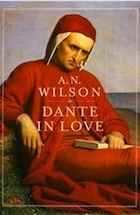
Dante Alighieri (born Florence 1265, died Ravenna 1321) is, AN Wilson declares, “a modern poet”. This claim is justifiable. Over the past two centuries, Dante’s poetry has replaced the ancients as the model of what any poet should aspire to achieve in precision of word and brilliance of image. TS Eliot is Wilson’s favoured illustration. Many others could be mentioned, as diverse as Mandelstam, Borges, Beckett, Walcott and Heaney. Indeed, anyone writing about Dante’s Commedia is likely to find messages in today’s Inbox from at least three aspiring poets currently composing Commedias of their own – as, to cite one moving instance, from a Muslim scholar in embattled Basra. So do we need a history of Dante’s still-living life? Yes and no. Yes, insofar as Dante may be credited (alongside Harold Bloom’s Shakespeare) with having invented that modern “self” – compounded of quirks, follies and interesting secrets – into which biographies now so profitably inquire. As 19th-century readers enthusiastically recognised, the Commedia is full of celebrities from Dante’s own time, vividly three-dimensional in voice, gesture and passion. (The most famous case is that of Francesca da Rimini, murdered by her husband for adultery with her brother-in-law.)
more from Robin Kirkpatrick at the FT here.
the solution can be so much worse than the problem

We think of Europe in 1914 as a continent all too eager for war — volunteers jamming recruiting offices, festooned soldiers joyfully marching to battle and delirious crowds waving them off. To a significant extent, that vision is true, and for a time the Great War brought domestic unity and shared purpose to European nations deeply divided by class, gender and politics. In the euphoria of what everyone from emperors to foot soldiers believed would be a short, glorious and cleansing war that, in the Social Darwinism of the age, could only make Europeans more fit, came an overriding sense of purpose. In “To End All Wars: A Story of Loyalty and Rebellion, 1914-1918,” Adam Hochschild challenges this image of the European home front. In this beautifully written and compellingly narrated story of Britain at war, Hochschild forces us to think about the Great War from the dual perspectives of those who prosecuted it and those who decried it. His primary focus is on well-known “divided families,” such as that of John French, hero of the Boer War, first commander in chief of the British Expeditionary Forces and last viceroy of Ireland, and his sister Charlotte Despard, militant suffragette, Labour Party activist, antiwar activist and, later, Sinn Fein member.
more from Marla Stone at the LA Times here.
China and Pakistan: An alliance is built
James Lamont and Farhan Bokhari in the Financial Times:

Some political analysts go so far as to refer to Pakistan as a “client state” of China and predict that the US will be displaced as the country’s long-term ally. They consider Pakistan as a test-bed for Chinese exports of sophisticated arms such as submarines as well as nuclear reactors and, in time, finance. “The pattern of trade and investment between Pakistan and China suggests that the US has little chance of retaining its status as Pakistan’s major ally,” says James Brazier, an analyst at IHS, a US-based political risk consultancy.
Referring to nearby Burma, he adds: “Pakistan’s relationship with China could soon resemble that of Myanmar, another former part of British India which is now closely dependent on China.”
Pakistan has made little secret about its fondness for Beijing. Aware that its stance irks India and the US, its leaders call China an “all-weather friend”, striking a deliberate contrast with others they consider less dependable. Wen Jiabao, China’s premier, has returned the compliment with his own rhetorical flourish. “No matter what changes might take place in the international landscape, China and Pakistan will remain forever good neighbours, good friends, good partners and good brothers,” he said in the days following Osama bin Laden’s killing by American forces on Pakistani soil in May.
More here. [Thanks to Mohsin Hamid.]