Memory Works Differently in the Age of Google

From Columbia.edu:

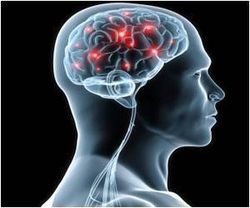
Brain The rise of Internet search engines like Google has changed the way our brain remembers information, according to research by Columbia University psychologist Betsy Sparrow published July 14 in Science. “Since the advent of search engines, we are reorganizing the way we remember things,” said Sparrow. “Our brains rely on the Internet for memory in much the same way they rely on the memory of a friend, family member or co-worker. We remember less through knowing information itself than by knowing where the information can be found.”

Sparrow’s research reveals that we forget things we are confident we can find on the Internet. We are more likely to remember things we think are not available online. And we are better able to remember where to find something on the Internet than we are at remembering the information itself. This is believed to be the first research of its kind into the impact of search engines on human memory organization. Sparrow’s paper in Science is titled, “Google Effects on Memory: Cognitive Consequences of Having Information at Our Fingertips.” With colleagues Jenny Liu of the University of Wisconsin-Madison and Daniel M. Wegner of Harvard University, Sparrow explains that the Internet has become a primary form of what psychologists call transactive memory—recollections that are external to us but that we know when and how to access.

More here.

Wednesday, July 20, 2011

Before ‘Catcher In The Rye’: J.D. Salinger’s First Holden Caulfield Stories

Michael Moats in The Awl:

Tomorrow marks the 60th anniversary of the publication of J.D. Salinger's The Catcher In The Rye. This excerpt is from a longer essay, “The Real Holden Caulfield,” available at the Fiction Advocate.

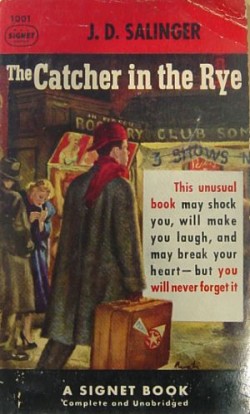
Catcherpaperback1-e1310742714711 It was either dumb luck or artistic excess that led Salinger to give his most sentimental and developmentally arrested character the name “Holden.” Salinger jammed his foot into the trap set by that name, and only managed to walk away because, as with everything about Holden, there is an authenticity that insulates him and his author from the annual term paper analyses that he is “holdin’ on to his innocence” or “holdin’ back his emotions.” According to one story, Salinger was walking through Manhattan some unassuming day in 1947 when he came across the marquee for the movie Dear Ruth, starring William Holden and Joan Caulfield. Side-by-side in marquee letters (in lights, as it were) were the words ‘Holden’ and ‘Caulfield.’ Another story carries over the Joan Caulfield connection, but instead claims that ‘Holden’ came from one of Salinger’s shipmates during his time as part of the entertainment crew on a cruise ship. The plot thickened in 2001 when Denver’s Rocky Mountain News printed the obituary of a man named Holden Bowler, an Idaho-born singer, ad man, 1932 U.S. Olympic athlete, and, in 1941, shipmate to J.D. Salinger on the cruise liner SS Kungsholm. According to Bowler’s widow, “Jerry told him, ‘What you like about Holden is taken from you, and what you don’t like about him, I made up.'” Salinger took no action to confirm or deny the story, nor did he ever comment on speculation that ‘Caulfield’ was pulled from Joan Caulfield.¹ Salinger’s daughter Margaret wrote that her father often complained about “giving his beloved characters ‘terrible’…names, such as Seymour, but that’s just what Seymour’s parents would have done, he said, so he had to do it even though it ‘nearly killed him.’”² So it simply may be that Mr. and Mrs. Caulfield are responsible. It may also be worth noting that the hero of David Copperfield, referred to by Holden in the opening sentences of The Catcher in the Rye, divulges in his own opening chapter that he was born with a caul. So perhaps there is some David Copperfield kind of crap in Holden’s story after all.

More here.

The Science of Sexism: Primate Behavior and the Culture of Sexual Coercion

Eric Michael Johnson in Scientific American:

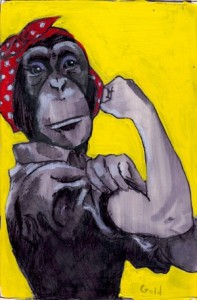
Rosie-197x300 According to statistics compiled by the US Equal Employment Opportunity Commission there were 12,772 workplace sexual harassment cases in 2010 (including all forms of sexual coercion in the work place, and representing a fraction of the number that actually occurred) and 84% of these cases were brought by women. Employers have gotten increasingly serious about cracking down on such abuses but during the last decade they were still held liable to the tune of $540 million. What is going on here? Could this kind of gender inequality be an intrinsic feature of human nature that we’re stuck with or is it simply a failure to create an environment that prevents such behaviors from reoccurring?

Primatologists and evolutionary biologists have taken this question seriously and have developed some surprising conclusions that could inform our approach to this issue. Unlike Randy Thornhill and Craig Palmer’s book A Natural History of Rape, a thesis that was criticized by scholars both in biology and gender studies, other evolutionary researchers have developed a much more balanced analysis. One example is from the recent edited volume Sexual Coercion in Primates and Humans by Martin Muller and Richard Wrangham.

More here.

Pakistan’s Middle Class Extremists

Graeme Blair, C. Christine Fair, Neil Malhotra, and Jacob N. Shapiro in Foreign Affairs:

PAKISTAN_-_Donne_picchiate To test the assumption that poor people are more likely to become radicalized, we fielded a 6,000-person, nationally representative survey of Pakistanis in the four provinces of Punjab, Balochistan, Sindh, and Khyber Pakhtunkhwa (formerly North-West Frontier Province) in the spring of 2009.

The survey measured attitudes toward four important militant groups: al Qaeda; the Afghan Taliban; the so-called Kashmiri groups, which include Lashkar-e-Taiba, Jaish-e-Mohammed, Hizbul Mujahideen, among others; and sectarian groups such as Lashkar-e-Jhangvi and Sipah-e-Sahaba. The survey was much larger than any previous effort and, for the first time, included rural Pakistan. Previous studies had been undermined by low response rates, perhaps because they asked Pakistanis directly about their support for militant groups. Instead, we measured attitudes toward the groups using an indirect questioning technique called an “endorsement” experiment. We presented respondents with a set of four policy issues, including World Health Organization’s administration of polio vaccinations and the redefinition of the Durand Line separating Pakistan from Afghanistan, and asked how much they supported each. Some respondents were told that one of the four militant groups supported the policy. Comparing the support for each policy of those who were told a militant group supported the policy with those who were not gives the measure of support for the group.

The data revealed four findings that undermine common wisdom about support for militancy in Pakistan. First, survey participants were generally negatively inclined toward all four militant organizations. Contrary to some popular accounts, Pakistanis do not have a taste for militants.

More here.

Julian Barnes: The Sense of an Ending

From The Telegraph:

Barnes1_1946309c 'The Sense of an Ending’, the disturbing new novel from Julian Barnes, is narrated by a man looking back on a lifetime of hope and remorse. In this exclusive extract, he grapples with his memories of a former friend – a charismatic figure who enters his life as a prodigious schoolboy and departs it with an act of chilling calculation. There were three of us, and he now made the fourth. We hadn’t expected to add to our tight number: cliques and pairings had happened long before, and we were already beginning to imagine our escape from school into life. His name was Adrian Finn, a tall, shy boy who initially kept his eyes down and his mind to himself.

For the first day or two, we took little notice of him: at our school there was no welcoming ceremony, let alone its opposite, the punitive induction. We just registered his presence and waited. The masters were more interested in him than we were. They had to work out his intelligence and sense of discipline, calculate how well he’d previously been taught, and if he might prove “scholarship material”. On the third morning of that autumn term, we had a history class with Old Joe Hunt, wryly affable in his three-piece suit, a teacher whose system of control depended on maintaining sufficient, but not excessive, boredom.

More here.

dispatch from lebanon

1310561571882

I was looking for Syrian kind of trouble but couldn’t get into Syria. Due in Beirut for a work trip, I had arrived a few days early to head up to Wadi Khaled in Lebanon’s far north. A small lick of land up there juts into Syria just south of Krak des Chevaliers and thousands of people from towns on the Syrian side of the border had fetched up in the preceding weeks before, fleeing house to house searches and outright invasion by their own army. Just the intense awareness of being in the line of sight of an invisible sniper’s rifle, on open ground. I’d met refugee families camped on open farmland, others who still commuted to Lebanon freely from the city of Homs as business owners or day labourers, and the many extended families whose members straddled the border. I’d walked across a freshly cropped field of hay to the edge of the Kabir River and looked twenty yards across the knee-deep muddy water to Syria, its reed beds, market garden hothouses and dirty, small-town concrete buildings indistinguishable from the Lebanese side on which I stood. No barbed wire or walls, no flags even. Just the intense awareness of being in the line of sight of an invisible sniper’s rifle, on open ground. Evidence of the crisis was everywhere. I forgot the rules of journalism and found myself stuffing a paltry wad of Lebanese lira into the hand of a reluctant elder, only to curse myself and the young man who trailed me back to my car looking for his own handout. But the humanitarian crisis itself was generic, much as it must have been in Kosovo or Bosnia, Libya or Iraq. As mobile, affluent, privileged outsiders, our questions to these refugees who had so recently had to flee their homes were just points along the single vector of suffering – how much have you suffered, are you suffering, will you suffer, and in what ways? That accumulated suffering, weighed and conveyed, becomes a kind of combustible fuel that feeds the news cycle.

more from Johnny West at Granta here.

in defense of pop

Lyricopener110718_560

So far, I’m not quite old enough to entertain any worries about the youth of the nation or the deficiencies of their character. Plenty of today’s young adults actually strike me as irritatingly great: Growing up with the Internet means they knew by age 10 what I learned last week, and a lot of them seem awfully bold and brave about asserting themselves all over everyone. My opinion might be in the minority. Lately, the conventional wisdom is that young people think far too much of themselves—they’re coddled little zeppelins of ego in desperate need of shooting down. The cover of July’s Atlantic is emblazoned with the headline how THE CULT OF SELF-ESTEEM IS RUINING OUR KIDS; inside, quotes from psychologist Jean M. Twenge explain how we’re producing generations of feckless narcissists. Earlier this year, the online equivalent of applause greeted a study of pop lyrics from 1980 to 2007 in which a whole team of psychologists, Twenge included, claimed there’s been a rise in narcissism, self-regard, and antisocial hostility at the top of the Billboard charts: Songs have moved from we and us to me and I, and come over all ornery in the process. Surprised? New York Times columnist David Brooks, for one, already saw that as self-evident: “It’s nice,” he wrote, “to have somebody rigorously confirm an impression many of us have formed.” “Rigorously” is a stretch. The study consists of little more than running ten lyrics per year through a word-counting computer program, which I can’t imagine taking longer than an afternoon.

more from Nitsuh Abebe at New York Magazine here.

Cell signalling caught in the act

From Nature:

Gp Brian Kobilka knew that his postdocs didn't like him peeking at their experiments until they were finished. But he couldn't resist a quick look — after all, he and his entire field had been waiting for this result for more than 20 years.

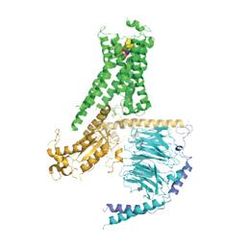
As Kobilka peered through the microscope, the dream finally came into focus. Nestled in a drop of viscous liquid were tiny crystals, each trapping millions of copies of a fragile protein complex. The structure of this complex could finally reveal how one of biology's most important signalling mechanisms, G-protein-coupled receptors (GPCRs), do their job. This structure, published online in Nature1 by a team led by Kobilka at Stanford University in California and Roger Sunahara at the University of Michigan in Ann Arbor, now reveals the complete three-dimensional atomic structure of an activated GPCR — the β2 adrenergic receptor (β2AR) — in a complex with its G protein. GPCRs sit in the membranes of cells throughout the body, where they detect signals from the outside world — such as light, odours and flavours — and signals from within the body, such as hormones and neurotransmitters. These signals are transmitted to the inside of the cell where they activate intracellular G proteins, which then trigger a variety of biochemical pathways.

More here.

grange’s england

Kenneth-Granges-designs-007

Somewhere in the backslapping fest that was the final issue of the News of the World, there were the stirrings of something worth reading. Under the headline “Cream of Britain”, the article revealed what MPs had chosen as the greatest designs from their constituencies. These included the custard cream, the fish finger and McCain Smiley Potato Faces. Not to belittle the cultural impact of anthropomorphised potato powder, but MPs should probably head down to the Design Museum. In a retrospective entitled Kenneth Grange: Making Britain Modern, which opens tomorrow, they’ll encounter a more apt selection of the cream of Britain – and it’s the work of just one man. Kenneth Grange, who turned 82 over the weekend, has designed much of the domestic and public landscape that we’ve taken for granted over the last 50 years. Indoors we’ve used his Kenwood food mixers, Wilkinson Sword razors and Parker pens. Outdoors we ride his InterCity 125 train and his London taxi cab, we sit at his bus stops and on his benches, and for decades we fed change into his parking meters. His output has had such a subtle and pervasive influence on our daily behaviour that it’s almost worrying.

more from Justin McGuirk at The Guardian here.

Wednesday Poem

The Kiss

for David

Not the mosaic couple made famous by Klimt,
bodies cleaved close, so thin they could be
construed as one person.
Not the floating lovers Chagall lifted,
praised with brush strokes of color.
But us, seconds before
you were transported to surgery,
our kiss witnessed by a few
who dared not look away.
They still carry the moment like a postcard
purchased at the Louvre, a souvenir
against forgetting what might
or might not be, the last—our portrait
rendered without an artist, love
sculpted more naked than Rodin's nudes.
How my feet could not feel the ground.
How your heart refused letting go
all that between us shimmered.

by Donna Doyle
from JAMA, June 22/29, 2011

Tuesday, July 19, 2011

Is Shame Necessary?

Jacquet640 Jennifer Jacquet in Edge:

Financial executives received almost $20 billion in bonuses in 2008 amid a serious financial crisis and a $245 billion government bailout. In 2008, more than 3 million American homes went into foreclosure because of mortgage blunders those same executives helped facilitate. Citigroup proposed to buy a $50 million corporate jet in early 2009, shortly after receiving $45 billion in taxpayer funds. Days later, President Barack Obama took note in an Oval Office interview. About the jet, he said, “They should know better.” And the bonuses, he said, were “shameful.”

What is shame's purpose? Is shame still necessary? These are questions I'm asking myself. After all, it's not just bankers we have to worry about. Most social dilemmas exhibit a similar tension between individual and group interests. Energy, food, and water shortages, climate disruption, declining fisheries, increasing resistance to antibiotics, the threat of nuclear warfare—all can be characterized as tragedies of the commons, in which the choices of individuals conflict with the greater good.

Balancing group and self-interest has never been easy, yet human societies display a high level of cooperation. To attain that level, specialized traits had to evolve, including such emotions as shame.1 Shame is what is supposed to occur after an individual fails to cooperate with the group. Shame regulates social behavior and serves as a forewarning of punishment: conform or suffer the consequences. The earliest feelings of shame were likely over issues of waste management, greediness, and incompetence. Whereas guilt is evoked by an individual's standards, shame is the result of group standards. Therefore, shame, unlike guilt, is felt only in the context of other people.

Rescuing Books

Brian Thill in his blog:

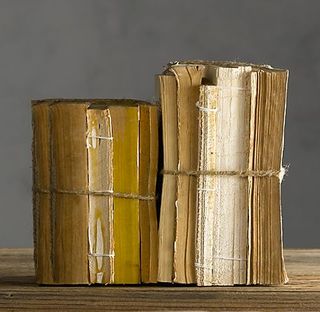
Antique_coverless_book_bundles_$29_from_restoration_hardware_2 Periodically the corporate headquarters would provide us with a new itemized inventory, and we would spend several days scouring the shelves to cull the proper number of books from the stock. Inevitably we would be left with great mounds of mass-market paperbacks that some obscure set of calculations had determined were no longer profitable for us to keep in stock. These were often books that had arrived in great numbers, loaded down with promotional displays, back-to-school promotional inserts, and more. What was necessary to have on hand in great numbers one month was literally garbage the next. The procedure in this case would be to rip the covers from each of the books, scan and bundle the covers and mail them to headquarters, and toss the piles of naked books in the trash compactor out behind the mall. In addition to being prohibited from selling coverless books, we were also forbidden to give them away; just as, each night, after having spent hours baking our fresh bread at the Italian restaurant where I worked every night cooking pasta, we were told to scoop up the heaping trays full of uneaten bread and throw them in the trash. When you’re poor, the pain of participating in the discarding of perfectly good things is particularly acute; it eats at you, you take it personally, as if that part of the world that can spare these things (a part you are kept from) is going out of its way to rub your face in it.

So I started making off with the coverless books. I’d volunteer to haul the great carts laden with garbage-books out to the compactor, and as I tossed the overstocked romance novels and spy thrillers into the bin, I would set aside the abject copies of Virginia Woolf or Philip K. Dick and tuck them behind the wall, retrieving them at the end of the night, when I would take them home and add them to my humble shelves. Neatly stacked, you could hardly tell they lacked covers. And who needed a cover anyway: hadn’t the old adage taught us how meaningless a cover was?

More here.

One big yawn: boredom is not just a state of mind

From The Guardian:

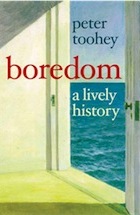
Boredom-A-Lively-History It may not be the most heart-pounding news of the moment, but boredom is coming back into fashion. Not boredom in the sense of lying around blank-faced in a brown study, a practice which in my experience has never really gone out of style, but boredom as a subject (rather than a product) of academic study. In recent years several scholarly books have reanimated a topic that had fallen into analytical torpor, the latest being Boredom: A Lively History by Peter Toohey, an Australian professor of classics who now lives and works in Canada – a country, alas, that bears an unfortunate reputation for being boring.

What is boredom? Is it a mood, an emotion, an affliction, a form of social protection, a gateway to the essence of the self, the human condition, or a modern affectation? These are questions that have concerned philosophers and thinkers dating back to the Enlightenment, not least because boredom occupies territory that overlaps with capital letter concepts like Being and Time. I can't pretend that my own interest in the matter has always been quite so elevated. Mostly when I think about boredom it is out of base self-interest, as a state that I'm very keen to avoid. Ever since I was a child, I have held an extreme aversion to situations that have the potential to be boring.

More here.

The Joy of a Sun Bath, a Snuggle, a Bite of Pâté

From The New York Times:

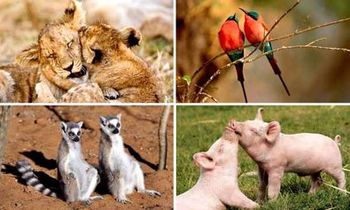
Animal Two ring-tailed lemurs, perhaps a pair, perhaps just two guys out to catch a few rays, sit side by side tilted back as if in beach chairs, their white bellies exposed, knees apart, feet splayed to catch every last drop of the Madagascar sun. All they need are cigars to complete the picture.

There’s a perfectly good evolutionary explanation for this posture. Scientists use the term “behavioral thermoregulation” to describe how an animal maintains a core body temperature. But as the animal behaviorist Jonathan Balcombe points out in his exuberant look at animal pleasure, “The Exultant Ark,” they are also clearly enjoying themselves. A scientist through and through, Dr. Balcombe can’t help giving the study of animal pleasure a properly scientific name: hedonic ethology. True to its subtitle — “A Pictorial Tour of Animal Pleasure” — “The Exultant Ark” showcases surprising, funny, touching, sad, heartwarming pictures by photographers all over the world. Dr. Balcombe’s text is a serious examination of the subject of animal pleasure, a study that “remains nascent and largely neglected in scientific discourse.” But it also delights us along the way with Dr. Balcombe’s observations and examples. On the subject of food as pleasure, for instance, he tells us, “Rats will enter a deadly cold room and navigate a maze to retrieve highly palatable food (e.g., shortbread, pâté or Coca-Cola).” If they happen to find rat chow instead, “they quickly return to their cozy nests, where they stay for the remainder of the experiment.”

More here.

Aatish’s personal fire

Ejaz Haider in The Express Tribune:

ScreenHunter_03 Jul. 19 15.05 The father was killed because he supported a Christian woman. How does that fit in with the article’s thesis that the father hated India (and Pakistan has to hate India and be Muslim) because that religious distinction lies at the core of its ‘other’-isation of India? Or is Pakistan more complex than is hinted in the article?

Aatish’s father did not ‘hate’ India. He was one of those who did much to open up Lahore — to Indians — by using the Basant festival. There is not a single viable political party in Pakistan that does not want to normalise with India. That is a matter of record. But Salmaan Taseer (Aatish’s eye for detail doesn’t inspire much confidence since he gets the spellings of his father’s name wrong), like others, was a proud Pakistani. We don’t need to ‘other’ India to be Pakistanis but neither can we ignore real problems that need to be addressed. Tackling those problems requires mature analysis, not reducing everything to Pakistan’s identity crisis vis-a-vis India.

But what of the Pakistani military, the villains in all this? Since Aatish began with India’s failed GSLV rocket test, let me put in some facts here for him.

The Indian Army, standing at over 1.1 million active-service personnel and 1.8 million reserves, is configured under six area commands (operational) and one army training command (ARTRAC). Three of these area commands — western, northern and southwestern — are totally Pakistan-specific. A fourth, central command, with one corps (1 Corps) is also primarily Pakistan-specific. The Indian Army has 13 corps, out of which eight, including one from the central command, are specific to Pakistan.

More here.

Why My Father Hated India

Aatish Taseer in the Wall Street Journal:

ScreenHunter_02 Jul. 19 11.56 Ten days before he was assassinated in January, my father, Salman Taseer, sent out a tweet about an Indian rocket that had come down over the Bay of Bengal: “Why does India make fools of themselves messing in space technology? Stick 2 bollywood my advice.”

My father was the governor of Punjab, Pakistan's largest province, and his tweet, with its taunt at India's misfortune, would have delighted his many thousands of followers. It fed straight into Pakistan's unhealthy obsession with India, the country from which it was carved in 1947.

Though my father's attitude went down well in Pakistan, it had caused considerable tension between us. I am half-Indian, raised in Delhi by my Indian mother: India is a country that I consider my own. When my father was killed by one of his own bodyguards for defending a Christian woman accused of blasphemy, we had not spoken for three years.

To understand the Pakistani obsession with India, to get a sense of its special edge—its hysteria—it is necessary to understand the rejection of India, its culture and past, that lies at the heart of the idea of Pakistan. This is not merely an academic question. Pakistan's animus toward India is the cause of both its unwillingness to fight Islamic extremism and its active complicity in undermining the aims of its ostensible ally, the United States.

More here.

half Eeyore, half Falstaff

Sad_sack

It pains me to say this, given that I don’t just admire Bloom, but also find him a surprisingly endearing cultural icon, half Eeyore, half Falstaff. When he’s not going around all sad-eyed and plangent, he’s likely to be complaining that “there live not three good critics unhanged in all America, and one of them is fat, and grows old.” Besieged by ravening hordes of ideologues, Bloom has long proclaimed himself the last champion of aesthetic criticism. When Childe Harold to the Ivory Tower Came, he soon discovered that the barbarians of ideology and political correctness were within the gates. In years past, he duly fretted about “theory” and cultural studies, though more recently he has begun to worry that “visual culture will end imaginative literature.” In one splendid diatribe, Bloom derides the academy’s current flood of “comma counters, ‘cultural’ materialists, new and newer historicists, gender commissars, and all the other academic impostors, mock journalists, inchoate rhapsodes, and good spellers.” Against their advocacy of what he calls “the New Cynicism,” he now argues—like any good Augustinian—that love should be the basis for all worthwhile criticism.

more from Michael Dirda at The American Scholar here.

SECRETS & LYRES

Raphael_07_11

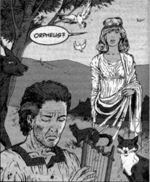
Ann Wroe’s favourite activity, it seems, is to plunge into the lacunae between myth and reality, history and fable. As she proved by her lively descant on Pontius Pilate (who she dared to suggest might have been born in Britain), she has a flighty capacity to spin webs of words, anchored in myth and anecdote, which supply a bridge between what others have said and what fancy supplies. Both erudite and eclectic, in Orpheus she seems as much at home in Greek myth as she was, several books ago, dealing with life in the Middle Ages in the French city of Rodez, in the Aveyron. Like Dionysus, who shares some of his distracting characteristics (both led people a pretty dance), Orpheus was an alien enchanter. Never quite fully Greek, he was born in bristling Thrace, where his father was said by some to be the king and by others to be a ‘sheep-herder and a lone dweller in the fields’. The lyrical Orpheus was a marginal and, at times, a commanding figure. As keleustes on the voyage of the Argo, he stood by the mast and gave the beat to the rowers, who included the A-list of heroic and semi-divine celebrities (that other hell-raiser Heracles not least of them). When the Argo put in at Lemnos, a flat island populated by fatal women (they had all killed their husbands in an earlier episode), the crew pleasured the dangerous females, but Orpheus refrained. He was literally the guiding spirit in the quest for the Golden Fleece, and his well-timed steersmanship later squeezed the Argo between the clashing rocks of the Symplegades.

more from Frederic Raphael at Literary Review here.