
Category: Recommended Reading
Tintin est Mort!
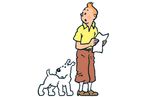
On March 3rd, 1983, the French daily Libération ran under an unusual cover: Against a black background, as though seen through a telescope, a circular drawing portrayed a cowlicked boy lying face down in the snow while a white fox terrier keened brokenly beside him. Tintin est Mort! tolled the headline. It was in fact Hergé, the Belgian-born creator of the tufty-haired hero, who had departed the day prior, but the headline of that issue — in which Libération replaced every illustration, including those for political news, TV listings, weather reports, and even ads, with drawings from Hergé’s canon — indicated the extent to which the man had become enmeshed with his famous creation. For the French-speaking world, it may as well have been Tintin who’d died, rather than the man who, despite valuing lightness, clarity, and humor above all, was never nearly so clear and precise in his politics as he was in his art. Hergé’s style, to bowdlerize Roland Barthes, might be called biographical: He and Tintin are linked by this very tension between truth and simplicity. The Tintin stories — published in 1929 in the right-leaning Catholic newspaper Le Petit Vingtieme, then later in Hergé’s own Journal Tintin and the series of Casterman albums through which we know them now — are celebrated for what the Dutch artist Joost Swarte, writing in 1977, dubbed Hergé’s ligne claire, or “clear line,” style. In his use of uniform, strong lines, flat, saturated color, and clearly delineated shapes and volumes, Hergé negotiates between the techniques of his era’s naturalistic adult adventure comics like Chester Gould’s Dick Tracy and those of gag-based newspaper strips like Bud Fisher’s Mutt and Jeff.
more from Jenny Hendrix at the LA Review of Books here.
the bridge
Once again we start the journey from Cairo to Amman and from there to the bridge. Since my first crossing in 1996, after thirty years of exile, I have crossed many times, sometimes with ease and sometimes with difficulty. I’ve seen Israeli soldiers whose seriousness, which can rise to the level of scowls of superiority, never leaves them and others who practice their job with professionalism, as though they were customs inspectors and nothing more. In the eyes of some, I’ve seen a certain confusion and, very occasionally, I’ve seen one who smiles or shows some desire to be of help. There is no homogeneity to their features—Ethiopian, Brooklynite, Slavic, Yemeni. The common factor is that they’re all armed. Some are newly conscripted adolescents, male and female, and some of these seem bewildered by their daily contact with hundreds of the Arab ‘enemy.’ In all cases, though, the rifles are ready for use at any moment. Taken together, they constitute a nightmare for every Palestinian who crosses the bridge. It’s difficult to trust the smile of a person carrying weapons here. Our problem with the Jew, here in this ‘Jewish state’ as they insist on calling it, is that all three or four generations of Palestinians have seen of him is his helmet. They’ve seen the Jew only in khaki, with his finger on the rifle’s trigger. They’ve seen him only as a sniper at a window, an officer in a tank, a conscript at a checkpoint, a guard clacking his metal heels past the doors to prison cells or along the long corridors that separate them, or a heavy hand in the interrogation rooms, where Israeli law allows the use of what they call ‘moderate physical force’(!) to extract confessions. Many western journalists who maintain a studied and malign blindness to the Occupation have asked me whether the Palestinian people are really ready to coexist with the Jews and I reply that we coexisted with them for hundreds of years in Palestine, the Arab countries, and Andalusia, and that it is Europe, which reproves us and holds us to account, that couldn’t coexist with them and sent millions of them mercilessly to the Holocaust. What is asked of us today, however, and has been ever since their military occupation of our land, is to coexist with their tanks in our bedrooms! Show me one person in this world, I say to them, who can live with a tank in his bedroom.
more from Mourid Barghouti at Guernica here.
christmas in india

I always say that I fell in love with my husband at Kinko’s. Charged with printing blown up photographs for the annual fundraiser for the afterschool program where we both worked, I arrived to pick them up only to find the pictures grainy and only half of the job completed. While I panicked that I’d be fired and was ready to scream at the woman at the counter, Terence calmly, but firmly explained what needed to be done and the urgency with which it had to be completed. We’d been dating for less than two months, but in that moment I thought, this is the person I need by my side. Three years later, we were engaged. For our Christmas affianced, we booked a trip overseas, eager to show our independence, and maybe even create a new tradition apart from our families. On December 22, 2009, we arrived to New Delhi, India. Our plan was to spend a few days there, and then on Christmas Eve we would take a train to Agra so that we could see the Taj Mahal on Christmas Day. From there, we’d travel through Rajasthan and eventually fly to Mumbai. We had tickets for an early morning train out of Delhi, and when we arrived at the station it was still dark. I knew immediately that I didn’t want to be there. People huddled around fires that were lit on the sidewalks and beggars swarmed. I told myself that when the sun came up, everything would feel less scary, but in my rush to get downstairs to the train track, I missed a step. My legs folded forward in a way that only a camel’s should.
more from Courtney Knowlton at The Common here.
Photographs of the year 2011
From The Guardian:

More here.
A Hipster’s Guide to Hinduism
From Smithsonian:
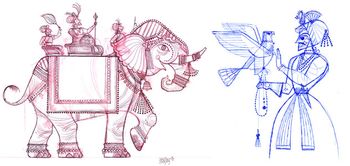
The name of the show—Deities, Demons and Dudes with ‘Staches—is as quirky and upbeat as the 36-year-old artist himself. It’s a lighthearted foil to the museum’s current exhibition, Maharaja: The Splendor of India’s Royal Courts. Patel, who created the bold banners and graphics for Maharaja, was given this one-room fiefdom to showcase his own career: a varied thali (plate) of the animated arts. “I’ve known of Sanjay’s work for a while,” says Qamar Adamjee, the museum’s associate curator of South Asian Art, ducking briefly into the gallery. At first, she wanted to scatter examples of Patel’s work throughout the museum; the notion of giving him a solo show evolved later. “[Hindu] stories are parts of a living tradition, and change with each retelling,” Adamjee observes. “Sanjay tells these stories with a vibrant visual style—it’s so sweet and so charming, yet very respectful. He’s inspired by the past, but has reformulated it in the visual language of the present.”
More here.
Wednesday Poem
Blues
Love won't behave. I've tried
all my life to keep it chained up.
Especially after I gave up pleading.
I don't mean the woman,
but the love itself. Truth is,
I don't know where it comes from,
why it comes, or where it goes.
It either leaves me feeling the knife
of my first breath
or hang-dog and sick
at someone else's unstoppable
and as the blues song says,
can't sit down, stand up, lay down pain.
Right now I want it.
Tuesday, December 27, 2011
Final Proof that Faster-Than-Light Neutrinos are Impossible?

Washington University St. Louis physicist Ramanath Cowsik and his team have come up with what is quite possibly an impossible problem for these faster-than-light neutrinos to overcome. Instead of focusing on the neutrinos themselves, Cowsik looked at the other subatomic particles in the experiment that were smashed together to create the neutrinos.
Here's how the OPERA experiment worked: Protons were shot towards a stationary object, which produced a pulse of particles known as pions. These are low-mass subatomic particles that are composed of a pair of quarks. (For more on pions, check out our particle physics field guide.) These pions were magnetically forced through a long tunnel, and there they decayed into neutrinos and muons, which are like a more massive cousin of electrons.
When the particles reached the end of the tunnel, the muons smashed into the wall and came to a stop, but the extremely light neutrinos slipped right through and made their way to Gran Sasso, a journey they seemingly completed 60 nanoseconds too quickly.
The problem, from a theoretical perspective, is how to fit the pions into this story. To reach superluminal speeds, the neutrinos must have possessed extreme amounts of energy. The law of conservation of energy and momentum demands that that energy came from somewhere — specifically, the pions. But Cowsik calculated that if pions were to have enough energy to create faster-than-light neutrinos, then their lifetimes would also increase.
Physics on the Fringe
Michael D. Gordin in American Scientist:

That is because the fringe is, well, fringy. Among Wertheim’s protagonists are those who deny quantum mechanics, postulate new structures for atoms, revive the ether or reject special relativity, and just about all of them despise general relativity. They self-publish their theories—sometimes they just photocopy handwritten manuscripts—and circulate them among scientists worldwide, who usually end up tossing them in the wastebasket. Wertheim, an accomplished science writer, has collected such texts for years now and sympathetically narrates many of them for us. Such ephemera are very hard to come by, given their frequent encounters with the trash heap, and her archival efforts are to be lauded (as is the renewed attention she brings to mathematician Augustus De Morgan’s delightful 1872 book, A Budget of Paradoxes, which catalogs the rejectamenta of the science of his day). She wants us to take these “outsider physicists” seriously, not as a kooky cultural phenomenon, but as people actually doing science in a way that demands as much attention from mainstream science as folk art now claims from the elite art community.
More here.
North Korea Party Rock Anthem
A Shared Fate: The Political Implications of the Eurozone Crisis
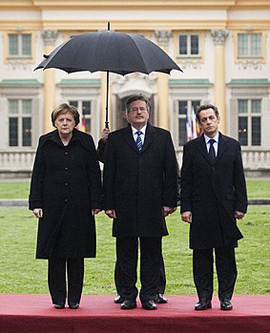
Paul Krugman recently wondered whether it was possible to be “both terrified and bored” by the Eurozone crisis. It is indeed terrifying: the EU—the most important political innovation since the invention of the democratic welfare state—might break apart, or worse. Some are predicting the return of large-scale political violence; protesters on the streets of Athens are already comparing Greece, 2011 to Dachau, 1933. But the crisis is also boring, in that a sad pattern has predictably been repeating itself: markets jitter; politicians declare a make-or-break moment; national leaders host an all-night summit; bleary-eyed, they declare the crisis’s final resolution; the market-confidence fairy makes a brief appearance; and then the cycle starts all over again.
By now most people have settled on one of two economic solutions: either let the European Central Bank act as lender of last resort and issue Eurobonds (everyone’s view, it seems, except the German government’s) or impose discipline so as to avoid inflation and a permanent Southern European Mezzogiorno (the official German view).
In the economic debate, however, it is easy to lose sight of the political and, ultimately, moral stakes. While it’s true that much of the business of the EU is business—running a common market—European integration was always first and foremost a political project: its goals included enduring peace, the entrenchment of democracy in member states, and, most recently, moving toward “ever closer union.” The crisis may indeed require Europeans to get serious about political union, at least among the Eurozone countries. But political union will not work without some sense of democratic legitimacy, which the current proposal for tighter cooperation among national executives is unlikely to generate.
Brian Leiter on the Analytic/Continental Distinction
Over at Philosophy Bites:
Many philosophers self-identify as 'analytic' or 'continental' philosophers. But does this sort of label make sense? Brian Leiter, who, amongst other things, is an expert on Nietzsche, is sceptical of the value of the terms as typically used. In this episode of the Philosophy Bites podcast he explains why.
Listen to Brian Leiter on the Analytic/Contintental Distinction
Rejoice for Utopia is Nigh!

ONE hundred years ago an American immigrant invented science fiction.
Okay, that’s not true. Not even close. People have been building fantastic narratives out of scientific gobbledygook since the days of the Greeks. Lucian of Samosata imagined a trip to the moon over 17 centuries before Jules Verne took a whack at it. And decades before 1911 Verne and H.G. Wells wrote the stories that established the contours of the genre: fantastic voyages in space and time, alien encounters, technology run amok, and so forth. The term “science fiction” wouldn’t even be invented until 1929.
But the genre as a coherent field of literary endeavour—as the thing that takes up a whole wall at your local Barnes & Noble or Waterstone’s—might not have come to be if it weren’t for a failed inventor-turned-publisher with aesthetic ambitions. Naive, utopian and romantic, a man named Hugo Gernsback ended up establishing a new strand of science fiction, one that helped shape (and was shaped by) the American century.
Gernsback had come to America in 1904 with the common immigrant dream of striking it rich. He planned to revolutionise battery technology, but when that didn’t pan out he turned to scientific-magazine publishing. He started out with mail-order catalogues for his imported radio-equipment business, but, as the years went on, his efforts took a more explicitly literary turn. Amazing Stories, which he founded in 1926, has a fair claim to being the first magazine dedicated solely to what he called “scientifiction”. It would go on to help define the genre, publishing the debuts of some of its greatest authors.
Imran Khan: My time has come
From The Telegraph:

Further evidence of Mr Khan’s steepling ascent was on display in Karachi, Pakistan’s biggest city, today on Christmas Day, when at least 100,000 people turned out to hear his message that change was sweeping the country. The figure is all the more remarkable as the city is far from Mr Khan’s stronghold of Lahore. “I’ve never seen a gathering like this in Karachi in two decades,” said a local journalist covering the rally. Everything changed in October, when he attracted more than 100,000 supporters to a parade ground in Lahore. The world took notice of a new star in Pakistan's political firmament, dominated for decades by a handful of the richest families. A YouGov-Cambridge poll released on Fri Dec 23 found that Khan is the most popular political figure in Pakistan by far, with some 81 per cent of respondents choosing him as the person they think best suited to lead the country. Two thirds meanwhile said they would vote for his PTI party.
More here.
The Hormone Surge of Middle Childhood
Natalie Angier in The New York Times:

Subsidizing the deft frenzy of brain maturation is a distinctive endocrinological event called adrenarche (a-DREN-ar-kee), when the adrenal glands that sit like tricornered hats atop the kidneys begin pumping out powerful hormones known to affect the brain, most notably the androgen dihydroepiandrosterone, or DHEA. Researchers have only begun to understand adrenarche in any detail, but they see it as a signature feature of middle childhood every bit as important as the more familiar gonadal reveille that follows a few years later. Middle childhood is when the parts of the brain most closely associated with being human finally come online: our ability to control our impulses, to reason, to focus, to plan for the future.
More here.
Tuesday Poem
An Ox Looks at Man
They are more delicate even than shrubs and they run
and run from one side to the other, always forgetting
something. Surely they lack I don't know what
basic ingredient, though they present themselves
as noble or serious, at times. Oh, terribly serious,
even tragic. Poor things, one would say that they hear
neither the song of the air nor the secrets of hay;
likewise they seem not to see what is visible
and common to each of us, in space. And they are sad,
and in the wake of sadness they come to cruelty.
All their expression lives in their eyes–and loses itself
to a simple lowering of lids, to a shadow.
And since there is little of the mountain about them —
nothing in the hair or in the terribly fragile limbs
but coldness and secrecy — it is impossible for them
to settle themselves into forms that are calm, lasting
and necessary. They have, perhaps, a kind
of melancholy grace (one minute) and with this they allow
themselves to forget the problems and translucent
inner emptiness that make them so poor and so lacking
when it comes to uttering silly and painful sounds:
desire, love, jealousy
(what do we know?) — sounds that scatter and fall in the field
like troubled stones and burn the herbs and the water,
and after this it is hard to keep chewing away at our truth.
by Carlos Drummond de Andrade
from In Praise of Fertile Land
translated by Mark Strand
from In Praise of Fertile Land
translated by Mark Strand
Václav havel: not quite who you thought….

Havel once said that the true dissident is not interested in power, has no desire for office and does not gather votes. It’s an ironic statement coming from a future president. The absurdity of his own rise to power has been pointed out numerous times, first and foremost by Havel himself. And yet, whether or not he lived up to his own values as a politician, Havel always felt that the role of a leader should be no different than the role of a dissident — a leader should simply be a voice for the people. The only kind of politics that makes sense, said Havel, is one that is guided by conscience. Political institutions should be open, dynamic and small, rather than closed, inviolable and huge. “It is better to have organizations springing up ad hoc,” he wrote in The Power of the Powerless, “infused with enthusiasm for a particular purpose and disappearing when that purpose has been achieved.” In other words, institutions are best when they serve a specific purpose, and are not a replacement for community. And they are best when they place moral concerns before political ones. Without addressing the spiritual needs of people, without focusing on real human relationships and personal trust, democracy was likely to be just as absurd as communism. In this, Havel was much more radical than most of his post-democracy peers, at least intellectually. He was a politician who saw good politics as a result rather than a solution.
more from Stefany Anne Golberg at The Smart Set here.
speaking N’Ko

When Ibrahima Traore takes his sons to a park in Montclair, N.J., he often sits on a bench and reads. He reads English, French and Arabic, but most of the time he reads N’Ko, a language few speakers of those languages would recognize. N’Ko is the standardized writing system for Mande languages, a family of closely related tongues — among them Traore’s language of Mandinka, but also Jula, Bamana, Koyaga, Marka — spoken, for the most part, in eight West African countries, by some 35 million people. N’Ko looks like a cross between Arabic and ancient Norse runes, written from right to left in a blocky script with the letters connected underneath. Traore types e-mail to his family on his laptop in N’Ko, works on his Web site in N’Ko, tweets in N’Ko on his iPhone and iPad and reads books and newspapers written in N’Ko to prepare for the N’Ko classes he teaches in the Bronx and for his appearances on an Internet radio program to discuss cultural issues around the use of N’Ko. For years, the Web’s lingua franca was English. Speakers of French, Hindi and Urdu, Arabic, Chinese and Russian chafed at the advantage the Internet gave not only American pop culture but also its language. For those who lived at the intersection of modern technology and traditional cultures, the problem was even worse. “For a long time, technology was the enemy,” says Inée Slaughter, executive director of the New Mexico-based Indigenous Language Institute, which teaches Native Americans and other indigenous peoples how to use digital technologies to keep their languages vital. Heritage languages were being killed off by increasing urbanization, the spread of formal education and the shift to cash crops, which ended the isolation of indigenous communities. Advances in technology seemed to intensify the decline. “Even in 1999 or 2000, people were saying technology killed their language,” Slaughter says. “Community elders worried about it. As television came into homes, English became pervasive 24/7. Mainstream culture infiltrated, and young kids want to be like that. It was a huge, huge problem, and it’s still there. But now we know ways technology can be helpful.”
more from Tina Rosenberg at the NYT Magazine here.
somewhat toilsome and perhaps fruitless adventure?
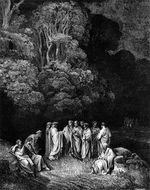
To put it another way, how do we make the ancient world make sense to us? How do we translate it? Young Taplow doesn’t actually rate Browning’s translation very highly, and indeed—to our tastes—it is written in awful nineteenth-century poetry-speak (“Who conquers mildly, God, from afar, benignantly regardeth,” as Browning puts the key line, is hardly going to send most of us rushing to the rest of the play.) But when, in his lessons, Taplow himself gets excited by Aeschylus’ Greek and comes out with a wonderfully spirited but slightly inaccurate version of one of the murderous bits, the Crock reprimands him—”you are supposed to be construing Greek“—that is, translating the language literally, word for word—”not collaborating with Aeschylus.” Most of us now, I suspect, are on the side of the collaborators, with their conviction that the classical tradition is something to be engaged with, and sparred against, not merely replicated and mouthed. In this context, I can’t resist reminding you of the flagrantly modern versions of Homer’s Iliad by the English poet Christopher Logue, who died on December 2—Kings, War Music, and others—”the best translation of Homer since [Alexander] Pope’s,” as Garry Wills called them in these pages.* This was, I think, both a heartfelt and a slightly ironic comment. For the joke is that Logue, our leading collaborator with Homer, knew not a word of Greek.
more from Mary Beard at the NYRB here.
