
Category: Recommended Reading
The Idea of Order at Key West
Saturday, December 31, 2011
Ein glückliches neues Jahr!
Progressives and the Ron Paul fallacies
Glenn Greenwald in Salon:
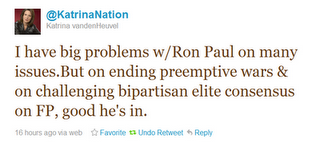
The Ron Paul candidacy, for so many reasons, spawns pervasive political confusion — both unintended and deliberate. Yesterday, The Nation‘s long-time liberal publisher, Katrina vanden Heuvel, wrote this on Twitter:
That’s fairly remarkable: here’s the Publisher of The Nation praising Ron Paul not on ancillary political topics but central ones (“ending preemptive wars & challenging bipartisan elite consensus” on foreign policy), and going even further and expressing general happiness that he’s in the presidential race. Despite this observation, Katrina vanden Heuvel — needless to say — does not support and will never vote for Ron Paul (indeed, in subsequent tweets, she condemned his newsletters as “despicable”). But the point that she’s making is important, if not too subtle for the with-us-or-against-us ethos that dominates the protracted presidential campaign: even though I don’t support him for President, Ron Paul is the only major candidate from either party advocating crucial views on vital issues that need to be heard, and so his candidacy generates important benefits.
Whatever else one wants to say, it is indisputably true that Ron Paul is the only political figure with any sort of a national platform — certainly the only major presidential candidate in either party — who advocates policy views on issues that liberals and progressives have long flamboyantly claimed are both compelling and crucial. The converse is equally true: the candidate supported by liberals and progressives and for whom most will vote — Barack Obama — advocates views on these issues (indeed, has taken action on these issues) that liberals and progressives have long claimed to find repellent, even evil.
Scientists List 2011’s Most Fascinating Discoveries

Matt Sponheimer, anthropologist at University of Colorado, Boulder:
“One of the big controversies that has been playing out in 2011 is what were the environments in which early hominin lived. There has been something of a fight between the Tim White and Thure Cerling groups over this, with the last salvo being a 2011 paper by Cerling, et al. White, et al. had been pushing for closed, even forested environments, while Cerling, et al. are pushing for quite open and probably very dry environments. These scenarios have very important implications for our understanding of human evolution.” [Top 10 Mysteries of the First Humans]
Zen Faulkes, brain, behavior and evolution researcher at University of Texas, Pan American:
“We are making headway in using fMRI (functional magnetic resonance imaging) brain scans to make crude predictions about what people 'think.' Lots of people are investigating the neural bases of deception, and from this, people have been thinking about whether fMRI could be used as a lie detector. This idea is so common now that it was even featured on 'MythBusters.'
“This paper showed a very simple way to 'beat the machine.' It's important because it shows that this fast-moving and exciting field of neuroscience is still very much at the basic research stage. It shouldn't be rushed out of the lab into law enforcement and intelligence communities yet.”
An Interview with Michael Ondaatje

The Barnes & Noble Review: In an essay on Leonard Cohen, you once wrote, “Nothing is more irritating than to have your work translated by your life.”
Michael Ondaatje: I was probably about eighteen years old at the time (laughs). Not to be trusted. No, I think he was someone who, very early on, was playing with the whole “persona” thing. I mean, he was “Leonard,” in quotation marks, and at that time in Canada, he was really kind of the only poetry superstar. I guess the problem is that, if that's the only way of interpreting the work, it's an irritation. But obviously, in this book, by using that name, I'm stepping into the lion's mouth.
BNR: But there were a couple of points where you seemed to make a very distinct choice to separate yourself from the narrator. One that stands out is when the narrator says, “I am someone who has a cold heart.” I hate to interpret that through the lens of your life, but to me it wasn't at all the impression your other work gives of you as a man.
MO: Actually, that would be the moment that clarified for me the distinction between me and him. I think that what's interesting is what you invent, in that even if it's fictional, it has many, many grains of yourself, and many grains of alternative selves. And what you pick as an alternative life is in many ways as autobiographical. It's like painters' self-portraits. On one level they're always more sophisticated than they are, or more humble than they are.
Sri Lanka’s Ghosts of War
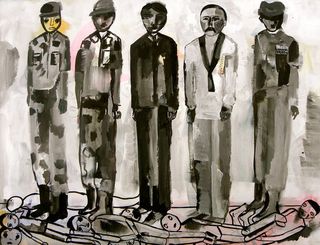
THE Sri Lankan government’s defeat of the separatist Tamil Tigers in 2009 ended a three-decade war that took tens of thousands of lives. But only now is the government beginning to acknowledge its huge human cost. Two weeks ago, a government-appointed reconciliation commission released a long-awaited report, giving voice to the war’s civilian victims for the first time.
From August 2010 to January 2011, hundreds of people appeared before the commission in tears, begging for news of their loved ones, many of whom had last been seen in the custody of security forces. A doctor spoke of how they managed to survive under deplorable conditions in places “littered with dead bodies and carcasses of dying animals.”
In October, I visited a rural school just 6 miles from Mullivaikkal, on the northeast coast of the island, where the army finally crushed the Tigers — an area still off-limits to civilians. The government says there are too many land mines to allow resettlement; critics say there are too many bodies in mass graves.
The classroom had a new roof, but more than two years after the war ended, its walls were still pockmarked with shrapnel, a window was shattered and the floor was cracked. Most students’ uniforms were discolored; many wore flip-flops and carried tattered bags. A 7-year-old with a deep scar across his back stared at me. A shell had landed while his family slept and his sister was killed, he told me in a thin voice.
One child after another spoke of injuries and deaths caused by shelling; of lingering wounds; of forced conscription by the Tigers; of poor widowed mothers; and of family members missing after being taken into state custody.
What Really Happened to Strauss-Kahn?
Edward Jay Epstein in the New York Review of Books:

He knew he had a serious problem with one of his BlackBerry cell phones—which he called his IMF BlackBerry. This was the phone he used to send and receive texts and e-mails—including for both personal and IMF business. According to several sources who are close to DSK, he had received a text message that morning from Paris from a woman friend temporarily working as a researcher at the Paris offices of the UMP, Sarkozy’s center-right political party. She warned DSK, who was then pulling ahead of Sarkozy in the polls, that at least one private e-mail he had recently sent from his BlackBerry to his wife, Anne Sinclair, had been read at the UMP offices in Paris.
More here.
Trials and Errors: Why Science Is Failing Us
Jonah Lehrer in Wired:

Researchers have developed an impressive system for testing these correlations. For the most part, they rely on an abstract measure known as statistical significance, invented by English mathematician Ronald Fisher in the 1920s. This test defines a “significant” result as any data point that would be produced by chance less than 5 percent of the time. While a significant result is no guarantee of truth, it’s widely seen as an important indicator of good data, a clue that the correlation is not a coincidence.
But here’s the bad news: The reliance on correlations has entered an age of diminishing returns. At least two major factors contribute to this trend. First, all of the easy causes have been found, which means that scientists are now forced to search for ever-subtler correlations, mining that mountain of facts for the tiniest of associations. Is that a new cause? Or just a statistical mistake? The line is getting finer; science is getting harder. Second—and this is the biggy—searching for correlations is a terrible way of dealing with the primary subject of much modern research: those complex networks at the center of life.
More here.
Eyebrow Dancing Girl
Climbing MOUNT EVEREST
From Panoramas:

Why did I climb Everest?
I have a theory that people climb for the smell of it. Air at very high altitude smells completely different to lower altitudes. People become addicted to this smell and need more and more to get less and less of it. This is what makes them get higher. What did I think of on the summit? When I reached the south summit I was suffering from a lack of Spanish Olives. I was most preoccupied with thoughts of the tin of olives sitting in my tent at base camp. The preoccupation was the result of a very intense dream about olives which was interrupted by the alarm summoning me to our summit attempt. When I reached the south summit the view to the main summit interested me from a mountaineering point of view and all dreamings of olives were banished from my head. On the summit I felt a mixture of apprehension and curiosity. Our only comments to each other after initial congratulations were about the fact that the summit is precisely half way. It seemed to me that the curvature of the earth was apparent, and I spent some time trying to think of a means to test if this was a real observation or an illusion. In the end I decided it was an illusion, but it was a strong illusion. Overall my main feeling was of surprise.
More here. (Note: Thanks to Iqbal Riza)
The Dirt About Gossip
From The New York Times:
All religions condemn gossip, and Judaism has gone so far as to declare it a sin: a sin to initiate it, to repeat it, to listen to it. Yahweh’s position, then, is unequivocal. But Epstein is of two minds, and while he deplores the blight gossip has inflicted on our culture, he convincingly argues that it serves any number of worthwhile purposes, from the literary (Elizabeth Hardwick called it “character analysis”) to the sociological (David Sloan Wilson, a professor of biology and anthropology at Binghamton University, says it’s important in regulating behavior and defining membership in a group). Ultimately, what makes Epstein such a congenial authority on the subject is that he relishes good gossip himself.
More here.
right-wing green

Not so long ago, environmentalism was assumed to be a leftwing cause: anti-capitalist, pro-social justice and on the side of the underdog. It is only recently that the idea that green goes better with blue than red has gained credence and in the philosopher Roger Scruton environmental conservatism has found its most eloquent, intelligent and passionate advocate. He is scathing about those on the left who “regard ‘conservatism’ as a dirty word, with no semantic connection to the ‘conservation’ they favour”. He argues that the link between the two is much more than etymological. “Conservatism and conservation are two aspects of a single long-term policy, which is that of husbanding resources and ensuring their renewal.” Scruton’s case for a green conservatism is compelling. Phrases such as “frugality is founded on the principle that all riches have limits”; “it is easier to destroy than it is to restore”; and society “is a partnership not only between those who are living, but between those who are to be born” could easily be inserted into speeches by ecologists. In fact, they all come from the pen of conservatism’s intellectual hero, Edmund Burke.
more from Julian Baggini at the FT here.
“paradise”

Here’s the striking thing about James M. Cain’s essay “Paradise,” originally published in the American Mercury in March 1933: Even then, before many of the prevailing tropes about Los Angeles had yet to assert themselves, we were already looking at the place through a mythic filter, one Cain sets out to undermine. You can see it in that fantastic opening sequence, with its intention to wash out all the preconceptions that have emerged from “Sunkist ads, newsreels, movie magazines, railroad folders, and so on.” You can see it in the deftly rendered metaphor by which Cain reframes Southern California as a kind of watercolor, because it “blurs here and there, and lacks a very clear outline.” He’s right, of course, as he is about the legendary “land of sunshine, fruit, and flowers” — all of which, he admits, are part of the territory, just “not with the lush, verdant fragrance that you have probably imagined.” For Cain, then, the idea is to cut through all the nonsense and offer up a vision of (as that long-ago issue of the Mercury promised on its cover) “What Southern California Is Really Like.”
more from David L. Ulin at the LA Times here.
graham is in pico’s head

Iyer, a journalist and world traveler, the author of seven books of nonfiction and two novels, begins his own memoir this way: “I was standing by the window in the Plaza Hotel, looking out.” Where is this Plaza Hotel? In New York? Hardly. It’s in La Paz, Bolivia, a country where Iyer and a friend nearly died in a car crash on a mountain road one New Year’s Day. And who is Iyer? The answer to that question unfolds in the ensuing pages, emerging from behind a scrim of other characters — not only Greene, but the author’s philosopher father, Raghavan Iyer, a professor at the University of California, Santa Barbara, as well as Iyer’s old traveling companions and school friends and the women he has encountered along the way. Iyer is far from the first Greenite to write about this prolific figure, whose long and illustrious career encompassed scores of novels, essays, short stories and plays. Greene’s official biographer, Norman Sherry, devoted more than 2,000 pages, gathered in three volumes, to an exploration of the author’s boyhood and manhood, his conflicted Roman Catholicism, his love affairs and friendships, his devious psychology. Greene teased out the knotted skein of attitudes that tangled his psyche in his published works, whose overall theme can be usefully (if reductively) condensed to the sentence that appears in his play “Carving a Statue,” in which a sculptor describes the subject that shapes his work: “My indifference and the world’s pain.”
more from Liesl Schillinger at the NY Times here.
Friday, December 30, 2011
Is Incest Wrong?

In my time teaching students about making choices, especially moral ones, based on sound reasoning and evidence, we often range into areas many have not thoroughly considered. After all, everything deserves scrutiny if we are to be fairly sure an idea (or belief) is worth pursuing, defending and so on. If this idea is worth our support, it will pass tests of reasonable scrutiny; if it does not, it either means we must strengthen the idea by addressing its failings or discard it altogether. For example, there is no good reason to justify the oppression of gay people or women – though there are plenty of reasons people do. Thus because there are no good arguments to support oppressing gay people, the idea should be discarded and indeed opposed where it arises. In an effort to battle bad ideas, we should scrutinise (or at least be willing to scrutinise) every view, belief and idea we have.
Nothing is sacred in my class (indeed, we’ve debated the merits of sanctity itself). We engage with questions that focus on real-life matters, which tend to evoke knee-jerk reactions of dismissal and/or disgust.
With this in mind, my students asked whether incest or necrophilia is wrong. Since in many countries, both of these are automatically crimes, I think it’s important to consider what arguments there are for considering these as automatically wrong. However, just because something is right or wrong does not mean that the law follows suit. Something can be legal and be wrong by a moral standard, and vice versa. Here we are mainly considering the morality of these two supposedly taboo types of sexual conduct. Are they, by definition, wrong?
Tariq also looks at whether necrophilia is wrong.
More Justice through More Europe
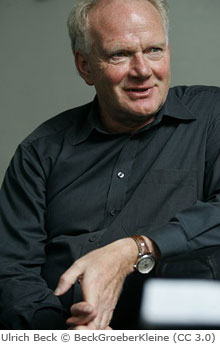
Mittelweg 36: What do the financial crisis and the nuclear energy crisis represented by Fukushima mean for Europe?
Ulrich Beck: I'd see the dynamics and the relevance of both events – the financial crisis and Fukushima – in terms of my concept of the risk society, or world risk society. The risk society is a could-be-society. The term risk refers to the “could-be”, the anticipation of catastrophes in the present. One has to differentiate here between the future, of which we know nothing, and our conception of the future, which is portrayed or socially constructed as a global risk in the widest sense. This catastrophic subjunctive is the typhoon of events that broke into the centre of social institutions and people's daily lives in the form of the financial crisis (though not only that): irregular, rooted neither in the constitution nor democracy, charged with unacknowledged incomprehension, blowing away hitherto fixed points of reference. As a result, the sense of a kind of common destiny arises. This is indicated by the abrupt downturns in the financial markets, whose turbulence makes tangible the interconnectedness of different worlds. If Greece declares bankruptcy, is that another sign that my pension in Germany is no longer safe? What does “state bankruptcy” actually mean? For me? Who would have thought that the banks, usually so arrogant, would ask the states for help, and that the chronically hard-up states would rush through measures enabling astronomical sums to be placed at the disposal of these cathedrals of capitalism? Today, it is universally taken for granted. That isn't to say that people actually understand what it means to be joined by a common financial destiny consisting of insecurity, incomprehension and the sense of cross-border dependency. This anticipation of global risk works its way into the very capillaries of daily life and, as I see it, is one of the major forms of mobilization in the twenty-first century. Everywhere these kinds of threat are perceived locally as cosmopolitan events creating an existential bond between one's own life and everyone else's. Such events collide with the conceptual and institutional framework that has so far delineated how we think about society and politics. They challenge this framework from within and at the same time encounter differing cultural conditions and contexts that lead to very contrary cultural and political estimations of the risks.
The Rule of Thumb: Vagina Types and Variability of Female Orgasm

In 1924 a revolutionary research paper on the female orgasm was published in Europe under the pen name A. E. Narjani. But as it turns out, the real author was actually Princess Marie Bonapart, great-grandniece of Emperor Napoleon I of France and daughter of Prince Roland Bonaparte. After she married Prince George of Greece and Denmark in 1907, her official title became Her Royal Highness, Princess George of Greece and Denmark.
Sadly, the Princess suffered from what many women today still do – the inability to reach orgasm solely through vaginal intercourse. Defying the social mores of her era, she discovered she could reach orgasm through masturbation. While this led her to blame physiology and not psyche, it still left her deeply frustrated with her husband and eventual four other lovers. But the Princess refused to accept such fate as a permanent condition! Instead, she began some of the most revolutionary work of her time on female sexuality and anatomy while also embarking on her quest for orgasm by penetrative sex.
She first examined and interviewed 243 women. One by one she measured the distance between their clitorises and the vaginas, then compared the distance to their frequency and ease of orgasm. What she discovered was a direct correlation between the ability to orgasm through vaginal sex and the measurement of space between the vagina and the clitoris. She categorized the findings from her subjects in three ways: paraclitoridiennes (para meaning “alongside”), mesoclitoriennes (meso meaning “in the middle”), and téléclitoridiennes (télé meaning “far”).
Paraclitoridiennes were the fortunate ones. The space between their vaginas and clitorises measured less than one inch. For the 69% of her test subjects that fell into this category, vaginal orgasm was easier than ever to reach. However, similar studies conducted in modern times prove this statistic extremely high.
Indie Rock Virtues

3:AM: So how did you start? You have brought a freshness to academia, how come?
Josh Knobe: From very early on I was interested in philosophical questions but I always had a fear of academia. I thought that if I ever became an academic I’d became this dried up person and spend my life writing about something that no one would ever read or care about. And I’d write about it for a few years for a few other professors who’d obsess over it but it would make no difference. So then after I was an undergraduate I was still very interested in philosophy but instead of going to philosophy school I instead did a whole bunch of weird jobs. I was working with homeless people and teaching English in Mexico and doing translations in France. So then over time I began to feel that I wasn’t getting anywhere and I’d always had this interest in philosophical problems and they wouldn’t go away. So in the end I decided to return to academia and I eventually did return to grad school.
3:AM: And what kind of philosophy interested you at the time, given that experimental philosophy didn’t exist then, obviously!
JK: At the time before I went to grad school the kind of philosophy I was interested in was very much the traditional philosophy. I was obsessed with Nietzsche and Kierkegaard and so I wanted to investigate and do the kinds of things that they were doing. So that was what my sense of what philosophy was all about. But at the same time I was doing all this research in psychology. I had published a bunch of papers with someone who had been a grad student at the time when I was an undergraduate student. And we were working away at these psychological projects. But at that time I saw this work as being sort of a thing on the side and separate from my real interests, which I took to be my philosophical interests. And then when I got to grad school something kind of weird happened. Someone started to write a commentary on the stuff that we had been doing in the psychology journals. But this person was in philosophy and wanted to treat these psychological papers as being of philosophical importance. So he’d be saying, you know, I think you’re right about this, wrong about that, maybe this needs better evidence. But he was treating it all as if it had philosophical significance.
Manners for the modern world
From Salon:
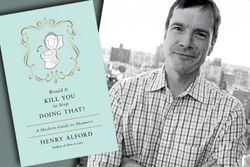
I would also argue that manners can be relative within the mind of a single individual. An anecdote (for anecdotes are the very soul of books on manners): I recently witnessed a man on an elliptical trainer at my gym scold a woman on a nearby machine for taking a (very brief and soft-spoken) phone call that was obviously from a doctor. It’s true that cellphone use in that area can be annoying and is therefore prohibited, but this is the same man who favors everyone around him with an angry running commentary on whatever he’s watching on TV as he works out. “One of the more curious aspects of bad manners,” Alford astutely observes, “is that we almost never think that we ourselves have them.” Which is why, when it comes to politeness, the letter of the law matters far less than the spirit. What Alford finally concludes is that courtesy derives from “imagination” rather than a careful adherence to established rules or even simple empathy. “Good manners,” he writes, “are your ability to take on another person’s point of view regardless of your own.”
More here.