the devil’s advocate

ID_PI_GOLBE_BIERC_FT_001

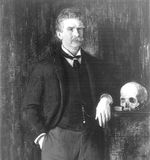
Cynicism, for Bierce, was not just an attitude; it was his life force. It’s ironic then that The Devil’s Dictionary is seen today primarily as a delightful little book of irreverent (if now anachronistic) witticisms. This is entirely Bierce’s fault. In life and in art, Bierce made it his prerogative to present himself as a Class A misanthropic know-it-all. Much of the real sensitivity and even anguish that produced The Devil’s Dictionary is obscured by an intentional ironic distance. By the time The Devil’s Dictionary was published, Bierce was 69. He had made a career as a curmudgeon, a writer with a big personality who always kept distance between himself and his public. He was famous for his motto “nothing matters” and was known as “Bitter Bierce.” Even his popular short stories, based on his experiences of the Civil War (see the classic “An Occurrence at Owl Creek Bridge”) were never autobiographical, never meant to bring readers closer to the man. He publicly attacked friends, employers, and of course, other writers. (Bierce had a literary run-in with Oscar Wilde once after the latter declared satire to be “as sterile as it is shameful, and as impotent as it is insolent.” Bierce responded in print with a torrent of insults, calling Wilde “a gawky gowk,” a “dunghill he-hen.” and the “littlest and looniest of a brotherhood of simpletons” who had “the divine effrontery to link his name with those of Swindburne, Rosetti and Morris.”) How could someone who addressed his book to “those…enlightened souls who prefer dry wines to sweet, sense to sentiment, wit to humor and clean English to slang” be taken all that seriously, especially by 21st-century readers? Today, The Devil’s Dictionary comes off as smart but smug. Who was Ambrose Bierce to pronounce such judgments on humanity?

more from Stefany Anne Golberg at The Smart Set here.
the pre-pre-raphaelite

C6f94546-e5b9-11e0-8e99-00144feabdc0

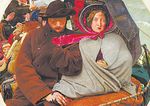
Most of what we associate with Victorian art is condensed into this picture: story-telling, social nuance, naturalism down to the last detail (“all the red-headed boys in Finchley” took turns sitting for the tousled ginger-haired child, for example, who appears as a mere fragment), humour (the cabbages dangling from the boat’s edge) balancing sentimentality, with the whole animated by vivid, piercing colour – the woman’s brilliant bonnet ribbon, fuchsia, crimson, mauve, magenta, fluttering across the picture; the deep maroon skeins of the deck rope – set against the grey wintry light and swell of a dull green sea. For the first time since this painting left Brown’s studio in 1855 it is shown here alongside a delicious preparatory oil sketch that reveals significant differences: the faces are finely featured, delicate as ivory and porcelain, rather than weather-beaten; textural details – an elaborate green and red embroidered shawl rather than the plain grey, for example – give a sumptuous surface sheen redolent of a Flemish miniature.

more from Jackie Wullschlager at the FT here.

Tuesday Poem

Postscript

And some time make the time to drive out west
Into County Clare, along the Flaggy Shore,
In September or October, when the wind
And the light are working off each other
So that the ocean on one side is wild
With foam and glitter, and inland among stones
The surface of a slate-grey lake is lit
By the earthed lightning of a flock of swans,
Their feathers roughed and ruffling, white on white,
Their fully grown headstrong-looking heads
Tucked or cresting or busy underwater.
Useless to think you'll park and capture it
More thoroughly. You are neither here nor there,
A hurry through which known and strange things pass
As big soft buffetings come at the car sideways
And catch the heart off guard and blow it open.

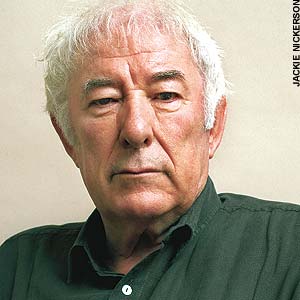
by Seamus Heaney
from The Spirit Level
publisher:Farrar, Straus and Giroux, 1996

paint speaking up for itself

Schwartz_12_101311_jpg_470x452_q85

Hals was an unusual artist in that, especially in the first half of his career, he was able to paint, with little or no coyness, people grinning, or being plain happy. The relative scarcity in the history of painting of people giggling or looking like they have just said or heard something tickling indicates how hard it must be for a painter to bring off such a thing. Hals’s images of laughter and mirth come across as being the underpinning of his approach. It is as if his work is based on a philosophical position, and he is saying, “We are alive, so how can we not be cheerful?” Far from all his people are effervescent. He was hardly a painter propounding a thesis. As Seymour Slive, our foremost authority on the artist, has suggested, Hals seems to have taken the key to each of his pictures from the nature of his encounter with the sitter. (Slive’s writings on Hals have the same warmth, directness, energy, and clarity that rise from the paintings.) The experience of the 1989 retrospective, which was largely Slive’s work and which can almost be recaptured in its catalog, where the reproductions are large and good, is that we are encountering a storehouse of subtle moods and expressions.

more from Sanford Schwartz at the NYRB here.

Monday, September 26, 2011

Sunday, September 25, 2011

Crediting Poetry: Nobel Lecture by Seamus Heaney

From the Nobel winners' site:

Arts-graphics-2007_1181158a When I first encountered the name of the city of Stockholm, I little thought that I would ever visit it, never mind end up being welcomed to it as a guest of the Swedish Academy and the Nobel Foundation. At the time I am thinking of, such an outcome was not just beyond expectation: it was simply beyond conception. In the nineteen forties, when I was the eldest child of an ever-growing family in rural Co. Derry, we crowded together in the three rooms of a traditional thatched farmstead and lived a kind of den-life which was more or less emotionally and intellectually proofed against the outside world. It was an intimate, physical, creaturely existence in which the night sounds of the horse in the stable beyond one bedroom wall mingled with the sounds of adult conversation from the kitchen beyond the other. We took in everything that was going on, of course – rain in the trees, mice on the ceiling, a steam train rumbling along the railway line one field back from the house – but we took it in as if we were in the doze of hibernation. Ahistorical, pre-sexual, in suspension between the archaic and the modern, we were as susceptible and impressionable as the drinking water that stood in a bucket in our scullery: every time a passing train made the earth shake, the surface of that water used to ripple delicately, concentrically, and in utter silence.

But it was not only the earth that shook for us: the air around and above us was alive and signalling too. When a wind stirred in the beeches, it also stirred an aerial wire attached to the topmost branch of the chestnut tree. Down it swept, in through a hole bored in the corner of the kitchen window, right on into the innards of our wireless set where a little pandemonium of burbles and squeaks would suddenly give way to the voice of a BBC newsreader speaking out of the unexpected like a deus ex machina. And that voice too we could hear in our bedroom, transmitting from beyond and behind the voices of the adults in the kitchen; just as we could often hear, behind and beyond every voice, the frantic, piercing signalling of morse code.

More here.

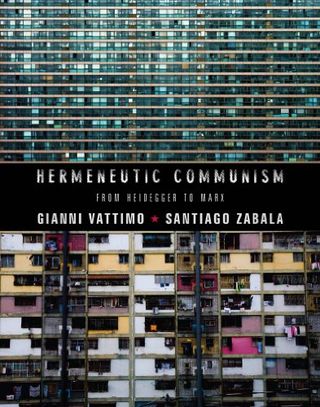
INTERVIEW WITH GIANNI VATTIMO AND SANTIAGO ZABALA, AUTHORS OF HERMENEUTIC COMMUNISM: FROM HEIDEGGER TO MARX

From Columbia University Press:

Question: Let’s talk about the structure of the book. Among the first things that come to mind looking at the table of contents is the balance among the two parts, four chapters, and twelve sections. Also, although all sections are the same length, chapters 2 and 4 contain many more notes than the other two chapters. Why is this?

61Ru7PWavKL GV: The last systematic book I wrote was Il soggetto e la maschera [The Subject and the Mask] (1974). There are various reasons why I stopped taking so much care in explicating my thesis though balanced order and style: perhaps for the same reasons as Derrida, Rorty, and so many other postmetaphysical philosophers, that is, the end of grand narratives, truth, and ideology? I’m glad Santiago persuaded me to follow this structure because it certainly helps the reader, who, in this case, we hope will be not only philosophical but also political.

SV: Those chapters contain many more notes because we needed to justify with documents, articles, and other information some of our theses, for example, how Obama has increased military spending or Chávez has forced the oil industry to finance free health care for the poorest citizens of Venezuela. But if these chapters had to have more notes it’s also because they are the “ontic” sections of the book; that is, while chapters 1 and 3 are philosophical or ontological, chapters 2 and 4 are ontic or political. I’m not saying they could be read independently, but they correspond to each other. While part 1, “Framed Democracy,” is really a deconstruction of the “winners’ history,” that is, of the conservative realist positions of John Searle, Robert Kagan, and Francis Fukuyama, part 2, “Hermeneutic Communism,” outlines (through the work of Jacques Derrida, Richard Rorty, and others) how the “anarchic vein of hermeneutics” points toward a weakened communism.

More here.

Obama Secretly Sold Israel Bunker-Buster Bombs

Eli Lake in The Daily Beast:

1316752791452 While publicly pressuring Israel to make deeper concessions to the Palestinians, President Obama has secretly authorized significant new aid to the Israeli military that includes the sale of 55 deep-penetrating bombs known as bunker busters, Newsweek has learned.

In an exclusive story to be published Monday on growing military cooperation between the two allies, U.S. and Israeli officials tell Newsweek that the GBU-28 Hard Target Penetrators—potentially useful in any future military strike against Iranian nuclear sites—were delivered to Israel in 2009, just several months after Obama took office.

The military sale was arranged behind the scenes as Obama’s demands for Israel to stop building settlements in disputed territories were fraying political relations between the two countries in public.

The Israelis first requested the bunker busters in 2005, only to be rebuffed by the Bush administration. At the time, the Pentagon had frozen almost all U.S.-Israeli joint defense projects out of concern that Israel was transferring advanced military technology to China.

More here.

Sunday Poem

Mistaken Identity

I thought I saw my mother
in the lesbian bar,
with a salt gray crew cut, a nose stud
and a tattoo of a parrot on her arm.
She was sitting at a corner table,
leaning forward to ignite, on someone’s match,
one of those low-tar things she used to smoke,

and she looked happy to be alive again
after her long marriage
to other people’s needs,
her twenty-year stint as Sisyphus,
struggling to push
a blue Ford station wagon full of screaming kids
up a mountainside of groceries.

My friend Debra had brought me there
to educate me on the issue
of my own unnecessariness,
and I stood against the wall, trying to look
simultaneously nonviolent

and nonchalant, watching couples
slowdance in the female dark,
but feeling speechless, really,
as the first horse to meet the first
horseless carriage on a cobbled street.

That’s when I noticed Mom,
whispering into the delicate
seashell ear of a brunette,
running a fingertip along
the shoreline of a tank top,

as if death had taught her finally
not to question what she wanted
and not to hesitate
in reaching out and taking it.

I want to figure out everything
right now, before I die,
but I admit that in the dark
(where a whole life can be mistaken) cavern of that bar
it took me one, maybe two big minutes

to find my footing
and to aim my antiquated glance
over the shoulder of that woman
pretending not to be my mother,
as if I were looking for someone else.

by Tony Hoagland
from What Narcissism Means To Me
Graywolf Press, 2003

The potent sweep of English history

Simon Jenkins in The Telegraph:

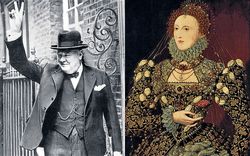
Churchill-elizabet_2005875b I have come to regard England as the most remarkable country in European history. While its relations with its neighbours, especially Celtic ones, have often been appalling, its ability to assimilate newcomers, reform its politics, care for its citizens and be a liberal beacon to the world, is astonishing. Its “game-changing” individuals – Elizabeth, Cromwell, Walpole, Gladstone, Lloyd George, Churchill, Thatcher – far outnumber its villains. The trouble with most history books is that they are either aimed at children and too naive, or at other historians and are too long. As a journalist, I have set out to tell England’s story as a brisk narrative to be read in an afternoon. It is intended to supply a context for the bromides of politicians and commentators, and a setting for the fragmentary histories offered in films and television series. It is a background, sometimes I hope a corrective, to the wisdom peddled by lawyers, economists, diplomats and generals.

I cannot trust any political argument, from left or right, that is bereft of historical evidence. As we repeat the mistakes of the past – in Afghanistan, in relations with Europe, in banking policy – we should wince. Surely we are not going back to the Afghan wars, or to the Entente Cordiale, or to the South Sea Bubble? Or at least if we are going back to the bubble, let us recall that, after it burst, the First Minister dropped dead in parliament, the Chancellor of the Exchequer was sent to the Tower, and the mob demanded bankers be “tied up in sacks filled with snakes and tipped into the murky Thames”.

More here.

Roll over Einstein: Law of physics challenged

From PhysOrg:

One of the very pillars of physics and Einstein's theory of relativity – that nothing can go faster than the speed of light – was rocked Thursday by new findings from one of the world's foremost laboratories.

Rollovereins European researchers said they clocked an oddball type of subatomic particle called a neutrino going faster than the 186,282 miles per second that has long been considered the cosmic speed limit. The claim was met with skepticism, with one outside physicist calling it the equivalent of saying you have a flying carpet. In fact, the researchers themselves are not ready to proclaim a discovery and are asking other physicists to independently try to verify their findings. “The feeling that most people have is this can't be right, this can't be real,” said James Gillies, a spokesman for the European Organization for Nuclear Research, or CERN, which provided the particle accelerator that sent neutrinos on their breakneck 454-mile trip underground from Geneva to Italy. Going faster than light is something that is just not supposed to happen according to Einstein's 1905 special theory of relativity – the one made famous by the equation E equals mc2. But no one is rushing out to rewrite the science books just yet. It is “a revolutionary discovery if confirmed,” said Indiana University theoretical physicist Alan Kostelecky, who has worked on this concept for a quarter of a century. Stephen Parke, who is head theoretician at the Fermilab near Chicago and was not part of the research, said: “It's a shock. It's going to cause us problems, no doubt about that – if it's true.”

CERN reported that a neutrino beam fired from a particle accelerator near Geneva to a lab 454 miles (730 kilometers) away in Italy traveled 60 nanoseconds faster than the speed of light. Scientists calculated the margin of error at just 10 nanoseconds. (A nanosecond is one-billionth of a second.)

More here. (Note: Do watch the video)

Saturday, September 24, 2011

A Doyle Man

Michael Dirda in The Paris Review:

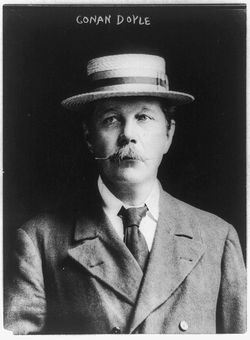
Conan_Doyle Sir Arthur Ignatius Conan Doyle (1859–1930), wasn’t knighted in 1902 for creating its protagonist, Sherlock Holmes, though many readers feel he should have been. The literary journalist Christopher Morley, founder of the Baker Street Irregulars, declared that he actually should have been sainted. In fact, Arthur Conan Doyle only reluctantly added Sir to his name—for his services and writings during the Boer Wars—because his beloved mother talked him into it. On his books he austerely remained A. Conan Doyle “without,” as he said, “any trimmings.” Such modesty is characteristic of this altogether remarkable man, one who gave his own stolid John Bull appearance, down to the military mustache, not to his Great Detective, but to the loyal Dr. Watson. Appropriately, Conan Doyle once named “unaffectedness” as his own favorite virtue, then listed “manliness” as his favorite virtue in another man; “work” as his favorite occupation; “time well filled” as his ideal of happiness; “men who do their duty” as his favorite heroes in real life; and “affectation and conceit” as his pet aversions. It should thus come as no surprise that Conan Doyle’s books are all fairly transparent endorsements of chivalric ideals of honor, duty, courage, and greatness of heart.

In Javier Marías’s charming volume of essays called Written Lives, the Spanish novelist retells a well-known story about the writer and his family. Sir Arthur was traveling by train through South Africa and “one of his grown-up sons commented on the ugliness of a woman who happened to walk down the corridor. He had barely had time to finish this sentence when he received a slap and saw, very close to his, the flushed face of his old father, who said very mildly: ‘Just remember that no woman is ugly.’ ” While no man is on oath for lapidary inscriptions, nearly every student of Conan Doyle agrees that as man, writer, and citizen he strove to live up to the knightly words etched on his tombstone: “Steel true, blade straight.”

More here.

The Post-Black Condition

From The New York Times:

PattersonSUB-sfSpan-v3 Much has been written on the benefits that accrued to the generation of African-Americans reaping the rewards of the civil rights revolution. But we have heard surprisingly little from those in the post-civil-rights age about what these benefits have meant to them, and especially how they view themselves as black people in an America now led by a black president. In his new book, Touré’s aim is to provide an account of this “post-black” condition, one that emerged only in the 1980s but by the ’90s had become the “new black.” Post-blackness entails a different perspective from earlier generations’, one that takes for granted what they fought for: equal rights, integration, middle-class status, affirmative action and political power. While rooted in blackness, it is not restricted by it, as Michael Eric Dyson says in the book’s foreword; it is an enormously complex and malleable state, Touré says, “a completely liquid shape-shifter that can take any form.” With so many ways of performing blackness, there is now no consensus about what it is or should be. One of his goals, Touré writes in “Who’s Afraid of Post-­Blackness? What It Means to Be Black Now,” is “to attack and destroy the idea that there is a correct or legitimate way of doing blackness.” Post-blackness has no patience with “self-appointed identity cops” and their “cultural bullying.”

What this malleability means, according to nearly all the 105 prominent African-Americans interviewed for this book, is a liberating pursuit of individuality. Black artists, like other professionals, now feel free to pursue any interest they like and are no longer burdened with the requirement to represent “the race.” Indeed, when they do explore black themes, as most still do, they feel at liberty to be irreverent and humorous. Thus Kara Walker, a typical post-black artist, unhesitatingly “mines modern visions of slavery for comedy without disrespecting slaves.” There are no sacred cows, not even the great civil rights leaders. The artist Rashid Johnson is typically candid in a way many older African-Americans are bound to find hurtful and ungrateful. According to Touré, some of Johnson’s work says, “These people are our history, so honor them, but also, these people are history, so let’s move on.” Ouch!

More here.

Saturday Poem

When the rich rain economic bombs upon ordinary folks, that just capitalism.
When ordinary folks point out the bombs, that's Class Warfare.
—Roshi Bob

A Reporter from New York Asks Edith Mae Chapman,
Age Nine, What Her Daddy Tells her about the Strike

We ain't to go in the company store, mooning
over peppermint sticks, shaming ourselves like a dog
begging under the table. They cut off our account
but we ain't no-account. We ain't to go to school
so's the company teacher can tell us we are.
We ain't going to meeting and bow our heads
for the company preacher, who claims it is the meek
will inherit the coal fields, instead of telling
how the mountains will crumble and rocks
rain down like fire upon the heads
of the operators, like it says in the Bible.
We ain't to talk to no dirtscum scabs
and we ain't to talk to God. My daddy
is very upset with the Lord.

by Diane Gilliam Fisher
from Kettle Bottom
publisher: Penguin Press, 2004

not just failure

New_SP_logo

With “American Dreamers: How the Left Changed a Nation,” Michael Kazin tackles a conventional wisdom so deeply believed that even those it disparages tend to accept it — namely, that the history of the American left, for all its drama and artistry, brilliance and passion, is one of failure. It is, in that telling, a story of causes unfulfilled, elections lost, unions busted, communes dispersed. Kazin emerges with a counterpoint, not so much of hidden victories as of grand and enduring achievement, often carried to fruition by moderates but envisioned by the left and propelled by its energy. It is, to say the least, a timely read.

more from Jim Newton at the LA Times here.

1493 was Year One

Discovery_of_America_12th_of_May_1492_Columbus_erects_the_Cross_and_baptizes_the_Isle_of_Guanahani_by_the_Christian_Name_of_St_Salvador_From_a_Stamp_engraved_on_Copper_by_Th_de_Bry_in_the_Collection_of_Grands_Voyages_in

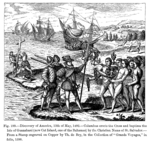
In hindsight, 1492 might have been a good point at which to reset the calendar. Traditionally, the year in which Columbus discovered America is seen as the moment Europe began to shape a New World. Today it looks more like the start of a process that has stitched the drifting continents back together: 1492 was the Year Zero of globalisation, and 1493 was Year One. It has been a thrilling and frequently catastrophic ride for humankind ever since, and science writer Charles C Mann’s excitement never flags as he tells his breathtaking story. His account enshrines Columbus as a founding father of globalisation, and recognises that its effects have been as much biological as economic. Here he borrows from the historian Alfred W Crosby, who in 1972 coined the phrase “Columbian Exchange” to describe the traffic of species between continents. The term is elegant, but the exchange was often anything but equitable. Europe sent malaria to the Americas; in return the Americas gave Europe a cure, the Andean cinchona bark from which quinine is derived.

more from Marek Kohn at the FT here.