
Category: Recommended Reading
a fantasy of empire

In 1929, two years after he resigned from his job as a policeman in Burma, George Orwell settled, in his mind at least, the question that still troubles many people in Britain and the US: whether the British empire was good or bad. Burma’s “relationship with the British empire”, Orwell wrote, “is that of slave and master. Is the master good or bad? That is not the question; let us simply say that this control is despotic and, to put it plainly, self-interested.” Writing in 1942 about Rudyard Kipling’s legend of British soldiers, administrators and engineers in the colonies carrying heroically the white man’s burden, Orwell was blunter. “He does not seem to realise,” Orwell wrote, “any more than the average soldier or colonial administrator, that an empire is primarily a money-making concern.” This, broadly speaking, was a consensus about the British empire that Orwell shared with some unlikely people: India’s governor-general Lord Bentinck, who in 1834 reported that the “bones of the cotton weavers” driven into destitution by British free traders “are bleaching the plains of India”; Adolf Hitler, who greatly admired and sought to emulate in eastern Europe what he called “the capitalist exploitation of the 350m Indian slaves”; as well as anti-colonial leaders and thinkers from Egypt to China who developed a systematic critique of the empire of “free trade”.
more from Pankaj Mishra at the FT here.
the maus’ shadow
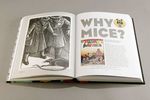
Art Spiegelman has been here before. At 63, dressed in black jeans, a denim shirt and that ubiquitous vest, he is talking, again, about his graphic memoir “Maus,” the saga of his father Vladek’s experiences during the Holocaust and of Spiegelman’s efforts to get to know that father — to inhabit his story, if you will. “Maus” was originally published in two parts, the first in 1986 and the second in 1991; it won a special Pulitzer Prize in 1992, the first comic to be so honored. Still, for the last two decades, Spiegelman has kept doubling back, reconsidering the project, drawing its mouse-like protagonist into nearly everything. “I’m blessed and cursed by this thing I made that obviously looms large for me and for others,” he observes on a sunny October morning in Beverly Hills, eyes blinking behind wire-frame glasses as he smokes on the balcony of his room in the Four Seasons Hotel. “But the result is that I can’t do this thing that seems quite easy but that I just can’t do, which is: ‘That’s that, and now I’m working on a new thing, and it’s a whole other thing.’ I just can’t get out of its gravitational field.”
more from David L. Ulin at the LA Times here.
Why Malthus is back in fashion
From Spiked:

Earlier this summer, a columnist for Time magazine was in no doubt as to the pastor’s relevance. The global population is ‘ever larger, ever hungrier’, he noted, ‘food prices are near historic highs’ and ‘every report of drought or flooding raises fears of global shortages’. ‘Taking a look around us today’, he continued, ‘it would be easy to conclude that Malthus was prescient’. Writing in the British weekly, the New Statesman, wildlife lover Sir David Attenborough was similarly convinced: ‘The fundamental truth that Malthus proclaimed remains the truth: there cannot be more people on this Earth than can be fed.’ Not to be outdone, the liberal-left’s favourite broadsheet, the Guardian, also suggested that Malthus may have been right after all: ‘[His] arguments were part of the inspiration for Charles Darwin’s theory of evolution, and they have validity in the natural world. On the savannah, in the rainforests, and across the tundra, animal populations explode when times are good, and crash when food reserves are exhausted. Is homo sapiens an exception?’ The melancholy tone whispered its answer in the negative. Writing in the New York Times, Paul Krugman was less coy: ‘Malthus was right!’ shouted the headline. Given the encomia that are currently coming the way of Malthus you may well wonder what exactly it was that he was meant to be right about. To find the answer to this it is worth actually taking a look at the work, first published in 1798, on which his supposed prescience is based: An Essay on the Principle of Population. It makes for surprising reading.
More here.
Roaring at the Screen With Pauline Kael
Frank Rich in The New York Times:
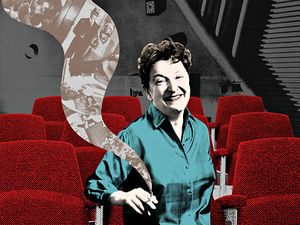
Kael and Horan hitchhiked across America in 1941 to break into the Manhattan literary world. Broke and homeless upon arrival, they camped out in Grand Central Terminal. Horan wandered the streets in search of food, and one night caught the eye of the composers and lovers Samuel Barber and Gian Carlo Menotti when they spotted him weaving in front of Saks Fifth Avenue as they walked home from the opera. The couple unofficially adopted Horan, and, unsurprisingly, he peeled away from Kael. Thus began an odyssey, lasting more than a decade, in which she supported her writing habit with what she called “crummy jobs” — among them stints as a publishing-house grunt, a clerk at Brentano’s, a violin teacher and a freelance tutor. After some four years of defeat in her efforts to break into professional writing in New York, she returned to San Francisco. By the early ’50s, she was running a laundry and tailoring business off Market Street, desperate to support her young daughter, Gina, fathered out of wedlock by Broughton in 1948. She continued to crank out unpublished stories and unproduced plays in whatever spare time she could find. When she learned that Gina had a congenital heart defect, she could not afford the surgery needed to repair it. Once Kael’s fortunes finally changed, it was through a lucky break as improbable as starlets being discovered at Schwab’s drugstore. Arguing with a friend about a film in a Berkeley coffeehouse in the fall of 1952, she was overheard by Peter D. Martin, the founder of a new film-criticism journal, City Lights. Martin was so captivated by Kael’s riff that he invited her to review Chaplin’s “Limelight” — which she did, in a pan revealing her critical voice in embryo. Mocking the film’s climax, in which the Chaplin hero, a has-been clown, dies in the wings of a theater after achieving redemption, Kael wrote that it was “surely the richest hunk of self-gratification since Huck and Tom attended their own funeral.” The piece attracted the attention of Mary McCarthy, among others, and soon Kael was submitting articles about film to other small but prestigious outlets like Partisan Review and Sight and Sound. At the ripe age of 33, she had at last found her subject as a writer. She had also found a literary community, in an exploding Bay Area bohemia populated by the likes of Kenneth Rexroth, Robert Creeley, Allen Ginsberg and Lawrence Ferlinghetti, Peter Martin’s partner in creating the legendary City Lights bookstore and the founder of its publishing-house spinoff.
More here.
Friend of 3QD just declared president of Ireland

VETERAN Labour politician Michael D Higgins was declared Ireland’s next president last night after a collapse in support for his nearest challenger, Independent Sean Gallagher, in Thursday’s vote. The first official count gave Mr Higgins 40 per cent of the vote. The resounding victory – 701,101 votes out of 1.77 million – was secured with a tidal wave of 11th hour support for the 70-year-old from Galway after controversy over his biggest rival’s political fundraising past. Mr Higgins, a former government minister, came from 15 points behind in the opinion polls last weekend to seal his victory, with all other candidates conceding defeat. Amid hectic scenes at the National Count Centre in Dublin Castle, president-elect Mr Higgins said his term in office would be about inclusion, ideas and transformation.
more from The Scotsman here. (Some of us will never forget Michael Higgins reciting his poetry at Flux Factory during a late night event some years ago. Wonderful man. Congrats to Ireland!)
Friday, October 28, 2011
Philosophical Education or Legitimations of Analytic Philosophy?
Santiago Zabala in Purlieu:

More here.
Wouldn’t It Be Cool if Shakespeare Wasn’t Shakespeare?
Stephan Marche in the New York Times:

Professors of Shakespeare — and I was one once upon a time — are blissfully unaware of the impending disaster that this film means for their professional lives. Thanks to “Anonymous,” undergraduates will be confidently asserting that Shakespeare wasn’t Shakespeare for the next 10 years at least, and profs will have to waste countless hours explaining the obvious. “Anonymous” subscribes to the Oxfordian theory of authorship, the contention that Edward de Vere, the 17th earl of Oxford, wrote Shakespeare’s plays. Among Shakespeare scholars, the idea has roughly the same currency as the faked moon landing does among astronauts.
The good news is that “Anonymous” makes an extraordinarily poor case for the Oxfordian theory. I could nitpick the film all day.
More here.
Christopher Hitchens Drops the Hammer
Counsel for OWS from Iran’s Green Movement
Kusha Sefat in Juan Cole's blog Informed Consent:

1) Pick a color to represent your movement and wear it daily in public places (work, restaurant, etc.). Remember, this is a numbers game. You want maximum visibility, and to bring your movement into everyday life.
2) Have an all-inclusive strategy. Accept people with different views who are willing to join you in protest. Contrary to popular belief, you don’t have to know what you want as a movement yet. The goal at this stage is to point to your opponents and say that they have been lying to you; that the show they have constructed is false and that you are sick of it.
3) Demonstrate peacefully. Committing violence during demonstrations leads to ruptures within your movement, diminishes public sympathy, and gives the security forces a reason to violently suppress your protest.
More here.
Didion’s Details
From The Paris Review:

This was a shopping center that embodied the future for which El Salvador was presumably being saved, and I wrote it down dutifully, this being the kind of “color” I knew how to interpret, the kind of inductive irony, the detail that was supposed to illuminate the story. As I wrote it down I realized that I was no longer much interested in this kind of irony, that this was a story that would not be illuminated by such details, that this was a story that would perhaps not be illuminated at all.
Her intelligence excavates a truth at once uncomfortable and crystalline: in the middle of a war you can’t see, you still want to look. You want to squint your keen and cutting eyes at whatever you can find. Because your subject is fear, and fear isn’t something with a particular scent or tint, only something in the air that makes it difficult to breath. It will not respond to any name when you call it into the light. Every night in El Salvador, people were being picked up in trucks, killed, and thrown in landfills, and Joan Didion stood looking at a row of imported vodkas, thinking, What? Just pointing at them, because they were there, and what right did they have? Irony is easier than hopeless silence but braver than flight. The problem is that sometimes your finger shakes as you gesture, there is no point, and you can’t point anywhere—or at least not at anything visible. I sometimes find myself in the role that Didion casts aside—the aisle-wandering, detail-pillaging self, who comes for water-purifying tablets and leaves with the price-tagged Cliff Notes of a country’s suffering.
More here.
Friday Poem
Matriot Acts, Act 1 (History of Mankind)
you no longer believe in anything
movement of train, mauve waves
grammar's anomie
gets you down or
war at the back and crown of head
PsyOps, o chicken little the sky! the sky!
o the fallen sky an edge of blue
hanging but
still breathing those colors?
a garden broken & restored many times
how often trying to leave it, bend away
words from that beautiful throat
listen or break or oscillate or
clamor as opposed to "read about"
could you be my model human being
up there on the dais?
o you, she...maybe he's the one
& we came back from the cinema
glow behind our tears
and you saying a woman, a woman!
how tragic to be such slender thread of a woman
where was I being led?
more people thick in space
in constant motion
twisted around a clock
solar wind, solar heat, sociable matrix
it's an atavistic mixed-up dream
and stirs the branches
high in Freedom Park
it was the voice of a desultory fragment
of speech now, talking about "state" and "union"
how darkness turns at the wrist
.
by Anne Waldman
from History of Mankind
Friendly bacteria move in mysterious ways
From Nature:

More here.
Thursday, October 27, 2011
The World of the Intellectual vs. The World of the Engineer
Timothy Ferris in Wired:
Being an intellectual had more to do with fashioning fresh ideas than with finding fresh facts. Facts used to be scarce on the ground anyway, so it was easy to skirt or ignore them while constructing an argument. The wildly popular 18th-century thinker Jean-Jacques Rousseau, whose disciples range from Robespierre and Hitler to the anti-vaccination crusaders currently bringing San Francisco to the brink of a public health crisis, built an entire philosophy (nature good, civilization bad) on almost no facts at all. Karl Marx studiously ignored the improving living standards of working-class Londoners — he visited no factories and interviewed not a single worker — while writing Das Kapital, which declared it an “iron law” that the lot of the proletariat must be getting worse. The 20th-century philosopher of science Paul Feyerabend boasted of having lectured on cosmology “without mentioning a single fact.”
Eventually it became fashionable in intellectual circles to assert that there was no such thing as a fact, or at least not an objective fact. Instead, many intellectuals maintained, facts depend on the perspective from which are adduced. Millions were taught as much in schools; many still believe it today.
More here. And here is a reaction from Massimo Pigluicci in Rationally Speaking:
“The world of the intellectual vs the world of the engineer” […] is a quasi incoherent rant about the evils of intellectualisms and the virtues of applied science. Ferris writes, I would argue as an intellectual, in one of the most intellectual of contemporary publications, about how the battle between intellectualism and science-engineering has been waged since the beginning of the printing press. The results are in – science/engineering won hands down – time to close the curtain on intellectualism.
Ferris engages in such a stereotypical piece of anti-intellectualism that Richard Hofstadter (the sociologist who authored the classic Anti-intellectualism in American Life) could have used him as a poster boy. Hofstadter defined anti-intellectualism as “a resentment and suspicion of the life of the mind and of those who are considered to represent it; and a disposition constantly to minimize the value of that life.” Indeed, Hofstadter even identified the precise category of anti-intellectualism to which Ferris’ rant belongs: instrumentalism, or the idea that only practical knowledge matters and should be cultivated. In America, the attitude traces its roots to the robber barons of the 19th century, as exemplified by the attitude of Andrew Carnegie about classical studies: a waste of “precious years trying to extract education from an ignorant past.”
More here.
Pixar Animator Rethinks Hindu Mythology

What if you could cross The Night Life of Trees, the magical artwork based on Indian mythology, with The Ancient Book of Myth and War, that delightful side project by a team of Pixar animators? You’d get The Little Book of Hindu Deities: From the Goddess of Wealth to the Sacred Cow — an impossibly charming illustrated almanac of gods and goddesses by Pixar animator Sanjay Patel. These beautiful stories from Indian mythology span the entire spectrum of human experience — petty quarrels and epic battles, love and betrayal, happiness and loss — with equal parts humor and respect, pairing each full-color illustration with a lively profile of that deity.
In the book’s introduction, Patel notes his fascination with Japanese animation, which influenced his style in depicting the Hindu deities — a curious case of creative cross-pollination across cultures. For an added smile, Patel originally self-published the book before Plume picked it up.
Is Self-Knowledge Overrated?

[T]here is a subtle optimism lurking in all of Kahneman’s work: it is the hope that self-awareness is a form of salvation, that if we know about our mental mistakes, we can avoid them. One day, we will learn to equally weigh losses and gains; science can help us escape from the cycle of human error. As Kahneman and Tversky noted in the final sentence of their classic 1974 paper, “A better understanding of these heuristics and of the biases to which they lead could improve judgments and decisions in situations of uncertainty.” Unfortunately, such hopes appear to be unfounded. Self-knowledge isn’t a cure for irrationality; even when we know why we stumble, we still find a way to fall.
Consider the story of Harry Markowitz, a Nobel Prize-winning economist who largely invented the field of investment-portfolio theory. By relying on a set of complicated equations, Markowitz was able to calculate the optimal mix of financial assets. (Due to loss-aversion, most investors hold too many low-risk bonds, but Markowitz’s work helped minimize the effect of the bias by mathematizing the decision.) Markowitz, however, was incapable of using his own research, at least when setting up his personal retirement fund. “I should have computed the historical co-variances of the asset classes and drawn an efficient frontier,” Markowitz later confessed. “Instead, I visualized my grief if the stock market … went way down and I was completely in it. My intention was to minimize my future regret. So I split my contributions 50/50 between bonds and equities.”
Football coaches have performed just as badly. Although it’s now clear that their biases have a meaningful impact—a coach immune to loss aversion would win one more game in three seasons out of every four—their collective decision-making hasn’t improved.
This same theme applies to practically all of our thinking errors: self-knowledge is surprisingly useless.
Pakistan Aslant: the two-hour version
Christopher Lydon at Radio Open Source:
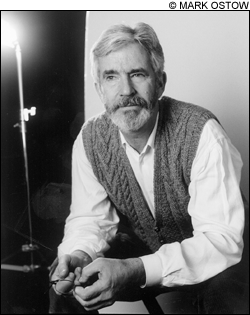
Both hours are illuminating the judgment that (1) Pakistan is not about to destroy itself, much less go away and (2) that Pakistan’s mutually-abusive marriage with the United States is not about to end, either. When our Pentagon accuses the Pakistan’s army intelligence of targeting American troops, and when Secretary of State Clinton says we’re not going to take it anymore, count on it that the Pakistan story is with us for a while. But what’s the history unfolding here? How did it come to this? What do Pakistanis say?
What I didn’t know, going in, was the deep old under-layer of tribulation in Pakistan. I wasn’t prepared for the edgy energy of Pakistan either, the confidence of tough people, and much beauty, too. Among the contradictory truths that we Americans barely know about Pakistan are (1) that it’s a cultural powerhouse (in poetry, fiction, and especially music) in South Asia and beyond; (2) it’s been a resentful and prickly junior partner in our US-sponsored proxy wars for thirty-plus years — first (embracing terrorism) against the Soviets and later against the terrorist groups and ideologies we promoted; (3) the troubles of Pakistan can be (and in conversation often are) traced back before the Cold War and the Islamic revolution to the moment of birth in 1947, the Partition of British India that created two unequal sibling rivals in 1947; and (4) that thoughtful Pakistanis talk not only of the rising trend of estrangement from the US but also of a convergent trend toward inequality and the over-reach of elites in both countries.
Listen to the excellent programs here.
The Effect Effect

In 1969, the psychologist Robert Zajonc published an article about a curious study. He'd posted a silly-sounding word—either kardirga, saricik, biwonjni, nansoma, or iktitaf—on the front page of some student newspapers in Michigan every day for several weeks. Then he sent questionnaires to the papers' readers, asking them to guess whether each word referred to “something 'good' ” or “something 'bad.’ ” Their answers were consistent, if a little strange: Nonsense words that showed up in print many times were judged to be more positive than those that appeared just once or twice. The fact of their repetition, said Zajonc, gave the words an aura of warmth and trustworthiness. He called this the mere exposure effect.
Maybe you've heard about this study before. Maybe you know a bit about Zajonc and his work. That's good. If you've already seen the phrase mere exposure effect in print, then you'll be more likely to believe that it's true. That's the whole point.
Psychologists have devised other ways to make a message more persuasive. “You should first maximize legibility,” says Daniel Kahneman, who describes the Zajonc experiment in Thinking, Fast and Slow, a compendium of his thought and work. Faced with two false statements, side-by-side, he explains, readers are more likely to believe the one that's typed out in boldface. More advice: “Do not use complex language where simpler language will do,” and “in addition to making your message simple, try to make it memorable.” These factors combine to produce a feeling of “cognitive ease” that lulls our vigilant, more rational selves into a stupor. It's an old story, and one that's been told many times before. It even has a name: Psychologists call it the illusion of truth.
See how it works? A simple or repeated phrase, printed in bold or italics, makes us feel good; it just seems right. For Kahneman, that's exactly what makes it so dangerous.
Amazing underwater swim
“Wife-sharing” haunts Indian villages as girls decline
Nita Bhalla at Reuters:

Aid workers say the practice of female foeticide has flourished among several communities across the country because of a traditional preference for sons, who are seen as old-age security.
“We are already seeing the terrible impacts of falling numbers of females in some communities,” says Bhagyashri Dengle, executive director of children's charity Plan India.
“We have to take this as a warning sign and we have to do something about it or we'll have a situation where women will constantly be at risk of kidnap, rape and much, much worse.”
More here.