Religion for Atheists

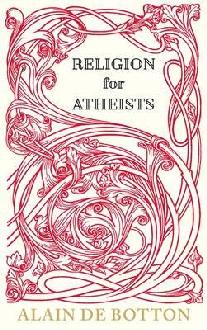
GetImageIn the Guardian, Terry Eagleton reviews Alain de Botton's Religion for Atheists: A Non-Believer's Guide to the Uses of Religion:

Diderot, a doyen of the French Enlightenment, wrote that the Christian gospel might have been a less gloomy affair if Jesus had fondled the breasts of the bridesmaids at Cana and caressed the buttocks of St John. Yet he, too, believed that religion was essential for social unity. Matthew Arnold feared the spread of godlessness among the Victorian working class. It could be countered, he thought, with a poeticised form of a Christianity in which he himself had long ceased to believe. The 19th-century French philosopher Auguste Comte, an out-and-out materialist, designed an ideal society complete with secular versions of God, priests, sacraments, prayer and feast days.

There is something deeply disingenuous about this whole tradition. “I don't believe myself, but it is politically prudent that you should” is the slogan of thinkers supposedly devoted to the integrity of the intellect. If the Almighty goes out of the window, how are social order and moral self-discipline to be maintained? It took the barefaced audacity of Friedrich Nietzsche to point out that if God was dead, then so was Man – or at least the conception of humanity favoured by the guardians of social order. The problem was not so much that God had inconveniently expired; it was that men and women were cravenly pretending that he was still alive, and thus refusing to revolutionise their idea of themselves.

God may be dead, but Alain de Botton's Religion for Atheists is a sign that the tradition from Voltaire to Arnold lives on. The book assumes that religious beliefs are a lot of nonsense, but that they remain indispensible to civilised existence. One wonders how this impeccably liberal author would react to being told that free speech and civil rights were all bunkum, but that they had their social uses and so shouldn't be knocked. Perhaps he might have the faintest sense of being patronised. De Botton claims that one can be an atheist while still finding religion “sporadically useful, interesting and consoling”, which makes it sound rather like knocking up a bookcase when you are feeling a bit low. Since Christianity requires one, if need be, to lay down one's life for a stranger, he must have a strange idea of consolation. Like many an atheist, his theology is rather conservative and old-fashioned.

De Botton does not want people literally to believe, but he remains a latter-day Matthew Arnold, as his high Victorian language makes plain.

Debating Casual Sex

82906-73427Over at Psychology Today, a series of pieces on casual sex. Stanley Siegel's advocacy of casual sex:

Society dictates that only within marriage or another long-term relationship do sex and intimacy exist and popular culture upholds this as the ultimate formula for happiness. Despite the high divorce rate, tax laws, for example, continue to bestow benefits on married couples, while relegating single people to second-class status.

How many times have you heard: He's afraid of intimacy? In arguing against casual sex, marriage advocates regularly flaunt research purportedly showing that spouses are happier than single people. But these studies contain a damaging methodology, which cannot be readily identified by their findings. That is, they fail to consider the guilt and shame that some single people internalize as a result of how society stigmatizes them.

The truth is, long-term relationships or marriage do not guarantee a satisfying emotional life or sexual intimacy. Everyone knows someone stuck in a barren marriage, whose members have lost their autonomy and in which sex has disappeared. Brandon's assertion that people do not belong together forever is correct, but too many of us fear facing that truth or consider alternatives to that permanence.

There are times when casual sex actually deepens one's self-knowledge. With intelligence and clarity of purpose, casual sex is more than instant gratification. By openly exploring our fantasies and true desires with different partners in a way that may not possible in a committed relationship, we can transcend our inhibitions. With each new encounter we can discover buried parts of ourselves and in time experience the totality of who we are. We can even experience profound, revelatory moments that unravel our past and show us things we never knew about ourselves. We can satisfy unmet needs by embracing those aspects of our sexuality that are deeply meaningful and we can choose to let go of those that no longer have importance.

How to Build Your Pop Culture Persona

McinerneyEmily Temple over at Flavorwire:

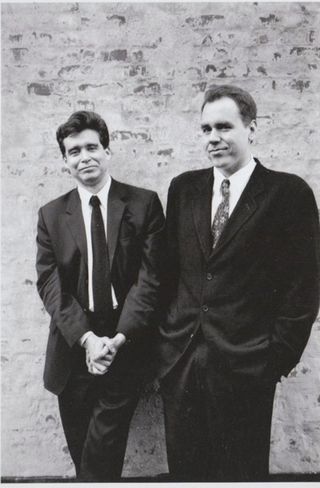
Branding is all anyone can talk about these days. It’s how celebrities stay famous. It’s what Twitter is really for. It’s even what the last season of America’s Next Top Model was all about (besides Tyra Banks’s book, we mean). This week saw famed Bright Lights, Big City author Jay McInerney’s birthday — the renowned playboy is 57 years old, if you can believe it. Inspired by the persistence of the McInerney legend even after all these years, we thought we’d give you a brief outline of how to build a successful pop culture persona using two demonstrative models: the aforementioned Jay McInerney, poster boy of ’80s excess, and Lady Gaga, Queen of overblown contemporary pop. Click through to pick up a few helpful tips on how to build your pop culture persona based on these two tabloid legends, and make sure to send us a postcard from the top when you get there.

1. Come onto the scene with a little salacious controversy.

You have several options on this front, depending on your existing skill set. But whether you write a novel, drop a hit single, or debut in a film, make sure there’s some scandal attached. For instance, if you decide to write a novel, you should make sure that the main character is almost identical to you, that he is consumed with cocaine and the party boy lifestyle, as Jay McInerney did with Bright Lights, Big City. It will help if you have a posse already, so you can look even more like one of the popular kids. If you’re a musician, make sure you’re wearing something so ridiculous no one can look away or shut up about it, like Lady Gaga — in this case, it will also help if that outfit makes it unclear whether or not you secretly have a penis. Now people are paying attention to you. You may proceed.

Zoologger: Unique Life Form is Half Plant, Half Animal

Dn21353-1_300Michael Marshall in New Scientist:

Species: Mesodinium chamaeleon

Habitat: seawater around Scandinavia and North America, chowing down on a new generation of slaves

Many animals transform themselves almost beyond recognition in the course of their lives. Caterpillars become butterflies and tadpoles become frogs, and if we couldn't watch them do so we might not even suspect that the two stages were the same creature.

Spectacular as these shifts are, they are only shape-shifting. A tadpole and a frog are both animals, so both must take in food from their surroundings.

Not so Mesodinium chamaeleon. This newly discovered single-celled organism is a unique mixture of animal and plant.

Plant pals M. chamaeleon is a ciliate – a kind of single-celled animal covered in hundreds of tiny “hairs” called cilia. It was discovered in Nivå bay in Denmark by Øjvind Moestrup of the University of Copenhagen, also in Denmark, and his team. Other specimens have since been found off the coasts of Finland and Rhode Island.

Ciliates using their hair-like cilia to motor around rapidly in water. Most get their food by eating other organisms, rather than by synthesising the nutrients themselves. This marks them as quite animal-like.

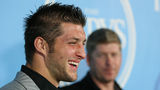
Tebow Time: Is God or Math the Explanation for Tim Tebow’s Success?

TebowDaniel Honan in Big Think:

In a very short time, Tim Tebow has become the most polarizing NFL player in a generation. There are many reasons for this, but one thing that has fascinated fans and foes alike is Tebow's apparent ability to rally his team, the Denver Broncos, when it matters the most.

Tebow's performance on the field is extremely uneven. He'll often stink it up for three quarters only to become what The New York Times describes as “a Hall of Fame candidate in the Fourth.” His efforts contributed to a crucial six-game winning streak that helped land Denver in the playoffs, and last week Tebow led the Broncos to a first-round victory with a touchdown pass in overtime. What is the explanation for his success? And how has Tebow been able to overcome seemingly insurmountable odds again and again? Do certain athletes possess the ability to elevate their game simply by willing it? Does Tebow share a common gene with Derek Jeter and Michael Jordan? Or is it divine intervention (43 percent of Americans believed so in a recent poll)?

If you are like me and believe that God has greater concerns than the outcome of a football game, you are left in search of another explanation.

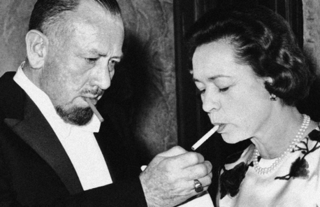
John Steinbeck on Falling in Love: A 1958 Letter

From The Atlantic:

ScreenHunter_09 Jan. 15 16.21Nobel laureate John Steinbeck (1902-1968) might be best-known as the author of East of Eden, The Grapes of Wrath, and Of Mice and Men, but he was also a prolific letter-writer. Steinbeck: A Life in Letters constructs an alternative biography of the iconic author through some 850 of his most thoughtful, witty, honest, opinionated, vulnerable, and revealing letters to family, friends, his editor, and a circle of equally well-known and influential public figures.

Among his correspondence is this beautiful response to his eldest son Thom's 1958 letter, in which the teenage boy confesses to have fallen desperately in love with a girl named Susan while at boarding school. Steinbeck's words of wisdom—tender, optimistic, timeless, infinitely sagacious—should be etched onto the heart and mind of every living, breathing human being.

New York
November 10, 1958

Dear Thom:

We had your letter this morning. I will answer it from my point of view and of course Elaine will from hers.

First — if you are in love — that's a good thing — that's about the best thing that can happen to anyone. Don't let anyone make it small or light to you.

Second — There are several kinds of love. One is a selfish, mean, grasping, egotistical thing which uses love for self-importance. This is the ugly and crippling kind. The other is an outpouring of everything good in you — of kindness and consideration and respect — not only the social respect of manners but the greater respect which is recognition of another person as unique and valuable. The first kind can make you sick and small and weak but the second can release in you strength, and courage and goodness and even wisdom you didn't know you had.

More here.

When You Were Dying

Rana Javadi in lensculture:

Javadi_4For me, the When You Were Dying series tells a story about the death of a beautiful era. About death of a peaceful life, when we didn’t live in a global village, the time when we lived with our own cultures, when life was not as fast as now — a life without electronic social networking, without so many environmental disasters and wars, a life with more peace in mind and the world. In this series of work, I have used old photographs from a famous Iranian photography studio, Chehrenegar, in the city of Shiraz. The photos were taken in the courtyard of his studio in open air because of the lack of artificial light in those days. My photographs are made of three layers: one, the original picture from 70 years ago, which is a dead and forgotten moment; the second layer is often made of dried flowers and fabric belonging to those days; and the third one is a reflection of the current environment, captured in the glass or a mirror. Of course, by creating this new layered picture, the present moment dies too, but in a way that starts another life in a new form.

More here.

Money is in the Eye of the Beholder

From Smithsonian:

MoneyA recent thread on the urban parenting site Urbanbaby.com asked a simple pair of questions: What is your household income, and how rich do you feel? The resulting contradictions of income and perceived wealth drew widespread remarkand some scorn. One commenter, from New York City’s Upper East Side, makes $350,000 per year and feels “so, so, so poor.” Another earns $1.2 million and feels upper-middle class, while a third, with an income in the $180,000 range in the D.C. suburbs, feels rich. How is this all possible? Everyone knows the old platitude “beauty is in the eye of the beholder.” A recent psychological study indicates that wealth is just the same. A new paper, published in the January issue of Psychological Science by Princeton researcher Abigail Sussman, demonstrates that total net worth is not the only thing that influences perceptions of wealth, whether for ourselves or others. If you were asked to consider two individuals—Mr. Blue, who has $120,200 in assets and $40,200 in debt, and Ms. Green, who has $80,200 in assets and just $200 in debt—who do you think is better off? Of participants in the study, 79% said Ms. Green, although net worth is the same for both. When assessing those with positive net worth, having a lower degree of both assets and debt was seen as better than having more of each.

More here.

What is your favorite deep, elegant, or beautiful explanation?

This year, along with 188 others, I was also asked by John Brockman to contribute a response to Edge.org's annual question. Here's my short piece:

ScreenHunter_08 Jan. 15 13.43My example of a deep, elegant, and beautiful explanation in science is John Maynard Smith's concept of an evolutionarily stable strategy (ESS). Not only does this wonderfully straightforward idea explain a whole host of biological phenomena, it also provides a very useful heuristic tool to test the plausibility of various types of claims in evolutionary biology, allowing us, for example, to quickly dismiss group-selectionist misconceptions such as the idea that altruistic acts by individuals can be explained by the benefits that accrue to the species as a whole from these acts. Indeed, the idea is so powerful that it explains things which I didn't even realize needed explaining until I was given the explanation! I will now present one such explanation below to illustrate the power of ESS. I should note that while Smith developed ESS using the mathematics of game theory (along with collaborators G. R. Price and G. A. Parker), I will attempt to explain the main idea using almost no math.

So, here is a question: think of common animal species like cats, or dogs, or humans, or golden eagles; why do all of them have (nearly) equal numbers of males and females? Why are there not sometimes 30% males in a species and 70% females? Or the other way? Or some other ratio altogether? Why are sex ratios almost exactly 50/50? I, at least, never even considered the question until I read the incredibly elegant explanation.

Let us consider walruses: they exist in the normal 50/50 sex ratio but most walrus males will die virgins. (But almost all females will mate.) Only a few dominant walrus males monopolize most of the females (in mating terms). So what's the point of having all those extra males around, then? They take up food and resources, but in the only thing that matters to evolution, they are useless, because they do not reproduce. From a species point-of-view, it would be better and more efficient if only a small proportion of walruses were males, and the rest were females, in the sense that such a species of walrus would make much more efficient use of its resources and would, according to the logic of group-selectionists, soon wipe out the actual existing species of walrus with the inefficient 50/50 ratio of males to females. So why don't they?

Continued here. All the responses can be seen here.

Sunday Poem

Now the bricks lay on Grand Street
Where the neon madmen climb
They all fall there so perfectly
It all seems so well timed
………………….. –Bob Dylan
.
The White Room
.
The obvious is difficult
To prove. Many prefer
The hidden. I did, too.
I listened to the trees.
.
They had a secret
Which they were about to
Make known to me,
And then didn’t.
.
Summer came. Each tree
On my street had its own
Scheherazade. My nights
Were a part of their wild
.
Storytelling. We were
Entering dark houses,
More and more dark houses
Hushed and abandoned.
.
There was someone with eyes closed
On the upper floors.
The thought of it, and the wonder,
Kept me sleepless.
.
The truth is bald and cold,
Said the woman
Who always wore white.
She didn’t leave her room much.
.
The sun pointed to one or two
Things that had survived
The long night intact,
The simplest things,
.
Difficult in their obviousness.
They made no noise.
It was the kind of day
People describe as “perfect.”
.
Gods disguising themselves
As black hairpins? A hand-mirror?
A comb with a tooth missing?
No! That wasn’t it.
.
Just things as they are,
Unblinking, lying mute
In that bright light,
And the trees waiting for the night.
.
.
by Charles Simic
from The Book of Gods and Devils
Houghton Mifflin Harcourtt, 1990

Saturday, January 14, 2012

Me, Myself and Yoga

12rfd-yoga-custom1A debate over at the NYT begins: “In a Times magazine article last weekend, the author quotes a yoga teacher blaming 'ego' for yoga-related injuries and pointing out that 'the whole point of yoga is to get rid of ego.' If that’s the case, then why is narcissism so often on display in the yoga studio with students spending huge amounts of money on gym memberships and gear and even clamoring to mark their territory with their mats, hours before the class begins?” Suketu Mehta, Kaitlin Quistgaard, Sarah Miller, David Surrenda, Joslyn Hamilton, and Ganesh Das debate. Suketu Mehta:

The Hippocratic Oath should also apply to yoga: first, do no harm.

Yoga was never meant to be a competitive sport, like ice hockey. But when it spread to this robustly competitive nation, where it got turbocharged by money — the U.S. yoga market is worth $6 billion a year — its original meaning got dispersed. What is now called for is a broader understanding of the meaning of yoga.

The yoga that most Americans are aware of is hatha yoga, only one (and perhaps the least important) of the various types of yoga. Krishna in the Bhagvad-Gita defines them: karma yoga (the yoga of action), bhakti yoga (the yoga of devotion) and jnana yoga (the yoga of knowledge). Volunteering at a soup kitchen is yoga; raising your voice in praise in a gospel choir is yoga; trying to understand how the galaxies shift and why the poor lack shoes is also yoga.

Hatha yoga is not for everyone. The other forms are. Not everyone can — or should — stand on their heads, but everyone can use their heads to make the world a better place; yoke their emotions to their intelligence and feel more centered.

In this sense, the greatest teacher of yoga is not Iyengar or Bikram, but Gandhi. “The yogi is not one who sits down to practise breathing exercises,” he wrote in his interpretation of the Gita. “He is one who looks upon all with an equal eye, sees other creatures in himself.”

Finishing Touches

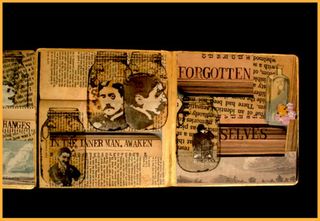
Tumblr_lxo1kaRtHL1qhwx0oMaggie Nelson discusses Eve Sedgwick's posthumous work The Weather in Proust, in the LA Review of Books:

When I first heard that Duke University Press would be putting out a collection of the final writings of Eve Kosofsky Sedgwick — one of the primary founders of the field known as queer theory, who died of breast cancer in 2009 — I first imagined a scrapbook-like volume of wild stray thoughts and posthumous revelations. Then, when I heard the collection was titled The Weather in Proust, and that it included all the unfinished writing Sedgwick had done in service of a critical study of Marcel Proust, I imagined it might be a swirling, dense, epic literary analysis, à la Walter Benjamin’s 1,088 page The Arcades Project, the likes of which the world had never seen.

The slimmish, 215-page collection, edited by Jonathan Goldberg, is neither of the above. It is decidedly not a hodgepodge of odds and ends that Sedgwick left behind, but rather nine solid, finished-feeling essays on topics that preoccupied Sedgwick throughout her prolific career. These topics — which include webs of relation in Proust, affect theory, non-Oedipal models of psychology (especially those offered by Melanie Klein, Sandor Ferenczi, Michael Balint, Silvan Tomkins, and Buddhism), non-dualistic thinking and antiseparatisms of all kinds, and itinerant, idiosyncratic, profound meditations on depression, illness, textiles, queerness, and mortality — will be familiar to anyone who has spent time with Sedgwick’s previous work, which includes the groundbreaking Between Men: English Literature and Male Homosocial Desire (1985), Epistemology of the Closet (1990), Tendencies (1993), and Touching Feeling: Affect, Pedagogy, Performativity (2003).

But while a great deal here is familiar — indeed, many passages from the above books resurface, verbatim, throughout these pages — there is nothing rehashed about the project itself. To the contrary: For a writer whose prose (and thought) could often be astoundingly dense, circuitous, and lovingly (if sometimes frustratingly) devoted to articulating the farthest reaches of complexity, the overall effect of The Weather in Proust is one of great clarification and distillation. Indeed, for those unfamiliar with Sedgwick’s work, I would recommend starting with The Weather in Proust and moving backward from there, as the volume offers an enjoyably compressed, coherent, and retrospective portrait of Sedgwick’s principal preoccupations.

Ricky Gervais Would Like to Nonapologize

15gervais1_span-articleLarge-v2Dave Itzkoff in the NYT Magazine:

In a onetime mess hall on a decommissioned Royal Air Force base outside London, Ricky Gervais was directing the 4-foot-6 star of a low-budget re-enactment of “The Passion of the Christ” on how to play the Crucifixion for more laughs.

“You’re threatening them,” Gervais said to Dean Whatton, a dirtied-up actor dressed in a loincloth and a crown of thorns and playing the role of “Little Jesus.” Gervais was helping him with his line reading: “ ‘You wait until Sunday. This is not a good Friday.’ ”

“Cool, cool,” Whatton replied from his cross — but in his next take he flubbed his dialogue and apologized for getting tongue-tied. Gervais forgave Little Jesus for the transgression. “That’s what happens when you’re crucified,” he shouted back at Whatton. “You’re all over the place.”

Gervais was filming his new comedy series, “Life’s Too Short,” created with his writing and directing partner, Stephen Merchant. The show stars Warwick Davis, a 3-foot-6 actor perhaps best known for playing Wicket the Ewok in “Return of the Jedi.” “Life’s Too Short,” which was shown on Britain’s BBC Two at the end of 2011 and will make its U.S. debut Feb. 19 on HBO, is framed as a documentary about Davis, and in the episode I watched being filmed, featured several comedic re-creations of films, cast with little people: “Brokeback Mountain” performed by two short actors in cowboy costumes, or a fastidious homage to Sharon Stone’s interrogation scene from “Basic Instinct,” played by an actress whose feet did not reach the ground as she sat in her chair.

Gervais’s first TV series, also created with Merchant, was the original, can-you-believe-it’s-10-years-old incarnation of “The Office,” a now-legendary BBC comedy. “The Office” com­mandeered a documentary-style format from American pioneers like Christopher Guest and Albert Brooks and mined laughs from a fictional workplace and its mundane employees, including Gervais, who played a relentlessly ingratiating manager named David Brent. When “The Office” became a worldwide hit — including the U.S. version of the show, which until recently starred Steve Carell — it gave Gervais the resources, the clout and the good will to do more or less whatever he wants for the rest of his career. So far the things he has chosen to do include a second comedy series, “Extras”; a podcast; a handful of not-widely-seen movies; several stand-up tours; and two outings as the host of the Golden Globe Awards, with a third tour of duty coming on Sunday, Jan. 15.

Even five years ago, such a proposal would not have seemed credible: Scientists gear up to take a picture of a black hole

From Physorg.com:

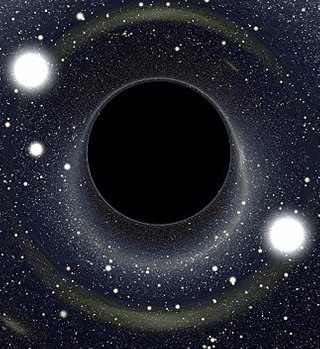
ScreenHunter_07 Jan. 14 22.07The field of gravity around a black hole is so immense that it swallows everything in its reach; not even light can escape its grip. For that reason, black holes are just that –emitting no light whatsoever, their “nothingness” blends into the black void of the universe.

So how does one take a picture of something that by definition is impossible to see?

“As dust and gas swirls around the black hole before it is drawn inside, a kind of cosmic traffic jam ensues,” Doeleman explained. “Swirling around the black hole like water circling the drain in a bathtub, the matter compresses and the resulting friction turns it into plasma heated to a billion degrees or more, causing it to 'glow' – and radiate energy that we can detect here on Earth.”

By imaging the glow of matter swirling around the black hole before it goes over the edge of the point of no return and plunges into the abyss of space and time, scientists can only see the outline of the black hole, also called its shadow. Because the laws of physics either don't apply to or cannot describe what happens beyond that point of no return from which not even light can escape, that boundary is called the Event Horizon.

“So far, we have indirect evidence that there is a black hole at the center of the Milky Way,” Psaltis said. “But once we see its shadow, there will be no doubt.”

Even though the black hole suspected to sit at the center of our galaxy is a supermassive one at four million times the mass of the Sun, it is tiny to the eyes of astronomers. Smaller than Mercury's orbit around the Sun, yet almost 26,000 light years away, it appears about the same size as a grapefruit on the moon.

“To see something that small and that far away, you need a very big telescope, and the biggest telescope you can make on Earth is to turn the whole planet into a telescope,” Marrone said.

To that end, the team is connecting up to 50 radio telescopes scattered around the globe…

More here.

Toby Young lambasts Johann Hari, picks a bone with Christopher Hitchens, and selects five books that exemplify good reporting

From The Browser:

Talking of bad practice, you've been particularly excoriating towards disgraced reporter Johann Hari. I enjoyed your fisking of his too-little too-late apology. What precisely was it that Hari did which was inexcusable?

ScreenHunter_06 Jan. 14 21.56Hari’s crime wasn’t to lift quotes from other people’s interviews and insert them into his own without attribution. That’s borderline acceptable. Rather, his crime was to do that and deliberately give the impression that the people in question had said those things to him. In addition, creating a fake identity on Wikipedia and using it to trash people on his political enemies list was pretty low. If Hari had been a News of the World journalist, those things wouldn’t have mattered that much. But because he’s a holier-than-though, butter-wouldn’t-melt-in-my-mouth, world-class prig, they do.

Is British journalism particularly nasty? What is your take on the phone hacking scandal and red-top tabloids in general?

I’m a fan of red tops and regret the closure of The News of the World. In the furore following The Guardian’s story that the deletion of Milly Dowler’s phone messages had given false hope to her parents, all the important stories The News of the World had broken over the years got overlooked. Let’s not forget, it broke the cricket match-fixing story, the Jeffrey Archer story and many others. It didn’t just deal in celebrity tittle-tattle, it also exposed corruption and many powerful people will be sleeping more easily now that the Screws has closed.

How did you rate Christopher Hitchens?

I liked Hitchens personally, admired his courage and thought he was right about Islamofascism and the Iraq war, but found most of his journalistic output unreadable. He had this verbose, hyperarticulate, mannered style that I just couldn’t stomach. I didn’t usually get beyond the first paragraph. I prefer reading his brother, Peter.

More here.

Amazing Airliner Tricks: Crosswinds, ‘Cat IIIC’ Landings

James Fallows in The Atlantic:

1) The “Crab Into Kick” Crosswind landing technique: A few weeks ago I posted a video of a dramatic landing by a Lufthansa plane, in Canada, as it coped with gale-force crosswinds. It was a useful demonstration of the classic “crab into kick” technique of landing in a crosswind. The airplane approaches the runway at a “crabbed” angle, to offset the wind — then at practically the last instant before touchdown the pilot uses the rudder to “kick” the plane into alignment with the runway, so when the wheels make contact they are pointed straight ahead. That post also had a lot of links to how-to discussions of landing techniques.

Here is a fascinating demonstration of how various pilots apply the technique, during tough crosswinds last week in Dusseldorf, Germany. As you watch the sequence of planes coming in, you're looking to see how close each touchdown point is to the runway's center line, and whether the plane has been “kicked” so that it points straight ahead.

The landings shown here range from very precise, to “good enough.” The results are a combination of the pilots' handling of the approach and the control characteristics of the various airplanes. Also, you get to see some crosswind takeoffs. At time 1:15 you'll note a plane “going around” — breaking off an approach so it can circle around for another landing attempt — because the pilot didn't like the way things were set up.

More here.

How Mosquitoes Fly in Rain

Mariel Emrich in Talking Science:

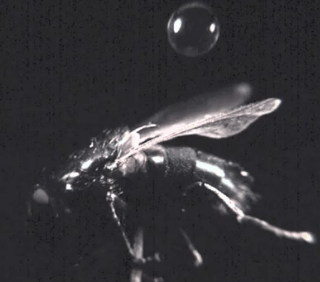
ScreenHunter_05 Jan. 14 21.42Mosquitoes are as adept at flying in rainstorms as under clear skies. But how is that possible? Wouldn’t rain crush a mosquito to the ground since mosquitoes weigh 50 times less than raindrops?

David Hu, an assistant professor of mechanical engineering and biology at the Georgia Institute of Technology, and his graduate research assistant Andrew Dickerson have found that while mosquitoes do get hit by raindrops, they don’t get crushed by them.

Hu discussed their research in a talk at November's APS Division of Fluid Dynamics Meeting that was entitled “How Mosquitoes Fly in the Rain”.

The researchers measured the impact forces of raindrops on both regular mosquitoes and custom-built mosquito mimics. The mimics were made from small Styrofoam spheres of mosquito-like size and mass. They used high-speed video to capture images of the mosquitoes getting hit with raindrops.

Since the bugs fly so slowly (a maximum of 1 meter per second) compared to the drops (which fall between 5 to 9 meters per second), the mosquitoes cannot react quickly enough for avoidance, and most likely cannot sense the imminent collision.

More here.

Why, despite everything, the Obamas seem to have a truly great marriage

From Slate:

ObamasI remember coming home and telling you about the one conversation I had with Michelle Obama, for a story I wrote about her husband the senator in 2006. She talked in the blunt way she used to be able to before he became a presidential candidate. She said she couldn’t stand Washington, couldn’t think of a single good thing to say about it, which is why she had decided to stay back in Chicago with their daughters. But she really believed in Barack and because of that was willing—though hardly eager—to make major personal sacrifices for the sake of his political career. That interview, and a longer one I had with him for the same story, left me with an inkling about their marriage. Not an understanding of it—just a sense of how rich a subject it might be. Both Obamas are deep, layered, hard-to-read people. As personalities, they have some appealing qualities in common. They’re driven, but unusually observant and reflective for driven people. The most reluctant of political couples, they’re allergic to performance and fakery. Their relationship is obviously authentic—and clearly has its share of tensions and difficulties.

More here.